
Imagine sitting on the playroom floor, watching your two-year-old stack blocks in silence while other children their age are starting to chatter. You might wonder if they're just a late bloomer or if there's a deeper delay. It's a common, heavy feeling, but you don't have to carry that uncertainty alone. If you're looking for a toddler not talking assessment Santa Clara County, you've already taken the most important first step toward supporting your child's growth and communication.
We understand how overwhelming it feels to face a complex system of regional centers and clinical terms when all you want is clarity. You deserve to know exactly where your child stands. This guide explains why your toddler might not be talking yet and how a multidisciplinary assessment provides the answers your family needs. We'll explore the 2026 updates to California Early Start eligibility, the 45-day assessment timeline, and how local experts in San Jose partner with you to turn confusion into a concrete roadmap for early intervention. This journey is about more than just words; it's about giving your child the tools they need to connect with the world around them.
Key Takeaways
- Learn to recognize the subtle differences between a typical "late talker" and a clinical delay by identifying key communication milestones for children aged 18 to 30 months.
- Discover how a comprehensive toddler not talking assessment Santa Clara County provides a complete picture of your child's development, including social-emotional and cognitive domains.
- Understand the vital distinction between a quick developmental screening and a deep-dive multidisciplinary evaluation to choose the best starting point for your family.
- Gain a clear roadmap for navigating local resources, including how to work with the San Andreas Regional Center (SARC) to access no-cost Early Start services.
- See how a family-centered team approach can transform a period of uncertainty into a clear, actionable plan for your child's future communication success.
When Your Toddler Isn’t Talking: Recognizing Signs in Santa Clara County
Watching your child grow is a journey filled with wonder, but it can also bring moments of quiet concern. Many parents in our community ask if their child is simply a "late talker" or if there's a clinical reason for the silence. It's a valid question. While every child follows their own timeline, developmental milestones exist to help us identify when a little extra support might be needed. About 15% of 24-month-old children experience language delays without a known cause, so you aren't alone in these observations.
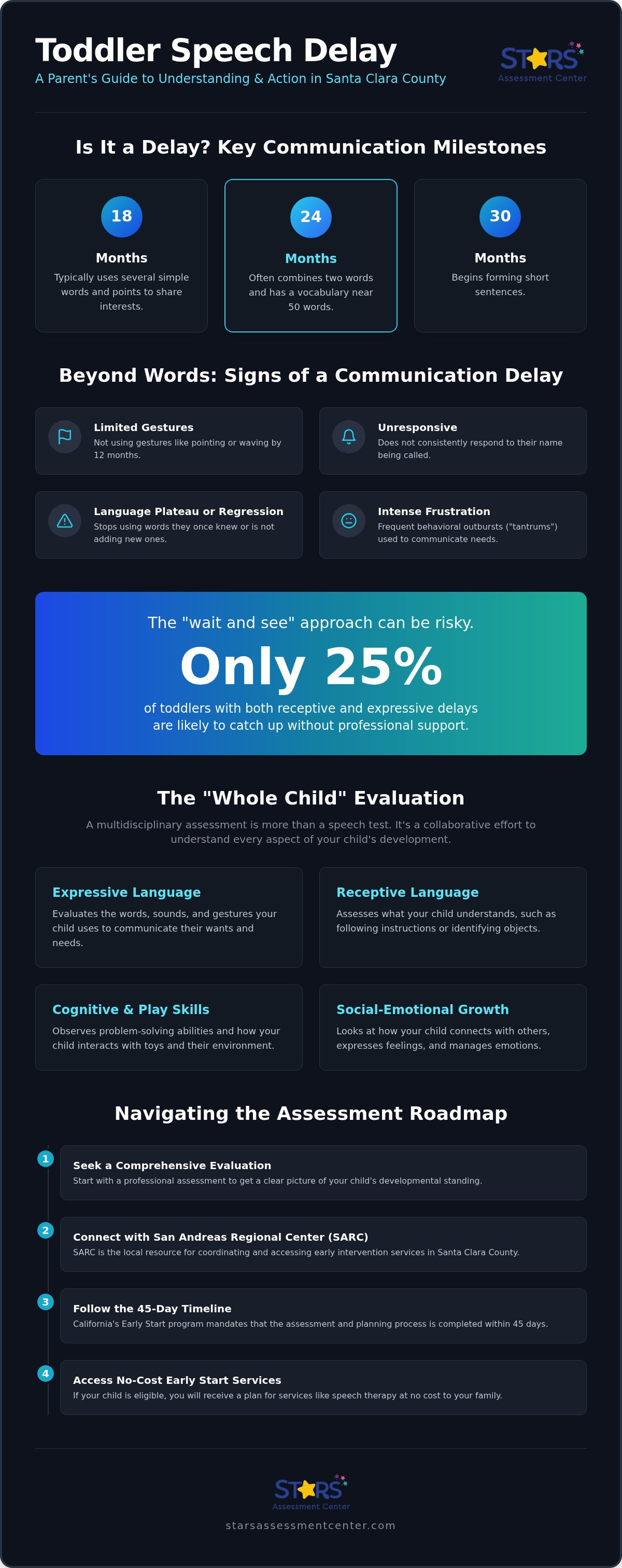
By 18 months, most toddlers use several simple words and point to share interests. By 24 months, they often combine two words and have a vocabulary near 50 words. By 30 months, they're typically forming short sentences. A speech delay is a gap between a child’s expressive abilities and their age-expected milestones. Research suggests that while some children catch up, others face a persistent Language delay that requires professional support. In fact, only 25% of toddlers with both receptive and expressive delays are likely to recover without assistance.
The "wait and see" approach is often outdated because the first three years of life are the most critical for brain development. Seeking a professional toddler not talking assessment Santa Clara County provides the clarity you need to move forward with confidence. Identifying a need early allows you to access resources while your child's brain is at its most adaptable.
Common Signs of Communication Delays
Sometimes the signs aren't just about the words a child says, but how they interact with their environment. You might notice your child isn't using gestures like pointing or waving by 12 months. They might not respond to their name or follow simple instructions at home. One of the most concerning signs is a "language plateau," where a child stops using words they once knew. These indicators suggest that a closer look at their communication development is a wise next step.
When "Not Talking" Signals Other Developmental Needs
Communication doesn't happen in a vacuum; it's deeply connected to social-emotional growth. When a child can't express their needs or feelings, it often leads to behavioral outbursts or intense frustration. These "tantrums" are frequently just a child's way of saying they don't have the words yet. This is why a social emotional assessment for toddlers is often recommended alongside speech evaluations. Looking at the whole child helps specialists understand if the speech delay is an isolated hurdle or part of a broader developmental pattern, such as Autism or social-emotional needs.
The Multidisciplinary Evaluation: Why It’s More Than Just a Speech Test
When you seek a professional toddler not talking assessment Santa Clara County, you aren't just looking for a speech therapist. You're looking for a team. A multidisciplinary model brings together specialists who look at your child from different angles. This collaboration ensures that no developmental stone is left unturned. It's a partnership between experts and your family that moves beyond a single-lens view of growth. This holistic approach prevents a narrow focus that might miss the underlying causes of a communication delay.
The Speech-Language Pathologist (SLP) is a central part of this team. They don't just count words. They evaluate expressive language, which is what your child says, and receptive language, which is what your child understands. Sometimes a child has a large receptive vocabulary but struggles to produce sounds. Other times, the challenge lies in processing instructions. Developmental specialists also observe cognitive and physical milestones during the process. How a child plays or manipulates toys can tell us a lot about their problem-solving skills. This "whole child" view is essential for California's Early Start program, which aims to support infants and toddlers during their most formative years.
Specialized Screenings: Autism and Down Syndrome
Sometimes, a speech delay is the first visible sign of a broader condition. Specialists look for early markers of Autism or Down syndrome during the evaluation. These screenings aren't about labels; they're about building a foundation for a tailored support plan. Understanding the difference between an autism screening vs evaluation for toddlers helps you decide which path provides the most clarity for your child's specific needs. Identifying these markers before age three allows for much more effective intervention.
The Social-Emotional Connection
Specialists also look closely at how your toddler interacts with you and others. A key indicator is "joint attention," which is when a child follows your gaze or points to show you something they find interesting. This skill is a vital precursor to language acquisition. If a child struggles with emotional regulation, it can also impact their ability to focus and communicate. We assess these social connections to see how they influence your child's desire to speak. If you're ready to move beyond the "wait and see" stage, our team at Stars Assessment Center is here to guide you through every step of this collaborative process.
Screening vs. Comprehensive Evaluation: Choosing the Best Path
Deciding between a quick screening and a full evaluation is a common crossroad for parents. A developmental screening acts as a quick snapshot of your child's growth; it's often the first step taken during a routine checkup to see if a child is meeting basic milestones. However, if you're seeking a toddler not talking assessment Santa Clara County, you likely need the depth that only a comprehensive evaluation provides. While a screening identifies a "red flag," the evaluation identifies the "root cause." This deeper diagnostic look is a mandatory requirement for determining eligibility within California's Early Start program. Without this detailed assessment, it's difficult to unlock the specific state-funded resources your child might need to thrive.
The Evaluation Process: What to Expect
The journey begins with an initial intake and parent interview. We want to hear your story and understand your child’s history from your perspective, as you're the expert on your own child. Our specialists use play-based assessment techniques to observe your toddler in a natural, low-stress environment. By watching how they interact with toys and people, we gather clinical data without making the child feel "tested." Once the assessment is complete, we share the results with you in a clear, supportive manner. We don't just hand over a report; we sit down with you to discuss what the findings mean for your family's next steps and how we can partner together for your child's success.
Why Early Evaluation Matters (Birth to Three)
The period from birth to age three represents a unique window of opportunity in brain development. During these early years, the brain is incredibly plastic and responsive to new learning. Securing a professional toddler not talking assessment Santa Clara County during this timeframe ensures that your child receives the right support at the right time. By addressing speech or social delays now, you can often reduce the need for more intensive special education services when your child reaches elementary school. For a broader look at how these checks fit into your child's overall wellness, you can explore our Early Childhood Developmental Screening guide. Taking action today means you aren't just reacting to a delay; you're proactively building a stronger foundation for your child's future communication and social skills.
Navigating the Assessment Roadmap in Santa Clara County
The path from noticing a delay to receiving support often feels like a maze. It starts with a conversation with your pediatrician, but for children under age three, the primary gateway in our region is the San Andreas Regional Center (SARC). SARC coordinates services for families throughout our community and determines eligibility for state-funded programs. Once you make contact, you have a legal right to a timely evaluation. In California, this assessment must be completed within 45 days of your initial request. Choosing a specialized partner for your toddler not talking assessment Santa Clara County ensures this process is thorough, professional, and family-centered.
After the evaluation, if your child qualifies, the next step is the Individualized Family Service Plan (IFSP). This isn't just a document; it's a collaborative roadmap tailored to your child's unique needs. We sit down with you to build this plan together, ensuring your family's priorities and daily routines are at the heart of every goal. It outlines the specific services and support systems that will help your child reach their communication potential while providing you with the tools to support them at home. This plan is designed to be a living guide that grows and changes as your child does.
Local Resources in San Jose, Milpitas, and Beyond
Our region is beautifully diverse, stretching from the tech hubs of San Jose and Milpitas to the agricultural hearts of Salinas and Gilroy. Accessing local resources shouldn't be a struggle regardless of where you live. Cultural sensitivity and multilingual support are essential components of care in Santa Clara County. Local specialists understand the unique pressures and values of Northern California families, ensuring that the assessment feels like a safe harbor rather than a bureaucratic hurdle. We focus on making sure every family feels heard and understood throughout the entire process.
Qualifying for Early Start Services
Understanding the numbers can help lower your stress during this time of uncertainty. As of August 2026, California has lowered the eligibility threshold for the Early Start program. Infants and toddlers now qualify with a developmental delay of at least 25% in one or more areas, such as communication or social-emotional skills. This shift from the previous 33% threshold means more children can access support sooner than ever before. Securing a professional toddler not talking assessment Santa Clara County is the most effective way to confirm if your child meets these updated standards. You can explore our Santa Clara County Toddler Speech Evaluation guide to see how these criteria apply to your child's specific situation. If you're ready to begin, you can contact our team at Stars Assessment Center to discuss how we can support your family's journey.
How Stars Assessment Program Supports Your Family’s Journey
At Stars Assessment Program, we believe the moment you notice a concern about your child's speech should be the moment you find a dedicated partner. We strive to be a "safe harbor" for families during a time that often feels like a storm of uncertainty. When you schedule a toddler not talking assessment Santa Clara County with our team, you aren't just receiving a clinical report. You're entering a partnership where your insights as a parent are valued as the most important piece of the puzzle. You know your child best; we simply provide the clinical expertise to help translate their behaviors into a clear developmental picture.
Our multidisciplinary team approach ensures that compassion meets clinical expertise at every turn. We don't just look at what your child isn't doing yet. We focus on their unique strengths and the specific ways they connect with you. By bridging the gap between that first spark of worry and the actual delivery of help, we help you move forward with a sense of purpose. We're here to empower you as the lead advocate for your child's growth, providing the data and support you need to navigate the road ahead with confidence.
Our Family-Centered Assessment Process
Evaluations shouldn't feel like a high-pressure test for your child. We create a low-stress, play-based environment where toddlers feel comfortable enough to be themselves. Whether we're supporting families in San Jose, Santa Cruz, or Morgan Hill, our goal is to capture an authentic snapshot of your child's personality and skills. This leads to clear, jargon-free reports that prioritize practical advice over confusing medical codes. We want you to walk away from our center feeling equipped and understood, rather than overwhelmed by complex terminology.
Next Steps: Moving Toward Clarity
Initiating an assessment with our multidisciplinary team is a straightforward process designed to lower your stress levels. When you're ready to begin, we recommend gathering any recent medical records or even short videos of your child communicating at home. These "real life" snapshots are incredibly helpful for our specialists. They allow us to see how your toddler interacts in their most natural and comfortable setting. If you're ready to find the clarity and reassurance your family deserves, you can schedule a compassionate assessment for your toddler today. We're ready to walk this path with you, ensuring your child receives the early support they need to thrive.
Empowering Your Child's Future Through Early Action
Watching your child struggle to find their words is difficult, but you've already taken a powerful step by seeking information. We've explored how identifying delays before age three leverages the brain's natural plasticity and how a multidisciplinary team provides the clarity a simple screening cannot. You now have a roadmap for navigating the San Andreas Regional Center and the state's updated eligibility requirements. Remember, you don't have to navigate this complex system alone.
Seeking a professional toddler not talking assessment Santa Clara County is the most vital step you can take to replace worry with a concrete plan. Our team of experts in San Jose provides family-centered, compassionate care designed to support families throughout Northern Central California. We're here to be your steady ally, ensuring your child receives the specialized attention they deserve. Begin your journey toward answers with a Stars Assessment and gain the peace of mind that comes from professional guidance. Your child’s voice is waiting to be heard, and we’re honored to help you find it.
Frequently Asked Questions
How do I know if my 2-year-old is just a late talker?
You can often distinguish a late talker from a clinical delay by looking at their receptive language and use of gestures. While some children catch up naturally, others show a significant gap between their expressive abilities and age-expected milestones. If your child isn't using 50 words or simple two-word phrases by age two, it's time for a professional evaluation. Early intervention ensures they don't fall further behind their peers in San Jose.
What happens during a multidisciplinary developmental assessment?
A multidisciplinary developmental assessment involves a team of specialists working together to observe your child’s cognitive, physical, and communication skills. Instead of just one therapist, you get a holistic view of your child's growth. Our team uses play-based techniques to see how your toddler interacts with toys and people in a natural way. This collaborative approach ensures that we identify the root cause of any delay rather than just observing surface-level red flags.
Does my child need a referral to get a speech evaluation in Santa Clara County?
You don't need a doctor's referral to initiate a toddler not talking assessment Santa Clara County through the Early Start program. Parents have the legal right to self-refer their child if they have concerns about development. While your pediatrician is a great first contact, you can reach out directly to the San Andreas Regional Center to begin the process. Taking this proactive step helps you access local resources and specialized support more quickly.
Is the assessment covered by insurance or the Regional Center?
Evaluations and service coordination through the California Early Start program are provided at no cost to eligible families. The San Andreas Regional Center (SARC) often contracts with specialized partners like Stars Assessment Program to conduct these comprehensive evaluations. This ensures that every child in our community has access to high-quality developmental support regardless of their family's insurance status or financial situation. It's a vital state-funded safety net for our youngest residents.
How long does the evaluation process take from start to finish?
In California, the law requires that an early intervention assessment be completed within 45 days of your initial contact. This timeline includes the intake interview, the evaluation itself, and the meeting to discuss the results with your family. We understand that waiting can be stressful for parents. Our team works diligently to meet these requirements so you can move from uncertainty to a clear action plan for your child as soon as possible.
What if my child is shy and won’t talk during the assessment?
It's very common for toddlers to be shy in new environments, and our specialists are trained to handle this with patience and warmth. We use play-based assessment techniques that feel like a normal playdate rather than a formal test. We also rely heavily on your observations as a parent during the intake interview. If your child won't speak, we look at their gestures, eye contact, and how they follow instructions to gather data.
What is the difference between a school district evaluation and a Regional Center evaluation?
The main difference lies in the age of the child and the focus of the services provided. The San Andreas Regional Center handles evaluations for children from birth to age three through the Early Start program. Once a child turns three, the local school district takes over the responsibility for assessments and special education services. For our youngest toddlers in Santa Clara County, the Regional Center is the primary gateway for developmental support.
Can a toddler be screened for Autism if they are only 18 months old?
Yes, a toddler can and should be screened for Autism as early as 18 months if concerns arise. Many early markers, such as challenges with joint attention or limited use of gestures, are visible well before age two. Our specialized screenings look for these specific indicators in a way that's appropriate for very young children. Identifying these needs early allows for more effective social-emotional support during these critical formative years in Northern California.


