
You're sitting on the living room floor watching your little one play, and you realize they haven't started waving "bye-bye" or calling for "mama" yet. While every child develops at their own pace, it's completely normal to feel a surge of anxiety when you notice your child isn't meeting the same milestones as their peers at the park. Understanding the signs of speech delay in 1 year old children is the first step toward replacing that uncertainty with a clear plan of action. You aren't alone in this journey; your intuition as a parent is one of the most powerful tools you have for supporting your child's growth.
We know how confusing it can be to interpret shifting CDC guidelines or to tell the difference between a late bloomer and a true developmental delay. This guide provides a compassionate look at the early red flags for 12-month-olds and explains the vital distinction between speech and language. You'll find a clear checklist of milestones and a straightforward path for accessing expert multidisciplinary evaluations right here in San Jose and Santa Clara County. By the end of this article, you'll have the clarity you need to move from "waiting and see" to feeling empowered as your child's best advocate.
Key Takeaways
- Learn the essential 12-month milestones, such as waving and simple word use, to help you track your child's progress with confidence.
- Identify the specific signs of speech delay in 1 year old toddlers, including limited babbling or a lack of gestures like pointing.
- Understand the distinction between speech and language so you can accurately describe your child's communication style to a professional.
- Discover why early action is more effective than the "wait and see" approach and how to prepare for a successful talk with your pediatrician.
- Get a clear roadmap for accessing multidisciplinary assessments and local intervention services throughout Santa Clara County and San Jose.
Communication Milestones: What to Expect at 12 Months
Reaching the first birthday is a momentous occasion, marked by a significant shift in how your child connects with the world. This period represents the transition from pre-linguistic communication, where babies use cries and coos to get their needs met, to linguistic communication, where sounds begin to carry specific meanings. It's a critical window for social-emotional observation because your child is starting to view you as a partner in their discovery of the world. You'll notice they don't just want things; they want to share their joy with you.
We often focus on what a child says, but what they understand is just as important. Receptive language involves following simple directions or looking at a favorite toy when you ask where it is. Expressive language is the actual production of sounds or gestures to share a thought. Understanding the Difference between these two areas helps parents see the full picture of their child's development. While every child's timeline is unique, being aware of these patterns can help you spot the early signs of speech delay in 1 year old toddlers. Receptive skills usually lead the way, providing the framework for the words that will eventually follow.
Verbal Milestones for 1-Year-Olds
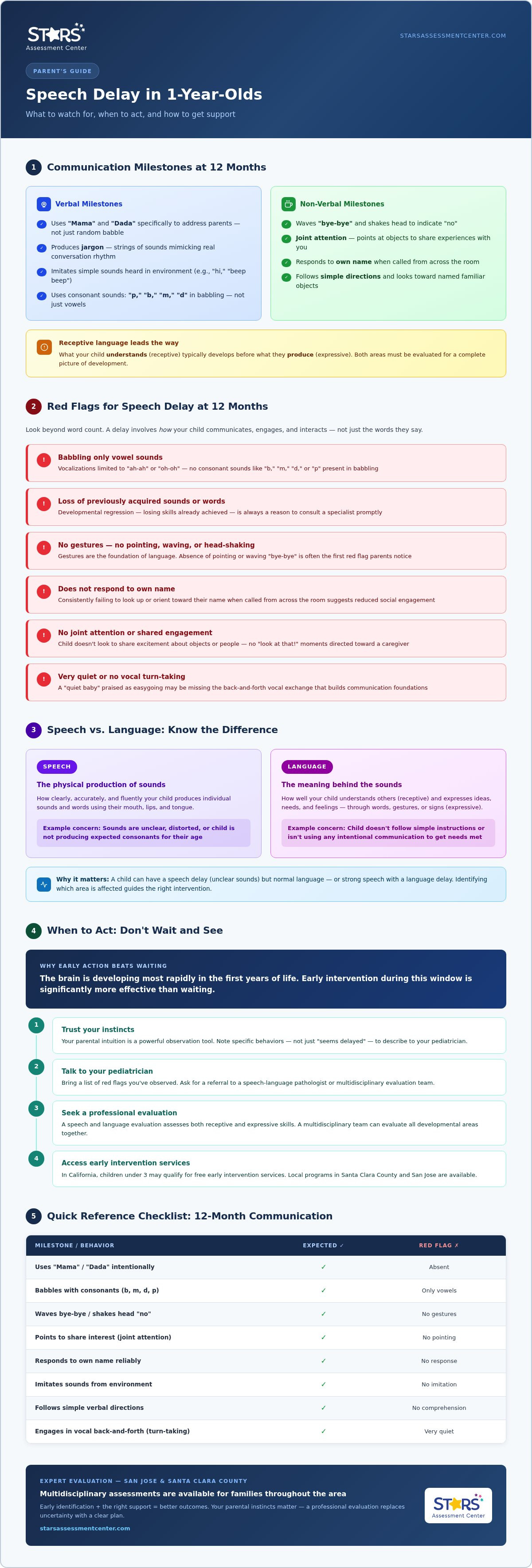
By twelve months, most children are beginning to use "Mama" and "Dada" specifically to address their parents rather than as random babbles. You'll likely hear "jargon," which is a delightful string of sounds that mimics the cadence and melody of real conversation. They're also starting to imitate simple sounds or words they hear in their environment, like the "beep beep" of a horn or a simple "hi." If your child is very quiet or hasn't started experimenting with these vocal patterns, it may be a reason to look closer at their communicative growth.
Non-Verbal Communication Foundations
Communication isn't just about the words we speak; it's about the connection we build. Non-verbal cues are the essential foundations of language. At this age, children should be using gestures like waving "bye-bye" or shaking their head to indicate "no." One of the most important behaviors is joint attention, where a child points at an object of interest to share the experience with you. They should also consistently respond to their own name when called from across the room, showing they are socially engaged. A lack of these gestures can sometimes be one of the signs of speech delay in 1 year old children that parents notice first.
It's vital to remember that developmental timelines are ranges, not rigid deadlines. Some children focus on physical milestones like walking first, while others prioritize vocalizing. This variation is normal, but identifying the foundational building blocks of communication ensures that every child receives the support they need to thrive in their own time.
Key Signs of Speech Delay in 1-Year-Olds
Watching your baby's first birthday pass can bring up a mix of emotions, especially if you're still waiting for those first clear words. Many parents wonder if their child is simply a "late bloomer" or if there's a clinical reason for the silence. While it's true that every child has a unique internal clock, certain patterns suggest that a child might need extra support to bridge the gap. Identifying the specific signs of speech delay in 1 year old infants requires looking beyond just the number of words they say. It involves observing how they engage with you and the world around them.
A "quiet baby" is often praised for being easygoing, but a lack of vocal experimentation can sometimes be a subtle indicator of a challenge. When a child doesn't respond to simple verbal cues or seems disconnected from the sounds in their environment, it creates a ripple effect on their social-emotional growth. Early detection isn't about labeling your child. It's about providing the right tools during a period of rapid brain development. If you feel like you're constantly second-guessing your child's progress, a professional speech and language evaluation can offer the peace of mind you deserve.
Red Flags in Expressive Communication
Expressive communication is how your child "talks" to you, even before they have a full vocabulary. One primary concern is the quality of their babbling. By twelve months, babies should be using a variety of consonant sounds like "p," "b," "m," or "d." If your child's vocalizations consist only of vowel sounds like "ah-ah" or "oh-oh," this is often one of the signs of speech delay in 1 year old toddlers. Another significant red flag is the loss of previously acquired sounds or words. Developmental regression is always a reason to consult a specialist. You should also look for "vocal turn-taking," where your baby waits for you to speak and then responds with their own sounds, mimicking a real conversation.
Red Flags in Receptive Language and Social Interaction
Receptive language, or what your child understands, often provides the foundation for speaking. According to the CDC's Communication Milestones: What to Expect, a 1-year-old should be able to follow simple commands like "give it to me" when accompanied by a gesture. If they seem unable to follow these directions or don't look at you when you call their name, it may indicate a delay. Social-emotional cues are equally important. A child who rarely makes eye contact, doesn't use facial expressions to show they're happy or frustrated, or fails to point at a dog in the park to show you what they see might be struggling with the foundational "social spark" of language.
Trusting your gut is the most important step you can take. If these milestones feel out of reach for your little one, remember that seeking help early is a proactive act of love that sets the stage for future success.
Speech vs. Language: Understanding the Difference
When we talk about communication, it's easy to use the terms "speech" and "language" as if they're the same thing. However, they represent two distinct areas of development that require different skills. Speech is the physical act of producing sounds and words. Language is much broader; it's the system we use to share thoughts, ideas, and meanings. Recognizing this distinction is helpful when you're looking for Key Signs of Speech Delay because a child might be thriving in one area while struggling in the other.
A child might understand every word you say and point to every animal in a picture book, showing strong receptive language skills, yet still struggle to form the specific sounds needed to say the words. Conversely, some children can repeat words clearly but don't yet understand how to use those words to ask for a snack or share a toy. Because these areas are so interconnected, a multidisciplinary developmental assessment is the most effective way to look at both domains. This comprehensive approach ensures that we aren't just looking at what a child says, but how they connect and process information.
The Mechanics of Speech Production
Speech production is a complex physical process. It requires precise oral-motor skills and the coordination of the lips, tongue, and jaw. Even at twelve months, babies are practicing these movements through varied babbling. Hearing health plays a massive role here too. If a child has had frequent ear infections, sounds might reach them muffled, like they're underwater, making it much harder for them to mimic clear sounds. While some sound errors are a normal part of learning, a total lack of consonant variety can be one of the signs of speech delay in 1 year old children that warrants a closer look by a professional.
The Cognitive Side of Language
Language is the cognitive engine behind the sounds. Before a child ever speaks their first word, they're building a massive mental vocabulary and learning the "rules" of social interaction. They're learning that when they point, you look, and when they cry, you respond. This "social spark" is the foundation of all future communication. Sometimes, underlying barriers to language aren't about the mouth or the ears, but about how a child relates to others. This is why social emotional development screening is such a vital part of the process. It helps us identify if a child is struggling with the desire to communicate or the social understanding needed to turn sounds into meaningful connections.
Understanding whether your child's challenge is physical, cognitive, or a mix of both allows for a much more tailored and effective support plan. You don't have to guess which area needs attention; expert guidance can help you see the full picture of your child's unique growth.
Next Steps: When and How to Seek an Evaluation
If you've noticed potential signs of speech delay in 1 year old children, you may hear well-meaning friends or relatives suggest that you should just "wait and see." While it's true that every child has their own rhythm, the first three years of life represent the most critical window for brain development. Choosing early action over waiting is a proactive way to support your child's natural growth. Research indicates that about 50% of "late talkers" may continue to face language or literacy challenges later in life, so seeking professional insight early provides a safety net for your child's future success.
Preparing for a conversation with your pediatrician is the best way to move forward. Instead of general worries, bring specific observations about how your child communicates. Does your little one use gestures? Do they respond to their name? A Speech-Language Pathologist (SLP) acts as a dedicated guide during this process, helping you translate these observations into a supportive plan. If you are ready to move past the uncertainty, you can schedule a multidisciplinary developmental assessment to get the clear answers you need.
The Evaluation Process Explained
A specialized speech and language evaluation for toddlers is designed to be a gentle, family-centered experience. Most assessments are observation-based and feel like a simple play session to your child. The specialist will engage your little one with age-appropriate toys and games to see how they interact and respond to cues. Parent interviews are also a vital component, as you are the expert on your child's daily life. Specialists use these insights alongside standardized tools to measure progress against developmental norms, ensuring a complete and accurate picture of your child's skills.
Empowering Parents in the Evaluation Room
You are your child's most important advocate, and your presence in the evaluation process is essential. To prepare, try documenting your child's sounds, gestures, and reactions to directions over the course of a week. This "snapshot" of their daily life is incredibly helpful for the assessment team. When you meet with the specialists, don't hesitate to ask specific questions, such as whether your child's social-emotional growth is on track. Remember that an evaluation is not a label or a diagnosis to fear. It is a powerful tool designed to unlock the right support and resources for your family.
Taking this step is an act of partnership. By seeking an evaluation, you're positioning yourself as a steady ally in your child's journey, ensuring they have every opportunity to find their voice and connect with the people who love them most.
Support for Families in Santa Clara County
Finding the right path for your child in the bustling San Jose or Salinas areas can feel like a heavy responsibility. When you begin noticing the early signs of speech delay in 1 year old toddlers, the local landscape of early intervention can seem complex. In Santa Clara County, the San Andreas Regional Center (SARC) serves as a primary gateway for state-funded services. However, many families find that a private, multidisciplinary approach offers a faster, more personal way to gain clarity. We act as a dedicated partner for families, helping you understand how local referral protocols work while providing the immediate, specialized attention your child deserves.
Whether you are in Milpitas, Gilroy, or Morgan Hill, our goal is to ensure you never feel lost in the system. We specialize in bridging the gap between your initial concerns and a comprehensive plan for support. By focusing exclusively on the birth-to-three population, we provide a "safe harbor" for families who need expert guidance during these foundational years. Our evaluations are designed to meet the specific requirements of regional centers, making the transition into long-term support services as seamless as possible.
The Stars Assessment Program Approach
Our team-based method is built on the belief that a child's development cannot be viewed in isolation. We bring together speech, social-emotional, and cognitive specialists to look at the "whole child." This multidisciplinary perspective is especially important when families are seeking autism screening for infants or toddlers. We understand that a 12-month-old isn't just a set of milestones; they are a unique individual with their own personality and social spark. Our evaluations are gentle and family-centered, ensuring that both you and your child feel comfortable and heard throughout the entire process.
Local Resources and Referral Pathways
Initiating a referral in Santa Clara County doesn't have to be a source of stress. Families can reach out to the San Andreas Regional Center directly at 1-844-700-9889 to begin the intake process for early intervention. For those in Santa Cruz or surrounding areas, similar pathways exist to connect you with community-based support. Our program works alongside these local entities to provide the specialized speech and language evaluations that form the backbone of an effective intervention plan. We help you move from a place of uncertainty to a clear, actionable roadmap for your child's success.
You don't have to navigate this journey alone. By tapping into local expertise and community resources, you're giving your child the best possible start. We're here to provide the professional warmth and authoritative expertise needed to help your family thrive in San Jose and beyond.
Empowering Your Child's Communication Journey
Navigating your child's first year is a journey filled with wonder and occasional worry. By learning to identify the signs of speech delay in 1 year old toddlers, you've already taken a significant step toward supporting their future growth. Remember that communication is about much more than the number of words spoken; it's about the social-emotional connection and the understanding your child shows every day. If those early milestones feel out of reach, trusting your intuition is always the right choice for your family.
You don't have to walk this path alone. Our specialized multidisciplinary team of specialists is dedicated to providing a gentle, family-centered evaluation process specifically for infants and toddlers. We proudly serve families across Santa Clara, Santa Cruz, and Monterey Counties, offering the clarity and professional support you need to move forward with confidence. Schedule a Compassionate Developmental Assessment for Your Child today to begin this partnership. Your proactive care is the greatest gift you can give your little one as they find their unique voice in the world.
Frequently Asked Questions
How many words should a 1-year-old be able to say?
Most 1-year-olds say "mama" and "dada" specifically to their parents and may have one or two other simple words. According to CDC milestones, they should also use gestures like waving "bye-bye" and understand the word "no." Communication at this age is a healthy mix of sounds and actions. If your child isn't yet using these foundational words, it's a good time to observe their social interactions for signs of speech delay in 1 year old infants.
Can a 12-month-old have a speech delay if they are babbling a lot?
Yes, a child can still have a delay even if they make a lot of noise. Effective babbling at 12 months should include a variety of consonant sounds like "ba," "da," and "ma." If your little one's babbles consist only of vowel sounds or lack the rhythmic "jargon" that sounds like a real conversation, it could indicate a challenge. A multidisciplinary assessment helps determine if these vocalizations are building the necessary foundation for future words and meaningful connection.
Is it normal for a 1-year-old to understand everything but not talk?
It's common for receptive language to develop faster than expressive language, but a significant gap shouldn't be ignored. If your child follows directions but hasn't started using sounds or gestures to communicate, they may have an expressive delay. While their strong understanding is a great sign, they still need the physical and cognitive tools to share their own thoughts. Early intervention ensures their ability to speak eventually catches up with their comprehension of the world around them.
What is the difference between a speech delay and autism in a 1-year-old?
A speech delay specifically impacts how a child produces sounds or uses words, while autism involves broader patterns in social communication and behavior. For example, a child with a speech delay might still use eye contact and pointing to share joy. In contrast, autism screenings look for challenges with joint attention or responding to their name. Because these areas often overlap, our team evaluates both communication and social-emotional growth to provide a clear and accurate picture for your family.
Does ear infection history contribute to speech delays at age one?
Frequent ear infections can definitely play a role in early communication challenges. When fluid builds up in the middle ear, it can muffle sounds, making it difficult for a baby to hear and mimic the clear consonant sounds needed for speech. This temporary hearing loss during critical development windows can lead to signs of speech delay in 1 year old children. We always recommend a hearing check as part of a comprehensive speech and language evaluation to rule out physical barriers.
How do I get my toddler evaluated for a speech delay in San Jose?
You can begin by contacting the Stars Assessment Program for a private, multidisciplinary evaluation designed for children under three. We serve families throughout San Jose, Milpitas, and the surrounding Santa Clara County area. Alternatively, you can reach out to the San Andreas Regional Center to initiate a referral for state-funded early intervention services. Our team is here to guide you through these local pathways, ensuring your family finds the right support without unnecessary stress or long waiting periods.
Will my child 'grow out' of a speech delay without help?
While some "late talkers" eventually catch up on their own, research shows that about half of these children continue to face language and literacy challenges later in life. Waiting to see if a child grows out of a delay can miss the most critical window for brain development. Early intervention is a proactive, low-stress way to ensure your child has the tools they need. It's always safer to seek an expert opinion than to wait and wonder about their progress.
What are the first signs of expressive language delay in infants?
The earliest signs often involve a lack of vocal play and limited use of gestures. By 12 months, an infant should be using varied babbles, waving "bye-bye," and pointing to show you things they like. If your baby is unusually quiet, doesn't try to mimic your sounds, or doesn't use their hands to communicate their needs, these are early red flags. Identifying these expressive barriers early allows for a much more effective and gentle support plan for your child.


