
You just finished a quick checklist at your toddler's checkup, and now your pediatrician is talking about "next steps." That moment often feels like a blur of worry and unanswered questions. Many parents find themselves at a crossroads, trying to understand the difference between autism screening vs evaluation for toddlers as they look at their child's unique development.
It's completely normal to feel anxious or even a bit lost when you're navigating the California early intervention system for the first time. You want what's best for your child, but the distinction between a "maybe" and a formal diagnosis isn't always clear. We promise to help you understand these critical differences to ensure your toddler gets the specific support they need without unnecessary delay. This article will break down how a screening identifies potential risks while a multidisciplinary evaluation provides a roadmap for care. You'll also learn how families in San Jose and Santa Clara can access these vital services to help bridge the gap between initial concerns and the specialized support that helps your child thrive.
Key Takeaways
- Understand that a screening is a quick tool to flag potential risks, while a full evaluation provides a formal diagnosis and a detailed developmental map.
- Learn why understanding autism screening vs evaluation for toddlers is essential for accessing the right early intervention services in Santa Clara County.
- Discover why a multidisciplinary team is the best approach to capture every nuance of your child's social, emotional, and communication growth.
- Identify the specific signs and screening results that indicate it's time to move toward a comprehensive multidisciplinary developmental assessment.
- Explore how local families can navigate the referral process to ensure their child receives compassionate, specialized support during the critical early intervention window.
Autism Screening vs. Evaluation: The Essential Differences
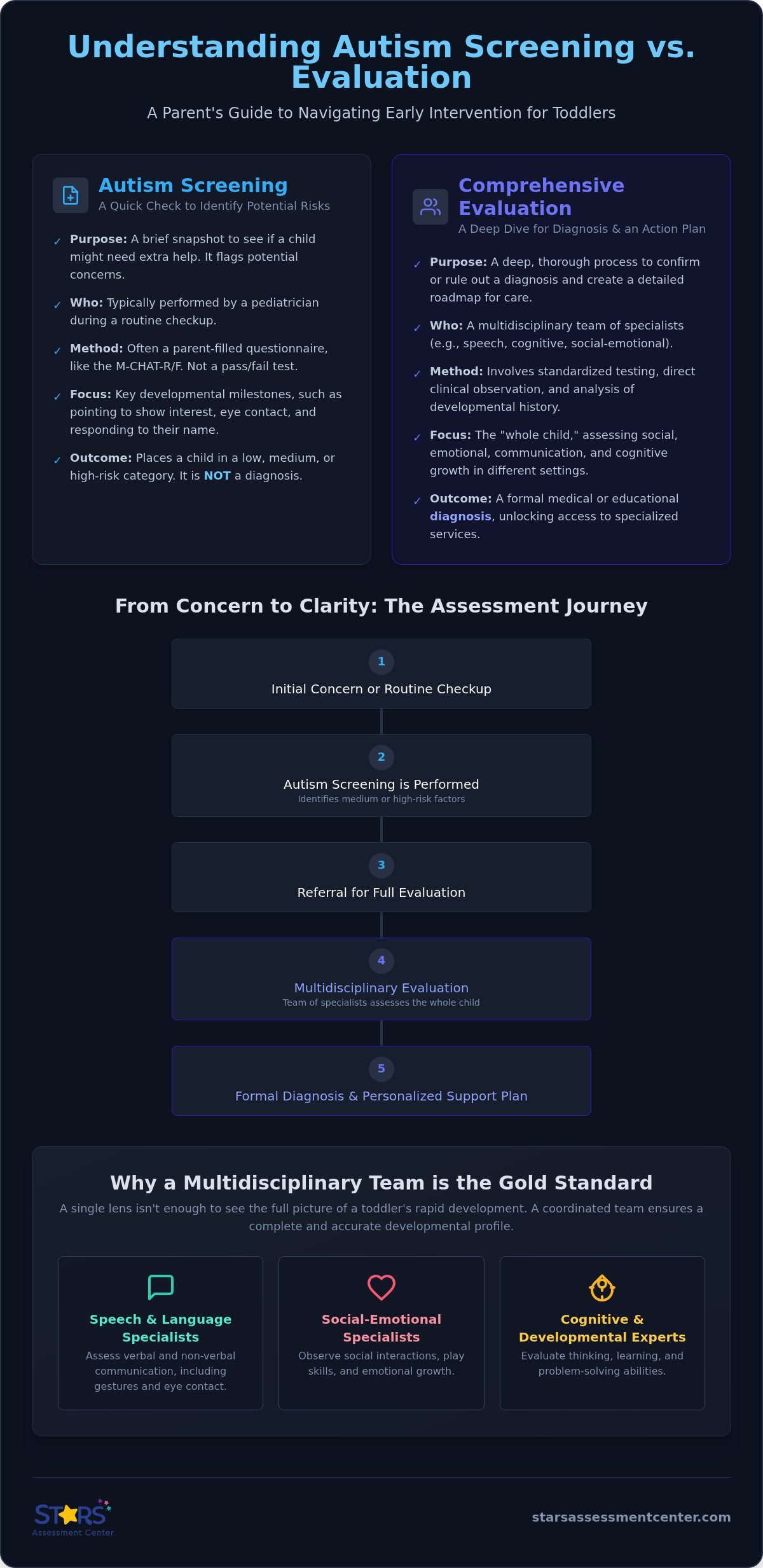
You might feel a rush of emotions when a professional suggests looking closer at your child's development. It's a moment filled with questions, but understanding the difference between autism screening vs evaluation for toddlers is the first step toward finding peace of mind. Think of a screening as a "red light" at a busy intersection. It tells you to stop and pay attention, but it doesn't tell you the whole story of the road ahead. It's a quick check designed to see if your child might need extra help.
Screening serves as a brief snapshot of your child's current skills. Its primary purpose is to identify potential risks rather than provide a definitive answer. On the other hand, a comprehensive evaluation is a deep dive into your child's world. This thorough process confirms or rules out a diagnosis, giving you the clarity needed to move forward. While a screening flags a concern, the evaluation provides the actual roadmap for specific therapies and local support. It transforms a "maybe" into a clear plan of action for your family.
The autism diagnosis process often starts with these two distinct stages to ensure no child's needs are overlooked. By separating the quick check from the detailed study, providers can quickly identify children who need help while ensuring that the final diagnosis is accurate and based on a full picture of the child's life. This structured approach helps lower stress for parents by providing a clear path forward.
What Happens During a Toddler Autism Screening?
Most parents first encounter a screening during a routine checkup. Pediatricians often use tools like the M-CHAT-R/F, which is a simple questionnaire for parents. This tool isn't a test your child passes or fails. Instead, it focuses on key milestones like whether your toddler points to show interest, maintains eye contact, or responds when you call their name. The result usually places your child in a low, medium, or high risk category. If the risk isn't low, it's simply a signal that your family deserves more information and support.
What is a Comprehensive Autism Evaluation?
A multidisciplinary developmental assessment is much more than a checklist. It's a formal process that involves standardized testing and careful clinical observation by a team of specialists. These experts look at your child's developmental history and social-emotional growth across different settings. This is the only way to receive a formal medical or educational diagnosis. It's a collaborative effort that ensures every nuance of your child's personality and behavior is understood. This step is vital because it unlocks the specific services and early intervention programs that help toddlers thrive.
Why Your Toddler Needs a Multidisciplinary Team
Toddlers are a whirlwind of growth. One day they're learning to stack blocks, and the next they're trying to mimic the sounds they hear around them. Because their brains develop so rapidly across multiple areas at once, a single lens often isn't enough to see the full picture. A child might have a speech delay that masks their social strengths, or a physical milestone delay that impacts how they interact with their environment. A multidisciplinary team ensures that these overlapping areas of growth are understood together rather than in isolation.
When families look into the best path for their child, they often find that the choice between autism screening vs evaluation for toddlers comes down to the depth of expertise involved. A screening is often done by a single provider, but a comprehensive evaluation brings together specialists in cognitive, communication, and social-emotional development. This coordinated approach is the gold standard because it prevents specialists from missing subtle nuances. Instead of looking at a checklist, our team at Stars looks at the whole child to create a complete developmental profile. This level of detail is vital for families following the recommended steps for autism screening and diagnosis.
Coordination between specialists leads to more accurate results. When a speech expert and a social-emotional specialist share their observations, they can determine if a behavior is a standalone delay or part of a broader pattern. If you're ready to move beyond basic checklists, a Multidisciplinary Developmental Assessment offers the clarity and partnership your family deserves.
The Role of Speech and Language Specialists
In toddlers under three, communication isn't just about the words they speak. It's about how they use eye contact, gestures, and facial expressions to connect with you. Our specialists work to differentiate between a simple speech delay and more complex social communication challenges. They carefully assess non-verbal cues to see how your child shares enjoyment or asks for help. A speech and language evaluation determines if a child's communication struggles are rooted in a developmental language delay or are part of a broader social-emotional pattern typical of autism.
Evaluating Social-Emotional and Cognitive Skills
Understanding how a toddler relates to their caregivers and their surroundings is a cornerstone of our assessment. We focus specifically on birth-to-three social-emotional milestones, such as how a child responds to their name or engages in "back-and-forth" play. This process also identifies cognitive strengths, like a child's ability to solve problems or their focused interest in how things work. By finding these "bright spots," we can help you build a future therapy plan that uses your child's natural talents to support their areas of growth.
When to Move From Screening to Full Evaluation
Receiving the results of a developmental screening can feel like a heavy weight. If your child’s pediatrician mentions a "medium" or "high" risk score, it's an immediate trigger to seek deeper answers. These scores aren't a final word, but they are a clear signal that your toddler needs a more specialized look. According to CDC guidelines on autism screening, regular checks at 18 and 24 months help identify children who need a formal evaluation as early as possible. When you're weighing the choice between autism screening vs evaluation for toddlers, remember that the screening is the starting line, while the evaluation is where the real support begins.
Sometimes, a screening might come back as "low risk," but your parental intuition tells you something is still not quite right. Trust your gut. You see your child every day in their most natural environment, and your observations are just as valid as a clinical checklist. Persistent concerns about eye contact, responding to their name, or repetitive play are reasons enough to request a full multidisciplinary assessment. In California, a formal evaluation is often the essential key that unlocks services through the San Andreas Regional Center or other local early intervention programs. Without that formal step, it's much harder to access the specific funding and specialized therapists your child may need.
Identifying Red Flags in Toddlers (Birth to Three)
While every child grows at their own pace, there are specific social-emotional markers we look for during the first three years of life. You might consider a full evaluation if you notice a lack of social smiling or joyful expressions by the time your baby is 6 to 9 months old. By 9 months, most babies are engaging in back-and-forth sharing of sounds, smiles, or other facial expressions. One of the most significant signs is a regression in skills. If your toddler suddenly stops using words they once knew or becomes less interested in social interaction, it's time to seek a professional opinion immediately.
Navigating the "Wait and See" Advice
Well-meaning friends or family members might suggest that your child is just a "late bloomer." However, the "wait and see" approach can be a trap that costs valuable time. The 0-3 window is a unique period of intense brain plasticity, making it the most effective time for early intervention. There's a vital difference between a child who is simply taking their time with milestones and one who has a developmental delay that requires professional support. Regardless of the final result, a professional evaluation provides the peace of mind that comes from knowing exactly how to support your child's next steps. Taking action now ensures you aren't looking back later wishing you had started sooner.
The Stars Assessment Process in Santa Clara County
We believe that every family in Santa Clara County deserves a clear path forward when they have concerns about their child's growth. Our process is designed to be a gentle, supportive experience that feels more like a partnership than a clinical appointment. We focus exclusively on children under the age of three. This ensures our work aligns perfectly with the critical early intervention windows when support is most effective. Whether your child needs specialized assessments for Autism, Down syndrome, or speech delays, our team is here to provide the answers you need.
Serving families across San Jose, Milpitas, and Morgan Hill, we understand the local landscape of care. When you're trying to decide between autism screening vs evaluation for toddlers, our local experts can guide you through the process with personal care. We aren't just a service provider; we are your neighbors dedicated to your child’s success. We strive to be a safe harbor where your questions are met with expertise and your anxieties are met with empathy.
Step-by-Step: Your Day at the Assessment Center
Your day begins with a thoughtful intake where we listen to your child’s unique developmental history. We don't just look at charts; we listen to your stories and observations. This is followed by observation-based play sessions. Our multidisciplinary team watches how your child interacts, plays, and communicates in a stress-free environment. Finally, we hold a collaborative feedback session. We sit down together to discuss our findings and map out the next steps for your family. This structured approach helps ensure you leave with a clear plan rather than more questions.
Connecting to Early Intervention in the South Bay
A formal evaluation is often the primary requirement to qualify for state-funded services. We work closely with local organizations like the San Andreas Regional Center to ensure your child’s assessment meets the necessary criteria for support. Our goal is to empower you to be your child’s best advocate. By providing a clear, professional report, we give you the tools you need to secure the right therapies and resources in the South Bay. You don't have to figure out the complex state system alone. We are here to bridge the gap between your initial concerns and the specialized care your child deserves.
If you're ready for a clearer picture of your child's needs, contact us today to begin your Multidisciplinary Developmental Assessment.
Taking the Next Step: Support for Your Family
Deciding to move forward with a formal assessment is an act of love and courage. While the technical differences between autism screening vs evaluation for toddlers are important to understand, the human side of this journey matters just as much. You don't have to navigate these developmental questions alone. We view an evaluation as much more than a diagnostic tool; it is the first real step toward a brighter and more supported future for your child. By gathering clear information now, you're building a foundation of understanding that will serve your family for years to come.
The Stars Assessment Program serves as a safe harbor for families in Santa Clara County. We know that the local system can sometimes feel overwhelming, but we are here to provide the steady guidance you need. Our team doesn't just deliver a report. We provide a partnership that helps you make sense of your child's unique way of interacting with the world. Whether you're in San Jose or Morgan Hill, our goal is to ensure you feel heard, validated, and empowered to take the next best step for your toddler.
Preparing Your Toddler for an Evaluation
The best way to prepare for an assessment is to keep life as normal as possible. Toddlers thrive on predictability, so try to keep their usual routines consistent on the day of the appointment. A well-rested and well-fed child is much more likely to show us their natural skills and personality. We also encourage you to bring along the things that make your child feel secure. These items help create a sense of home within our center:
- Familiar snacks and a favorite water bottle.
- A few favorite toys or a "comfort" stuffed animal.
- Any specific sensory items your child enjoys.
It's also helpful to manage your own anxiety during this time. Children are incredibly sensitive to their parents' emotions and often mirror the energy they feel around them. If you remain calm and see the day as a special "play date" with new friends, your child will likely feel much more at ease.
Contacting the Stars Assessment Program
Initiating a referral for a multidisciplinary developmental assessment is a straightforward process designed with your stress levels in mind. We are deeply committed to cultural sensitivity and personal connection, ensuring that every family feels respected and understood from the very first phone call. We believe that every child’s potential is a light worth nurturing, and we are honored to help you find the way forward. When you're ready to move beyond the uncertainty of autism screening vs evaluation for toddlers, our local specialists are here to help. Schedule a consultation with our local specialists today to begin your journey toward clarity and support.
Empowering Your Child’s Bright Future
Understanding the nuances of autism screening vs evaluation for toddlers is a powerful first step in advocating for your child's needs. While a screening provides a helpful snapshot, a full multidisciplinary evaluation offers the comprehensive roadmap required to unlock essential Early Intervention resources. By choosing a team that specializes exclusively in children under age three, you ensure that every social, emotional, and communicative milestone is viewed with expert care.
Our specialists provide clarity and hope for families throughout San Jose, Milpitas, and Gilroy. We focus on creating a supportive environment where you can finally find the answers you've been looking for. Taking action during these early years is the most impactful way to support your child's unique developmental path. You don't have to walk this road alone; we are here to partner with you every step of the way.
Ready to take the next step? Request a Multidisciplinary Evaluation for Your Toddler today. You're doing the right thing for your child, and the right support is just around the corner.
Frequently Asked Questions
Can a screening tool diagnose my toddler with autism?
No, a screening tool cannot provide a formal diagnosis. When looking at autism screening vs evaluation for toddlers, it's vital to remember that a screening tool is just a brief snapshot designed to flag potential developmental risks. If a screening indicates a high risk, it simply means your child needs more specialized attention. The next step is to schedule a comprehensive evaluation to confirm or rule out a diagnosis and create a supportive plan for your family.
How long does a full autism evaluation take for a two-year-old?
A comprehensive evaluation typically takes between two and four hours, though it may be split into multiple sessions depending on your child's energy levels. This time allows our team to observe play, social interactions, and communication skills thoroughly in a natural way. We move at your toddler's pace to ensure they feel comfortable and secure throughout the entire assessment process. This methodical approach ensures we capture an accurate picture of your child's unique strengths.
Will my insurance cover a multidisciplinary developmental assessment?
Many insurance plans cover developmental assessments, but the specific coverage depends on your provider and policy. In California, the Early and Periodic Screening, Diagnostic, and Treatment (EPSDT) benefit of Medicaid also covers these evaluations for eligible children. We recommend contacting your insurance coordinator or your local regional center to verify your specific benefits. Our team can often help guide you through the initial steps of verifying how your plan supports these specialized services.
What is the difference between a medical diagnosis and an educational one?
A medical diagnosis is provided by a clinical team to guide healthcare and insurance-funded therapies like speech or behavioral support. An educational diagnosis is determined by a school district to see if a child qualifies for special education services under the Individuals with Disabilities Education Act (IDEA). While they use similar criteria, a medical diagnosis is often the first step families take to access private specialized support and regional center services before their child enters the school system.
What happens if the evaluation shows my child does not have autism?
If an evaluation rules out autism, the process still provides valuable answers about your child's unique developmental path. Our multidisciplinary team will identify any other delays in speech, motor skills, or social-emotional growth that might be causing your initial concerns. You'll receive a detailed roadmap of recommendations and resources to support your child's specific areas of need. This ensures that every child receives the right support to thrive, regardless of their final diagnosis.
How do I get a referral for an evaluation in San Jose or Santa Clara?
You can start by asking your pediatrician for a referral or by contacting the Stars Assessment Program directly to discuss your concerns. Families living in San Jose and Santa Clara can also reach out to the San Andreas Regional Center to begin the intake process for early intervention services. We are here to help you navigate these local pathways and ensure your child is seen by specialists who deeply understand the California early intervention system.
Is an autism evaluation the same as a speech evaluation?
No, these are distinct assessments, though they often overlap in the areas they study. A speech evaluation focuses specifically on language and communication skills. When comparing autism screening vs evaluation for toddlers, a full evaluation is much broader. It includes a speech specialist but also looks at social-emotional milestones, cognitive skills, and behavioral patterns. This multidisciplinary approach ensures that we don't miss nuances that a single-specialty evaluation might overlook.
Can my child be "too young" for an autism evaluation?
Children are never too young for a developmental check if you have concerns about their growth. While some traits become clearer as a child matures, specialists can reliably identify autism in children as young as 18 to 24 months. Early intervention is most effective during the first three years of life because of intense brain plasticity. Seeking answers early is the best way to ensure your child gets the support they need during this critical window of development.


