
What if the advice to "just wait and see" is actually keeping you from the answers your child needs right now? It's natural to feel a knot of worry when you notice your toddler isn't hitting milestones at the same time as their peers. You might wonder if a struggle is just a temporary speech delay or something more complex. Seeking a professional cognitive assessment for toddlers Santa Clara is often the first step toward replacing that heavy uncertainty with a clear, supportive plan. You're not alone in feeling overwhelmed by the regional center system; many local families face that same confusion while looking for a path forward.
We believe that every parent deserves a partner in their child's development. This article will show you how a professional cognitive assessment provides the roadmap your toddler needs for healthy growth and early intervention success. We'll look at the differences between basic screenings and full evaluations; we'll also explain how a multidisciplinary team identifies your child's unique strengths. You'll gain a clear understanding of the actionable steps available in Santa Clara County to ensure your little one receives the compassionate care and expert guidance they deserve.
Key Takeaways
- Understand why the first three years are a critical window for brain growth and how a professional evaluation identifies how your child thinks and learns.
- Learn to recognize subtle signs that your child might benefit from a cognitive assessment for toddlers Santa Clara, such as challenges with imitation or following simple directions.
- Discover the vital difference between a quick pediatrician screening and a deep clinical evaluation so you can choose the right level of support for your family.
- Identify the essential qualities to look for in a local provider, including a multidisciplinary team approach that focuses exclusively on the birth-to-three age group.
- Find out how a gentle, family-centered assessment process can replace "wait and see" anxiety with a clear, actionable roadmap for early intervention.
What is a Cognitive Assessment for Toddlers?
It is natural to feel curious about what goes on inside your little one's head as they explore their world. A professional cognitive assessment for toddlers Santa Clara is a gentle, structured evaluation of how your child thinks, learns, and solves problems. Unlike a traditional test you might remember from school, this process is designed specifically for the unique needs of children under age three. It provides a snapshot of your child's current development and helps identify where they may need extra support to thrive.
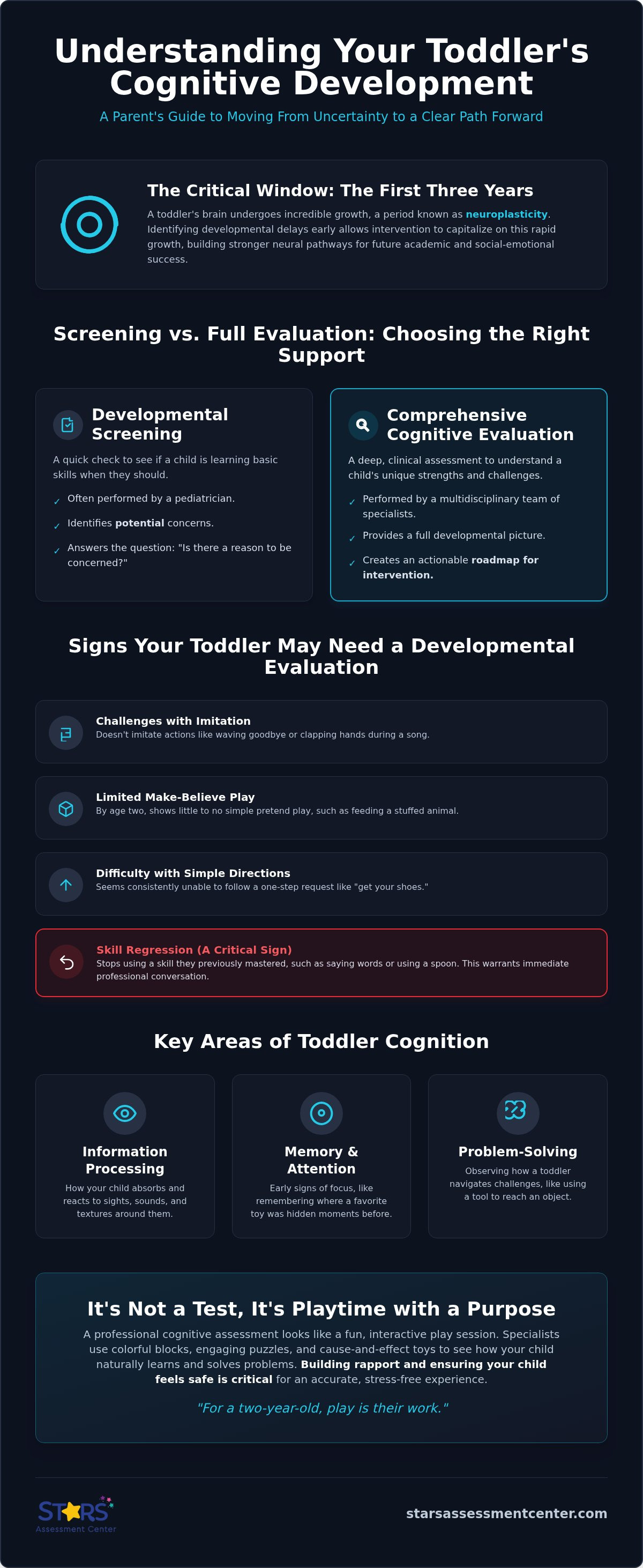
The first three years of life are a period of incredible brain growth. This is often referred to as neuroplasticity, which means the brain is highly adaptable and responsive to early intervention. When we identify a delay early, we can take advantage of this rapid growth to build stronger neural pathways. A cognitive evaluation doesn't just look at what a child knows; it looks at how they process information and interact with their environment. This understanding is the foundation for future academic success and social-emotional health.
We often find a deep connection between thinking skills and communication. For example, a What is Cognitive Development? search might show how language is just one way a child expresses their internal logic. If a toddler isn't yet using words, an assessment can help us see if they understand the concepts behind those words. This helps distinguish between a speech delay and a broader cognitive delay, ensuring your child gets the specific type of help they need.
Key Areas Measured in Toddler Cognition
During an evaluation, specialists look at several distinct domains to get a full picture of your child's strengths. These include:
- Information processing: How your child absorbs and reacts to the sights, sounds, and textures around them.
- Memory and attention: Early signs of focus, such as whether a child can remember where a favorite toy was hidden just moments before.
- Problem-solving: This involves watching how a toddler navigates a challenge, like figuring out how to open a container or using a tool to reach an object.
The Role of Play in Cognitive Testing
For a two-year-old, play is their work. That's why a professional cognitive assessment for toddlers Santa Clara looks like a fun, interactive play session rather than a "test." Specialists use colorful blocks, engaging puzzles, and cause-and-effect toys to see how your child naturally reacts. By watching a child push a button to make a toy pop up, we learn about their understanding of logic and sequence.
Building rapport is a critical part of this process. Specialists take the time to ensure your child feels safe and comfortable before beginning any observations. When a child feels secure, they are more likely to show us their true abilities and natural curiosity. This compassionate, family-centered approach ensures the results are accurate and the experience is stress-free for both you and your toddler.
Signs Your Toddler May Need a Developmental Evaluation
You know your child better than anyone else. Often, the first sign that a toddler might need extra support isn't a single "missed" milestone but a collection of small observations that leave you feeling uncertain. Perhaps you've noticed that your little one doesn't imitate your actions, like waving goodbye or clapping during a song. By age two, most children begin to engage in simple make-believe play, such as pretending to drink from an empty cup or feeding a stuffed animal. If these imaginative behaviors are missing, it might be time to look closer.
Cognitive growth is also visible in how a child follows instructions and explores their world. Most toddlers can follow simple, one-step directions by their second birthday. If your child seems consistently unable to follow a request like "get your shoes," it may indicate a challenge in how they process information. Similarly, a lack of interest in exploring new environments or interactive toys can be a sign that their curiosity is being hindered by a developmental hurdle. The CDC emphasizes the value of Developmental Monitoring and Screening as a way to keep track of how your little one is growing and when to seek professional advice.
One of the most significant indicators for specialists is skill regression. If a child previously mastered a skill, such as saying a few words or using a spoon, and then stops doing it entirely, this warrants an immediate conversation with a professional. While every child develops at their own pace, a cognitive assessment for toddlers Santa Clara can help determine if these signs are part of a typical growth pattern or if early intervention is necessary. If you've noticed these signs, a multidisciplinary developmental assessment can provide the clarity and reassurance your family needs.
Cognitive vs. Communication Delays
It's common for parents to focus on speech, but a speech delay can sometimes mask deep cognitive strengths or hidden challenges. A communication delay assessment for infants is often the first step many families take, yet it's only one piece of the puzzle. We evaluate the whole child to see if a struggle with words is purely about language or if it involves broader thinking and problem-solving skills. Understanding this distinction ensures that the support your child receives is targeted and effective.
Social-Emotional Red Flags
Social-emotional growth and cognitive development are deeply intertwined. If a toddler avoids eye contact or rarely shares a "social smile" during play, it affects how they learn from the people around them. You might also notice extreme difficulty with transitions, where moving from one activity to another causes significant distress. A social-emotional assessment complements our cognitive findings, helping us understand how your child's feelings and social interactions influence their ability to learn and process the world.
Screening vs. Evaluation: Choosing the Right Level of Care
Parents often hear the terms "screening" and "evaluation" used interchangeably, but they serve very different purposes in your child's journey. A screening is essentially a quick check-up. In Santa Clara County, many pediatricians use tools like the Ages and Stages Questionnaires (ASQ-3) to see if a child is generally on track. It's a helpful first step, but it isn't a diagnosis. Think of it as a smoke alarm; it can tell you there might be something to look at, but it won't tell you exactly what's happening or how to fix it.
A full evaluation is a deep, clinical dive. This is where a cognitive assessment for toddlers Santa Clara becomes essential. While a screening might take fifteen minutes of paperwork, an evaluation involves hours of direct observation and interaction by specialists. This level of care is often required to establish eligibility for services through the Santa Clara County regional center system. Choosing a comprehensive evaluation over a simple screening means you're looking for answers rather than just indicators.
The "wait and see" approach is common advice, yet it carries real risks. If a screening suggests a potential delay, waiting six months to see if a child "catches up" can mean missing a vital window for early intervention. Early identification allows us to support a child's brain while it's at its most flexible. Taking action now ensures your child doesn't fall further behind while you're waiting for clarity.
What is a Multidisciplinary Evaluation?
When a child faces a challenge, it rarely exists in a vacuum. A multidisciplinary assessment provides a holistic view of a child's growth by bringing different experts together. Instead of visiting a speech therapist one week and a psychologist the next, you have a team observing your child simultaneously. This approach reduces the "silo" effect, where different doctors might give conflicting or disconnected advice. A multidisciplinary assessment is a holistic view of a child's growth that considers how every area of development works together.
Specialized Screenings for Autism and Down Syndrome
Sometimes, early behavioral markers suggest the need for more specific tools. We integrate specialized screenings for Autism and Down syndrome into our broader assessment plans when needed. Identifying these conditions early is crucial for accessing specific California state funding and specialized programs designed for these unique developmental paths. A formal diagnosis from a trusted cognitive assessment for toddlers Santa Clara provider acts as a key. It unlocks the door to the specialized resources and financial supports your child is entitled to under state law.
Choosing a Cognitive Assessment Provider in Santa Clara
Finding the right fit for your family is just as important as the evaluation itself. When you are looking for a cognitive assessment for toddlers Santa Clara, your first priority should be specialization. The developmental needs of a two-year-old are vastly different from those of a school-aged child. You want a provider that focuses specifically on the birth-to-three age group. These experts understand the nuances of early milestones and the rapid pace of neuroplasticity during these formative years.
It's also vital to look for a multidisciplinary team. While a single practitioner can offer valuable insights, a team of experts provides a more balanced perspective. This collaborative approach ensures that different areas of growth, such as social-emotional health and communication, are all considered. Beyond technical skill, the environment should feel like a safe harbor. A family-centered provider will treat you as a partner, ensuring you feel heard and supported throughout the entire process. If you are ready to take this step, you can schedule a multidisciplinary developmental assessment to begin your journey.
Experience with the local system is another non-negotiable factor. Your provider should be well-versed in the specific requirements of the Santa Clara County Regional Center system. This ensures that the final report is not just a document for your files, but a functional tool that helps you access state-funded services and support programs without unnecessary delays.
Questions to Ask a Potential Evaluator
Before committing to a provider, it's helpful to have a brief conversation to gauge their approach. Consider asking these specific questions:
- What tools do you use for cognitive and communication delay assessment for infants?
- How do you involve parents in the assessment process to ensure our observations are included?
- What is the typical timeline for receiving a written report that I can submit to the Regional Center?
Navigating Local Resources in San Jose and Milpitas
In our area, the San Andreas Regional Center (SARC) is the primary hub for early intervention services. While SARC provides essential support, many families find that the intake process can take time. A private cognitive assessment for toddlers Santa Clara can often speed up this path. By arriving at your SARC appointment with a professional evaluation already in hand, you can move more quickly toward the services your child needs.
Our community is fortunate to have accessible clinics located throughout the Santa Clara County area. Whether you are coming from San Jose or Milpitas, look for a center that is easy to reach and offers a calming, child-friendly atmosphere. Being close to local landmarks and major transit routes makes it easier to keep appointments and maintain a consistent schedule for your child's care.
The Stars Assessment Approach: Clarity for Your Family
At the Stars Assessment Center, we understand that the journey to find answers for your child can feel lonely. Our goal is to transform that sense of "I'm worried" into a confident "I have a plan." We provide a cognitive assessment for toddlers Santa Clara that feels less like a clinical appointment and more like a supportive partnership. By focusing exclusively on children from birth to age three, our multidisciplinary team creates a space where your child feels safe to explore and play while we gather the insights needed to support their growth.
Our approach is rooted in the local Santa Clara landscape. Because we work closely with the community, we understand the specific pathways to services in our county. We also prioritize cultural sensitivity, ensuring that every family feels respected and heard regardless of their background. We don't just hand you a report; we provide a roadmap designed to help your child reach their full potential through early intervention success.
What to Expect During Your Visit
We believe that a stress-free environment leads to the most accurate results. Your experience with us follows a methodical, patient rhythm designed to keep you informed at every turn:
- Initial intake: This is your time to share your story. We listen to your concerns and your child's history to ensure we have a complete picture of their daily life.
- The assessment session: We use structured play and interactive tasks to observe your child's natural abilities. This gentle process allows us to see how they solve problems and interact with their world.
- The feedback meeting: We meet with you to provide a warm, clear explanation of our findings. You'll leave with a deep understanding of your child's strengths and a list of actionable steps.
Next Steps After the Assessment
The conclusion of an evaluation is actually the beginning of a new chapter for your family. We provide detailed guidance on local early intervention resources and therapy options that align with your child's specific needs. Whether you are transitioning to San Andreas Regional Center (SARC) services or preparing for school district programs, we are here to support that move. Our reports are written to meet the high standards required by these agencies, helping you secure the funding and support your child deserves. If you are ready to replace uncertainty with a clear path forward, please Contact the Stars Assessment Center to schedule your evaluation.
Empowering Your Child's Brightest Future
Navigating developmental concerns is a journey that requires both expert knowledge and a gentle heart. You've learned how the first three years are a unique window of opportunity for growth. By choosing a comprehensive cognitive assessment for toddlers Santa Clara, you move beyond the uncertainty of "waiting and seeing." You gain a dedicated partner who understands the local system and provides a clear roadmap for your child's success.
Our multidisciplinary team of specialists focuses exclusively on infants and toddlers. We pride ourselves on creating a compassionate, family-centered environment where your child can feel safe to show us their true potential. We're here to help you turn your questions into answers and your concerns into actionable steps. You don't have to navigate this path alone; we are ready to guide you every step of the way.
Schedule a Reassuring Assessment for Your Child Today
Your child's development is our priority, and we look forward to supporting your family with clarity and hope.
Frequently Asked Questions
What is a cognitive assessment for a 2-year-old?
A cognitive assessment for a 2-year-old is a specialized evaluation that observes how your child processes information and interacts with their surroundings. Unlike tests for older children, this process focuses on age-appropriate milestones like problem-solving, memory, and attention through structured play activities. It helps identify your child's unique learning style and determines if they need extra support to reach their full potential.
How do I know if my toddler has a cognitive delay?
You might notice your toddler isn't hitting milestones such as imitating your actions or engaging in simple pretend play. Other signs include difficulty following one-step directions or a lack of curiosity about new toys. While every child grows at their own pace, a professional cognitive assessment for toddlers Santa Clara provides a clear picture of whether these signs indicate a delay or a typical developmental variation.
How long does a developmental evaluation take?
A comprehensive evaluation typically takes a few hours of direct observation and interaction with your child. This time allows our specialists to build rapport and see your child's natural abilities in a comfortable setting. We also include time for a thorough intake interview with you and a subsequent feedback meeting to explain the results and next steps.
Will my child be stressed during the cognitive testing?
We design our assessments to feel like a fun, low-pressure play session for your toddler. Our specialists are experts in building a safe harbor for little ones, using engaging toys and games to observe their development. Most children enjoy the one-on-one attention and the interactive nature of the tasks; this ensures the experience is positive for both the child and the parent.
Where can I get a cognitive assessment for toddlers in Santa Clara County?
You can find specialized services at centers like the Stars Assessment Center in San Jose, which focuses exclusively on the birth-to-three age group. Families in Santa Clara County also have access to free screenings and evaluations through California's Early Start Program and the San Andreas Regional Center. Choosing a local provider who understands the regional center system ensures a smoother transition to intervention services.
Does a speech delay mean my child has a cognitive delay?
A speech delay doesn't automatically mean your child has a cognitive delay. Many children struggle with expressive language while possessing strong problem-solving and thinking skills. A cognitive assessment for toddlers Santa Clara helps distinguish between a language-specific challenge and a broader developmental delay, ensuring your child receives the most effective and targeted support.
What happens if the assessment shows a developmental delay?
If an assessment identifies a delay, you'll receive a detailed roadmap for early intervention. This often includes referrals to specific therapies and guidance on how to access support through the Regional Center or local school district. Identifying a delay early allows you to take advantage of your child's neuroplasticity, providing them with the best possible foundation for future success.
How much does a private developmental evaluation cost in California?
The cost of a private evaluation varies depending on the depth of the assessment and the size of the multidisciplinary team involved. While some private providers in the Bay Area may charge several thousand dollars, many families in Santa Clara County qualify for free assessments through the state's Early Start Program. We recommend checking with your insurance provider or local regional center to explore all available funding options.


