

Not following every direction doesn’t automatically mean something is wrong, but understanding simple commands is a skill to watch at 18 months. If my 18-month-old doesn’t understand instructions, it helps to look at the whole picture: a toddler may also show understanding by pointing to a few body parts when asked, responding to simple questions, or pointing to named pictures in a book.
It’s understandable to wonder whether your child is listening, still learning what words mean, or simply focused on something else. Toddlers won’t follow every direction on cue, and one moment alone can’t explain the reason. What matters is noticing how your child communicates and responds across everyday situations.
This article explains what listening, understanding, and early speech can look like at this age, and why a toddler might not follow directions. It also covers when hearing or speech-language evaluations can help clarify what’s going on, so you can take a thoughtful next step without feeling you have to figure it all out alone.
Key Takeaways
- Look for understanding in everyday responses, such as pointing to named pictures or body parts, not only in whether your toddler follows a direction on cue.
- Separate receptive language, what your child understands, from expressive language, what they communicate through words, signs, and meaningful sounds.
- Consider how attention, simple wording, and time to process may affect your toddler’s response to directions.
- If speech or responsiveness raises concerns, a hearing test and speech-language evaluation can help clarify what support may be useful.
- A developmental assessment can help bring together observations about communication, social-emotional growth, and other areas of development.
1. Developmental expectations for listening and impulse control
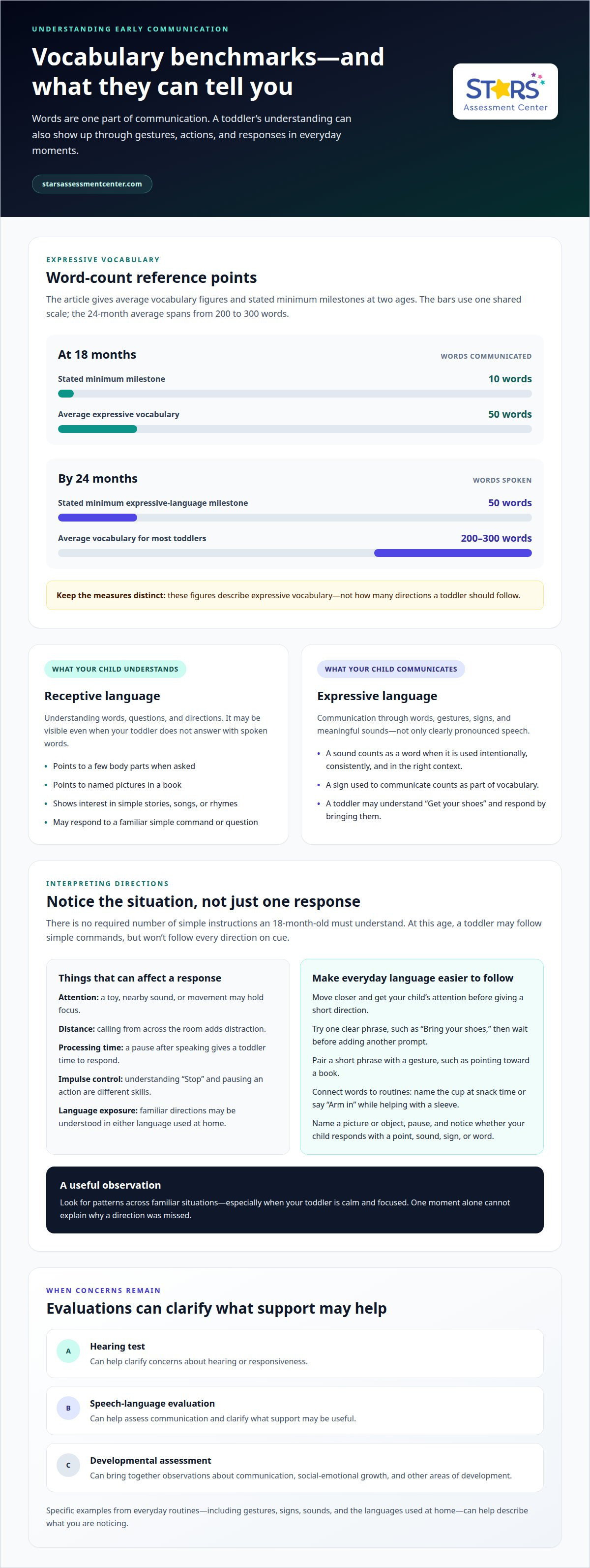
At 18 months, understanding is still growing, and a toddler may respond differently from one moment to another. Receptive language means understanding words, questions, or directions. Expressive language means communicating through words, gestures, signs, or meaningful sounds. A child might understand “Get your shoes” but answer by bringing them rather than speaking.
Between one and two years, toddlers are expected to gain receptive-language skills, including following simple commands and understanding simple questions. At 18 months, examples include pointing to a few body parts when asked, showing interest in simple stories, songs, and rhymes, or pointing to named pictures in a book. These everyday responses help show how your child understands language beyond spoken answers.
There isn’t one required number of simple instructions every 18-month-old should understand. At this age, the expectation is that a toddler may follow simple commands, not that they’ll obey every direction consistently. Notice what happens with familiar examples, such as “Come here” or “Give me the cup,” especially when your child is calm and focused.
Listening and following through are also affected by attention and impulse control. Children under three haven’t fully developed impulse control, so an 18-month-old may understand “Stop” yet keep reaching for a toy. Understanding a direction and being able to pause an action are different skills. A toddler who doesn’t stop immediately may need a clear boundary, a nearby adult, and repeated practice.
Bilingual exposure alone doesn’t tell you whether a toddler understands instructions. Try familiar directions in both languages your child hears, such as “Bring the ball” and its equivalent in another language. A response may be a gesture or action rather than a spoken word. Include the languages used at home when describing your child’s communication during an assessment.
Simple routines offer practical ways to support communication. During dressing, say “Arm in” as you guide one sleeve; at snack time, name the cup before handing it over. Pause briefly after speaking so your child has time to respond. Pair short phrases with gestures, such as pointing toward the book while saying, “Bring the book.”
Shared books, songs, and rhymes also create chances to connect words with meaning. Name a picture, then give your toddler a moment to point; during a familiar song, pause before a repeated word. These small exchanges support receptive language while inviting expressive communication through sounds, signs, gestures, or words. If responses remain unclear across familiar situations, note specific examples to discuss during a developmental or speech-language evaluation.
2. Understanding milestones for toddlers
Understanding develops alongside communication, but a toddler’s words don’t tell the whole story. At 18 months, the average expressive vocabulary is 50 words, while the stated minimum milestone is 10 words. These figures describe words a child communicates, not a required number of directions they must follow. Consider how your child responds to familiar words, gestures, and everyday situations.
Vocabulary can include more than clearly pronounced speech. A word counts when a child uses a sound intentionally, consistently, and in the right context. For example, “ba” used to request a ball can count, while a sound without a clear meaning may not. Sign language signs count, too, so include signs your child uses to communicate when describing their vocabulary.
By age 24 months, most toddlers say an average of 200-300 words, and the stated minimum expressive-language milestone is 50 words. These figures offer a point of reference, not a way to predict exactly when your child will follow a particular instruction. Look at communication over time, including whether your toddler understands familiar words and uses gestures or sounds to share needs.
Too many directions can make an everyday interaction harder to follow. Instead of giving several instructions while getting ready, try one clear phrase, such as “Bring your shoes.” Give your toddler a chance to respond before adding another prompt. During play, let your child choose between blocks and a book rather than directing every action. This connects language to what captures their attention.
Modeling words gives your toddler a useful example without turning play into a test. If your child points toward a cup, say, “Cup. You want your cup,” then pause for a response. If they say “wa” for water, respond with “Water” as you hand it over. This gentle expansion acknowledges their communication and offers a clear word in context.
Try the same approach during a familiar activity, such as bath time: name the duck, wait, and respond to your toddler’s gesture or sound. If your child uses a sign, say the matching word as you respond. A pattern of difficulty understanding familiar language, alongside concerns about communication, is worth discussing. Support for communication concerns can help clarify what to consider next.
Disconnection and following directions
A toddler may seem disconnected when focused on a toy, a sound, or movement nearby. Calling from across the room while your child stacks blocks, for example, adds distance and distraction. Move closer, say your child’s name, and wait until they look or pause before giving a short direction. Then you can better notice whether they respond to the words, the gesture, or both.
Understanding a direction and acting on it are separate parts of communication. A toddler might understand “Bring the ball” but keep playing because the ball is exciting or the request interrupts an activity. The U.S. Department of Health and Human Services identifies following one- or two-step directions as an example of understanding simple sentences. Start with one familiar action, such as “Give me the book,” before trying a two-part request.
To help your 18-month-old understand and follow simple directions, use short, familiar words and pair them with a gesture. Say “Put the cup here” while pointing to the table, then pause so your toddler has time to respond. During cleanup, keep the same phrase and routine rather than adding several instructions at once.
Indiana University describes visual schedules, simplified language, extra processing time, and predictable routines as supports for children who need individualized help following directions. A simple picture cue can show that shoes come before going outside. A consistent bedtime sequence, such as pajamas followed by a book, also gives words a familiar context. These supports can make the next step easier to understand without requiring a toddler to remember a long string of words.
Notice whether the difficulty changes by setting. A child may follow “Come here” in a quiet kitchen but not during a busy playgroup, where other children and toys compete for attention. Try the same simple direction during a calm routine, then see whether a gesture, closer distance, or extra pause changes the response. Record a few examples, including the words used and what was happening around your child.
If your toddler responds inconsistently across familiar routines, consider their overall communication rather than treating every missed direction as refusal. Notice whether they respond to their name, use gestures to share interest, or understand familiar words in daily activities. A developmental assessment that includes speech and language can help you understand how your child communicates and what may affect their responses to directions.
4. Expressive vocabulary milestones at 18 months
At 18 months, expressive vocabulary is one part of how a toddler communicates. A child may use words, signs, or meaningful sounds to request, label, or comment. For example, reaching toward a snack while saying “more” communicates a clear message. The milestone gives families a reference point, but everyday communication includes more than speech that sounds like an adult’s.
Count a sound as a word when your toddler uses it intentionally, consistently, and in the right context. If “ba” repeatedly means “ball” during play, it may count as a word. A sound that happens randomly, without a clear message, doesn’t show the same purposeful use. Notice what your child means, not only how clearly the sound is pronounced.
Animal sounds and other noises can also count when they carry meaning. A toddler who says “moo” while pointing to a cow in a book may be labeling it. “Vroom” for a toy car or “uh-oh” after dropping a block can express a comment. Context helps distinguish communication from playful sounds without a clear message.
Pronunciation doesn’t need to be perfect for an attempted word to count. If your child says “duh” for “duck” each time they see one, record the word they’re trying to say. Sign language signs count, too. A child who signs “more” at snack time is communicating a word, even without saying it aloud.
A simple vocabulary note can help you remember words across daily routines. Write down each consistent word, sign, or meaningful sound, along with what your child means by it. For example, note “night-night” before bed or a hand sign for “drink.” These notes make it easier to describe communication patterns during a developmental assessment.
Look at how your toddler communicates, not just the size of their word list. Does your child use “up” to ask to be picked up, or point while making a sound to share interest? These examples show how words and gestures work together. A word used to request, name, or comment provides more context than a sound heard only once.
Try observing vocabulary during familiar moments, such as meals, play, or getting dressed. If your toddler says “shoe” while bringing one over, record both the word and its purpose. Revisit your notes to see which expressions remain consistent and which new ones appear. These everyday examples can help you explain your concerns clearly during an assessment.
5. Hearing tests and speech-language evaluations
If you find yourself thinking, “my 18 month old doesn't understand instructions,” hearing is one part of the picture to explore. A toddler may respond to some sounds but miss spoken words, especially when attention or surroundings vary. Parents concerned about language should have their child’s hearing tested to help rule out hearing loss. A hearing test can clarify whether hearing may affect responses to voices, names, or directions.
Share concrete examples of what you notice. For instance, describe whether your child turns toward a familiar voice, responds to their name, or reacts differently to sounds than to gestures. A parent may say, “my 18 month old doesn't understand instructions,” when they notice repeated difficulty with familiar requests. That concern is useful context, but it doesn’t by itself explain why. Hearing and communication should be considered together.
A speech and language evaluation can help assess how a toddler understands and communicates. Parents concerned about language development should seek this kind of evaluation. It considers receptive language alongside expressive communication through speech, signs, gestures, and meaningful sounds. For example, an evaluator may consider whether a child uses a gesture to request a snack and how they respond to familiar language during everyday interactions.
Make the conversation more specific with examples from meals, play, and routines. Record the words or gestures used, the direction given, and what happened next. Include whether your child responded after a pause or when you were nearby. If your family uses more than one language, describe the languages your child hears and the words or signs used in each. These details connect your concerns to daily communication.
A hearing test and a developmental assessment address related but different questions. Hearing testing focuses on whether hearing may affect access to spoken language. A developmental assessment can explore understanding and communication. One doesn’t replace the other when both hearing and language concerns are present. A pediatrician can help guide next steps, and you can raise ongoing concerns without waiting for a specific age.
If your toddler has limited speech, doesn’t consistently respond to their name, or seems not to understand familiar language, share those examples with a professional. Don’t wait for speech concerns to resolve before asking about hearing. A Speech and Language Evaluation can help clarify your toddler’s communication strengths and areas of concern, giving your family a clearer basis for deciding what support to pursue.
Stars Assessment Program
Stars Assessment Program can help clarify whether difficulty following directions is part of a broader communication or developmental concern. If your toddler’s responses, gestures, or speech raise questions across everyday routines, an assessment can bring these observations together and help you understand your child’s developmental profile.
Depending on your concerns, support may include a Speech and Language Evaluation, Social-Emotional Assessment, or Multidisciplinary Developmental Assessment. These assessments can help explore communication alongside other areas of development. Stars Assessment Program also provides Autism services when autism-related developmental questions are part of your concerns.
You don’t need to have a diagnosis or a complete explanation before seeking guidance. Share the examples you’ve noticed, such as difficulty responding to familiar directions or communicating needs. To discuss your concerns and possible next steps, contact Stars Assessment Program.
Take the next step with confidence
If you’re concerned that your 18-month-old doesn’t understand instructions, you don’t need to have a complete explanation before asking for guidance. Your observations matter, even when your toddler’s responses vary from one day or setting to another. Sharing what you’ve noticed can help turn uncertainty into a clearer understanding of your child’s needs.
Consider what would help you feel more informed now. You might want support making sense of communication patterns or a clearer view of your child’s development. A play-based, child-led assessment can help you discuss those concerns and consider next steps without expecting you to work out the reason on your own.
Contact Stars Assessment Program to talk about your concerns and explore a helpful next step for your family. Asking questions is a thoughtful way to support your child, and you can move forward one step at a time.
Frequently Asked Questions
What language comprehension is typical for an 18-month-old?
An 18-month-old may understand familiar words, simple questions, and everyday requests, though responses can vary with attention and context. For example, your toddler might look toward a familiar person when named or point to a body part after hearing its name. Understanding doesn’t always appear as spoken words; an action, gesture, or point can also show that your child grasped what you said.
What are signs of receptive language delay at 18 months?
Possible signs include rarely responding to familiar words, difficulty understanding simple questions, or not following familiar directions across everyday settings. Notice whether your toddler understands language during quiet play as well as busy routines, and whether gestures help them respond. One missed direction doesn’t establish a delay, but a pattern that concerns you is worth discussing with your child’s pediatrician or an assessment specialist.
When should I talk to a pediatrician about an 18-month-old's language development?
Bring up your concerns at your child’s next visit, or contact the pediatrician sooner if communication or understanding is worrying you. Share specific examples, such as your toddler rarely responding to their name or having difficulty communicating a need. You can ask whether a hearing test and speech-language evaluation would help clarify the concern. You don’t need to wait for a milestone deadline to start that conversation.
How is hearing tested in toddlers with possible language delays?
A hearing professional selects an approach suited to your toddler’s age and ability to participate. The purpose is to assess hearing, not to judge whether your child follows instructions or cooperates. Before the appointment, note how your child responds to voices and everyday sounds, and share those observations. If a test is difficult to complete, the professional can explain what the results show and whether further assessment is needed.
What developmental screening is recommended at the 18-month checkup?
Ask the pediatrician to review your child’s development during the 18-month checkup and explain which screening tools are appropriate. Bring examples from communication, play, social interaction, and daily routines, such as how your toddler asks for help or responds to familiar requests. If you have concerns about autism or another developmental area, mention them directly so the conversation addresses your questions.
How do I get an early intervention evaluation for a toddler in the United States?
Ask your pediatrician how to request an evaluation through your state’s early intervention program; you can also contact that program directly. Procedures vary by location, so explain your concerns and ask what information is needed to begin. Families in San Jose, Santa Clara, Santa Cruz, Salinas, Milpitas, Gilroy, and Morgan Hill can ask about California’s Early Start process and local evaluation options.


