

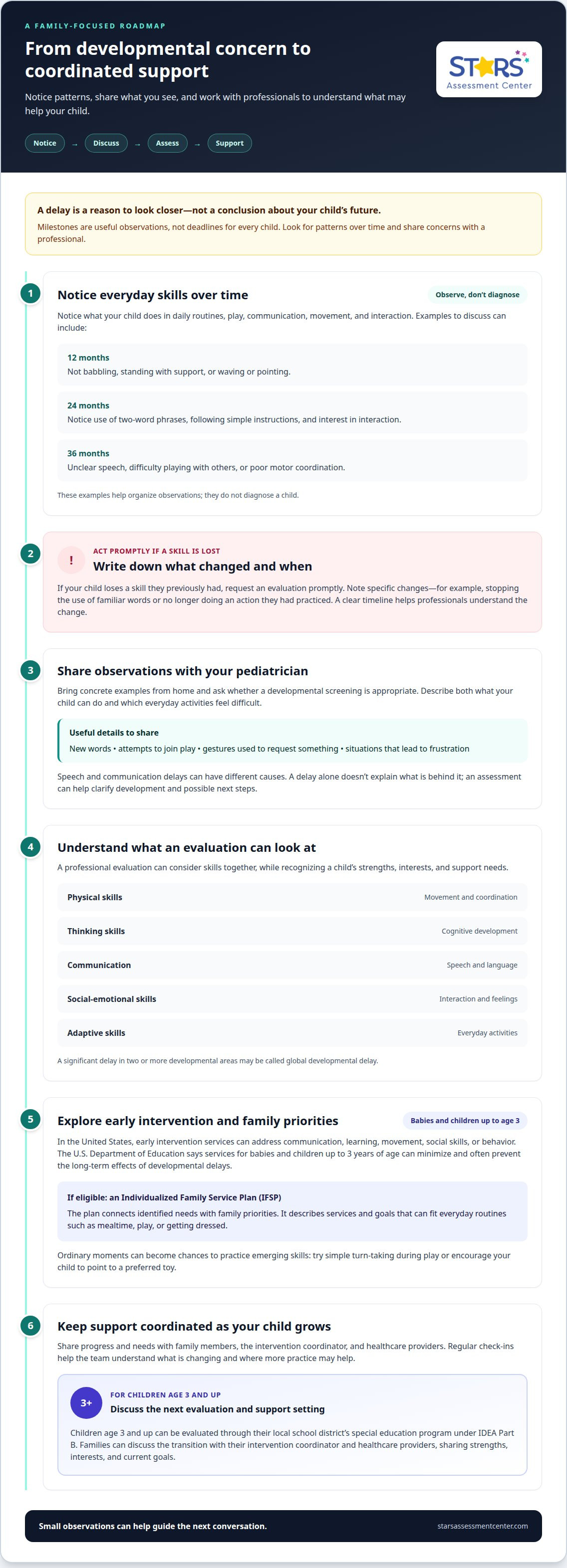
A developmental delay is a reason to look closer, not a conclusion about your child’s future. Learning how to support a child with developmental delays starts with everyday encouragement at home, alongside a conversation with your pediatrician about screening and next steps. According to the U.S. Department of Education, early intervention services for babies and children up to 3 years of age can minimize and often prevent the long-term effects of developmental delays.
It’s understandable to wonder whether a delay is significant, whether your child will catch up, or whether it may relate to autism. Speech and communication delays can have different causes, so a delay alone doesn’t explain what’s behind it. Your observations matter, and an assessment can help clarify your child’s development and possible next steps.
This article covers practical ways to support learning through routines, play, and clear instructions; what to share with your pediatrician; and how developmental assessments and early intervention work. It also explains how developmental delays and autism differ, so you can better understand what questions to raise and what steps may help your child.
Key Takeaways
- Use predictable routines and picture schedules to make daily activities easier to understand.
- Give simple instructions, reduce distractions, and break new skills into smaller steps.
- Share your observations with your child’s pediatrician and ask whether a developmental screening is appropriate.
- A developmental evaluation can look across physical, thinking, communication, social-emotional, and everyday skills.
- A speech delay can have different possible causes, so an assessment can help clarify what support may fit your child’s needs.
What are early intervention services?
Early intervention helps connect young children with developmental support and gives families ways to build skills into everyday routines. In the United States, support focuses on the child’s needs and the family’s priorities.
Early intervention services for babies and children up to 3 years of age can minimize and often prevent the long-term effects of developmental delays, according to the U.S. Department of Education. Support may address communication, learning, movement, social skills, or behavior. For example, a caregiver might practice simple turn-taking during play or encourage a child to point to a preferred toy. These ordinary moments give children chances to use emerging skills in familiar settings.
An assessment can help identify areas where a child may benefit from support while recognizing strengths and interests, such as enjoying songs, watching other children, or exploring blocks. Share what captures your child’s attention and which daily activities feel difficult. These details help keep support relevant to your child’s life, rather than focusing only on a skill that is still developing.
Individualized Family Plans
An Individualized Family Service Plan, or IFSP, describes early intervention services for an eligible child and family. It connects identified needs with family priorities, so support can fit everyday routines such as mealtime, play, or getting dressed. Parents can use the plan to understand which goals are being addressed and discuss their child’s progress. It also gives the family and support team a shared reference point.
When concerns continue, parents can ask their pediatrician about a specialist referral and contact their state or territory’s early intervention program to learn about possible services, according to the Centers for Disease Control and Prevention (CDC). Share specific examples to explain the concern: a child may use gestures to request a snack but rarely use words. Families can also ask how suggested activities might fit naturally into the day.
Coordinating Services
Coordinating support means keeping the family, intervention coordinator, and healthcare providers informed about the child’s progress and needs. Caregivers can share observations from home, such as new words, attempts to join play, or situations that lead to frustration. Regular check-ins help everyone understand what is changing and where the child may benefit from more practice.
Age matters when planning what comes next. In the United States, children age 3 and up can be evaluated through their local school district’s special education program under IDEA Part B, according to the U.S. Department of Education. Local public school systems typically provide developmental services and support for children age 3 years and older, according to the CDC. A family can discuss the transition with its intervention coordinator and healthcare providers, sharing the child’s strengths, interests, and current goals. This continuity helps the next team understand what supports the child’s learning and participation.
What is a developmental delay?
A developmental delay means a child is taking longer to gain skills in areas such as movement, communication, thinking, or social-emotional development. Milestones describe skills children generally develop by certain ages, but they aren’t deadlines for every child. Look at patterns over time rather than one isolated action, and share concerns with a professional.
Look at everyday examples across areas. At 12 months, not babbling, standing with support, or waving or pointing can be signs to discuss. At 24 months, notice whether a child uses two-word phrases, follows simple instructions, or shows interest in interaction. At 36 months, unclear speech, difficulty playing with others, or poor motor coordination may warrant attention. These examples help organize observations, not diagnose a child.
Under IDEA, states choose the age range within ages 3 to 9 for which they use the term developmental delay, including the option of ages 3 to 5, according to the U.S. Department of Education. A significant delay in two or more developmental areas may be called global developmental delay. A professional evaluation can consider physical, cognitive, communication, social-emotional, and adaptive skills together.
If a child loses a skill they previously had, request an evaluation promptly. Note what changed and when, such as a child stopping the use of familiar words or no longer doing an action they had practiced. A clear timeline helps professionals understand the change and consider what evaluation may be appropriate.
At home, break a new skill into smaller actions. For example, learning to put on a coat can start with finding the sleeves, then pushing one arm through, before practicing the whole task. Give one clear instruction at a time, use simple words, and allow extra time to respond. These steps can support progress without rushing your child.
Play offers practical ways to build communication and friendships. Take turns rolling a ball, name the action, and pause so your child can respond with a word, gesture, or point. Playing with peers can help children learn sharing, turn-taking, and social skills by watching and joining at their own pace.
Different professionals support different needs. A pediatrician can discuss developmental concerns; speech-language pathologists evaluate speech and language, while occupational and physical therapists address fine and gross motor skills. Support for social skills may help with sharing, play, or understanding nonverbal cues.
Insurance coverage varies by plan and service, so evaluation, therapy, and early intervention may be covered differently. In the United States, children under age 3 can usually receive a free evaluation through their state’s Early Intervention program. Families can also connect with support groups to share encouragement and practical experience.
If you’re seeking a clearer picture of your child’s strengths and support needs, a multidisciplinary developmental assessment can help inform next steps.
Pediatrician consultation and developmental screening
A pediatrician can help turn concerns about speech, play, movement, or behavior into a clear next step. Describe what you notice, ask about developmental screening, and discuss whether a more detailed evaluation may be helpful.
A developmental screening is a brief, general check of a child’s skills. The results can indicate whether a fuller evaluation may help. A lab or blood test does not determine whether a child has a developmental delay. Instead, professionals consider observations, screening results, and development in areas such as communication and movement. They may also check hearing or vision, which can affect learning and language.
Screening questionnaires are usually given at 18 and 24 months. Tools may include the Ages and Stages Questionnaire, ASQ-3, or autism-specific questionnaires such as the M-CHAT-R. A screening result is not the same as a diagnosis. If a toddler is identified as at risk for autism, the result can guide referral for further evaluation. For a possible speech delay, an evaluation may consider hearing, speech abilities, and social interaction.
Children age 3 and older can be evaluated through their local school district’s special education program under IDEA Part B, according to the U.S. Department of Education. Eligible children may receive special education services through an Individualized Education Program, or IEP, provided through the public school system. The evaluation helps identify educational needs and the supports that may help the child participate and learn.
To request a school evaluation, contact the local school district and describe the child’s developmental or learning concerns. Ask about an evaluation for special education or, when access needs are the concern, an assessment for a 504 plan. Section 504 is identified as a federal law addressing equal access to educational and occupational opportunities. A school team uses the child’s needs and available evaluation information to consider appropriate support.
If a doctor dismisses your concerns, write down specific examples, such as difficulty following a familiar direction or a change in communication. Bring your notes to a follow-up conversation and ask about screening or a specialist referral. If concerns persist, parents can contact their state or territory’s early intervention program, according to the Centers for Disease Control and Prevention (CDC).
In the United States, Child Find systems typically provide developmental screenings and evaluations free to families. Pediatricians can discuss developmental concerns, while speech-language pathologists evaluate speech and language. A multidisciplinary assessment can consider several areas together, helping families understand a child’s strengths and needs.
Building predictable routines and supportive environments
For parents learning how to support a child with developmental delays, predictable routines can make daily expectations easier to understand. Small changes, such as reducing background noise, can also help a child focus on one activity at a time.
Predictable Schedules and Routines
A predictable routine follows familiar steps, while a picture schedule shows those steps visually. For example, pictures of breakfast, getting dressed, and leaving home can show a child what comes next. Consistency can make transitions easier to understand, especially for a child who has difficulty following spoken directions. Keep the schedule simple and point to each picture as the activity begins.
Use short prompts just before an activity, such as “Shoes on, then outside,” instead of giving several instructions at once. A quiet space can help a child listen and focus. If a routine changes, show the new picture or calmly explain what happens next. Ask your pediatrician or other providers which activities at home can support recommended developmental goals.
At-Home Play and Reading
Play and shared reading create everyday opportunities to practice communication, attention, and motor skills. While reading, pause so your child can point to a picture, make a sound, or turn the page. With blocks, take turns stacking pieces and describe each action. Follow your child’s interests, such as choosing a favorite animal book or building a tower together.
Notice effort with specific encouragement: “You handed me the block” tells a child exactly what went well. Choose activities that suit your child’s current abilities, then make them a little more challenging as skills grow. If your child enjoys music, sing a familiar song together and pause for a gesture or sound. Shared moments can support learning without turning play into a test.
When a child finds a task difficult, divide it into smaller actions. For handwashing, show turning on the tap, wetting hands, and drying them as separate steps. Give your child time to try each part. Dancing or digging in soil can encourage gross motor practice, while play-dough gives fingers a chance to squeeze and shape.
Keep conversations with providers practical. Share which routines are difficult, what your child enjoys, and which strategies work at home. For example, explain whether a picture cue helps during meals or a quieter room makes play easier. Providers can suggest ways to include recommended activities in familiar parts of the day. This is one practical way to support a child with developmental delays consistently at home.
A supportive environment also allows for breaks and choices. Offer two options, such as a puzzle or a book, and let your child point or gesture. If frustration builds during a task, pause and return to one manageable step. These adjustments encourage participation while respecting your child’s pace and abilities.
Differences between developmental delay and autism
A developmental delay describes slower progress in one or more areas, such as communication, movement, or social-emotional skills. Autism is a developmental condition that may be considered when a child’s communication or social interaction raises concerns. The terms aren’t interchangeable, and one behavior alone cannot explain a child’s development.
Speech differences show why an assessment should consider more than one possibility. A child may speak later because of hearing difficulties, challenges making speech sounds, or differences in communication and social interaction. For example, a child who rarely uses words may benefit from closer attention to hearing, speech, and social-emotional development. A speech delay alone does not establish an autism diagnosis.
Developmental milestones offer useful context, but describe skills generally expected by certain ages, not a diagnosis. Professionals consider how a child communicates, plays, responds to others, and manages everyday activities. A parent might notice that a child uses gestures to request a toy but seldom tries to share interest in it. That example is useful to report, but it should be understood alongside the child’s broader development.
Screening and assessment serve different purposes. A screening tool, such as the M-CHAT-R, can indicate whether a toddler may benefit from further assessment. It doesn’t confirm autism. A more detailed assessment looks at a child’s strengths and support needs, including communication and social-emotional development. The evaluator considers caregiver information and observations of the child, rather than relying on one missed milestone or a single questionnaire.
Autism and developmental delays can raise overlapping questions about language, play, or interaction. That overlap can make one sign difficult to interpret on its own. Instead, note specific examples: whether your child points to share interest, responds during back-and-forth play, or uses words or gestures to communicate a need. Include what happens in different settings, such as at home and with other children.
Keep the goal practical. An assessment can clarify which skills may need support and what your child already does well. If communication is the main concern, a Speech and Language Evaluation can look at how your child understands and expresses messages. When concerns involve several areas, a broader developmental assessment can provide a fuller picture. The focus should reflect your child’s observed needs, not a label based on one sign.
Parents can bring written observations and examples of play or communication to a developmental assessment. To explore concerns about autism and your child’s development, request an autism assessment.
Stars Assessment Program: Multidisciplinary Developmental Assessment
Stars Assessment Program offers developmental assessments for children under the age of three when concerns involve several areas of development. The play-based assessment considers speech and language, cognitive, motor, social-emotional, and adaptive development, as well as vision and hearing. It helps families understand their child’s current developmental levels and next steps.
If your questions involve communication, social-emotional development, or autism, an assessment can help clarify which areas may need further attention. Stars provides developmental assessments that consider these areas as part of a child’s development. The results can complement the observations you share with your pediatrician and help guide conversations about next steps.
Families in Santa Clara County who would like a clearer picture of their child’s development can contact Stars Assessment Program to discuss an assessment.
Take the Next Step at Your Child’s Pace
Supporting your child doesn’t require having every answer at once. Notice what helps them communicate, take part, and feel understood, then use those observations to guide your next conversation. If you’re still working out how to support a child with developmental delays, start with one practical question: what would make an everyday moment easier for your child right now?
Bring that question and specific examples from home to a developmental assessment. Clear observations can help focus the conversation on your child’s needs and the kind of assessment that may be useful. You can take the next step when you feel ready, without needing a diagnosis or a complete plan beforehand.
Contact Stars Assessment Program today to discuss your child’s developmental assessment needs. Each child’s path is individual, and thoughtful support can begin with one conversation.
Frequently Asked Questions
What If the Delay Is Significant or Doesn’t Improve?
Consider an assessment if concerns persist, affect everyday activities, or involve several areas of development. If your child loses a skill they previously used, seek an evaluation promptly. Keep brief notes about what changed, when you noticed it, and where it happens. For example, a parent in San Jose might note that their child stopped using a familiar gesture at home and during play.
What are common signs of developmental delays in children by age?
Possible signs depend on a child’s age and the skill area. At 12 months, not babbling or waving may be worth discussing; at 24 months, watch for limited two-word phrases or difficulty following simple instructions. At 36 months, unclear speech or difficulty playing with others may raise questions. These examples can help parents organize observations, but milestones alone don’t establish a diagnosis.
How can parents support a child with developmental delays at home?
Make everyday moments easier to join. During snack time, offer a choice between two foods and accept a point, gesture, or word as an answer. While getting ready, give one short direction, then allow time to respond. A parent in Gilroy could describe each step while sharing a familiar picture book. Notice and name your child’s effort, such as handing over a cup.
What early intervention services are available for children under age 3 in the US?
Early intervention programs generally serve children from birth through 36 months, with support based on a child’s developmental needs. After evaluation, an eligible child may receive an Individualized Family Service Plan that sets out supports in partnership with the family. In California, families can ask about the state’s Early Start program. Parents in Santa Clara, Santa Cruz, or San Benito counties can also discuss concerns with their child’s healthcare provider.
What therapies help children with developmental delays, and how do they compare?
Support should reflect the skills a child needs to build. Speech-language pathologists work on communication, such as understanding words or expressing needs. Occupational therapists address fine motor tasks, while physical therapists focus on movement skills. Social skills support can help children practice sharing, turn-taking, or joining play. A family in Salinas can discuss their child’s needs with a healthcare provider and consider an assessment to understand development across areas.
What resources and support groups are available for families of children with developmental delays?
Families can ask their pediatrician about referrals and contact their state or territory’s early intervention program to learn about services. Support groups and other families of children with special needs can also offer practical experience, assistance, and encouragement.


