

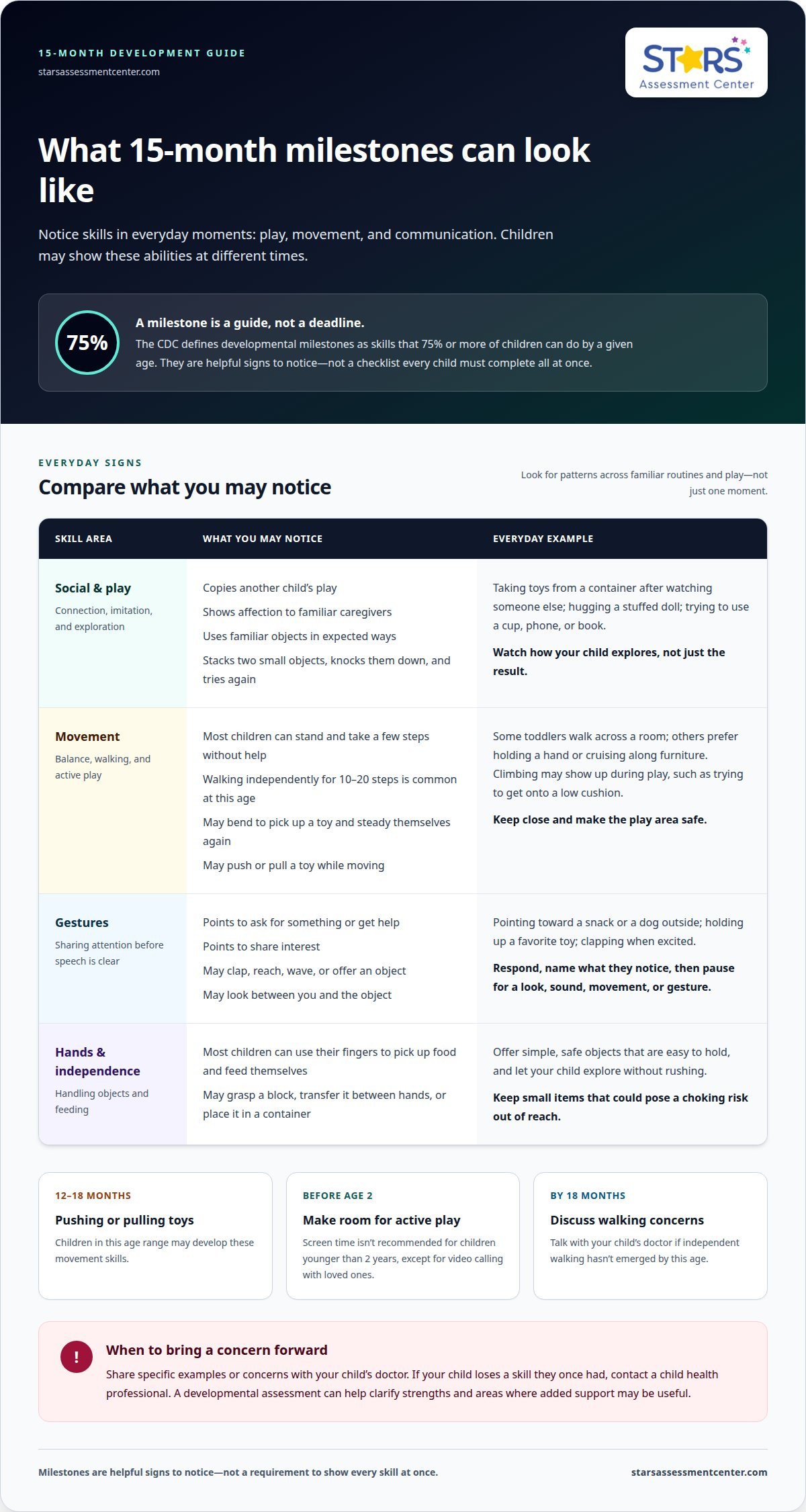
Not every 15-month-old will show every skill at the same time. The CDC defines developmental milestones as skills that 75% or more of children can do by a given age, so milestones for a 15 month old are helpful signs to notice, not a checklist your child must complete all at once.
It’s understandable to feel concerned when your child isn’t doing something you expected. A skill may still be emerging, but noticing what your child can do and sharing concerns or lost skills with their doctor can help you decide what support may be useful.
This guide explores milestones for a 15 month old across social and emotional development, movement, communication, and following simple directions. You’ll learn what skills may emerge around this age and what to consider if your child isn’t showing some yet.
Key Takeaways
- Notice how your toddler shows interest in people and objects, including copying play or sharing something they enjoy.
- Look at movement in everyday play, from taking a few steps to pushing or pulling a toy.
- Pointing, clapping, and showing objects can all help a young child communicate before speech is clear.
- Pay attention to how your child uses sounds and words, and whether they look toward familiar objects when named.
- Simple directions may be easier to understand when you pair your words with a gesture.
Social and emotional development
At 15 months, social skills often appear in small, everyday interactions. A child may copy another child’s play, such as taking toys from a container after watching them. They may clap when excited or hug a stuffed doll. With familiar caregivers, affection can show through hugs, cuddles, or kisses. These actions help you notice how your toddler shares attention and responds to people.
Developmental milestones are skills that 75% or more of children can do by a given age, according to the Centers for Disease Control and Prevention. They offer a useful guide, not a requirement that every child show every skill on the same day. At 15 months, most children can use their fingers to pick up food and feed themselves, according to the Centers for Disease Control and Prevention. This practical skill also shows how children explore objects and act with growing independence.
Cognitive development involves how children learn, explore, and solve simple problems. A toddler may try to use a phone, cup, or book in a familiar way. They may stack two small objects, knock them down, and try again. Watch how your child explores rather than expecting a particular result. Repeating an action can be part of learning what an object does.
Play gives toddlers safe opportunities to practice social and thinking skills. Offer a container and a few toys, then take turns putting objects in and taking them out. Copy your child’s actions, pause, and see whether they respond with a gesture or sound. A soft doll can invite gentle hugs, while a familiar cup or book encourages purposeful handling. Keep play simple and follow your child’s interest.
Tantrums can happen at this age, especially when a child is tired or hungry. Notice what happens before an upset, such as a missed snack or a change in activity. Calmly naming a feeling and offering comfort can help your toddler feel understood. A difficult moment alone doesn’t explain a child’s overall development; look at patterns across daily interactions.
Bring concerns to your child’s doctor during a well visit, including questions about social responses, play, or feeding skills. Share specific examples, such as whether your child copies play, shows affection, or explores everyday objects. If your child loses a skill they once had, contact a child health professional. A developmental assessment can help clarify strengths and areas where added support may be useful.
Walking, climbing, and other gross motor skills
At 15 months, most children can stand and take a few steps without help. Some toddlers walk across a room, pause, then turn toward a caregiver. Others still prefer holding a hand or cruising along furniture. Walking independently for 10-20 steps is common at this age, but movement can look different from child to child. Notice how your toddler moves through familiar spaces, not just whether they walk on demand.
Walking combines balance, strength, and planning. Your child might bend to pick up a toy, then steady themselves while standing again. They may push or pull a toy as they move, skills children aged 12 to 18 months may develop. Climbing can also appear during play, such as trying to get onto a low cushion. Stay close and keep the play area clear, especially around stairs or furniture.
Movement and thinking work together. A toddler may remember where a favorite ball rolled, then move toward it. They might try a different route around a chair after bumping into it. These small attempts show exploration and problem-solving, not just physical strength. Give your child room to move between safe, stable objects, and talk about what they’re doing: “You’re reaching for the ball.”
Hand coordination develops alongside larger movements. During play, children may grasp a block, transfer it between hands, or place it in a container. At mealtime, picking up small pieces of food with their fingers gives them practice with hand control. Offer simple, safe objects that are easy to hold, and let your child explore without rushing. Keep small items that could pose a choking risk out of reach.
Social moments can shape active play, too. Your toddler may bring you a toy, smile after taking a few steps, or seek cuddles after a tumble. Talking calmly while your child explores helps connect movement with shared attention. A familiar adult nearby can encourage another attempt, while a favorite toy can make moving across the room more engaging.
Keep screens from replacing active play. Screen time isn’t recommended for children younger than 2 years, except for video calling with loved ones. Floor play, reaching for toys, and moving between caregivers offer everyday opportunities to practice. If your child loses movement skills they once had, speak with a child health professional. Discuss concerns if independent walking hasn’t emerged by 18 months. If worries also involve emotional responses or interactions, a Social-Emotional Assessment can help explore that part of your child’s development.
Gestures and non-verbal communication
At 15 months, a gesture can carry a clear message before speech does. A child may point toward a snack to ask for it, or point toward a closed container when they need help. Watch what happens before and after the gesture. Looking between you and the object, then reaching, gives context about what your toddler is communicating.
Pointing can share interest, not just request something. Your child might point toward a dog outside, then look back at you. They may hold up a toy or block they enjoy, inviting you to notice it. Respond by naming the object and following their attention. “You found the red block” connects the gesture with a spoken word.
Clapping is another way to express excitement. Your child might clap after a favorite song or when a familiar person enters the room. Gestures such as reaching, waving, and offering an object also help children take turns in everyday exchanges. Pause after responding, giving your toddler time to answer with a look, movement, sound, or another gesture.
Communication includes more than spoken words. Notice whether your child looks toward a familiar object when someone names it, such as turning toward a cup after hearing “cup.” Pair simple words with actions: wave while saying goodbye, or point to shoes while getting ready to leave. These repeated moments connect what your child sees, hears, and does.
Try a short play routine with blocks. Hold out a block, wait for your child to reach or point, then pass it over and name it. Offer a choice by showing two familiar objects, such as a book and a toy. Notice how your child makes a selection, whether by reaching, looking, or vocalizing. Follow their cue and respond warmly rather than requiring a spoken answer.
Look for patterns across different people and daily routines. Does your child use gestures to request, share attention, or get help? Do they respond to familiar words with a look or action? If you’re concerned about how your toddler understands or communicates, describe specific examples to a primary care clinician. A Speech and Language Evaluation can help assess communication skills when spoken language or understanding is a concern. If your child loses a communication skill they previously used, seek advice from a child health professional.
Speech, language, and understanding
At 15 months, children may communicate through sounds, early words, and actions. The Centers for Disease Control and Prevention says most children try one or two simple words besides “mama” or “dada.”
Speech and Language Development
Speech is the sounds a child makes, while language includes words, gestures, and understanding. At 15 months, these skills can develop at different rates. A toddler may babble or copy a familiar sound without saying a clear word. They may also look toward a familiar object when someone names it. Noticing both spoken and understood communication gives a fuller picture of learning.
Early Words
Early words are sounds a child uses consistently to name people, objects, or needs. A toddler might say “ball” while reaching for one, or use a familiar sound for a caregiver. The word doesn’t need perfect pronunciation to carry meaning. Listen for words used with clear intent across routines, such as during feeding or play. Record examples to describe changes over time.
Typical Language Milestones
Typical language milestones describe skills children often develop around a certain age. By 15 months, most children try one or two words besides “mama” or “dada,” according to the Centers for Disease Control and Prevention. Children aged 12 to 18 months may also babble and mimic simple words or sounds. At 18 months, most try three or more words besides “mama” and “dada.” These examples provide context, not a deadline for each child.
Everyday conversation creates chances to connect words with actions. While dressing, say “sock” as you hold one up, then pause for your child’s response. At lunch, name a cup or spoon as your toddler reaches for it. Short phrases repeated in familiar routines can make meaning easier to understand. Respond to attempts, whether your child answers with a sound, look, gesture, or word.
Books and songs offer another simple way to support language. Point to a picture of a dog, name it, and wait briefly before turning the page. Sing a familiar song, then pause before a repeated word or sound. These moments invite children to listen, watch, and take a turn without pressure. Describe your child’s actions during play, such as “You’re rolling the car.”
Share specific examples with a pediatric professional if you have concerns about communication. You might describe words your child uses, sounds they copy, or whether they look toward named objects. Seek professional advice if your child loses a communication skill they previously used. A clear picture across play, routines, and conversations can help guide a discussion about development.
Understanding simple directions
At 15 months, most toddlers follow directions given with both gestures and words. This skill appears in familiar routines, such as putting a toy away or coming to the table. Notice how your child responds when your words and actions point toward the same task. Looking, reaching, or beginning the action can all show understanding.
Gestures give spoken directions useful context. Hold out a shoe and say, “Give me your shoe,” or point toward a toy and say, “Bring the ball.” Your toddler can use the visible object and your words together to understand what you mean. Use a calm voice and a short phrase, then allow time for your child to respond.
Daily routines offer natural chances to observe understanding. While eating, you might say, “Put the spoon on the table,” while pointing to the table. During play, try “Bring the book” and gesture toward it. These examples make the action clear without turning the moment into a test. Your child’s response may vary with their attention, interest, or familiarity with the routine.
Simple instructions describe one clear action. “Get your cup” gives a specific task, while several requests at once can be harder to follow. Pair words with a gesture when introducing a direction, then use the same phrase in similar situations. Consistent language helps connect the instruction with what happens next, such as placing a cup beside the plate.
Notice the whole exchange, not only whether your toddler completes the task. Your child might look toward the named object, pause, then reach for it. They might respond differently while focused on a toy or feeling upset. For example, a child absorbed in blocks may not turn immediately when called. Comparing responses across familiar moments gives you more context than a single instance.
Play can make directions feel engaging and clear. During a clean-up game, say, “Put the block in the box,” while showing the box. During dressing, offer a simple cue such as “Find your hat,” and point toward it. Respond warmly to an attempt, even if your child needs help finishing. If understanding or responding to directions concerns you, write down examples from playing, eating, and daily routines. A Multidisciplinary Developmental Assessment can help assess development across areas, including communication and understanding.
Stars Assessment Program
Stars Assessment Program helps families understand a child’s development when skills or behaviors raise questions. If you’re concerned about communication, social interaction, or several areas of development, an assessment can provide a clearer picture of your child’s strengths and support needs. Available options include a Social-Emotional Assessment, Speech and Language Evaluation, or Multidisciplinary Developmental Assessment. Stars Assessment Program also offers autism-related assessment. The right focus depends on the concerns you’ve noticed, such as difficulty communicating, interacting, or following everyday directions. You can share examples from play and daily routines to help guide the conversation. If you’d like support understanding your child’s development, contact Stars Assessment Program.
Choose a Clear Next Step
Development unfolds through everyday moments, and one observation rarely tells the whole story. Use milestones for a 15-month-old as context, then consider what you notice across different routines. A skill may appear during play but not during a busy transition. Those details can help you describe your concerns clearly and decide what support would be useful.
Before discussing your child’s development, jot down a few examples: what happened, the setting, and how your child responded. Include skills you’ve noticed as well as concerns, and mention any abilities your child has lost. This gives a professional a clearer picture than a general impression alone. If questions remain, an assessment can help clarify your child’s developmental strengths and needs.
Stars Assessment Program offers developmental and communication assessments for families seeking that added clarity. Contact Stars Assessment Program to discuss your concerns. Taking one thoughtful next step can make the path forward feel more manageable for you and your child.
Frequently Asked Questions
What if my child can’t do some of these yet?
One skill not appearing yet doesn’t, by itself, explain your child’s development. The Centers for Disease Control and Prevention defines milestones as skills that 75% or more of children can do by a certain age, so a milestone isn’t something every child will show at the same time. Note what your child does in everyday situations and discuss concerns at a well visit. Seek advice promptly if your child loses a skill they previously had.
What Are Toddler Milestones?
Toddler milestones are skills that children commonly develop as they grow, learn, and interact with people and objects. Toddlerhood spans a child’s first birthday through their third birthday. Milestones can describe areas such as movement, communication, and social interaction. They offer a way to talk about development, rather than a score or a pass-or-fail test. For example, a caregiver can share when a child began using a new gesture or action.
What are toddlers doing at 15-18 months?
Between 15 and 18 months, children may babble, imitate simple sounds, and explore objects through play. A toddler might push or pull a toy, stack blocks or rings, or try using a cup in a familiar way. These everyday actions show how movement, communication, and exploration can overlap. Notice which activities attract your child’s attention and how they engage with people, toys, and household objects during familiar routines.
When to Seek Professional Help?
Talk with your child’s doctor if you’re concerned about development or if your child loses a skill they once had. Bring specific examples from play, meals, or interactions to make the concern easier to discuss. Developmental screenings are recommended at 18 and 24 months. For families with children under age 3 in Santa Clara, Santa Cruz, and San Benito counties, Stars Assessment Program offers assessments at no cost, with no referral needed.
What physical milestones should a 15-month-old reach?
At 15 months, most children can stand and take a few steps without help. Some walk farther while carrying a toy or push and pull toys as they move. Children build coordination through ordinary activities, such as walking toward a caregiver or bending to pick up an object. If independent walking hasn’t developed by 18 months, discuss it with a health professional. Share other movement concerns, including changes in skills your child previously used.
What social and emotional milestones are typical for a 15-month-old?
At 15 months, children may copy another child’s play, clap when excited, or show affection to a caregiver with a hug, cuddle, or kiss. They may also hug a stuffed toy. Tantrums are normal at this age and are more likely when a child is tired or hungry. Consider what happened before an upset, such as a change in routine, and describe recurring concerns during a well visit.
What cognitive and problem-solving milestones should a 15-month-old show?
At this age, a child may explore how familiar objects work, such as holding a cup or turning pages in a book. Most 15-month-olds can stack at least two small objects. Repeating an action, such as placing a block and knocking it down, lets a toddler explore what happens. Notice how your child handles different toys and responds to a small challenge, such as reaching for an object just out of reach.
How many words should a 15-month-old say, and should they walk independently?
At 15 months, most children try to say one or two simple words besides “mama” or “dada,” according to the Centers for Disease Control and Prevention. Most can also stand and take a few steps without help. A child’s communication includes gestures and sounds, too. If your toddler isn’t walking independently by 18 months, or has lost a skill, raise your concern with a health professional.


