

A toddler who hangs back doesn’t need to be pushed into the group. Temperament and sensitivity, family history of anxiety, difficult social experiences, and avoidance that grows over time may all play a part. Learning how to help a toddler with social anxiety starts with noticing what feels difficult and offering steady support without forcing interaction.
It can be hard to tell whether your child is simply slow to warm up or whether anxiety is getting in the way of everyday activities. Shyness and separation worries can be part of development, but concern grows when fear repeatedly limits play, new experiences, or time with others. This article explains how to help a toddler with social anxiety through gentle, practical steps, what signs to notice, and when an assessment may clarify your child’s developmental needs.
Key Takeaways
- Notice when your toddler feels uneasy and what situations seem to bring it on; patterns can help you understand what support may help.
- Look at whether fear is limiting everyday play, new experiences, or time with others, rather than judging by quietness alone.
- Prepare for social situations in small steps, stay nearby, and offer breaks without pushing your child to interact.
- Recognize small efforts with warm, specific praise to help your toddler build confidence at their own pace.
- When anxiety repeatedly affects daily life, a social-emotional assessment can help clarify your child’s needs and next steps.
1. How can I tell if my child is shy or has social anxiety disorder?
Signs of social anxiety in toddlers can include hiding behind a parent, staying quiet, avoiding eye contact, or refusing activities with others. Normal shyness may ease as a child gets familiar with a person or place. Concern rises when fear persists across settings and limits everyday participation.
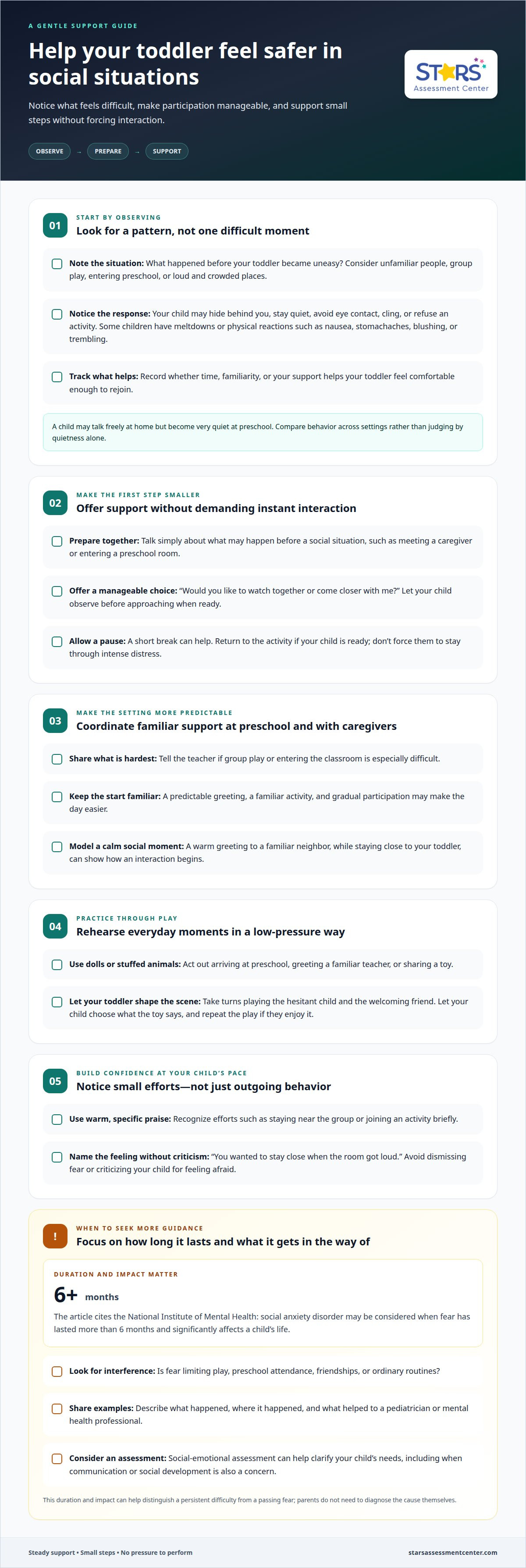
Look at the pattern, not one difficult moment. A toddler might cling during a crowded gathering, then explore once the room feels familiar. Anxiety may also show up as meltdowns in loud places, a long adjustment to new settings, or physical reactions such as nausea, stomachaches, blushing, or trembling. Some children talk freely at home but become very quiet at preschool. Note what happened before the behavior, how your child responded, and whether support helped them rejoin.
A child’s social anxiety may be social anxiety disorder when it has lasted more than 6 months and significantly affects the child’s life, according to the National Institute of Mental Health. This duration and impact can help distinguish a passing fear from a persistent difficulty, but parents don’t need to diagnose the cause themselves. Pay attention to avoidance that interferes with play, preschool attendance, friendships, or ordinary routines, and share those examples with a pediatrician or mental health professional.
Adjust expectations to your child’s comfort instead of expecting quick conversation or immediate participation. At school or preschool, tell the teacher which situations are hardest, such as group play or entering the classroom. A predictable greeting, a familiar activity, and gradual participation can make the day easier. Ask caregivers to notice small steps, like staying near the group or joining an activity briefly, rather than measuring success by how outgoing your child seems.
Talk about fear in simple, accepting language: “You wanted to stay close when the room got loud.” Then offer a manageable choice, such as watching together or approaching with you. Don’t dismiss the feeling or criticize your child for being afraid. Older children may work on feared situations gradually with a mental health professional; if EMDR is being considered, discuss its relevance with that clinician rather than assuming one approach fits every child.
For a mental health crisis in the United States, call 988 or go to the nearest emergency room, according to the Substance Abuse and Mental Health Services Administration. For a physical health emergency, call 911 or go to the nearest emergency room, according to the Federal Communications Commission.
2. What causes social anxiety in toddlers?
A toddler’s social anxiety may relate to temperament, sensitivity, family anxiety patterns, difficult social experiences, or avoidance learned over time. Quietness around unfamiliar people doesn’t reveal one cause by itself. Notice what changes between familiar and unfamiliar situations, and whether your child gradually feels safer with time and support.
Some toddlers are naturally slow to warm up. At a playgroup, one child may watch from a caregiver’s lap before exploring toys; another may stay silent when a new adult speaks. Give your child time to observe and let them approach when ready. Pressure to greet, perform, or answer immediately can make an uncertain moment harder.
Social situations that draw attention or feel unpredictable may trigger worry. Examples include entering a busy preschool room, meeting an unfamiliar caregiver, joining a group game, or being approached by a stranger. Loud, crowded settings can also overwhelm a young child. A difficult experience may make a similar situation feel harder next time, especially if the child starts avoiding it altogether.
Avoidance can bring quick relief, but repeated escape may leave a child with fewer chances to discover that a situation can become manageable. Don’t force your toddler to stay through intense distress. Instead, prepare together, offer your calm presence, and try a smaller step: watch the group nearby, approach with you, or take a short break and return if your child is ready. This gradual approach supports participation without demanding instant interaction.
Play can make practice feel safer. Use dolls or stuffed animals to act out arriving at preschool, greeting a familiar teacher, or sharing a toy. Take turns playing the hesitant child and the welcoming friend. Keep the scene simple, let your toddler choose what the toy says, and repeat it if they enjoy the game. Role-play can help explain what might happen while giving your child a chance to rehearse a response.
Social anxiety behaviors can overlap with signs of autism or speech-language delays, but quietness or avoidance alone doesn’t establish either. If your toddler’s communication or social development also concerns you, a professional assessment can help clarify what support fits. A Social-Emotional Assessment can help families better understand emotional and social concerns alongside observed behavior.
Researchers de Rosnay and colleagues reported in a 2006 study that infants showed more fear and avoidance toward a stranger after their mothers interacted with that stranger anxiously. This finding suggests that a caregiver’s response may shape a child’s reaction, but it doesn’t mean parents cause anxiety. A calm example, such as greeting a familiar neighbor warmly while staying close, can show your toddler how a social moment begins.
3. Distinguishing developmentally normal shyness from anxiety that interferes with daily life
Shyness describes a child’s temperament, not automatically a disorder. A toddler might watch other children before joining play, then warm up once the activity feels familiar. Another child may prefer one-on-one play over a busy group but still enjoy time with a familiar friend. These differences can reflect comfort and personality. The key question is whether fear repeatedly blocks experiences your child wants or needs to manage.
Compare your child’s behavior across settings instead of judging one difficult moment. For example, note whether they participate at home but freeze at preschool, or avoid both familiar playdates and new activities. Consider what happens before and after each situation: does your child settle with a known routine, or remain distressed and unable to take part? Concrete patterns offer a clearer picture than labels such as “shy” or “antisocial.”
Developmentally common separation worries can also affect social behavior. A toddler might cry at drop-off, then engage with a teacher after the goodbye routine ends. Anxiety is more concerning when it repeatedly prevents participation, such as refusing preschool, staying apart from peers, or avoiding activities they previously enjoyed. Look at the effect on daily life, not simply whether your child speaks to strangers.
Use a brief observation record to make patterns easier to discuss. Write down the setting, what your child did, how long they needed to settle, and what helped them rejoin. For instance, note whether sitting beside a familiar caregiver helped during story time or whether a noisy group remained overwhelming. Include positive moments too, such as approaching a peer after watching first. This balanced record captures emotional needs and emerging social skills.
A child’s anxiety isn’t determined by a single behavior or a parent’s impression. A qualified professional considers the pattern, its impact, the child’s development, and other possible explanations. Share examples from home and preschool, including communication, play, and participation. If fear prevents everyday activities or keeps your child from trying new experiences, discuss your concerns with a pediatrician or mental health professional. Their assessment can help distinguish temperament from anxiety that needs additional support.
Expectations should match your toddler’s current abilities. Success might mean staying in the classroom, watching a group activity, or sharing space with another child, rather than speaking immediately. Recognizing these small steps can help children build confidence without being compared with outgoing peers. Focus on whether your child can gradually engage in meaningful routines, not whether they behave the same way in every social setting.
4. Supporting toddlers without forcing interactions
Learning how to help a toddler with social anxiety starts with making practice manageable, not turning it into a test. Before a playgroup, explain what may happen: “We’ll arrive, put your coat away, and look at the toys.” Stay nearby while your toddler observes. Invite a small step, such as choosing a toy beside another child, without requiring conversation or immediate participation.
Pressure and avoidance can both make social situations harder. Demanding a hug may intensify distress, while leaving every time your toddler feels uncomfortable can strengthen avoidance. Speaking for your child or preventing every challenge may also suggest that social situations are unsafe. A more supportive response acknowledges the feeling, offers your presence, and leaves room for a gentle next step.
For parents wondering how to help a toddler with social anxiety, gradual practice can begin with familiar people and places. Your child might first play near a familiar friend at home, then explore toys together, and later try a short activity in a new setting. Offer a break if distress rises. If your toddler is ready, return together; don’t force them to stay through intense distress.
Play can help your toddler rehearse unfamiliar moments. Use stuffed animals to act out arriving at preschool, waiting for a turn, or asking for a toy. Let your child choose what each character does, and repeat the scene without correcting every response. Before an event, briefly explain who will be there and what the first activity might be.
Cognitive behavioral therapy can help children practice feared situations gradually in a structured, supportive way. A qualified mental health professional can discuss approaches suitable for your child’s age and needs, including whether parent-child interaction therapy may be appropriate. Parents can ask how therapy activities might fit the child’s developmental level and how caregivers can reinforce strategies at home.
Consider professional support if anxiety repeatedly disrupts routines such as preschool, play, or meeting friends. A pediatrician or mental health professional can discuss the pattern and possible next steps. For parents still asking how to help a toddler with social anxiety, a developmental assessment may clarify whether social-emotional or other developmental needs deserve attention.
A supportive community can make practice more predictable. Tell a trusted preschool teacher what helps your child settle, such as a consistent greeting or time to observe before joining. Coordinate on a shared approach with caregivers, and arrange calm play with a familiar friend. Consistent, low-pressure responses can help your toddler approach new situations with support.
5. Praise, reassurance, and confidence-building
Parents can build confidence by noticing effort, not expecting a toddler to become outgoing. If your child watches other children before joining, say, “You stayed nearby and watched the game.” This specific praise recognizes a brave step without demanding more. It also shows your child that you noticed their effort, even when they didn’t speak or play.
Reassurance works best when it acknowledges feelings instead of trying to erase them. Try, “You look nervous about saying hello. I’ll stay beside you.” Naming the feeling helps your toddler feel understood, while your calm presence offers support. Avoid saying “There’s nothing to be scared of,” which can make a real worry feel dismissed.
Break a challenging social moment into manageable steps. At a playdate, your toddler might first stay with you, then explore a toy, and later sit near a friend. Praise each effort with a clear observation, such as, “You brought the ball over.” If your child pauses or changes their mind, remain encouraging rather than treating the moment as failure.
Choose praise that describes what your child did rather than assigning a personality label. “You waved when Maya said hello” is more useful than “You’re such a good, brave kid.” The first example connects the accomplishment to an action your toddler can repeat. It also avoids making your child feel expected to act the same way next time.
Prepare your child for a specific challenge by explaining the plan before arriving. For example, say, “We’ll visit the playground, stay together, and see whether you want to play.” Offer a simple choice, such as watching first or walking closer with you. If your toddler feels embarrassed after freezing or hiding, respond gently: “That felt hard. We can try again another time.”
Notice social accomplishments that may look small to adults: staying while a friend plays, accepting a toy, or answering a familiar caregiver. Praise should be warm and brief, not a spotlight that makes a nervous child feel observed. A quiet “I saw you share the crayons” can recognize the moment without drawing attention from others.
Confidence grows through repeated experiences of being supported while taking manageable steps. If social or emotional concerns continue to affect your child’s daily routines, explore a social-emotional assessment to better understand their needs and possible supports.
Stars Assessment Program: Social-Emotional Assessment
Stars Assessment Program offers a Social-Emotional Assessment to help families better understand a toddler’s social and emotional development. Consider an assessment if anxiety repeatedly makes preschool, play, or everyday routines difficult, or if you’re unsure whether your child’s behavior reflects shyness or a broader developmental concern. The assessment can help clarify your child’s needs and guide next steps. If concerns also involve communication or other areas of development, a Speech and Language Evaluation or Multidisciplinary Developmental Assessment may help provide a fuller picture. Seeking clarity doesn’t mean you’ve done anything wrong; it gives you a chance to better understand how your child experiences social situations. Contact Stars Assessment Program to discuss an assessment for your child.
Let your next step follow your child’s pace
Knowing how to help a toddler with social anxiety isn’t about measuring progress by how quickly they join in. A more useful guide is whether your child can feel heard, take part in decisions, and approach social experiences with support. Make space for your toddler’s signals, including pauses and small expressions of interest. Those moments can help you shape the next step around what feels manageable for your family.
If you’d like help understanding your child’s social-emotional development, contact Stars Assessment Program. You can share what you’ve noticed and discuss whether an assessment may help clarify your child’s needs.
There’s no need to turn every gathering into a test of confidence. Let connection grow through the everyday moments you share, and take the next step when you’re ready.
Frequently Asked Questions
What causes social anxiety in toddlers?
Social anxiety can be associated with temperament and sensitivity, family anxiety patterns, difficult social experiences, and avoidance that develops over time. These factors don’t mean a parent caused a child’s anxiety. For example, a toddler who feels overwhelmed in a crowded playgroup may become wary of similar gatherings. Noticing what tends to happen before anxiety appears can help parents understand their child’s needs.
Does CBT work for social anxiety in kids?
Cognitive behavioral therapy (CBT) can help children address social anxiety by practicing feared situations gradually in a structured, supportive way. A clinician may adapt activities to the child’s developmental level and involve parents in supporting practice at home. For a toddler, familiar play or simple role-play may make a situation easier to understand. A mental health professional can determine whether CBT fits a child’s age and needs.
How can I tell if my child is shy or has social anxiety disorder?
Shyness often eases as a child becomes familiar with a person or setting, while anxiety may persist and limit daily activities. Notice whether fear affects preschool, play, or meeting others across different settings. According to the National Institute of Mental Health, social anxiety may be social anxiety disorder when it has lasted more than 6 months and significantly affects a child’s life. A professional can assess the pattern and its impact.
When should parents seek professional help for a toddler’s social anxiety?
Talk with a pediatrician or mental health professional when anxiety repeatedly disrupts routines, such as preschool attendance, play, or family activities. Share concrete examples, including situations your toddler avoids and what happens when they feel distressed. For children under age 3, Stars Assessment Program offers a Social-Emotional Assessment. Its local focus includes San Jose, Santa Clara, Santa Cruz, Salinas, Milpitas, Gilroy, and Morgan Hill, serving Santa Clara, Santa Cruz, and San Benito counties.
How can parents gradually help a toddler feel comfortable in social situations?
Choose a manageable first step and build from there. Before a family gathering, describe who will be there and where your child can take a quiet break. At the event, let your toddler observe from a comfortable spot before deciding whether to move closer. A familiar toy or planned greeting with one trusted person can make the experience more predictable without making participation a requirement.
How should parents respond when a toddler clings, freezes, or refuses to join a group?
Stay calm, acknowledge your child’s reaction, and offer a choice that doesn’t demand immediate interaction. You might say, “You can hold my hand while we watch,” then give your toddler time to observe. Avoid scolding, teasing, or speaking as if the child is being difficult. If the group feels overwhelming, step aside together and decide whether your child is ready to return or needs to leave.
How can daycare or preschool teachers support a toddler with social anxiety?
Teachers can make arrivals and transitions more predictable by greeting the child consistently and introducing one activity at a time. Parents can explain which situations feel difficult and what helps their toddler settle. For instance, a teacher might offer a familiar puzzle before inviting the child toward group play. Brief, low-pressure opportunities to participate can help the child become familiar with classroom routines without being singled out.


