

Shyness alone usually isn’t a problem; it can be a natural, slow-to-warm-up temperament. If you’re asking, “Is my toddler’s shyness a problem?” consider whether it causes substantial distress or gets in the way of everyday activities and relationships.
It’s understandable to worry when your toddler hangs back, clings to you, or takes time to join in. Give them space and gentle support as they warm up, without forcing social interaction. Persistent fear, difficulty connecting after time to adjust, or shyness that limits participation may deserve closer attention.
This article explains how to support a shy toddler, what anxiety can look like, and how to tell whether shyness affects daily life. You’ll also learn when an evaluation may help clarify your child’s social-emotional or developmental needs, so you can choose a supportive next step.
Key Takeaways
- Shyness is often a slow-to-warm temperament; consider whether it causes distress or limits your toddler’s everyday participation.
- Give your child time to adjust, stay close in unfamiliar situations, and encourage small steps without pressure or labels.
- Notice whether fear persists after your child has had time to settle, or makes social connection and activities difficult.
- Social behavior can have different explanations, so look at your child’s communication, relationships, and overall development together.
- If shyness is interfering with daily life, an evaluation can help clarify your child’s social-emotional or developmental needs.
How can I help a shy child?
Notice how your child responds after having time to warm up. Difficulty establishing or maintaining relationships even after that adjustment deserves attention, especially if shyness repeatedly limits play, activities, or everyday participation.
Supporting Social Situations
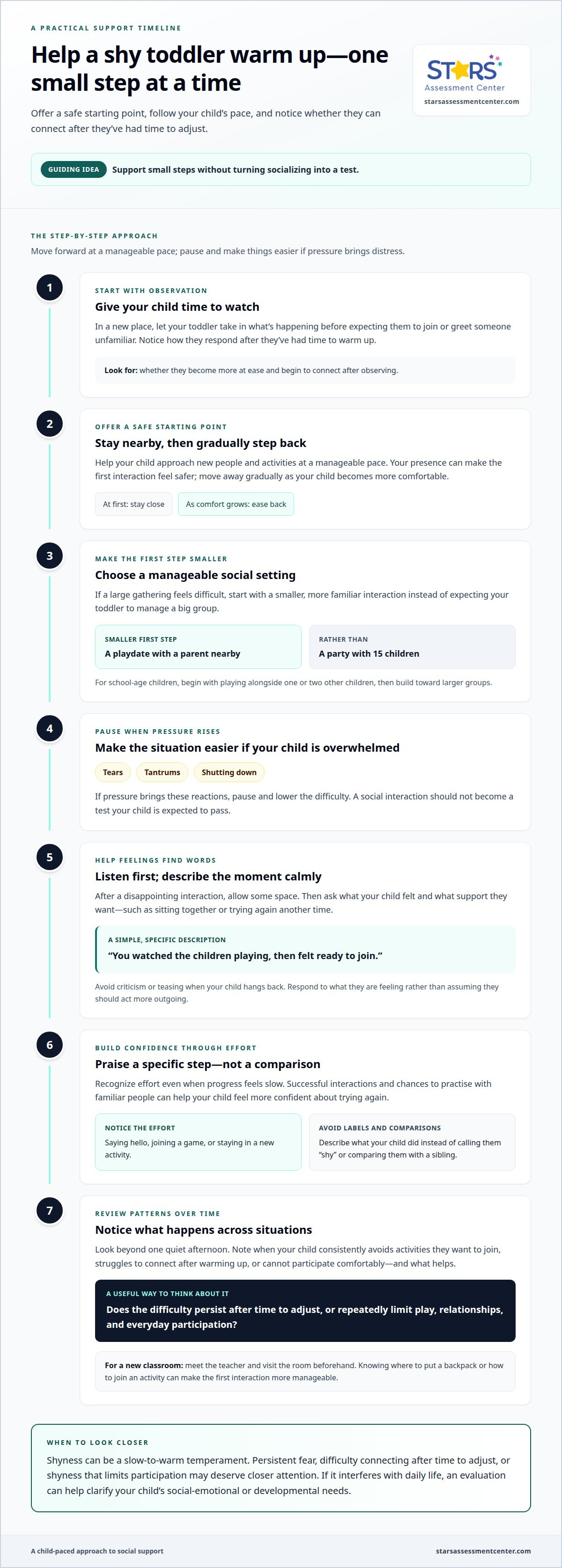
Help your child approach new people and activities at a manageable pace. Give your toddler time to watch before expecting them to join or greet an unfamiliar adult. Stay nearby at first, then gradually move away as your child becomes more comfortable. This offers a safe starting point without turning socializing into a test.
Keep the first steps small. If your toddler finds a large gathering difficult, try a playdate with a parent close by or a birthday with a few familiar friends instead of a party with 15 children. For school-age children, begin with playing alongside one or two other children, then build toward larger groups. If pressure brings tears, tantrums, or shutting down, pause and make the situation easier.
Processing and Expressing Feelings
Give your child time to understand and express their feelings. After a disappointing interaction, allow some space before asking what they felt. Then ask what support they want, such as sitting together or trying again another time. This helps you respond to their needs instead of assuming they should act more outgoing.
Use simple, specific words to describe the moment: “You watched the children playing, then felt ready to join.” Avoid criticism or teasing when your child hangs back. A calm response can make it easier for them to share their feelings and consider another small step.
Building Confidence Without Comparisons
Build confidence by recognizing your child’s efforts rather than comparing them with more outgoing children. Praise a specific step, such as saying hello, joining a game, or staying in a new activity. Notice the effort even when progress feels slower than you hoped. Small successes can help your child feel more confident about trying again.
Avoid treating “shy” as a fixed identity or saying, “Your sibling made friends right away.” Instead, describe what you saw: “You took time to watch, then asked to play.” Children can build confidence through successful interactions and chances to practise at home or with familiar friends and relatives.
Look for patterns across situations, not just one quiet afternoon. If your child consistently avoids activities they want to join, struggles to connect after warming up, or cannot participate comfortably, note when it happens and what helps. Those details can guide your next step. To prepare for a new classroom, meet the teacher and visit the room beforehand. Predictable details, such as where to put a backpack or how to join an activity, can make the first interaction feel more manageable.
What are the signs of anxiety in children?
Social behavior can reflect temperament, anxiety, or other developmental factors. Notice what happens across settings, including whether your child settles in and connects after observing.
Toddlers’ Social Preferences
Social preferences describe how children choose to spend time with others, and they can vary from child to child. Between ages 2 and 3, toddlers may prefer playing with one or two close friends rather than joining a large group. Some children also enjoy solitary activities or time with family members, other adults, or pets. A preference for familiar company alone doesn’t show whether anxiety is present; consider whether your child seems content and can take part in activities they enjoy.
Adjusting to Social Situations
Adjusting means taking time to feel comfortable in a new place or with unfamiliar people. A slow-to-warm child may watch other children at the edge of a playground for 20 minutes before exploring. You can describe what to expect, such as where children play or how they take turns, then suggest a simple way to join. That preparation makes an unfamiliar situation more predictable and gives you a chance to see whether your child becomes more at ease.
Age and context matter, too. Fear of strangers can begin at 5-6 months and may pass by age 2. Separation and stranger anxiety are developmental stages, distinct from shyness. A toddler who hesitates with a new adult but engages with familiar people may be responding differently than one who cannot connect even after settling in. Look for patterns, not one moment of avoiding eye contact.
Other factors can shape social behavior. A child with a language delay may want to connect but become frustrated when others can’t understand them. Hearing loss can make it harder to hear or respond to people or follow instructions. Notice whether your child responds differently in quiet settings, with familiar people, or when gestures and demonstrations help. These clues can clarify what makes interaction difficult.
Model simple actions during play to encourage social interaction. Show your child how to offer a toy, wait for a turn, or respond when another child says hello. Practise with familiar people, such as a relative or an adult friend, before an unfamiliar activity. Notice the skills your child already uses, then demonstrate one next step. This supports connection without expecting instant conversation.
Encourage brave behavior by praising a clear effort, such as looking toward a new child, answering a greeting, or trying an activity. Keep the praise specific: “You asked to play after watching.” If your child may feel uncertain, offer a concrete preview of the place and activity. A social-emotional assessment can help clarify concerns about how your child responds and connects; learn more about your child’s social-emotional development.
Is shyness or reduced eye contact always a sign of anxiety?
No. Shyness can reflect temperament, and reduced eye contact alone doesn’t establish that a toddler has anxiety. Consider whether fear or withdrawal persists, causes distress, or affects relationships and everyday participation.
At a pediatric visit, a pediatrician may ask when the shyness began, where it happens, how your child responds to familiar and unfamiliar people, and whether it affects play or routines. They may also ask what helps your child feel comfortable and whether you have communication or other developmental concerns.
Can forced socializing or labeling a toddler as shy make the problem worse? Pressure to join can lead to crying, tantrums, or shutting down, while a fixed label may shape how a child sees their behavior. Describe the moment without defining your child, for example: “You’re watching before you decide whether to join.”
Transitions and separations can bring out hesitation that looks like shyness. Separation anxiety can begin at 6 months and peak at 14-18 months. Separation and stranger anxiety are common developmental stages beginning at about 8-9 months, and are distinct from shyness. Give your child a clear, calm goodbye and a little time to settle with a familiar caregiver.
Parents can support social situations without taking over. At a gentle playdate, stay nearby while your toddler gets familiar with one child and the room. Let your child observe, then offer a simple invitation, such as rolling a ball together. Gradually step back when your child seems ready. A positive, low-pressure experience gives children room to practise social skills.
Consider professional guidance if your child’s shyness is significant and hard to change, or affects socializing, school, or other areas of development. Persistent difficulty connecting after time to adjust may also deserve attention. A child who seems unable to speak in certain settings or with certain people may experience selective mutism, which is linked to anxiety. This differs from simply choosing not to speak in a particular moment.
When shyness substantially interferes with daily life, possible support can include family therapy, parenting training, or individual counseling. A child mental-health professional, such as a psychologist, can assess how anxiety and social behavior affect your child. The right support depends on the difficulties and where they occur.
Consider reduced eye contact alongside your child’s overall behavior, rather than as a standalone sign. Notice whether your toddler shares enjoyment, responds to familiar people, communicates needs, and engages in preferred activities. If concerns persist across situations, discuss the pattern with a pediatrician and explain what you observe at home and during play.
Shyness and learning, relationships, interests, and self-esteem
Shyness can shape how a child joins activities, shares ideas, and builds relationships. Its effect on daily life matters more than whether a child is naturally quiet.
Effects on Learning and Relationships
Shyness may affect learning and relationships when hesitation prevents a child from participating in activities they enjoy. For example, a toddler may watch group play but never approach, or stay silent when they need help. This can limit opportunities to practise interacting, share interests, and build connections. At the same time, quiet observation can give a child time to notice patterns and learn about the world.
Look for a repeated pattern across settings. Does your child join after time to warm up, or remain distressed and unable to participate? A child who avoids a favorite activity because other children are there may need more support than one who watches first, then plays. Consider how the behavior affects learning, relationships, and confidence, rather than comparing your child with outgoing peers.
Speech, Play, Daycare, and Friendships
Shyness can affect how readily a toddler speaks, plays, settles into daycare, or approaches friends. A child may want to join a game but wait for someone else to invite them. They might speak freely at home yet use few words around unfamiliar children. Notice where communication happens and whether your child connects in comfortable settings.
Can toddler shyness affect speech, play, daycare, or making friends? It can make a child less likely to speak up, join play, or approach peers in unfamiliar settings. A language delay is another possible explanation: a child may want social connection but feel frustrated when others can’t understand them.
Peer-interaction skills grow through practical moments, not comparisons. During a familiar game, model offering a toy, waiting for a turn, or responding to another child’s invitation. Then give your child space to try one action. If they don’t join right away, keep the activity welcoming and notice whether they engage later. This lets you observe both your child’s interests and their comfort interacting with peers.
Self-esteem can be affected when a child repeatedly feels unable to take part or is criticized for being quiet. Name the effort rather than the personality: “You showed your block tower to Maya,” rather than “You’re finally being confident.” Avoid comparing siblings or classmates. If your child feels distressed, excluded, or unable to enjoy preferred activities, consider whether this pattern interferes with everyday life and deserves closer attention.
When severe shyness may need evaluation
A slow-to-warm child may watch unfamiliar adults or children before joining in. Concern grows when fear seems to keep the child from participating, even in situations they want to enjoy. Look beyond quietness: consider distress, relationships, play, and whether shyness interferes with daily life across settings.
Notice what happens after your child has time to adjust. For example, a toddler may cling at drop-off, then play after settling. More concern is warranted when the child remains unable to engage, repeatedly avoids activities, or struggles to establish and maintain relationships after the initial adjustment. Patterns across home, daycare, and family gatherings can clarify the impact.
Consider how shyness affects school and ordinary routines as your child grows. A child who cannot ask a teacher for help, join a preferred game, or speak with familiar adults may miss experiences they want. Severe, persistent shyness can limit opportunities to practise social skills and take part in activities with others. The key is the effect on the child, not how outgoing they appear.
Some children may be unable to speak in certain settings or with particular people because of anxiety. This pattern is called selective mutism. If your child speaks comfortably at home but consistently cannot speak elsewhere, share that specific pattern with a professional. Avoid treating silence as defiance or forcing speech; notice where communication feels easier and what changes between settings.
Start by discussing your concerns with your child’s pediatrician. Describe specific examples, such as withdrawing from a favorite activity, being unable to communicate needs at daycare, or remaining distressed around familiar peers. A child mental-health professional, such as a psychologist, may be considered when shyness is especially debilitating. The focus is how your child feels and functions, not changing their temperament.
Support may include family therapy, parenting training, or individual counseling when shyness affects school, socializing, or other areas of development. If communication also concerns you, a Speech and Language Evaluation can help assess your child’s communication needs. Share examples of what your child says, how they communicate without words, and where speaking or interacting becomes difficult.
If your toddler’s fear or withdrawal repeatedly prevents participation, relationships, or communication, an evaluation can help clarify what support fits. Request a Speech and Language Evaluation when communication concerns are part of the picture.
Stars Assessment Program
Stars Assessment Program can help clarify whether persistent shyness connects with a child’s social-emotional or broader developmental needs. A Social-Emotional Assessment may be useful when fear or withdrawal affects participation, relationships, or comfort around others. If concerns also involve communication or other areas of development, a Multidisciplinary Developmental Assessment can consider a child’s cognitive, physical, and communication skills. Speech and Language Evaluation or screening for autism may also be relevant when those concerns are part of the picture.
An evaluation can give families a clearer understanding of what their child may need, rather than treating quiet behavior alone as the whole answer. Contact Stars Assessment Program to discuss your concerns about your child’s development.
Take the next step with confidence
You don’t need to decide alone what your child’s quietness means. If you’re still wondering whether your toddler’s shyness is a problem, focus on what would help your child feel understood and take part in daily life. A developmental assessment can offer a clearer picture of your child’s needs and help guide your next steps.
Stars Assessment Program offers Social-Emotional Assessment, Multidisciplinary Developmental Assessment, and Speech and Language Evaluation. These assessments can help families explore concerns about social-emotional development, broader developmental skills, or communication. The goal is to understand your child more fully, not to force them into someone else’s idea of confidence.
If you’re ready to talk through your concerns and consider an evaluation, contact Stars Assessment Program. Your careful attention and steady support are meaningful starting points for your child’s growth.
Frequently Asked Questions
Shyness or something else?
Shyness is one possible explanation for a toddler’s quiet behavior, but context can reveal other needs. Notice whether your child communicates comfortably at home, responds to familiar people, and shows interest in connecting. Frustration when others can’t understand your child may point to communication concerns; difficulty hearing speech or following directions may also affect interactions. Share these patterns with your pediatrician rather than assuming one behavior explains everything.
How Do I Know If My Child Needs To See A Therapist?
Consider professional support when fear or withdrawal is persistent, distressing, and prevents your child from participating in activities or relationships. For example, a child who wants to join a familiar game but repeatedly cannot engage may need help beyond gentle encouragement. A pediatrician can discuss the pattern and suggest appropriate next steps. A child mental-health professional may be considered when shyness feels especially debilitating.
The Shy Child: When Is Shyness a Problem?
Shyness becomes a concern when it substantially interferes with your child’s daily life, rather than simply making them quieter than other children. Ask whether your child can take part in preferred activities, communicate needs, and connect with people after settling in. If fear consistently blocks those experiences, write down examples from home, childcare, and family gatherings. Specific observations can make a conversation about support more useful.
Is shyness normal in toddlers, and at what age does it become concerning?
Shyness can be a normal part of a toddler’s temperament, and there isn’t a single age when it automatically becomes a problem. Separation and stranger anxiety are common developmental stages, beginning at about 8-9 months, and differ from shyness. Focus on whether your child can adjust and participate, rather than waiting for a particular birthday. Persistent distress or reduced participation deserves attention at any age.
What are signs of normal toddler shyness versus social anxiety or another developmental concern?
A slow-to-warm toddler may watch quietly, then engage once a place feels familiar. Greater concern arises when fear repeatedly prevents interaction, even in comfortable settings, or causes marked distress. Also consider communication: a child may want friends but feel frustrated when others can’t understand them. One behavior, including limited eye contact, can’t explain the whole picture; consider communication, play, relationships, and participation together.
When should parents talk to a pediatrician about a shy toddler?
Talk with your pediatrician when shyness is difficult to change, causes ongoing distress, or interferes with communication, play, or relationships. Bring examples of where your child participates and where they withdraw, including any differences between home and childcare. For families in San Jose, Santa Clara, Santa Cruz, Salinas, Milpitas, Gilroy, or Morgan Hill, Stars Assessment Program evaluates children under age 3. No referral is needed.
How can parents help a shy toddler feel comfortable in social situations?
Make a new situation easier to understand before expecting your toddler to join. Describe who will be there and what the activity involves, then offer a simple first step, such as watching a game or handing over a toy. Stay close while your child gets comfortable, and notice their efforts to participate. If your toddler needs a pause, allow one; a manageable experience can make trying again feel easier.
What should parents avoid doing when a toddler is shy?
Avoid pushing your toddler to greet, perform, or join before they feel ready; pressure can lead to crying, tantrums, or shutting down. Don’t mock, criticize, or compare them with a more outgoing sibling or friend. Repeatedly calling a child “shy” can turn a temporary response into a label they may adopt. Describe what you observe instead, then offer calm support and space to respond.


