

Can a 2-year-old be nonverbal without being autistic? Yes: not speaking alone doesn’t identify the reason. The American Academy of Pediatrics notes that language delays may signal hearing loss, delays in other developmental areas, or autism. If you’re wondering how to help your nonverbal 2-year-old, the first step is to seek an evaluation rather than rely on speech alone to explain what’s happening.
It’s understandable to feel concerned when your child isn’t using words, especially when you’re unsure what support to seek or what it may cost. An evaluation can help clarify your child’s communication and developmental needs, while everyday interactions can offer gentle opportunities to connect and communicate.
This guide explains signs that may point to autism, other possible reasons for a language delay, and when to consider a speech and language evaluation. It also explores care and cost considerations in the United States, along with practical ways to support communication at home while you take the next step.
Key Takeaways
- Not speaking doesn’t by itself tell you whether autism is the reason; a broader developmental evaluation can help clarify what support may fit.
- Learn how gestures, visual supports, and augmentative and alternative communication can give your child more ways to express needs.
- Recognize signs of stalled or lost communication skills and understand why they deserve prompt attention.
- Explore what can shape therapy costs and how state early intervention programs can provide free assessments for children under 3.
- Understand which social and communication differences may be early signs of autism, and how an assessment can help make the next steps clearer.
1. Can a child be nonverbal but not autistic?
Yes. A child may have delayed speech without being autistic, because limited spoken words can have different causes. The American Academy of Pediatrics notes that language delays may signal hearing loss, delays in other developmental areas, or autism spectrum disorder. A broader developmental picture matters: notice how your child uses gestures, shares attention, responds to people, and communicates needs through actions. If you’re asking yourself, “how to help my nonverbal 2 year old communicate,” start by noticing these everyday patterns.
Hearing differences are one possible factor in delayed speech. A hearing screening considers how a child responds to sounds, voices, and other everyday cues. Communication concerns can involve more than spoken words: a child may respond to familiar sounds yet need support with understanding language, using gestures, or expressing wants. Stars Assessment Program includes vision and hearing screening in its developmental assessments.
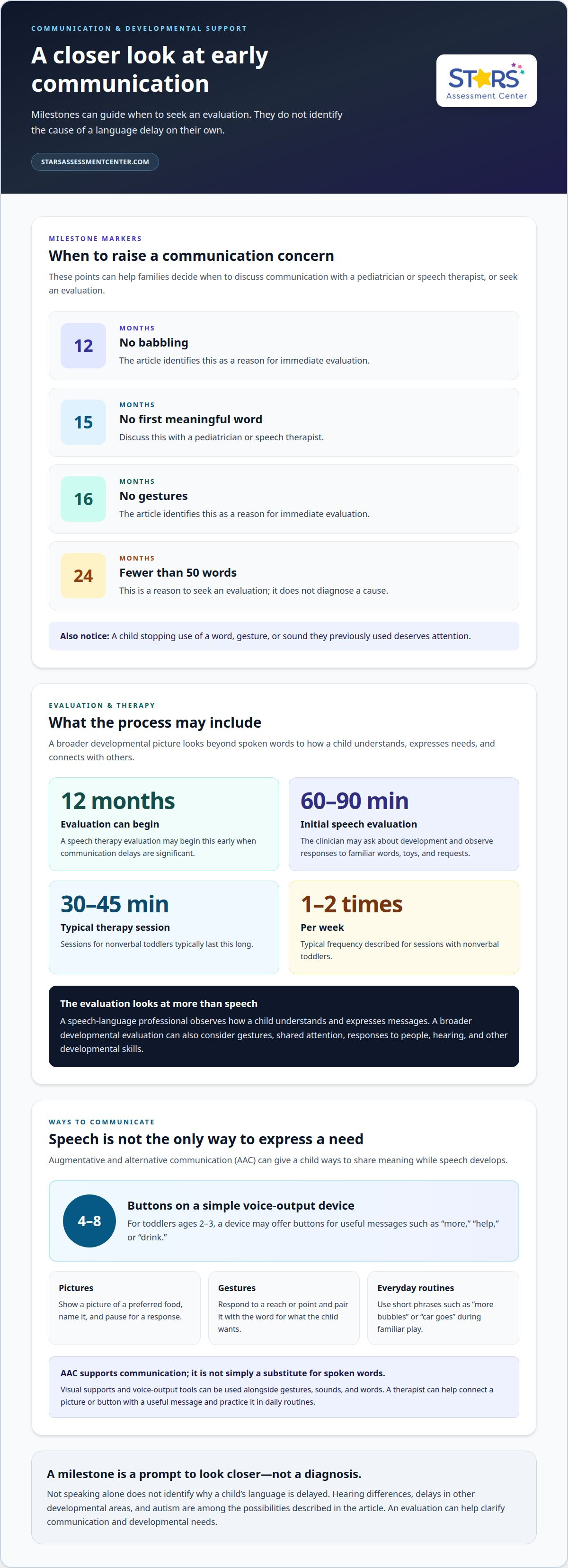
Milestones can help families decide when to raise a concern. If a child hasn’t said a first meaningful word by 15 months, discuss it with a pediatrician or speech therapist. At 24 months, fewer than 50 words is a reason to seek an evaluation. These signs don’t diagnose a cause; they help identify when a closer look at communication may be useful.
Communication doesn’t have to wait for speech. Augmentative and alternative communication, or AAC, includes ways to express meaning through pictures, gestures, and communication devices. Simple voice-output devices for toddlers ages 2-3 can have 4-8 buttons. A child might press a picture or button for “more,” “help,” or “drink.” Visual supports can foster speech development, too; they aren’t simply substitutes for spoken words.
Build communication into familiar routines. At snack time, show a picture of a preferred food, name it, then pause. If your child reaches or points, respond to the gesture and say the word. During play, copy a sound or action, then wait for your child to take a turn. Short phrases such as “more bubbles” or “car goes” connect words with what your child sees.
Some autistic children are minimally verbal or nonspeaking, but that describes communication, not a child’s full abilities. Responding to gestures, eye contact, and pictures can help a child share choices without requiring speech. If you’re wondering “how to help my nonverbal 2 year old share a choice,” model a useful action, such as opening your hands to invite a toy, then acknowledge your child’s response. An evaluation can look at communication alongside social-emotional and other developmental skills.
2. Speech therapy evaluations, sessions, and parent training
Speech therapy can help nonverbal toddlers communicate through gestures, pictures, sounds, words, or assistive devices. A speech-language professional observes how a child understands and expresses messages, then uses play and family routines to identify useful next steps. An evaluation can begin as early as 12 months when communication delays are significant. Parents wondering “how to help my nonverbal 2 year old” can use an evaluation to understand which communication approaches fit their child.
An initial speech therapy evaluation typically lasts 60-90 minutes. The clinician may ask about your child’s development and observe how they respond to familiar words, toys, and everyday requests. Share examples such as how your child asks for a snack or reacts when you say “come here.” These details help show what communication looks like beyond spoken words.
Use enjoyable activities to encourage interaction. Roll a ball back and forth, sing a familiar song, or pause during bubbles to give your child time to respond. Follow your child’s interest, model a simple word or gesture, then wait. If your child reaches for a toy, you might say, “Want car?” and offer it in response to their communication.
Speak clearly and use short phrases to make key words easier to notice. Say “more juice,” emphasize “more,” and pair the word with the action or object. If your child uses one word, respond with a phrase that adds a word, such as answering “ball” with “big ball.” Keep sentences direct and focused on one idea.
Assistive devices can be part of therapy when speech alone isn’t meeting a child’s communication needs. A simple voice-output device for toddlers ages 2-3 may have 4-8 buttons. The therapist can help your family connect a button or picture with a useful message, then practice using it during play, meals, or getting dressed. Visual and voice-output supports can encourage speech development, not just replace speech.
Parent coaching helps carry practice into daily life. A therapist can demonstrate a strategy, watch you try it, and suggest ways to adjust it for routines like bath time or snack time. Sessions for nonverbal toddlers typically last 30-45 minutes and occur 1-2 times per week. If you’re asking “how to help my nonverbal 2 year old express a need,” a therapist can help adapt practice to familiar routines. The approach builds on what your child already does to communicate, then offers manageable opportunities to try something new.
If you’re considering an assessment to understand your child’s communication strengths and needs, explore a speech and language evaluation.
3. Warning signs of stalled or regressed language
Track changes in your child’s communication, not only spoken words. Warning signs include no babbling by 12 months or no gestures by 16 months; both call for immediate evaluation. Also notice whether your child stops using a word, gesture, or sound they previously used. A lost communication skill deserves attention, even if your child still smiles, plays, or follows familiar routines.
Communication has receptive and expressive parts. Receptive language is what your child understands, such as responding to “bring your shoes” or looking toward a named toy. Expressive communication is how they share a message through speech, gestures, sounds, or pictures. A child may understand more than they can express. Notice specific examples, such as whether they point to ask for help or follow a familiar direction.
Behavior offers clues, too. During play, watch whether your child looks between you and a toy, reaches to request something, or responds when you offer a choice. These actions can communicate interest or a need, even without words. If language skills show no improvement for one month, consider speech therapy. Record the action and situation, such as “reached for cup at breakfast,” to describe patterns clearly.
A shoe box activity can create a simple back-and-forth language routine. Choose familiar objects, such as a spoon, ball, or toy animal, and place an empty box nearby. As your child puts each object inside, label it up to three times: “Ball in,” “in the box,” or “ball.” Pause between turns so your child can look, gesture, make a sound, or take another action. Respond to each attempt as communication.
Practice language during a 15-20-minute period within an everyday routine. At snack time, show two choices, name each one, and wait for your child to point, reach, vocalize, or use a picture. Then say a short phrase that matches their message. During cleanup, pair “in” with placing a block in a basket. Repeating useful words alongside meaningful actions helps connect language with daily experiences.
Keep a brief record of communication across routines. Note what your child understands, how they try to express a message, and whether a skill is new, steady, or no longer appearing. For example, record when a familiar gesture disappears or when your child begins following a new direction. These concrete observations can help describe your concerns during an assessment and inform next steps.
4. Therapy costs and state early intervention services
For families in the United States, state early intervention programs provide free assessments for children under 3 years old. An assessment can help identify developmental needs and whether communication support may be useful. At age 2, a parent can describe how their child communicates at home, during play, and in other familiar routines.
An assessment and ongoing therapy are different parts of care. The assessment helps clarify a child’s strengths and needs; therapy then supports specific communication goals. Private therapy costs vary with the service, session frequency, session length, and coverage arrangements. The price depends on the case and is given after a quote request; factors include the type of service and the support involved.
For an autistic child who isn’t talking, communication support can focus on everyday situations, not speech sounds alone. Useful goals might include asking for a favorite snack, choosing between toys, or getting an adult’s attention. A child can work toward these goals with speech, gestures, pictures, or other communication supports. Build on the child’s current ways of expressing needs.
Early intervention can make communication support part of ordinary routines. For example, an adult can pause during a familiar game, offer two pictured choices, and respond when the child points or reaches. A therapist can help adapt that strategy for play, meals, or getting dressed. These practical examples make it easier to connect intervention with a child’s daily experiences.
Working with therapists is a shared process. Caregivers can describe what happens at home, such as whether a child follows “bring your cup” or uses a gesture to request help. Therapists can use those observations to shape goals and demonstrate strategies. In turn, caregivers can share which activities hold the child’s attention and where communication feels hardest.
To understand the financial side, separate assessment costs from ongoing therapy expenses and consider how often sessions are planned. Ask how the proposed approach supports communication, including gestures, pictures, sounds, and talking. A written plan can make goals and practice strategies easier to follow between sessions. Early intervention assessments offer families a practical starting point for understanding developmental needs before a child turns 3.
5. Early signs of autism in toddlers
Discuss delayed speech or language, limited interest in social interaction, repetitive behaviors, and difficulty with joint attention with a doctor. At age 2, these patterns can be possible early signs of autism, but one behavior alone doesn’t establish a diagnosis.
Look at how your toddler shares attention, not only whether they speak. Joint attention means noticing something together, such as looking toward a toy after you point to it. During play, observe whether your child looks between you and a favorite object or tries to show you something interesting. These examples can be useful to describe during an assessment.
Social communication includes the small exchanges that happen throughout the day. Notice whether your child responds to their name, seeks your attention, or joins a familiar game with another person. Some toddlers may prefer playing alone or show less interest in sharing enjoyment. Record what you see in a specific routine, such as how your child responds when you invite them to roll a ball.
Repetitive behaviors can include repeating an action or focusing closely on one part of a toy. A toddler might line up toy cars in the same pattern or repeatedly spin a wheel instead of using the car in pretend play. Notice how often an action occurs and whether it affects transitions, play, or interaction. A specific example gives more context than a general label.
Learning and communication vary across children, including autistic children. Some toddlers use gestures, pictures, sounds, or actions to express themselves, while spoken words may be limited. Consider whether your child shares interests, imitates actions, or responds to simple play routines. These details describe your child’s abilities across daily situations, rather than measuring progress only by spoken words.
Keep brief notes for familiar settings, such as meals, play, and time with relatives. Write down the interaction, what happened before it, and how your child responded. For instance, note whether your toddler followed your point toward a book or continued focusing on a spinning toy. Patterns across situations can help distinguish an ongoing concern from a single moment.
Families don’t need to wait until every possible sign appears before raising concerns. Share specific examples of social interaction, repetitive behaviors, joint attention, and communication with a doctor. An autism assessment can help clarify whether these patterns fit autism or point toward another developmental need. Explore an autism assessment to take a next step toward understanding your toddler’s developmental profile.
Stars Assessment Program
Stars Assessment Program helps families understand a toddler’s communication and broader developmental needs through assessment. If your child isn’t speaking, has lost communication skills, or shows differences in social interaction, an evaluation can help clarify what support may be appropriate. A Multidisciplinary Developmental Assessment considers development across areas, while a Speech and Language Evaluation focuses on communication. Social-Emotional Assessment and autism-related assessment can also help address specific concerns.
Bring examples from everyday life, such as how your child asks for help, responds to familiar words, or joins play. These observations help make the assessment relevant to your child and family. For guidance on your child’s developmental needs, contact Stars Assessment Program.
Take the next step with confidence
Choosing an assessment is a way to turn questions about communication into a clearer understanding of your child’s needs. If you’re considering how to help your nonverbal 2-year-old, bring your observations and concerns into a conversation with a developmental assessment team. You don’t need to have every answer before taking that step.
Stars Assessment Program offers a Social-Emotional Assessment, Multidisciplinary Developmental Assessment, and Speech and Language Evaluation. These assessment options can help families explore communication and development from different angles, based on the questions they want addressed. The aim is to better understand your child’s strengths and needs, so you can consider a meaningful path forward.
Contact Stars Assessment Program to discuss an assessment for your child. Each new understanding can help you meet your child with greater clarity and support.
Frequently Asked Questions
Can a child be nonverbal but not autistic?
Yes. Not speaking does not by itself mean a child is autistic. A language delay can also relate to hearing or other developmental differences. For example, a toddler may understand familiar directions but use few spoken words. Looking at hearing, understanding, gestures, play, and social interaction together can help clarify what to discuss during an assessment. This is not a diagnostic assessment.
What are the early signs of autism in a 2-year-old?
Possible signs include delayed speech or language, less interest in social interaction, repetitive behaviors, and differences in joint attention. For example, a toddler might not look toward an object when someone points or may repeat the same play action often. These observations can guide a conversation about your child’s development, but they do not establish a diagnosis. Describe what you notice across familiar settings.
What communication milestones are typical for a 2-year-old?
Children develop communication at different paces, but fewer than 50 words by 24 months is a reason to seek an evaluation. Spoken vocabulary is only one part of communication: a toddler may also use gestures, sounds, or pictures to express needs. Notice whether your child understands familiar words and communicates choices. Share specific examples with a professional rather than judging progress by speaking alone.
When should a nonverbal 2-year-old be evaluated by a pediatrician?
Arrange a conversation if your toddler isn’t speaking, isn’t progressing, or has lost communication skills they previously used. No meaningful first word by 15 months and no words by 18 months are reasons to discuss evaluation. A sudden or gradual loss of gestures, sounds, or words also deserves attention. Bring examples of what changed and when, such as a word your child stopped using during meals.
How can I request a speech and language evaluation for my toddler?
Families in Santa Clara and Santa Cruz counties can contact Stars Assessment Program directly; no referral is needed. Call (844) 700-9889 or use the online request form to ask about an assessment for a child under 3. The assessment is provided at no cost to families and is not diagnostic. Families can request an assessment in their preferred language, and results are explained in clear, simple language.
How do I contact early intervention services for a child under 3 in the United States?
Start by finding your state’s early intervention program and requesting an assessment for your child under 3. State early intervention programs provide free assessments for children under 3. You can also tell your child’s pediatrician that you’re seeking an early intervention assessment. Keep notes on your child’s communication and development so you can describe the concerns that led you to reach out.
How can parents encourage communication at home without pressuring a toddler?
Make communication part of a routine your child already enjoys, and respond to gestures or sounds as meaningful attempts. While getting dressed, for example, offer a choice between two shirts, pause, then acknowledge a point or reach. Follow your toddler’s interest rather than insisting on a spoken answer. A relaxed turn-taking game can create opportunities to connect without making talking a requirement.
Can sign language, picture cards, or AAC help a nonverbal 2-year-old?
Yes. Gestures, picture cards, and augmentative and alternative communication can give a toddler ways to express needs and choices. A child might point to a picture for a snack or use a voice-output device to request “help.” Visual supports and assistive technology can support speech development, rather than simply replace speech. A speech-language professional can help match communication tools to a child’s abilities and daily routines.


