
What if a child’s communication needs become clearer through a closer look at how they understand and use language? If you’re wondering how to get a speech evaluation in Milpitas, start by looking for an evaluation that considers your child’s communication skills and developmental needs. According to the California Department of Developmental Services, Early Start is for infants and toddlers under age three who have a developmental delay or disability.
It’s understandable to want clear answers about what an evaluation involves, how to begin, and what to expect from the process. An assessment can help describe a child’s current speech and language skills and where support may be helpful.
This guide explains where families can find evaluations in and near Milpitas, what may happen during a session, and how to take the next steps. It also covers what to prepare and how fees are determined, so you can approach the process with a clearer sense of what lies ahead.
Key Takeaways
- Learn which nearby options may fit your child’s speech and language evaluation needs.
- Understand what can affect session length and how to plan for an appointment.
- Follow the main steps for starting an evaluation and preparing relevant information.
- See what can influence evaluation fees and what to consider when planning costs.
- Explore how a speech and language evaluation can help clarify your child’s communication needs.
Speech and language evaluations in Milpitas and nearby areas
Families near Milpitas can look for a speech-language pathologist whose evaluation addresses their child’s communication needs. Compare the assessment’s focus, setting, and approach to the languages the child uses.
Finding Speech-Language Pathologists Near Milpitas
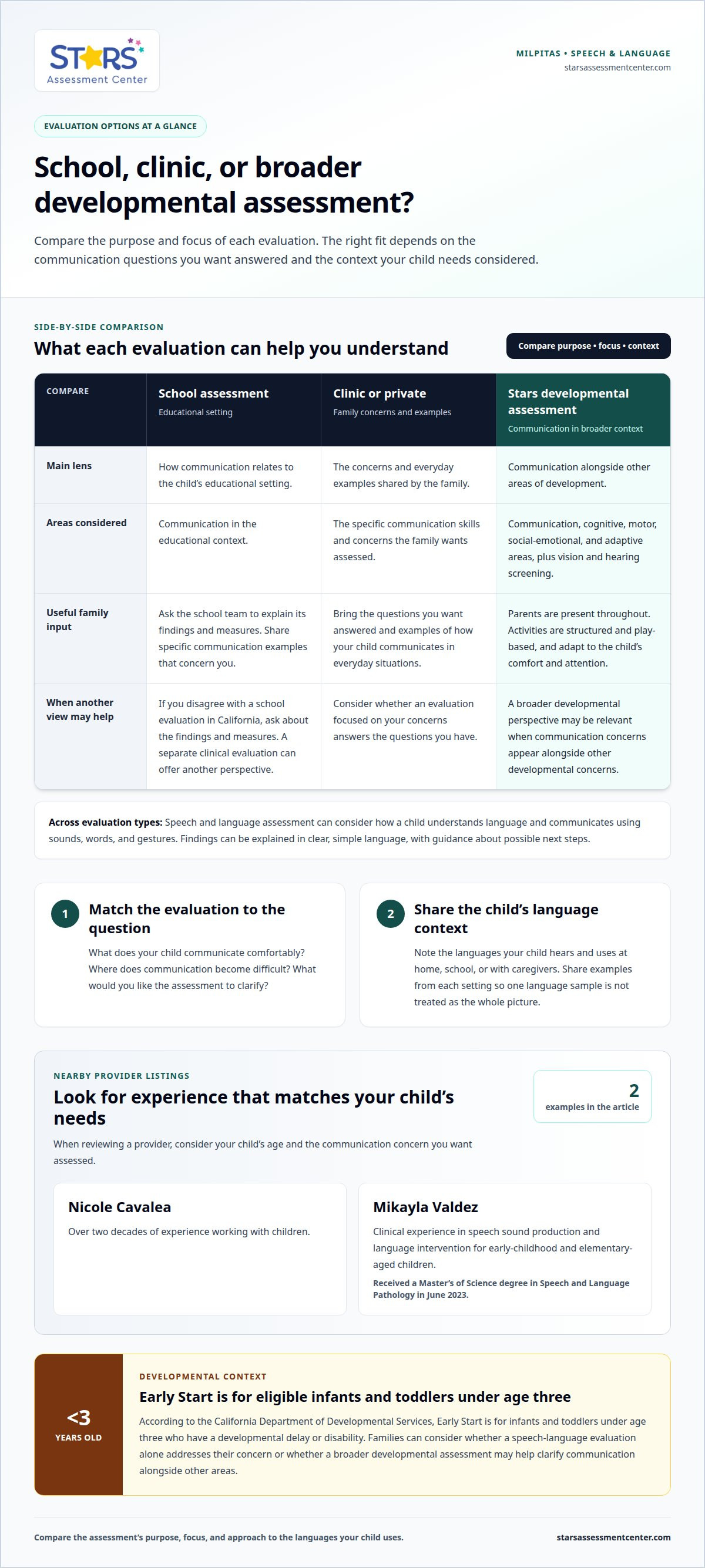
Listings for nearby speech-language pathologists include Nicole Cavalea and Mikayla Valdez. Cavalea has over two decades of experience working with children. Valdez has clinical experience in speech sound production and language intervention for early-childhood and elementary-aged children. When reviewing a listing, look for experience that matches your child’s age and the communication concern you want assessed.
Comparing School, Clinic, and Private Evaluations
Compare each evaluation by its purpose, the skills assessed, and how the findings will be explained. A school assessment considers communication in the educational setting, while a clinic or private evaluation can focus on the concerns and examples shared by the family. If you disagree with a school evaluation in California, ask the school team to explain its findings and measures, then describe specific communication examples that concern you. A separate clinical evaluation can offer another perspective.
Speech and language assessment considers how a child understands language and communicates using sounds, words, and gestures. Stars Assessment Program also reviews communication alongside cognitive, motor, social-emotional, adaptive, and vision and hearing screening areas. This broader context can help families understand what the assessment findings mean for their child’s development.
Language services should also account for the languages a child hears and uses in daily life. Before choosing an evaluation, note the languages used at home, school, or with caregivers, and share examples of how the child communicates in each setting. This gives the evaluator context for interpreting communication rather than treating one language sample as the whole picture.
For infants and toddlers, developmental context can guide the next step. According to the California Department of Developmental Services, Early Start is for infants and toddlers under the age of three who have a developmental delay or disability. Families can consider whether a speech-language evaluation alone addresses their concern or whether a broader developmental assessment may help clarify communication alongside other areas of development.
As you prepare, keep the question specific: what does your child communicate comfortably, where does communication become difficult, and what would you like to understand? Share everyday examples with the assessor. The results are explained in clear, simple language, with guidance about possible next steps.
Mikayla Valdez received her Master’s of Science degree in Speech and Language Pathology in June of 2023. Families considering an evaluation can ask how a provider’s education and experience relate to the communication concerns they want assessed. They can also clarify what questions the evaluation is intended to answer and how its findings may guide next steps.
Provider locations and distances
For families in Milpitas, the most convenient evaluation location depends on the child’s routine and the trip required. Start with the home, school, or childcare address you travel from most often. Then compare available listings by travel route, appointment setting, and whether the location works with your child’s usual schedule.
A map can help compare routes from different parts of Milpitas, but the shortest distance may not mean the simplest trip. For example, a location near home may be harder to reach during a school pickup window than one closer to a regular commute. Consider the whole journey, including parking, walking from the car, and time for your child to settle before an appointment.
Nearby listings may serve families across Santa Clara County, so a provider’s listed city alone won’t show how practical the trip is. Look at the precise appointment address and compare directions from your starting point. If your child attends school or childcare in another part of the area, compare that route too. This can help you choose a location that fits both learning routines and family schedules.
- Starting point: Use the address you’ll travel from most often, such as home or school in Milpitas.
- Route: Compare map directions at the time you expect to travel, not just straight-line distance.
- Appointment setting: Note whether the listing identifies a clinic, school-based, or other evaluation setting.
- Child’s needs: Consider how a new environment or a longer journey may affect your child’s comfort and ability to participate.
Before settling on a location, write down the travel plan and the questions that matter to your family. For example, note the expected route from Milpitas, who will accompany your child, and whether the appointment fits around school or childcare. These details help you compare locations consistently instead of choosing by city name alone.
Travel convenience matters, but the assessment’s purpose matters too. Stars Assessment Center’s developmental assessment looks at communication alongside other areas of development, using structured, play-based activities. The approach adapts to the child’s comfort and attention, with parents present throughout.
As you weigh local routes and appointment settings, consider how a broader developmental perspective may help when communication concerns appear alongside other areas of development. You can review developmental assessment information as one relevant next step.
Evaluation application process
Start by identifying the communication concern you want the assessment to address. A useful example might be difficulty following spoken directions, expressing ideas, or using sounds, words, or gestures. Describe what happens and where, and how it affects everyday routines or conversations.
Next, choose the evaluation route that matches your goal. A school evaluation focuses on communication in the educational setting, while a clinic or private evaluation addresses concerns through its assessment process. If you’re seeking an independent speech and language evaluation, provide the evaluator with a concise picture of your child’s communication skills and the questions you hope the assessment will answer.
- Describe the concern. Give examples of what your child says, understands, or finds difficult. “Has trouble communicating” is less useful than describing a moment, such as difficulty telling a caregiver what happened at school.
- Share relevant context. Note the languages your child uses and the settings where you observe the concern, such as home, school, or childcare.
- Gather existing information. Collect relevant school notes, previous evaluation summaries, or examples of communication concerns. These details help connect the request to your child’s day-to-day experience.
- Explain your goal. State whether you want a closer look at speech sounds, understanding language, expressing ideas, or several communication skills.
Keep your description specific and balanced. Include what your child communicates successfully alongside situations that feel difficult. For instance, your child may share ideas comfortably with family but communicate differently in an unfamiliar setting. These examples give useful context for the assessment.
Describe what you have observed rather than trying to decide on a diagnosis. For example, you might note that your child has difficulty following spoken directions. The assessment is not diagnostic. Its findings can help families understand communication and discuss possible next steps.
Before submitting an application or starting an intake conversation, organize your notes into a short summary. Include your main concern, a recent example, the settings where it occurs, and any earlier assessment information. This makes it easier to explain why you’re seeking an evaluation and what you hope to learn from it.
The assessment process includes an initial consultation, developmental review, structured assessment, parent discussion, and next-step guidance. Think about the questions you want answered, such as how your child understands language or communicates using sounds, words, and gestures. Results are explained in clear, simple language.
Describe the communication concern with a recent example, noting where it occurs and how it affects everyday routines or conversations. Share the languages your toddler uses, relevant school or prior evaluation information, and whether you want the assessment to focus on speech sounds, understanding language, expressing ideas, or several skills.
Evaluation fees
Stars Assessment Center’s developmental assessment, including Early Start developmental assessments, is provided at no cost to families. The assessment considers speech and language as part of a broader review of development. Early Start is a program that may be informed by the assessment, which helps inform eligibility when applicable.
Start by identifying what you want to understand about your child’s communication. For example, you may want to discuss speech sounds, understanding language, or expressing ideas. Share those questions when you contact Stars Assessment Center so the assessment can take your concerns into account.
The setting also matters when comparing options. A school-based evaluation is connected to educational concerns, while a private pediatric assessment is arranged through a provider. These routes have different purposes and processes, so compare what each evaluation covers rather than assuming the same services or costs apply. If a school assessment has already taken place, its findings may help clarify whether another evaluation is needed.
Before requesting a quote, prepare a concise description of the concern. Include examples from home, childcare, or school, and note whether the question involves speech sounds, language understanding, or expression. If you have an earlier report, explain what it covers and what remains unclear. This context helps define the work being requested without relying on a broad label such as “speech concerns.”
- Scope: Identify the communication areas you want assessed, such as speech clarity or language use.
- Purpose: Explain whether your main concern relates to education, everyday communication, or both.
- Existing records: Mention relevant school or pediatric assessment documents that may help describe the question.
- Deliverables: Clarify what findings or written information the evaluation includes.
When discussing your concerns, compare the questions you bring with the areas considered in the assessment. Stars Assessment Center assesses speech and language, cognitive, motor, social-emotional, adaptive, vision and hearing screening. The findings are explained in clear, simple language.
Focus on what you want to understand about your child, not just one communication concern in isolation. Stars Assessment Center’s developmental assessment considers communication alongside other areas of development. This can help families discuss next steps with a clearer picture of their child’s development.
What should I bring to a speech evaluation appointment?
A few prepared materials can help make a speech evaluation more specific to your child. Bring relevant records, your notes about everyday communication, and practical items needed for the appointment. For example, a school summary can provide context, while a short note about communication at home can explain what you’ve observed beyond the classroom.
Gather documents that relate directly to the questions you want answered. These might include an earlier evaluation summary, school communication, or notes from a pediatric visit. You don’t need to bring every record your family has. Choose material that describes your child’s speech, language, or communication in settings such as home, school, or childcare.
Your own examples matter, too. Write down a few situations that show what your child communicates comfortably and where communication becomes difficult. A note might describe trouble being understood during a family conversation, or difficulty following spoken directions at school. Include the setting and what happened, so the evaluator can understand the context.
- Relevant records: Bring earlier assessment summaries or school notes connected to communication.
- Parent observations: Note examples of speech and language use at home or in the community.
- Language context: List the languages your child hears and uses in everyday settings.
- Appointment essentials: Bring any forms or materials provided for the appointment, along with items that help your child feel settled.
If you have oversized original documents, copy them onto standard U.S. letter-size paper, listed as 8.5x11. Keep the copies organized so the evaluator can find relevant pages easily. For a longer report, mark the sections that describe communication concerns or previous findings.
Prepare a brief summary before leaving home. Include your main concern, one or two examples, and the questions you hope the evaluation will address. This can help if your child is shy, tired, or communicates differently in an unfamiliar setting. You can also mention how your child responds to new people or activities.
Bring familiar items only if they help your child feel comfortable or communicate. A favorite book, toy, or picture may help show how your child shares ideas during a typical activity. The assessment is child-led and adapts to your child’s comfort and attention.
To prepare for a speech and language evaluation, request an evaluation and have relevant records and observations ready to discuss.
Stars Assessment Program: Speech and Language Evaluation
Stars Assessment Program offers a Speech and Language Evaluation for families seeking a clearer picture of a child’s communication skills. The evaluation can help address questions about speech sounds, understanding language, or expressing ideas. If concerns extend beyond communication, a Multidisciplinary Developmental Assessment can consider development more broadly. Social-Emotional Assessment and autism-related assessment are also relevant when those concerns are part of the family’s questions.
If you have questions about your child’s communication or development, contact Stars Assessment Center to request an assessment. No referral needed. Families can contact Stars directly. Assessment in your preferred language. The assessment is provided at no cost to families.
Take the next step with confidence
Choosing how to get a speech evaluation in Milpitas is a meaningful step toward understanding your child’s communication. You don’t need to have every concern neatly defined before starting. A clear example of what you’ve noticed can help begin a thoughtful conversation about what would be useful to assess.
As you move forward, focus on the questions that matter most to your family. What would you like to understand about your child’s communication, and what information would help you consider next steps? Contact Stars Assessment Center to discuss a developmental assessment.
Contact Stars Assessment Program to discuss a speech and language evaluation. Taking one step at a time can help make the process feel more manageable, and your observations are a valuable place to begin.
Frequently Asked Questions
Where can I get a speech-language evaluation in Milpitas, California?
Families in Milpitas can seek an evaluation through school processes or a private provider. For families asking how to get a speech evaluation in Milpitas, Stars Assessment Program offers a speech and language evaluation as part of its developmental assessment for children under the age of 3 years. The assessment is provided at no cost to families, and no referral is needed. Its San Jose address is 6910 Santa Teresa Blvd., Suite 200, San Jose, CA.
Which pediatric speech-language pathologists near Milpitas offer evaluations?
Nearby listings include speech-language pathologists Nicole Cavalea and Mikayla Valdez. A name in a listing doesn’t establish whether a particular evaluation fits your child’s needs. Compare the evaluation’s focus with your concern, such as speech sound production or language use. For children under 3 years, Stars Assessment Program also offers a developmental assessment that includes speech and language.
How much does a private speech evaluation cost in Milpitas?
Private evaluation fees depend on the case and are provided after a quote request; assessment scope and reporting needs affect the cost. Stars Assessment Program’s developmental assessment is provided at no cost to families. It’s intended for children under the age of 3 years and is not a diagnostic assessment. Clarify what a private evaluation covers so you can compare its purpose with the questions you want answered.
Does health insurance or Medi-Cal cover speech-language evaluations in California?
Coverage depends on the specific plan and service, so don’t assume Medi-Cal or another health plan will cover every evaluation. Stars Assessment Program’s developmental assessment is provided at no cost to families, rather than billed as a paid assessment. Families can contact the program directly without a referral. The assessment can help inform next steps, but it isn’t diagnostic.
What happens during a speech-language evaluation and how long does it take?
At Stars Assessment Center, the process includes an initial consultation, developmental review, structured assessment, parent discussion, and next-step guidance. The assessment is flexible, play-based, and child-led, with parents present throughout. Its length depends on the child’s age and attention, and it is structured and paced to the child. Assessment areas are speech and language, cognitive, motor, social-emotional, adaptive, vision and hearing screening. For families in Milpitas, Santa Clara, San Jose, Santa Cruz, Salinas, Gilroy, and Morgan Hill, these details help explain what to expect. Assessment in your preferred language. Results are explained in clear, simple language.


