

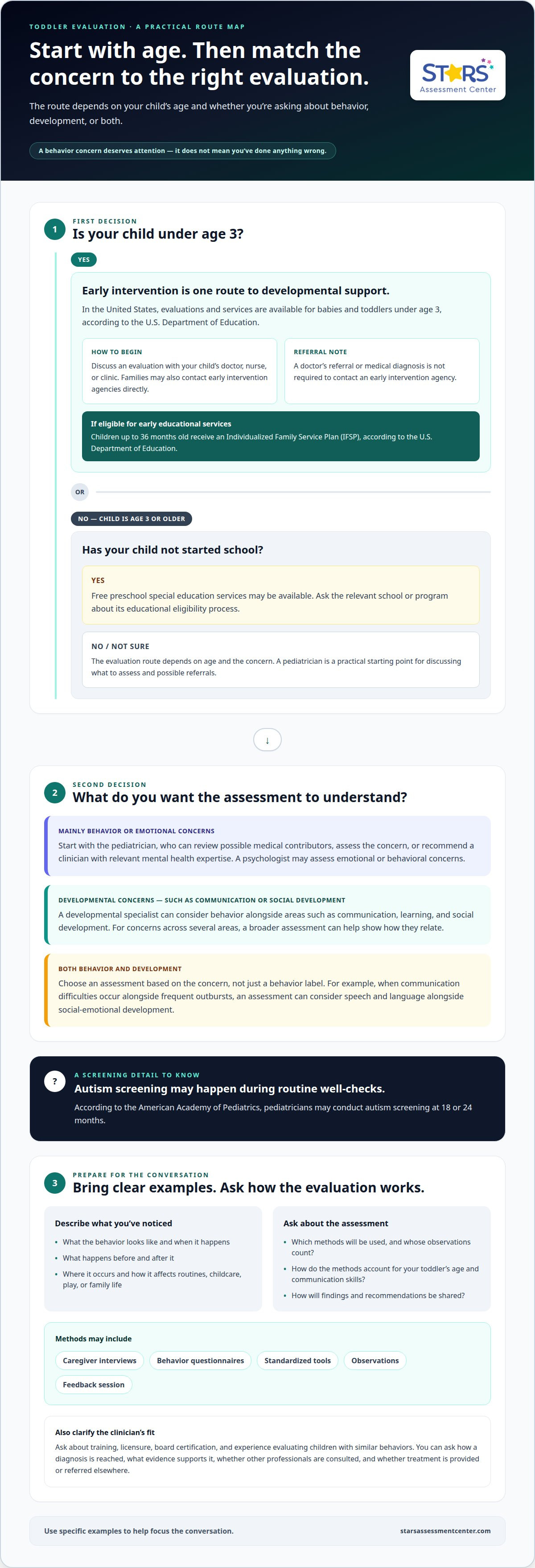
A behavior concern deserves attention, but it doesn’t mean you’ve done anything wrong. If you’re asking how to get your toddler evaluated for behavior problems, start by describing your concerns to their pediatrician, including what you’ve noticed, when it happens, and how it affects daily life. For children under age 3, the U.S. Department of Education says early intervention evaluations and services are available as another route to developmental support.
It can be hard to tell what’s a typical toddler behavior and what may benefit from a closer look. An evaluation can consider your child’s behavior alongside their development, communication, social interactions, and emotional responses. This article explains what an evaluation may involve, how to ask about assessment methods and referrals, and what to clarify about insurance and fees. It also covers where to find developmental expertise so you can take a thoughtful next step.
Key Takeaways
- Track the behaviors that concern you and how they affect your toddler’s everyday life to make conversations about an evaluation more focused.
- Ask how the evaluation gathers information, what assessment methods it uses, and how the findings and recommendations will be shared with you.
- Use your pediatrician as a starting point for discussing concerns, possible referrals, and whether medical factors may be contributing to behavior.
- According to the American Academy of Pediatrics, pediatricians may conduct autism screening during well-checks at 18 or 24 months.
- Learn how insurance coverage, fees, and possible university or teaching-hospital services may shape your options for finding developmental expertise.
What Are Behavioral Evaluations?
A behavioral evaluation looks at a child’s behavior, emotions, development, and daily experiences. A pediatrician is often a practical starting point; a psychologist or developmental specialist may assess particular mental health or developmental concerns.
Signs an Evaluation May Help
An assessment may be worth considering when behaviors persist, disrupt routines, or make interactions harder. Repeated head banging or biting, hitting, and kicking are examples to discuss with a professional. Note when the behavior occurs and what happens before and after it. That context can help identify patterns without treating every tantrum as a diagnosis. If something does not feel right, you do not have to wait for certainty to act.
Tantrums and boundary-testing can be part of toddlerhood, especially when a child is tired or distressed. Look at the broader pattern: is behavior affecting play, communication, family routines, or participation in everyday activities? Changes in emotional expression or social interaction may also be useful to discuss.
Professionals Who Evaluate Toddlers
A pediatrician can review the concern, consider possible medical contributors, and guide the family toward an appropriate evaluation. A psychologist can assess emotional or behavioral concerns using interviews, questionnaires, observations, or standardized tools. A developmental specialist considers behavior alongside areas such as communication, learning, and social development.
Which professional fits depends on the question being explored. If you’re unsure where to start, share specific examples with your toddler’s pediatrician, who may evaluate the concern or recommend a clinician with relevant expertise. For concerns involving several developmental areas, a broader assessment can help show how those areas relate to behavior.
Diagnostic Assessments for Children and Teens
A diagnostic assessment gathers information to understand a child’s challenges and guide next steps. It may include an interview with caregivers, questionnaires, and observations of the child. Information from teachers or other important adults can add context for older children and teens. A feedback session can explain diagnostic impressions and recommendations.
Choose an assessment based on the concerns you have, not just a behavior label. For example, if a toddler has difficulty communicating and frequent outbursts, an assessment can consider speech and language alongside social-emotional development. Share what you’ve noticed and ask how the findings may help inform next steps.
For babies and toddlers under age 3, early intervention evaluations and services are available in the United States, according to the U.S. Department of Education. Families can contact the child’s doctor, nurse, or clinic to begin discussing an evaluation. Children up to 36 months old who qualify for early educational services receive an Individualized Family Service Plan, according to the U.S. Department of Education.
For a child who is age 3 or older and has not started school, free preschool special education services may be available. The evaluation route depends on the child’s age and the type of concern. Clarifying whether the main question involves behavior, development, or both can help determine which assessment is most relevant.
Asking about diagnostic methods, referrals, insurance, and fees
A useful assessment explains what was observed and how the findings may guide support. Before the appointment, note the behaviors that concern you, where they happen, and how they affect family routines, childcare, or play. Give specific examples instead of relying on a broad label such as “difficult behavior.”
If you’re asking, “How do I get my toddler evaluated for behavior problems?” begin by telling the clinician what you’ve observed and what you hope to understand. Ask which methods they’ll use and whose observations will count. An assessment may combine caregiver interviews, behavior questionnaires, standardized tools, and observations. For a toddler, ask how methods account for age and communication skills, and how findings will be shared.
Qualifications and experience matter because different specialists assess different concerns. Ask about the clinician’s training, licensure, and board certification, plus their experience evaluating children with similar behaviors. You can also ask how they reach a diagnosis, what evidence supports it, and when they consult other professionals. Clarify whether the clinician provides recommended treatment or refers families to other specialists.
Oppositional defiant disorder involves recurring defiant or hostile behavior toward authority figures that interferes with daily life. The diagnostic threshold described for children includes at least four frequently occurring behaviors. A diagnosis depends on the pattern and its impact, not one difficult day or a single disagreement. Ask how the clinician considers your child’s age, setting, and other possible explanations.
Referrals depend on the route you’re using. A pediatrician can assess concerns or refer you to a clinician with mental health expertise. Families can contact early intervention agencies directly without a doctor’s referral or medical diagnosis. For school-related concerns, a school counselor may also connect families with clinicians who evaluate children.
A developmental assessment and an educational evaluation answer different questions. Stars Assessment Program’s assessment helps families understand a child’s development and possible next steps. Ask the relevant school or program about its own educational eligibility process if that is also a concern.
Insurance coverage depends on the family’s health plan. Ask the insurer whether the evaluation is covered and whether a referral is required. Ask the clinician about insurance acceptance and fees, including whether sliding-scale fees or payment plans are available. Clarify what the fee covers, such as assessment, written findings, and a feedback meeting.
If you’re still wondering, “How do I get my toddler evaluated for behavior problems?” use the evaluation findings to discuss possible next steps. An individualized plan may include counseling, family support, or other recommendations. Ask how progress will be reviewed and what happens if the first approach doesn’t address your child’s needs. If communication concerns accompany behavior, a Speech and Language Evaluation can help assess that area.
Finding services at universities and teaching hospitals
University clinics, teaching hospitals, and local nonprofits may offer or help connect families with children’s mental health services. These settings can be useful when an assessment needs input from more than one person or professional.
Caregiver and Teacher Input
Caregiver and teacher input describes how a child behaves across familiar people and settings. It matters because a behavior seen at home may differ from one seen during childcare or play. Share specific examples, such as how your child responds to transitions, communicates needs, or joins group activities. For an older child or adolescent, teacher observations can add information about school routines and peer relationships.
Instead of relying on a behavior label, describe what you see and how it affects your toddler’s day. The assessment considers observations in context, including communication, social-emotional development, and other areas. Results are explained in clear, simple language, so you can understand what they may mean for your child.
Local Providers and Evaluation Timelines
Universities, teaching hospitals, and nearby nonprofits may provide evaluations or help families find local children’s mental health services. Start with the institution’s child development, psychology, or behavioral health services directory. Your insurer’s online provider database can also identify nearby clinicians. A pediatrician or school counselor may offer a referral route when the concern relates to health or school.
There isn’t one timeline that applies to every family. The time to begin depends on local appointment availability and the assessment’s scope. An evaluation may take several hours or extend across multiple days and sessions. Ask how many visits are planned, whether caregivers complete forms beforehand, and when findings will be discussed.
University and teaching-hospital settings can bring different clinical perspectives together. Depending on the service, an evaluation may draw on caregivers, teachers, guardians, and other adults who know the child. That broader view can help clarify whether a behavior appears in one setting or across daily life. For example, a toddler who struggles with transitions at home and childcare may need a different assessment focus from a child whose difficulties occur only in one routine.
Bring concise notes about the behavior, when it occurs, and what helps your child settle or participate. Include changes in routine and any communication concerns. These examples help the assessment team understand your concerns in the context of your child’s everyday development.
Before scheduling, ask whether the service evaluates toddlers and whether its clinicians assess the specific condition or developmental concern you’re exploring. Also ask who will gather caregiver or teacher input, how the assessment findings are shared, and whether recommendations include school or community support. These details help you understand what the evaluation can answer and how its results may guide next steps.
Developmental concerns and pediatrician screening
A pediatrician can discuss behavior concerns in relation to your toddler’s health and development. If your toddler threatens or harms themselves or someone else, seek immediate medical care or an emergency-room mental health assessment.
Discussing Concerns With a Provider
A focused conversation starts with specific examples, rather than a general impression. Before an appointment, note what happens, when it occurs, and how your toddler responds to changes, play, or communication. Include what helps and whether you see the behavior at home, childcare, or both.
Tell the pediatrician about changes in sleep, communication, attention, or interaction. Ask whether a medical concern could contribute and whether a developmental evaluation or referral would help. The pediatrician can observe your child, consider information from household members, and guide the next step.
Developmental concerns may involve communication, social interaction, emotional responses, or behavior. Pediatricians may conduct autism screening during well-checks at 18 or 24 months, according to the American Academy of Pediatrics. A screening measure, such as the M-CHAT-R, helps identify whether further assessment may be appropriate; it isn’t an official autism diagnosis.
Common Behavioral Health Concerns
Concerns about attention, emotional regulation, or social interaction may be useful to discuss with a professional. Repeated head banging or biting, hitting, and kicking are also examples parents may raise. One behavior alone does not explain its cause, so describe its pattern and effect on everyday routines.
Different developmental and mental health concerns can have overlapping signs. A developmental assessment can consider behavior alongside speech and language, cognitive, motor, social-emotional, adaptive, and vision and hearing screening areas. This is not a diagnostic assessment, but it can help families understand development and possible next steps.
Bring a short written list to the visit. Include the behavior, when it happens, how often it affects daily activities, and any recent changes in routine. For example, note whether a toddler’s distress occurs during transitions, limits, or attempts to communicate. This helps the provider understand the context and decide what needs closer attention.
Share safety details plainly, including any threats, injuries, or repeated self-harm behaviors. If there’s immediate danger, don’t wait for a routine appointment; seek emergency care. For concerns that aren’t immediate emergencies, the pediatrician can discuss screening, evaluation, and referral options based on your child’s developmental needs.
Developmental-behavioral pediatricians
A developmental-behavioral pediatrician is a pediatrician with additional training in children’s social, emotional, academic, and behavioral development. This expertise can help connect behavior symptoms with developmental skills and everyday experiences.
Starting With a Pediatrician
Your child’s doctor can be a useful starting point when behavior raises concerns. Describe what you’ve observed, when it happens, and how it affects routines, play, or communication. For example, explain whether difficulty with transitions appears at home, childcare, or both.
A pediatrician can discuss possible next steps, including an evaluation or referral to a specialist. Bring questions about emotional development, communication, and learning so the conversation covers more than one behavior. This helps the doctor understand what you’re noticing and whether a broader developmental perspective may be useful.
The Pediatrician’s Evaluation Role
A pediatrician considers a child’s symptoms alongside health and developmental information. They may observe behavior, review caregiver reports, and perform a medical examination to consider whether an underlying condition contributes. Laboratory work or other testing may also help address specific medical questions.
Some pediatricians evaluate and diagnose children, while others refer families to clinicians with mental health expertise. Ask what the current evaluation can answer and what a referral would add. For example, persistent outbursts alongside communication difficulties may call for attention to both behavior and developmental skills.
Developmental-Behavioral Pediatrician Role
A developmental assessment looks at how a toddler’s social-emotional development relates to other skills. This perspective can be useful when behavior occurs alongside concerns about communication, learning, or relationships. It helps families consider the child’s development as a whole, rather than treating one behavior in isolation.
Stars Assessment Program’s assessment helps families understand developmental findings and how they relate to daily life. For example, difficulty joining play can be considered alongside social-emotional and communication development. The parent discussion includes guidance on possible next steps.
As you prepare, think about your toddler’s age, developmental history, and behavior across everyday settings. Share examples from home or childcare, along with changes you’ve noticed in communication or play. These details help keep the assessment focused on your child’s needs, not a label alone.
If concerns involve several areas of development, a broader assessment can help examine how those areas fit together. Explore developmental assessment options for a clearer view of your child’s developmental needs.
Stars Assessment Program
Stars Assessment Program helps families explore toddler behavior concerns through developmental assessment. If behavior concerns appear alongside emotional, communication, or developmental differences, an evaluation can help clarify what your child may need. A Social-Emotional Assessment can focus on emotional and behavioral concerns, while a Multidisciplinary Developmental Assessment considers development across areas. A Speech and Language Evaluation may be relevant when communication challenges are part of the picture. Autism assessment is also available for families seeking evaluation in that area.
An assessment can help you understand your toddler’s strengths and areas where support may help. Share what prompted you to seek an evaluation, such as difficulty with transitions, communication, or social interaction. Evaluations are provided in your preferred language.
Contact Stars Assessment Program to discuss your toddler’s evaluation needs.
Take the next step with confidence
Seeking an assessment isn’t about labeling your toddler. It’s a way to understand their development and possible next steps. If you’re still asking, “How do I get my toddler evaluated for behavior problems?” start by sharing specific examples of what you’ve noticed and what you hope to understand. No referral needed. Families can contact Stars directly.
Stars Assessment Program can help families explore developmental and social-emotional concerns through an evaluation suited to the questions they bring. You can take the next step at a pace that feels manageable for your family.
Contact Stars Assessment Program to discuss your toddler’s evaluation needs. A clearer understanding can help you decide what support to explore next.
Frequently Asked Questions
How will the results be shared with me?
Ask for a written summary and a conversation explaining what the findings mean for your child. A useful report connects observations to everyday examples, such as communication during play or coping with transitions. Stars Assessment Program explains developmental assessment results in clear, simple language, so families can understand their child’s progress and possible next steps. Assessment in your preferred language is available.
What happens if a behavioral issue is identified?
The findings can help clarify what support or further evaluation may be appropriate. A clinician may recommend interventions, resources, or additional care based on the child’s needs. Keep in mind that Stars Assessment Program’s developmental assessment helps families understand development, but this is not a diagnostic assessment. It does not replace a medical diagnosis or treatment. Ask how the findings relate to your child’s daily routines and who can address the next concern.
What behavior problems in toddlers warrant a professional evaluation?
Consider discussing behaviors that persist, affect daily routines, or raise safety concerns. Examples include repeated head banging, biting, hitting, kicking, or difficulty engaging with other children during play. Note what happens before and after the behavior, where it occurs, and how your toddler communicates needs. These details can help a professional understand whether the concern connects with development, emotional responses, or another factor.
At what age can toddlers be evaluated for behavioral or developmental concerns?
In the United States, early intervention evaluations and services described here are for babies and toddlers under age 3, according to the U.S. Department of Education. Stars Assessment Program evaluates children under 3 years. Families in San Jose, Santa Clara, Santa Cruz, Salinas, Milpitas, Gilroy, and Morgan Hill can consider whether a developmental assessment addresses their concerns. The program’s assessment is not a diagnostic evaluation.
How do I ask my toddler’s pediatrician for a behavioral evaluation?
Describe one or two specific situations, then explain how often they happen and how they affect your toddler. For example, you might say, “My child becomes very distressed during transitions at home and childcare.” Ask whether the doctor recommends a behavioral, developmental, or medical evaluation, and what information would help. No referral needed. Families can contact Stars directly for its developmental assessment.
What happens during a toddler behavioral evaluation?
A behavioral evaluation may include caregiver interviews, questionnaires, and observations of your toddler. The clinician gathers examples to understand how behavior appears in daily life and may discuss findings and recommendations with you. Stars Assessment Program’s developmental assessment is structured, play-based, and child-led, with parents present throughout. Its length depends on the child’s age and attention, and activities are paced to the child.
What screenings or assessments are used to evaluate behavior problems in toddlers?
Methods depend on the concern and may include caregiver questionnaires, standardized tools, interviews, and observation. The Child Behavior Checklist uses about 100 statements for parents and teachers to rate behaviors. Autism screening measures, such as the M-CHAT-R, can indicate whether further assessment may help, but they aren’t an autism diagnosis. A developmental assessment can also examine communication, social-emotional development, and other skills.
Does health insurance cover toddler behavioral evaluations, and what are typical costs?
Coverage for a behavioral evaluation depends on your health plan, so ask the insurer which assessment services it covers and whether it requires a referral. Stars Assessment Program’s developmental assessment is provided at no cost to families. It is not a diagnostic assessment, and insurance coverage for other services may differ. Ask the relevant provider what the evaluation includes and how results will be shared before scheduling.


