

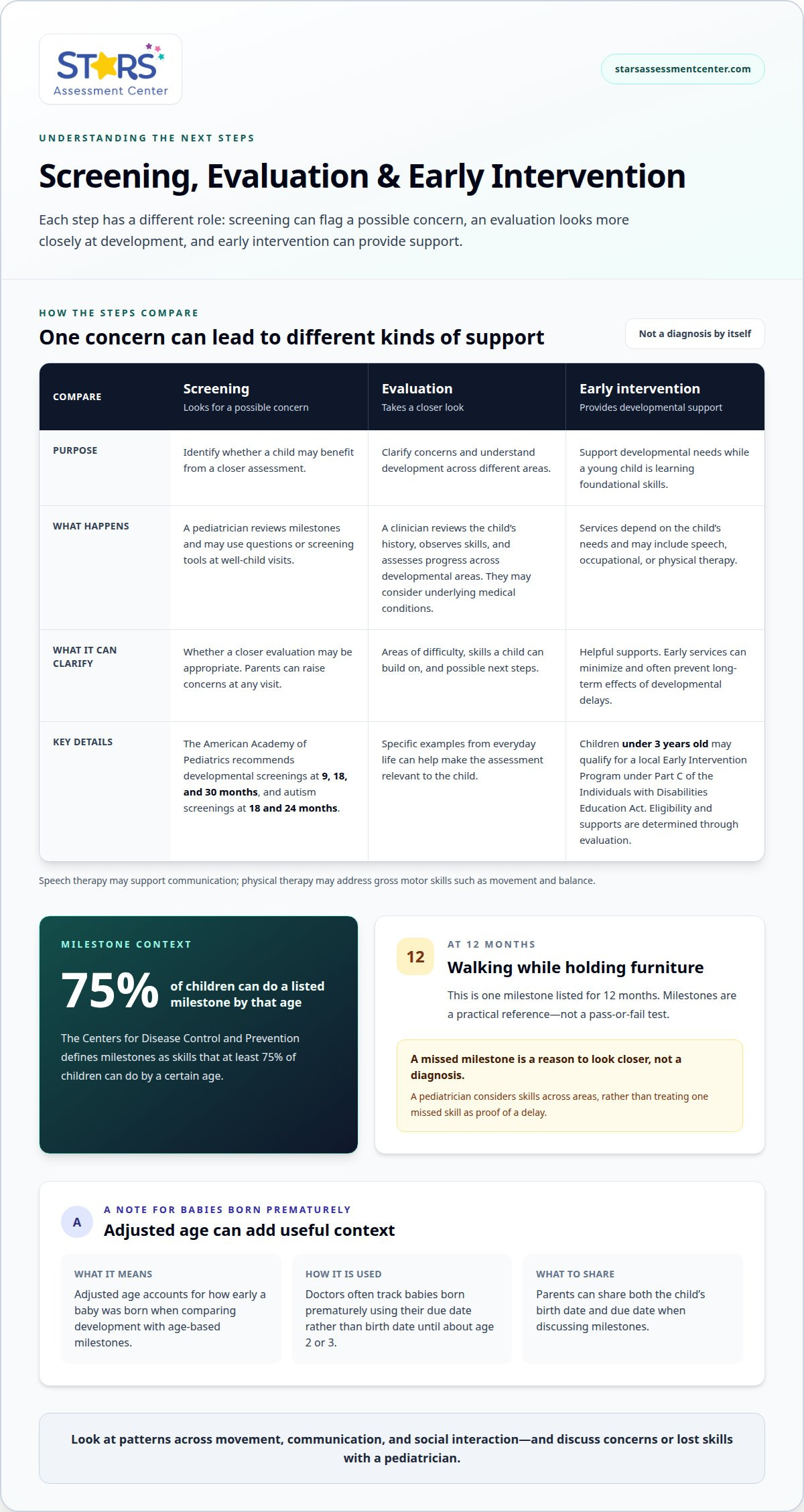
A missed milestone is a reason to look closer, not a diagnosis. The signs of developmental delay in a 12-month-old may include not pulling up to stand, making few or no sounds, or rarely using gestures such as waving. A developmental delay means a child is consistently behind in developing skills expected for their age, though babies reach new skills at different times.
It’s understandable to wonder whether your child’s pace is a concern. According to the Centers for Disease Control and Prevention, developmental milestones are skills that at least 75% of children can do by a certain age; one listed milestone at 12 months is walking while holding on to furniture. This article explains movement, communication, thinking, and social skills to watch, how signs at other ages can differ, and how an assessment can help clarify what support may be useful. Early attention can help families understand their child’s development and consider appropriate next steps.
Key Takeaways
- Look across movement, communication, thinking, and social interaction to understand your child’s development as a whole.
- Notice skills such as pulling to stand, babbling, responding to their name, and using gestures, while remembering that children develop at different paces.
- Pay attention to missed milestones at other ages and to any loss of skills your child had already learned.
- Learn how developmental assessments and early intervention can help clarify your child’s needs and identify helpful next steps.
What Is a Developmental Delay?
A developmental delay means a child continues to develop skills later than expected for their age. At 12 months, a missed milestone is a reason to discuss the child’s growth with a pediatrician, not a diagnosis by itself.
How Developmental Milestones Are Defined
Developmental milestones are skills children typically gain by certain ages across areas such as movement, communication, and social interaction. The Centers for Disease Control and Prevention defines milestones as skills that at least 75% of children can do by a certain age. That benchmark helps parents and pediatricians notice patterns, while recognizing that one child may reach a skill earlier or later than another.
For example, walking while holding on to furniture is a milestone listed for 12 months by the Centers for Disease Control and Prevention. Milestones offer a practical reference, not a pass-or-fail test. A pediatrician considers what a child can do across different areas, rather than treating one missed skill as proof of a delay.
Delayed Skill Development
Delayed skill development means a child is consistently behind in gaining expected skills, rather than simply reaching one milestone later than peers. A 10-12-month-old who has not started babbling, for example, may need closer attention to communication development. Looking at several skills together helps parents and a pediatrician understand whether a concern affects one area or more.
Discuss a missed milestone with the pediatrician, especially if a child has not gained skills across movement, communication, or social interaction. The American Academy of Pediatrics recommends developmental screenings at 9, 18, and 30 months. It also recommends autism screenings at 18 and 24 months. These screenings help identify when a closer evaluation may be appropriate; parents can raise concerns at any visit rather than waiting for a scheduled screening.
Consider the child’s everyday actions, too. Does your 12-month-old turn toward their name, use sounds to get your attention, or try to move toward a favorite toy? Specific examples help the pediatrician understand what you observe and when it happens. A pattern of missed milestones or lost skills deserves prompt discussion.
Adjusted Age for Premature Babies
Adjusted age accounts for how early a baby was born when comparing development with age-based milestones. Doctors often track babies born prematurely using their due date rather than their birth date until about age 2 or 3. This can provide a more useful comparison because the baby had less time to develop before birth.
For instance, parents can share both the child’s birth date and due date when discussing a 12-month milestone. The pediatrician can consider adjusted age alongside the child’s movement, communication, and social skills. This context helps make milestone conversations more specific, without overlooking a parent’s concern.
Early intervention services
Early intervention connects young children with support for developmental needs. A screening or evaluation can help clarify concerns and guide next steps.
Developmental Screening and Evaluation
Developmental screening uses questions or tools to identify whether a child may benefit from a closer assessment. At routine well-child visits, pediatricians review milestones and ask about a child’s skills and progress. If a screening or a parent’s concern points to a possible delay, an assessment can look more closely at development.
Doctors screen and evaluate by reviewing the child’s history, observing skills, and assessing progress across developmental areas. They can also consider underlying medical conditions and recommend appropriate support. Parents can describe specific examples, such as difficulty using sounds to communicate or moving between sitting and standing. These details help make the evaluation more relevant to the child’s everyday life.
Benefits of Early Intervention
Early intervention provides support for developmental needs while a young child is learning foundational skills. Depending on the child’s needs, services may include speech therapy, occupational therapy, or physical therapy. For example, speech therapy may support communication, while physical therapy may address gross motor skills such as movement and balance.
Early services for babies and children up to 3 years of age can minimize and often prevent the long-term effects of developmental delays. Children under 3 years old may qualify for a local Early Intervention Program under Part C of the Individuals with Disabilities Education Act, according to the U.S. Department of Education. Eligibility and supports are determined through the program’s evaluation process. An evaluation can help identify both areas of difficulty and skills a child can build on.
Early intervention does not mean a child has a particular diagnosis. An assessment can help families understand the child’s current development and what next steps may be appropriate. If communication is a concern, a speech and language evaluation can provide a closer look at communication skills.
Supporting Development at Home
While arranging an assessment, parents can support learning through everyday, responsive play. Play does not replace professional assessment, but it offers chances to notice how a child communicates, explores, and moves.
- Talk through daily routines, name familiar objects, and pause for your child to respond with a sound, look, or gesture.
- Share books and simple games, such as taking turns rolling a ball or copying claps.
- Place a favorite toy within reach during supervised floor play, and notice how your child tries to move toward it.
- Write down examples of new skills, concerns, and changes to share during the evaluation.
Keep activities comfortable and follow your child’s cues. If questions remain, a developmental assessment can help families better understand a child’s strengths and support needs.
12-Month-old movement and standing skills
At 12 months, babies may use furniture to move around while standing. Some pull themselves up, move from sitting into another position, or briefly stand without support. A child doesn’t need to walk independently to show progress. Look at how they use their body to explore and reach people or toys.
Patterns matter more than a single missed milestone. If a baby is not pulling up to stand, showing interest in moving, or sitting independently, share your observations with a pediatrician. Describe what happens during play, such as whether your child pushes through their legs when supported, reaches for a nearby toy, or shifts position to get closer. These examples give a fuller picture than a checklist alone.
Movement may also appear uneven. For example, dragging one side of the body while crawling for over one month may be a concern to discuss. Notice whether both arms and legs are involved when your baby reaches, crawls, or tries to stand. An assessment can consider these patterns alongside other developmental skills.
Hand and finger skills are part of movement, too. By 12 months, a baby may use a pincer grasp, picking up a small object with the thumb and finger. During play, notice whether your child reaches toward a toy, picks it up, and transfers or explores it. Limited use of one hand, or difficulty grasping objects, is useful information to share during an evaluation.
Play and social behavior offer additional clues. A 12-month-old may imitate gestures, wave, or play a familiar game such as pat-a-cake. They may show shyness around strangers. Notice how your baby responds when you smile, offer a toy, or pause during a game. These exchanges combine attention, movement, and communication.
Adaptive skills show how a child uses developing abilities in everyday routines. At 12 months, observe how your baby handles a cup or finger food, reaches for a spoon, and participates during dressing. These examples aren’t a pass-or-fail test; they help describe what your child can do with support and practice.
Most importantly, report any loss of a skill your baby previously used. If your child stops sitting, reaching, babbling, or using a learned gesture, seek prompt evaluation. A clear timeline can help explain what changed and when.
Cognitive, social-emotional, speech-language, and motor delays
Development includes connected skills, from moving toward a toy to communicating interest. At 12 months, consider patterns across areas, not one behavior alone.
Motor Development and Mobility
Motor development includes how babies control their bodies to change position and explore. At 12 months, notice whether your child moves between sitting and other positions, reaches for toys, or tries to get closer to familiar people. Mobility offers opportunities to explore, while movement patterns can show where a child may need support.
A baby who shows little interest in moving, struggles to sit independently, or uses one side differently may benefit from further discussion. Share examples from play, such as whether your child reaches with both arms or shifts their body toward a sound. These details help describe motor skills in context.
Gross Motor Skills
Gross motor skills use larger muscles for actions such as sitting, crawling, pulling up, and standing. A 12-month-old may pull to stand or walk while holding furniture; independent walking isn’t required at this age. Difficulty with several movement skills, rather than one missed action alone, can be useful to discuss during developmental screening.
Observe how your child moves during everyday routines. For example, note whether they can sit to play, push up from the floor, or bear weight when supported. A baby who is not sitting independently between 10 and 12 months may show a possible developmental concern. Describe what support your child needs and how movement changes across settings.
Fine Motor Skills
Fine motor skills involve smaller hand and finger movements used to grasp, release, and explore objects. By 12 months, a baby may use a pincer grasp to pick up a small item with the thumb and finger. This skill can support play and early self-help tasks, such as bringing finger food toward the mouth.
Notice whether your child reaches for toys, picks them up, and uses both hands during play. If your baby rarely tries to grasp objects or shows clear differences between hands, share this with a pediatrician or assessment team. Fine motor observations can also include everyday activities, such as handling a cup or trying to feed themselves.
Cognitive, Social-Emotional, and Speech-Language Development
Cognitive skills help babies learn through attention, memory, and problem-solving; social-emotional skills involve connection and responses to people. Speech-language development includes understanding communication and expressing needs through sounds, gestures, or words. At 12 months, notice whether your child searches for a toy hidden while watching, imitates a gesture, or responds to their name.
Communication concerns can include not babbling consonant sounds such as “ba” or “da,” making no sounds, or rarely using gestures like waving. Social observations include whether your baby shares attention during a game or responds to familiar caregivers. Record specific examples, including what happened before and after, to describe your concerns across developmental areas.
Developmental delay signs at other ages
Developmental concerns change as children gain new skills, so compare observations with the child’s age. A concern at 6 months may involve rolling or responding to caregivers, while a concern at 2 years may involve combining words. Milestones provide age-based reference points, but a developmental screening considers the child’s skills and patterns together.
At 1 month, not startling at loud sounds may be worth discussing with a pediatrician. By 2 months, babies are expected to make sounds beyond crying. At 2-3 months, limited social smiling may raise concern. By 6 months, not rolling, reaching for toys, or sitting with support may signal a need for closer attention. Very stiff or floppy movements at 6 months also deserve discussion.
Between 6 and 8 months, independent sitting typically develops. At 7 months, babies often babble more, sit with less support, and may scoot or begin crawling. At 8-12 months, not crawling may be a possible concern, but crawling styles vary. Watch how your child explores: do they move toward objects, reach with both arms, and change positions during play?
For a 12-month-old, notice gestures as well as gross motor skills. A child who does not point, wave, respond to their name, or search for an object hidden while they watched may need further evaluation. A pattern across communication, social interaction, and movement gives a pediatrician more useful context than one behavior alone. Loss of a skill at any age calls for prompt evaluation.
By 15-18 months, having no spoken words may warrant assessment; difficulty forming simple words by 18 months is another possible concern. Not walking independently by 18 months is also a developmental red flag. At 18 months, fewer than six words or difficulty imitating sounds or gestures may be worth discussing. Share examples, such as whether your child uses a word to request a familiar toy.
At age 2, concerns may include not combining two words, having no two-word phrases, or struggling with simple instructions. At age 3, speech that caregivers find difficult to understand may need attention. By age 4, limited imaginative play or difficulty interacting with other children may signal a concern. These examples help families recognize how developmental expectations shift with age.
If your child has missed skills for their age or lost a skill, a multidisciplinary developmental assessment can help clarify strengths and areas needing support.
Stars Assessment Program: Multidisciplinary Developmental Assessment
Stars Assessment Program provides a Multidisciplinary Developmental Assessment to help families understand a child’s development and identify areas where support may be useful. If you have ongoing concerns about movement, communication, thinking, or social interaction, an assessment can offer a clearer picture of your child’s strengths and needs.
Depending on your concerns, Stars also provides social-emotional assessments, speech and language evaluations, and specialized screenings for autism and Down syndrome. Sharing specific examples, such as skills your child has gained or stopped using, can help guide the assessment. If something does not feel right, you do not have to wait for certainty to act.
For a supportive next step, contact Stars Assessment Program to discuss your child’s developmental assessment needs.
Take the Next Step With Confidence
Noticing signs of developmental delay in a 12-month-old can bring up difficult questions. You don’t need to have every answer before seeking guidance. A clear account of what you’ve observed can help shape a conversation about your child’s needs and the kind of evaluation that may be helpful.
Stars Assessment Program offers a Multidisciplinary Developmental Assessment, Social-Emotional Assessment, and Speech and Language Evaluation. These assessment options can help families explore concerns in different areas of development and better understand what support may fit. If you’re unsure where to begin, sharing your concerns is a meaningful first step.
Contact Stars Assessment Program to discuss an assessment for your child. With thoughtful guidance, you can move forward with greater clarity and support your child’s continued growth.
Frequently Asked Questions
If my child does have a delay, what could be causing it?
Possible causes include hearing or vision impairments, genetic conditions, and differences in the child’s experiences or health. For example, hearing difficulties can affect speech development, while some genetic conditions may influence movement, communication, or thinking. Limited social interaction, lack of stimulation, or poor nutrition can also affect development. These factors don’t identify a cause for an individual child. Parents in San Jose, Santa Clara, Santa Cruz, Salinas, Milpitas, Gilroy, and Morgan Hill can discuss their observations with a pediatrician.
Can this be prevented?
Not every developmental delay can be prevented, as possible factors include genetic conditions and hearing or vision impairments. Families can support learning through responsive interaction, play, conversation, and attention to health and nutrition. Taking turns making sounds or naming familiar objects, for example, creates opportunities for communication. Everyday activities support development, but they cannot guarantee that a delay will not occur or replace an assessment when concerns arise.
How common is this condition?
About 1 in 6 children has a developmental delay or disability. This figure includes different types of developmental needs, so it doesn’t predict whether a particular child will have a delay. Children may need support in one area, such as speech, or across several areas. If you’re concerned about your child’s development, describe the specific skills you’ve noticed and the situations where they appear.
What Are Developmental Milestones?
Developmental milestones are skills used to describe what children commonly learn by certain ages. The Centers for Disease Control and Prevention defines them as skills that at least 75% of children can do by a certain age. This benchmark helps families and professionals track development, but it isn’t a test that determines a diagnosis. A child’s overall pattern of skills matters more than treating one milestone as a pass-or-fail result.
What developmental milestones should most 12-month-olds reach?
At 12 months, many babies use a special name such as “mama” or “dada,” play simple social games, and wave bye-bye. They may also crawl, understand simple instructions, and use a few words. The Centers for Disease Control and Prevention lists walking while holding on to furniture as a 12-month milestone. These skills can appear at different times, so consider your child’s overall development and share concerns with their pediatrician.
What are signs of gross motor delay at 12 months?
Possible signs of gross motor delay include difficulty sitting independently, little interest in moving, or not pulling up to stand. A baby might also struggle to use both sides of the body during crawling or reaching. Possible signs of developmental delay in a 12-month-old should be considered alongside the child’s other abilities and history. Share concrete examples, such as how your child moves toward a favorite toy or changes position during play.
What are signs of fine motor delay in a 12-month-old?
Fine motor concerns may include rarely reaching for objects, difficulty picking them up, or limited use of the fingers to handle small items. Around this age, babies may begin using a pincer grasp, bringing the thumb and finger together to pick something up. Notice how your child handles toys, finger foods, or a cup during everyday routines. Differences in hand use or grasping are useful examples to share during an assessment.
What communication and language delays may appear around 12 months?
Communication concerns may include little or no babbling, few sounds beyond crying, or not using gestures such as waving or pointing. Some babies may also have difficulty responding to their name or understanding simple spoken requests. Notice whether your child uses sounds, looks, or gestures to get your attention during familiar routines. A pediatrician or assessment team can consider these observations alongside hearing, social interaction, and other developmental skills.


