
Can a parent prevent a developmental delay? There isn’t one action that prevents every delay, but noticing concerns and seeking screening can help clarify what support may help your child. About 1 in 6 children in the United States has at least one developmental delay. Finding help for parents of a child with a developmental delay starts with understanding the skills involved and knowing what steps to take.
It can be hard to tell whether your child is developing at a different pace or might benefit from an assessment. Screening provides a general look at development, but it is not a diagnosis. Asking questions is a constructive step toward clearer answers and practical help for parents of a child with developmental delay.
This guide explains developmental delays, how screening and early intervention work, and when to share concerns about your child’s development. You’ll also find practical ways to encourage learning at home through play, reading, and familiar routines, while noticing and celebrating your child’s progress.
Key Takeaways
- Learn which areas of development a delay may affect and how definitions can vary by state and age.
- Understand how formal evaluations help identify a child’s needs and inform early intervention eligibility.
- Use milestones as helpful reference points while remembering that children develop at different rates.
- Find out what to expect from developmental screening and how it differs from a professional evaluation.
- Explore simple ways to build learning into everyday play, shared reading, and familiar routines.
1. What is a developmental delay?
A developmental delay means a child is learning or using skills later than expected for their age. It may affect one area or several, including movement, language, thinking, social-emotional development, or everyday self-help. For example, a child may need support to communicate, use utensils, or join play. A delay describes a support need; by itself, it does not explain the cause.
Definitions can also depend on a child’s age and state. According to the Office of the Federal Register, National Archives and Records Administration, states may add details to their definition and choose the age range within ages 3 to 9 years. IDEA describes developmental delay across areas such as physical, cognitive, communication, social or emotional, and adaptive development. This matters because the same child may need different supports as expectations change.
Notice strengths as well as challenges. A child who has trouble using words might communicate through eye contact, gestures, or bringing an adult a toy. Those strengths offer useful starting points for connection and learning. Note what holds your child’s interest, which activities feel easier, and where challenges arise, such as during transitions or when following several steps. These observations describe progress more clearly than a label alone.
Communication support can make daily interactions easier while spoken language develops. Pair a simple phrase with a gesture, such as pointing to a cup while saying, “Want water?” Sign language, picture boards, and familiar gestures can give a child additional ways to express choices or needs. Give your child time to respond and notice all attempts to communicate, including sounds, looks, and movements.
Predictable routines can help a child understand what comes next. For example, use the same short sequence before leaving home: shoes, coat, then the door. A picture schedule can show the steps visually. Keep instructions brief and break tasks into manageable parts when they involve several steps. A calm, organized space with fewer distractions may also help your child focus and participate.
Parents and a child’s support team can share observations and agree on practical steps. Give specific examples, such as difficulty asking for help or joining a game, rather than relying on broad impressions. Ask educators and professionals what support works in each setting, then share changes you notice at home. This exchange can help the team use consistent approaches and adjust them as your child’s needs and progress change.
Caregiver support matters, too. Ask trusted family members or friends for help with a practical task, make time to rest, or connect with other families who understand developmental needs. A written list of priorities can make it easier to explain what would help, such as company during an appointment or time to recharge. Supporting a child is ongoing work, and caring for yourself can help you sustain it.
2. What are early intervention services?
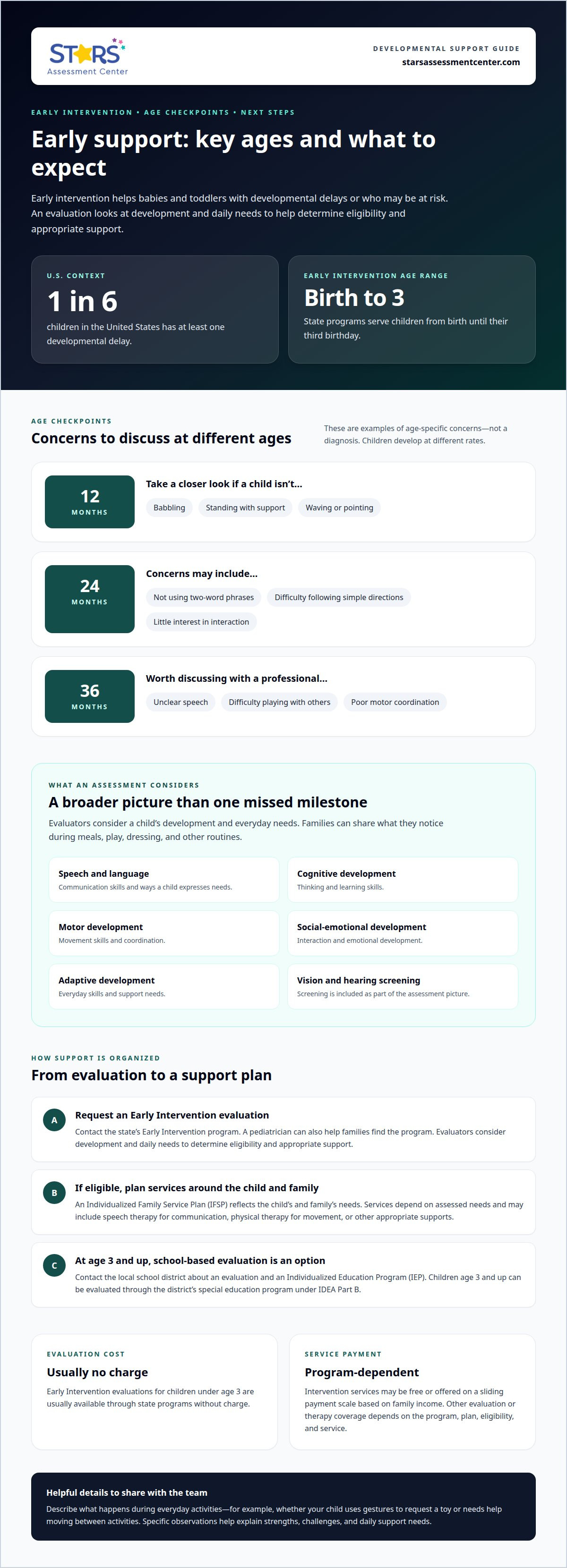
Early intervention services support babies and toddlers who have developmental delays or may be at risk. In the United States, state programs serve children from birth until their third birthday. The first step is requesting an evaluation through the state’s Early Intervention program. Evaluators consider the child’s development and daily needs to determine eligibility and appropriate support.
A developmental assessment looks beyond a single missed milestone. It considers speech and language, cognitive, motor, social-emotional, adaptive, vision and hearing screening. Parents can describe what they notice during meals, play, dressing, or other routines. For example, explain whether your child uses gestures to request a toy or needs help moving between activities. The assessment helps inform eligibility for Early Start, a program that may provide support at no cost to families, when applicable.
Age-specific concerns can help families decide when to request an evaluation. At 12 months, a child who isn’t babbling, standing with support, or waving or pointing may need closer attention. At 24 months, concerns can include not using two-word phrases, difficulty following simple directions, or little interest in interaction. At 36 months, unclear speech, difficulty playing with others, or poor motor coordination may be worth discussing.
Therapies depend on the child’s assessed needs and the skills affecting daily life. A pediatrician may recommend speech therapy for communication, physical therapy for movement, or other supports suited to the evaluation. Families can discuss the child’s strengths, goals, and everyday challenges with the team, then consider which services address those needs. For concerns about spoken language, a Speech and Language Evaluation can help clarify communication skills.
To request an IFSP, contact the state’s Early Intervention program and ask for an evaluation; a pediatrician can also help families find the program. If the child is eligible, the plan reflects the child’s and family’s needs. For school-based support after age three, contact the local school district about an evaluation and an Individualized Education Program, or IEP. The U.S. Department of Education says children age 3 and up can be evaluated through their local school district’s special education program under IDEA Part B.
Early Intervention evaluations for children under age three are usually available through state programs without charge. Intervention services may be free or offered on a sliding payment scale based on family income. Coverage for other developmental evaluations or therapy through private insurance, Medicaid, or CHIP depends on the program, plan, eligibility, and service. Ask the program handling the evaluation to explain its payment process and any coverage steps.
While an evaluation is being arranged, keep brief notes about skills, concerns, and examples from home. A child’s communication during play may look different from communication during meals, so recording both can help describe support needs. If you’re considering a closer look at development, a developmental assessment can help clarify which areas need attention.
3. Developmental milestones and varied rates of development
Developmental milestones are skills children are expected to develop around particular ages. They offer a reference point, not a timetable every child follows exactly. Children develop at different rates, so one skill appearing later does not explain a child’s overall development. Look at the pattern across skills, including movement, communication, thinking, and emotional connection, rather than treating one milestone as the whole picture.
During the first three years, new abilities emerge across many parts of daily life. The NC Infant-Toddler Program Developmental Milestones chart helps parents consider skills across those early years. For a closer look at a baby’s first year, the North Carolina Early Intervention Infant Toddler Program brochure includes a developmental milestones checklist. These tools can help organize observations and identify specific skills to discuss with a professional.
When considering age-related milestones, note what your child does consistently, what they are beginning to try, and what remains difficult. For example, record whether a skill appears during play, meals, or time with familiar adults. Include the setting and any support that helped. These details create a clearer picture than a simple “yes” or “no” beside a milestone.
Milestones cover different areas, and progress may not look the same in each one. A child might move confidently but communicate mainly through gestures, or enjoy social play while needing help with daily tasks. That uneven pattern is useful information. Write down both abilities and support needs, such as how your child expresses a choice or responds when another person joins play.
Types of delay can describe the area where a child needs support, such as communication, movement, cognitive skills, or social-emotional development. A concern in one area doesn’t automatically tell you whether other areas are developing similarly. If a toddler older than 18 months isn’t using single words, hearing may be one possible concern to raise. Share the observation with the child’s doctor rather than drawing a conclusion from that sign alone.
Notice changes over time, not just when a skill first appears. Keep a brief record of new attempts, repeated challenges, and small steps, such as trying a new gesture or joining an activity for longer. Small steps can be meaningful accomplishments. If your child loses abilities they had already gained, request an assessment right away. A timeline of observations helps professionals understand your child’s progress and needs.
4. Developmental screening and professional diagnosis
A developmental screening is a brief check of a child’s abilities, not a diagnosis. A pediatrician may ask questions, talk with your child, or observe play and movement. They may notice how your child responds to speech, uses motor skills, or interacts with you. There’s no laboratory or blood test that determines whether a child has a developmental delay. Screening helps identify whether a fuller evaluation could clarify development.
Screening questionnaires are commonly used at 18 and 24 months. A pediatrician may use the ASQ-3, or Ages and Stages Questionnaire, to review skills across developmental areas. The M-CHAT-R, or Modified Checklist for Autism in Toddlers, Revised, screens for signs associated with autism. These tools organize observations; they don’t provide a diagnosis on their own. Share specific examples, such as how your child communicates during play or follows a familiar direction.
To discuss screening, tell your child’s pediatrician what you’ve noticed and when it happens. Mention concerns about speech, movement, learning, behavior, or play. For instance, explain if your child has stopped using a word they previously said or seems to have difficulty with a movement they used to manage. If your child loses previously acquired abilities, request an assessment right away. Ask the pediatrician to explain unfamiliar terms and what the next step involves.
A developmental evaluation is more detailed than a screening. It looks at physical, cognitive, communication, social or emotional, and adaptive development. The evaluator may consider how your child moves, expresses needs, plays, learns, and manages everyday activities. A physician may refer families to specialists such as a hearing specialist, speech therapist, developmental pediatrician, neurologist, or early intervention provider. A referral helps connect a concern with a professional who can assess that area.
Child Find systems operate across the United States and typically provide developmental screenings and evaluations free of charge to families. They can be a route to identifying support needs through local education systems. For children age 3 and up, the U.S. Department of Education says evaluation is available through the local school district’s special education program under IDEA Part B. Families can contact the school district to request an evaluation and describe the skills or activities causing concern.
Before an appointment, write down a few examples from different settings, such as home, childcare, or a playground. Note what your child does independently, what support helps, and whether a concern is new or ongoing. Bring questions about the assessment, findings, and possible next steps. If an explanation feels unclear, ask for the results in everyday language and how they relate to your child’s daily abilities.
5. At-home play, reading and routines
Everyday moments offer chances to practice skills without turning home into a classroom. During play, follow your child’s interest, describe what they’re doing, and pause so they can respond with a sound, gesture, or word. If your child rolls a toy car, you might say, “Car goes,” and roll it back. This simple exchange invites communication while keeping the activity enjoyable.
Choose activities that offer practice in different areas. Stacking blocks can build coordination and turn-taking; drawing with chunky crayons offers fine motor practice. Pretend play with toy food can invite imitation, choices, and simple language. Start with an achievable action, such as placing one block, then model the next step. Give your child time to try before offering help, and notice their effort with specific praise.
Shared reading can support language and attention. Choose a familiar picture book, name one image on each page, and wait for your child to look, point, or make a sound. Follow their focus rather than asking repeated questions. If your child points to a dog, respond, “That’s a dog,” and add a simple detail, such as, “The dog is running.” Warm, repeated exchanges make books interactive.
A predictable routine can make daily activities easier to understand. Use a short picture schedule for steps such as washing hands, eating, and cleaning up. Keep the order consistent, point to each picture, and use brief instructions. If getting dressed feels difficult, break it into smaller actions: choose a shirt, put one arm through, then the other. A visual reminder can show what comes next.
Play-based developmental approaches combine relationship-building with skill practice. The Early Start Denver Model and DIR/Floortime are approaches described for toddlers and preschoolers. Their activities use interaction and play to encourage development. At home, parents can apply the broad idea by joining a child’s preferred activity, taking turns, and adding one manageable challenge. For example, during a familiar puzzle, invite your child to choose the next piece.
Consistency matters more than elaborate materials. Repeat a simple game, book, or routine during ordinary days, and share useful observations with your child’s support team. If a provider recommends a specific practice, ask how it might fit into meals, play, or bedtime. A calm space with fewer background distractions can help your child focus. For young children, keep screen time under one hour per day.
Home activities support learning, but they don’t replace professional guidance when concerns or challenges persist. If you want a clearer picture of your child’s development, request a developmental assessment to discuss their skills and support needs.
Stars Assessment Program: Multidisciplinary Developmental Assessment
Stars Assessment Program offers a Multidisciplinary Developmental Assessment for families concerned about an infant’s or toddler’s development. A multidisciplinary team evaluates areas such as cognitive, physical, and communication skills to help clarify a child’s strengths and support needs. Consider an assessment if you’ve noticed differences in how your child learns, moves, communicates, or interacts, or if screening has raised questions.
Stars Assessment Program also provides social-emotional assessments, speech and language evaluations, and specialized screenings related to Autism and Down syndrome. Assessment in your preferred language. No cost to families. No referral needed. Families can contact Stars directly. This is not a diagnostic assessment, and results are explained in clear, simple language to help you understand your child’s development and possible next steps.
Contact Stars Assessment Program to discuss your concerns and explore an assessment for your child.
Choose a Next Step That Fits Your Family
You don’t have to solve every concern at once. Choose one practical next step, such as writing down a question for your child’s care team or noting a skill you’d like to discuss. Small, focused actions can make the path ahead feel more manageable and help keep your child’s needs at the center.
Finding help for parents of a child with developmental delay can also mean making space for your own perspective. You know your child’s everyday rhythms, interests, and ways of communicating. Sharing those observations can guide conversations about what support may be useful. It’s okay to ask for explanations in plain language and take time to consider what you hear.
If you’d like to talk about your child’s developmental needs, contact Stars Assessment Program. Each family’s next step is personal, and seeking clarity is a meaningful way to support your child’s growth.
Frequently Asked Questions
Can this be prevented?
Not every developmental delay can be prevented, and a delay doesn’t mean a parent did something wrong. Some causes are outside a family’s control. Focus on practical steps: attend routine pediatric visits, share developmental concerns, and follow up if your child loses skills or progress stalls. An assessment can help clarify what support may be useful, even when it cannot prevent the original delay.
What If the Delay Is Significant or Doesn’t Improve?
Ask for an evaluation if your child’s challenges are affecting communication, movement, learning, or daily activities. Bring concrete examples, such as difficulty asking for help or completing a familiar task. If your child loses an ability they previously had, request an evaluation right away. If something does not feel right, you do not have to wait for certainty to act. Ask the professional to explain the next steps in plain language.
What are early intervention services?
Early intervention services support eligible children under age three and their families with development-related needs. After an evaluation, an Individualized Family Service Plan, or IFSP, can outline goals and supports based on the child’s and family’s needs. For example, a family’s priorities might include helping a child communicate during meals or participate in play. The plan gives caregivers and professionals a shared way to focus support in everyday settings.
What is a developmental delay?
A developmental delay describes a child developing certain skills later than expected for their age. It can involve communication, movement, thinking, social-emotional development, or adaptive skills such as feeding and dressing. The term describes an area where support may be needed; it does not explain the cause by itself. A fuller assessment considers how a child learns and functions across daily activities, not just one isolated skill.
What is developmental screening?
Developmental screening is an initial check that helps identify whether a closer evaluation could be useful. A pediatrician might ask about skills at home, use a questionnaire, or observe how a child plays and responds. Screening tools such as the ASQ-3 organize information about development, but they don’t provide a diagnosis. Bring examples from everyday situations, such as how your child communicates a choice or responds to a familiar request.
What are the early signs of developmental delay in children?
Signs vary by age and child. At 12 months, concerns can include not babbling, standing with support, or waving or pointing. At 24 months, watch for not using two-word phrases, difficulty following simple instructions, or little interest in interaction. At 36 months, unclear speech, difficulty playing with others, or poor motor coordination can be reasons to discuss development with a professional. One sign alone doesn’t establish a diagnosis.
How can parents get a developmental evaluation for their child?
Start by sharing your concerns with your child’s pediatrician or contacting the appropriate evaluation program directly. Families in Santa Clara, Santa Cruz, and San Benito counties can contact Stars Assessment Program directly for children under 3 years. No referral needed. The assessment is not diagnostic and reviews speech and language, cognitive, motor, social-emotional, adaptive, vision and hearing screening. Assessment in your preferred language, with results explained in clear, simple language.
What financial assistance and respite services are available for parents of children with developmental delays?
Stars Assessment Center’s developmental assessment, including assessments that help inform Early Start eligibility, is provided at no cost to families. Early Start is a program that may provide support, and the assessment is not diagnostic. Assessment in your preferred language. For families in Santa Clara, Santa Cruz, and San Benito counties, no referral is needed; families can contact Stars directly.


