

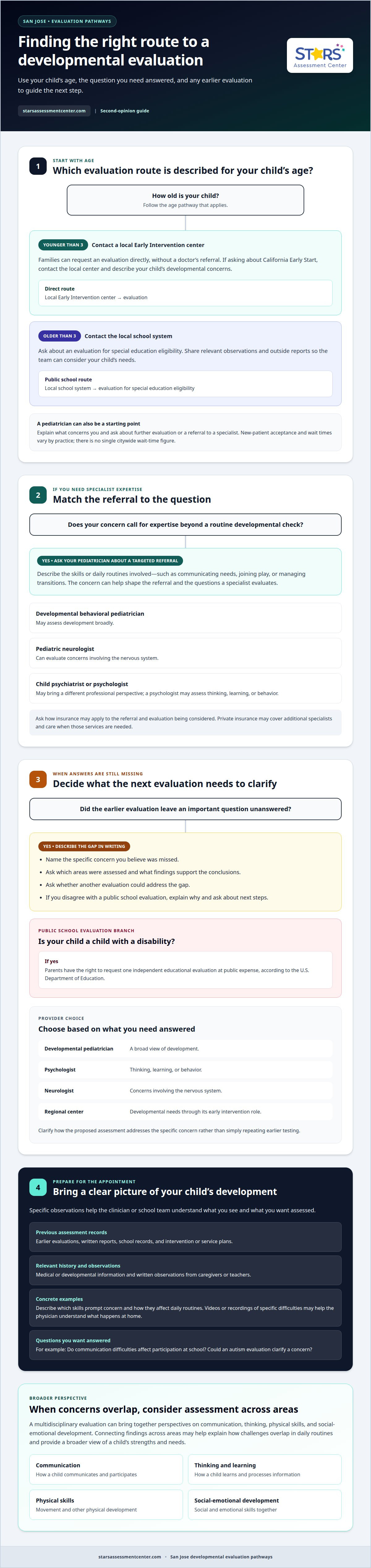
A second opinion should look beyond the milestone that first raised concern. In San Jose, getting a second opinion on developmental delay can start with asking your child’s pediatrician for further evaluation or another opinion; if your child is younger than 3, you can also contact a local Early Intervention center directly for an evaluation without a doctor’s referral.
It’s understandable to want clearer answers when your child’s development feels different from what you expected, especially if an earlier conversation did not address all your concerns. A developmental assessment looks across areas such as communication, learning, movement, and social-emotional development, rather than focusing on one skill alone.
This guide explains how to prepare observations for an appointment, seek referrals to specialists, and request further evaluation. You’ll also learn what developmental assessments may examine and how a multidisciplinary assessment can bring different areas of your child’s development into focus, so you can take a more informed next step.
Key Takeaways
- Bring clear observations about your child’s development to a pediatrician and explain which concerns you feel still need attention.
- Ask about referrals for specialist expertise or further evaluation when your questions remain unanswered.
- According to the U.S. Department of Education, families can access the public special education system through their local school system if their child is older than 3 years.
- Learn how developmental testing can consider physical, cognitive, communication, social, and emotional skills together.
- Explore how a multidisciplinary developmental assessment may help bring different observations into a clearer picture of your child’s needs.
Referral to developmental and behavioral specialists
San Jose families can ask a pediatrician about referrals to a developmental behavioral pediatrician, pediatric neurologist, child psychiatrist, or psychologist. New-patient acceptance and wait times vary by practice, so there is no single citywide wait-time figure.
- Describe the concern clearly. At the pediatrician appointment, explain which skills prompted concern and how they affect daily routines. For example, describe difficulty communicating needs, joining play, or managing transitions. Written observations, along with videos or recordings of specific difficulties, can help the physician understand what you see at home and decide which specialist’s expertise may be relevant.
- Ask for a targeted referral. Request a referral when you need expertise beyond a routine developmental check. A developmental behavioral pediatrician may assess development broadly, while a pediatric neurologist, child psychiatrist, or psychologist may bring a different professional perspective. The concern you describe, such as communication, behavior, or learning, can help shape the referral and the questions the specialist evaluates.
- Request an evaluation through Early Start if your child is younger than 3. In the United States, families can contact their local Early Intervention center directly for an evaluation without a doctor’s referral. If you are asking about California Early Start, begin by contacting the local Early Intervention center and describing your child’s developmental concerns. This is a direct route to an evaluation for a child under 3.
- Contact the local school system for older children. According to the U.S. Department of Education, families can access the public special education system through their local school system if their child is older than 3 years. Ask the school system about an evaluation for special education eligibility. Share relevant observations and outside reports, which can help the team consider your child’s needs.
- Take part in special education planning. If an evaluation leads to an Individualized Education Program, or IEP, parents may attend meetings and represent their child’s interests. Discuss how the child’s needs affect participation at school and what supports the plan should address. For a school-age child, a special education plan can be designed around that child’s specific needs.
- Ask how insurance may apply. Private insurance may cover additional specialists and care when those services are needed. Ask about coverage for the referral being considered and the steps required for the evaluation. San Jose families can also begin with their pediatrician, local Early Intervention center, or local school system, depending on the child’s age and the type of evaluation sought.
Requesting further evaluation or a second opinion
If an evaluation leaves important questions unanswered, you can ask for further assessment or another opinion. For parents getting a second opinion on developmental delay San Jose, the next step is to clarify what remains uncertain and what a new evaluation should address.
-
Request Further Evaluation
Write to the clinician or school team and describe the specific concern you believe the evaluation missed. Ask what areas were assessed, what findings support the conclusions, and whether another evaluation could address the gap. If you disagree with a public school evaluation, explain your reasons and ask about next steps. According to the U.S. Department of Education, parents of children with disabilities have the right to request one independent educational evaluation at public expense.
-
Choose an Evaluation Provider
Match the provider’s role to the question you need answered. A developmental pediatrician can consider development broadly; a psychologist may assess thinking, learning, or behavior; a neurologist can evaluate concerns involving the nervous system; and a regional center can assess developmental needs through its early intervention role. For a family getting a second opinion on developmental delay San Jose, clarify how the proposed assessment addresses the specific concern rather than simply repeating earlier testing.
-
Prepare Records for the Appointment
Gather previous evaluations, the written report, school records, and any intervention or service plans. Include relevant medical or developmental information, plus written observations from caregivers or teachers. Outside reports may be provided as part of a child’s evaluation. At the appointment, identify the questions you want answered, such as whether communication difficulties affect participation at school or whether an autism evaluation may clarify a concern. Keep copies together so the specialist can review the history.
-
Consider a Multidisciplinary Evaluation
Ask whether your child’s questions call for assessment across more than one developmental area. A multidisciplinary evaluation can bring together perspectives on communication, thinking, physical skills, and social-emotional development, helping connect findings rather than treating each concern alone. It may help when a single evaluation doesn’t explain how challenges overlap in daily routines. A multidisciplinary developmental assessment can provide a broader view of your child’s strengths and needs.
Parents who do not feel that a physician has addressed their developmental concerns can request further evaluation or seek a second opinion from another primary care physician or pediatrician. When deciding what to request, keep the focus on the developmental concerns you believe remain unaddressed. You can make clear that you are asking for further evaluation, or that you want a second opinion from another primary care physician or pediatrician. These are options when you do not feel that a physician has addressed your developmental concerns. Choose the route that best reflects what you are seeking: further evaluation or another opinion.
Developmental tests
A developmental assessment considers how a child uses skills in everyday situations. Knowing what it covers can help you describe your concerns and understand how the findings relate to your child’s daily life.
- Ask what the assessment will cover. Stars Assessment Program assesses speech and language, cognitive, motor, social-emotional, adaptive, and vision and hearing screening areas. This may include how a child understands and uses communication, learns through play, moves and handles objects, interacts with others, manages routines, and responds to sounds and sights. Ask how the assessment connects these areas with the concern that led you to seek another opinion.
- Understand the role of developmental milestones. Milestone checklists can offer a reference for monitoring progress, but they don’t replace an individual assessment. Yale Medicine describes development from gestation through the first five years of life. It identifies 4 to 18 months as a phase when social, sensory, motor, and cognitive skills become more complex, and preschool as ages 3 to 5. A child’s age and broader pattern matter when interpreting a milestone.
- Share examples from ordinary activities. Describe what happens during meals, play, dressing, or conversations, rather than relying only on a general statement such as “my child is behind.” A specific example might be difficulty following a familiar direction or joining a simple game. Notes from home, childcare, or school can show whether a skill appears in different settings. Such context helps the specialist interpret what a task or observation means for your child.
- Ask how observations and activities inform results. A developmental assessment brings together information from the family and observations of the child’s skills. Stars uses a structured, play-based approach that is child-friendly, flexible, and child-led, with parents present throughout. Activities are adjusted to the child’s comfort and attention. The visit is paced to the child, and its length depends on the child’s age and attention.
- Discuss what the findings mean for next steps. Ask the specialist to explain strengths, areas needing support, and any limits of the assessment in plain language. If a result raises a medical question, ask whether another professional evaluation is appropriate. Yale Medicine notes that milestones are meaningful within a normal range; a healthy child who walks late may have little reason for concern if all else is well. Use the report to guide follow-up questions, not as a label detached from your child’s overall development.
Physical, cognitive, social, and emotional development
A clear loss of a skill your child previously used deserves prompt discussion with their pediatrician. Note what changed and when, such as a child no longer using familiar words or walking independently.
- Describe physical skills through everyday tasks. Consider how your child moves, reaches, handles objects, and manages routines such as dressing or eating. For example, note whether climbing steps, holding a cup, or using both hands has changed. A specific description helps distinguish a new difficulty from a skill your child hasn’t learned yet. Share when you first noticed the change and whether it appears at home, childcare, or school.
- Connect cognitive skills with learning and problem-solving. Describe how your child explores toys, remembers familiar routines, follows directions, or tries a simple puzzle. A child who finds a hidden toy but struggles to copy an action may show different abilities across activities. These examples give an evaluator context beyond a single task. Mention what your child does independently and what happens after you demonstrate or repeat an activity.
- Give examples of communication and social interaction. Note how your child asks for help, responds to their name, shares attention, or joins play. For example, describe whether they bring a toy to show someone or respond when another child invites them to play. Also share how communication changes with familiar people. Social and language skills may look different across settings, so examples from home and school can add useful context.
- Track emotional responses and behavior in context. Describe what happens before and after a challenging moment, such as a transition away from a favorite activity. Note whether your child withdraws, becomes aggressive, or has difficulty interpreting social cues. Children who struggle with emotional regulation may also find social situations difficult. Recording the setting, trigger, and response helps an evaluator understand the behavior’s effect on play, learning, and family routines.
- Consider age and the overall pattern, not one milestone alone. Yale Medicine describes preschool development as ages 3 to 5 and notes that milestones matter within a normal range. A healthy child who walks late may have little reason for concern if all else is well. Share the full pattern of strengths and difficulties with the evaluator, including changes over time. A developmental assessment can consider how physical, cognitive, social, and emotional abilities work together in daily life.
Pediatricians monitor developmental progress during routine well-child visits. Families can also keep notes on their child’s skills and daily routines to share when asking about an assessment. If something does not feel right, you do not have to wait for certainty to act.
Where can families in San Jose get a second opinion for developmental delay?
For families in San Jose, the right route depends on the child’s age and the question needing review. Use these steps to identify an evaluation pathway and prepare for a useful second opinion.
- Start with your child’s pediatrician. Tell the pediatrician which concern remains unresolved and ask for a further evaluation or referral. A developmental behavioral pediatrician, pediatric neurologist, child psychiatrist, or psychologist may offer relevant expertise. The concern helps guide the referral: questions about communication, learning, behavior, or movement may call for different professional perspectives. Bring a brief description of what you want the next evaluation to clarify.
- Contact Early Intervention for a child younger than 3. Families can contact their local Early Intervention center directly for an evaluation without a doctor’s referral. Explain the developmental concern and ask about the evaluation process. This route can help families seek an early assessment when questions involve communication, physical skills, or social development. Keep notes about the referral or intake conversation, including any requested records, so you can follow the process clearly.
- Ask the local school system about evaluation for a child older than 3. According to the U.S. Department of Education, families can access the public special education system through their local school system if their child is older than 3 years. Request information about an evaluation and provide relevant outside reports. If the school’s findings don’t address your concern, ask how to express disagreement and what options apply to the evaluation.
- Use the evaluation setting that matches your question. A physician referral may connect a family with a medical specialist, while an Early Intervention or school evaluation focuses on its respective developmental or educational process. Ask what areas the assessment covers and how its findings will be explained. For example, if a child’s communication difficulty affects play and classroom participation, clarify whether the evaluation considers both communication and its impact on daily activities.
- Organize records before scheduling the next appointment. Gather prior evaluations, school reports, intervention plans, and observations from caregivers. List the questions you want answered, such as whether a concern involves one skill or several connected areas. Private insurance may cover additional specialists and care when those services are needed, so ask your insurer about the referral process and relevant coverage. A clear record set helps each professional understand what has already been assessed.
Stars Assessment Program: Multidisciplinary Developmental Assessment
Stars Assessment Program offers a Multidisciplinary Developmental Assessment for families seeking a broader understanding of their young child’s development. Its assessment considers areas such as cognitive, physical, and communication skills, helping bring related concerns into one evaluation. When questions center on emotional or social development, a Social-Emotional Assessment may be relevant; communication concerns can also be explored through a Speech and Language Evaluation. Families seeking an assessment related to autism can discuss that concern as part of the evaluation process.
If earlier findings haven’t answered your questions, these assessments can offer another perspective on your child’s developmental needs. Contact Stars Assessment Program to discuss which assessment may fit your concerns.
Take the next step toward clearer answers
If you’re getting a second opinion on developmental delay in San Jose, let the questions still on your mind shape the next conversation. You do not need to have every concern neatly explained before asking for support. Start with what you hope to understand better about your child’s development, then bring that question to an assessment discussion.
A thoughtful next step can help turn uncertainty into a clearer picture of your child’s strengths and areas where support may be useful. Stars Assessment Program offers assessments focused on children’s development, social-emotional skills, and communication. The right starting point depends on the concern you want explored.
When you’re ready to talk through your child’s needs, contact Stars Assessment Program. You can share what you’ve noticed and discuss an assessment that fits your questions. Taking that first step can help you move forward with greater clarity and care.
Frequently Asked Questions
What type of specialist should evaluate a child with developmental delays?
The right specialist depends on the developmental concern and what you need clarified. A developmental behavioral pediatrician can review development broadly; a psychologist may focus on learning or behavior, while a pediatric neurologist can assess concerns involving the nervous system. For a child under 3, a multidisciplinary assessment can consider several developmental areas together. For example, if communication and play both raise questions, ask whether the evaluation addresses both.
How do I request a second opinion and transfer medical records in California?
Tell the current clinician which question remains unanswered, then request an appointment for another opinion. Ask the current office how to obtain copies of prior reports and how the new specialist prefers to receive them. Include relevant evaluations, medical history, and notes from childcare or school. Before the appointment, write down what you want clarified, such as how a finding relates to your child’s communication during daily routines.
Does California insurance cover a second opinion for developmental delay, and are referrals required?
Private insurance may cover additional specialists and care when those services are needed; coverage depends on your plan and the service. A referral may be part of accessing specialist care, so ask your plan about its process. For a child under 3, families can contact a local Early Intervention center directly for an evaluation without a doctor’s referral. Stars Assessment Program requires no referral for its developmental assessment.
What are the costs for private developmental evaluations in San Jose?
Costs for private evaluations vary with the provider and the scope of the assessment. Stars Assessment Program’s developmental assessment is provided at no cost to families. It is intended for children under 3 and is not a diagnostic assessment. Families in San Jose and Santa Clara County can ask about an assessment in their preferred language; results are explained in clear, simple language to support next-step discussions.
What should I do if specialists disagree about a child’s diagnosis or treatment plan?
Ask each specialist to explain the observations behind their conclusion and which questions remain open. Share both reports during a follow-up discussion, then ask whether another evaluation could clarify the difference. For disagreements about special education decisions, parents may request an impartial due process hearing. Keep the focus on your child’s daily needs, such as communication, learning, or participation at school, while the differing views are reviewed.


