
The first steps after a developmental delay diagnosis are to understand which areas of development need support, discuss early intervention, and build predictable routines around your child’s needs. For children up to 3 years of age, early intervention services can address developmental delays; according to the U.S. Department of Education, a provider creates an Individualized Family Service Plan if a child qualifies. A diagnosis can also raise questions about autism, but it doesn’t by itself explain every aspect of a child’s development.
It’s understandable to want to know what the diagnosis means and whether anything could have prevented it. The focus now can be on understanding how your child communicates, plays, moves, and connects with others, then identifying support that fits your family’s everyday life.
This article explains developmental delay, how early intervention works, and how consistent routines and responsive support can help. It also explores how developmental delay and autism relate, so you can approach your next conversations with greater clarity and care.
Key Takeaways
- Early intervention services for babies and children up to 3 years of age can minimize and often prevent the long-term effects of developmental delays, according to the U.S. Department of Education.
- Developmental concerns can involve communication, movement, social-emotional skills, thinking, and everyday activities. A specialist evaluation can help clarify which areas may need support.
- Predictable routines, simple instructions, and visual cues can make everyday activities easier to understand and follow.
- Developmental delay and autism are not interchangeable terms; an assessment can help identify a child’s individual strengths and support needs.
- Bring developmental concerns to a healthcare provider and ask about screening or evaluation to understand possible next steps.
What are early intervention services?
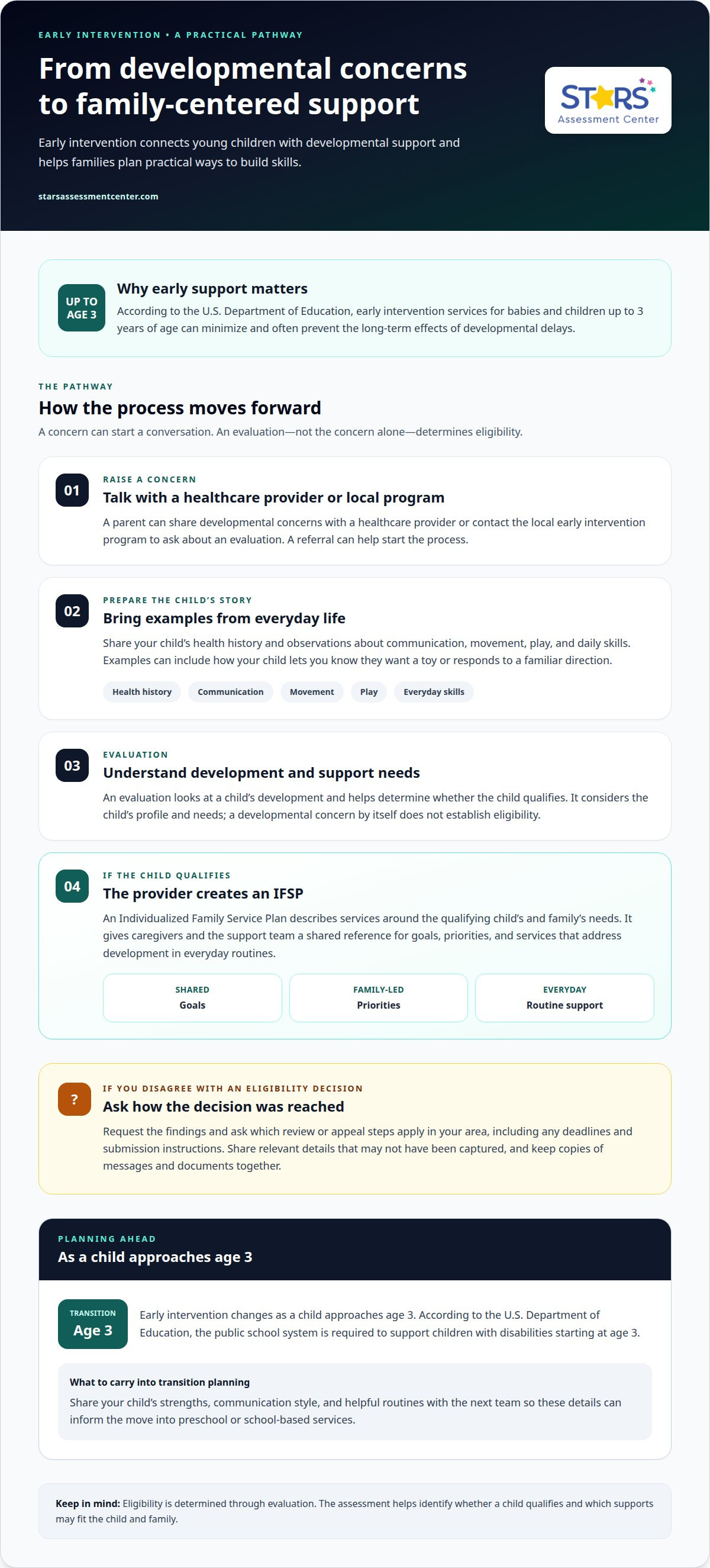
Early intervention connects young children with developmental support and helps families plan practical ways to build skills. According to the U.S. Department of Education, services for babies and children up to 3 years of age can minimize and often prevent the long-term effects of developmental delays.
Family Service Plans
An Individualized Family Service Plan (IFSP) describes early intervention services around a qualifying child’s and family’s needs. According to the U.S. Department of Education, the provider creates this plan when a child qualifies. It gives caregivers and the support team a shared reference for goals, priorities, and the services that address the child’s development in everyday routines.
Eligibility and Referrals
Eligibility is determined through an evaluation of a child’s development and support needs. A parent can raise concerns with a healthcare provider or contact the local early intervention program to ask about an evaluation. A referral can help start that process; a developmental concern alone doesn’t establish eligibility. The assessment helps determine whether the child qualifies and what supports may fit.
Medical History and Parent Interview
A child’s history and a parent discussion provide context for an assessment. Be ready to describe your child’s health, communication, movement, play, and everyday skills. For example, explain how your child lets you know they want a toy or responds to a familiar direction. These details help build a picture of what happens at home, not only during an appointment.
Appealing an Early Intervention Decision
If you disagree with an eligibility decision, ask the program to explain how it reached that conclusion. Request the findings and ask what review or appeal steps apply in your area, including any deadlines and submission instructions. You can also share relevant details the assessment may not have captured, such as how your child communicates during meals or play. Keep copies of messages and documents together.
Transitioning From Early Intervention to Preschool
Early intervention changes as a child approaches age 3. According to the U.S. Department of Education, the public school system is required to support children with disabilities starting at age 3. The transition involves planning what support may follow and sharing information with the next team. Discuss your child’s strengths, communication style, and helpful routines so those details inform the move into preschool or school-based services.
Does insurance, Medicaid, or the school district pay for developmental delay services? Payment depends on the service and program involved, so there isn’t one funding route for every family. Early intervention uses an IFSP when a child qualifies, while the U.S. Department of Education states that public schools are required to support children with disabilities starting at age 3.
What is a developmental delay?
A developmental delay means a child is gaining skills more slowly than expected in one or more areas. These can include movement, language, thinking, social skills, and everyday activities. A delay describes a child’s development; it doesn’t, by itself, explain why skills are emerging differently or predict a child’s future ability.
Developmental screening is a brief check of milestones and possible concerns. If a screen or a parent’s observations point to a need for closer review, a developmental evaluation looks more deeply at how a child communicates, moves, learns, follows directions, focuses, and interacts with others. There is no lab or blood test that determines whether a child has a developmental delay.
An evaluation can bring together a child’s history, observations, and developmental profile. For preschoolers and school-age children, an assessment may take place over two or three office visits. For example, an evaluator may look at how a child uses words during play, responds to instructions, or engages with another person. These examples help describe skills across settings, rather than relying on one isolated moment.
When should a child be evaluated for underlying medical or genetic causes of developmental delay? A healthcare provider considers further evaluation when a child’s developmental profile, medical history, or examination raises concern about an underlying cause. The provider may refer the child to a specialist, such as a developmental pediatrician or neurologist, based on the concerns identified.
Referrals can also address specific support needs. A pediatrician may recommend a hearing evaluation because hearing difficulties can affect speech and language. A speech and language specialist can assess communication, while other specialists may help examine particular developmental concerns. The referral should connect the question being asked with the right area of evaluation, such as understanding spoken directions or expressing needs.
Developmental concerns can also lead to an evaluation for special education services. The purpose is to understand a child’s abilities and support needs in an educational setting. Parents can share examples from daily life, such as difficulty joining group play or following classroom directions. These details help explain how a developmental difference affects participation, learning, and social skills at preschool or school.
Assessment findings describe strengths as well as areas where support may help. A child who uses gestures to request a favorite toy, for instance, is communicating, even if spoken words are limited. An assessment should capture how a child learns and connects, not only which milestones are emerging more slowly. Developmental information can help guide conversations about next steps.
If you’re seeking a clearer picture of your child’s communication, learning, or social-emotional development, a developmental assessment can help identify areas for further attention.
Consistent routines and simplified instructions
A predictable routine gives a child clear cues about what happens next. For example, a morning sequence might be getting dressed, eating breakfast, then putting on shoes. Repeating that order can help a child anticipate transitions and understand familiar expectations. A picture or a simple word for each activity can make the sequence easier to follow.
Keep routines practical for your family. Choose everyday moments, such as washing hands before lunch or putting toys away before bedtime. Use the same short cue for each step, then allow time for your child to respond. If the child seems unsure, point to a picture or demonstrate the action rather than adding several instructions.
Long directions can be hard to process when they contain several steps. Instead of saying, “Get your coat, find your shoes, and wait by the door,” give one instruction at a time: “Get your coat.” After that step, say, “Now find your shoes.” Getting your child’s attention before speaking can help them prepare to listen. Repeat the same wording as needed.
Break a new skill into smaller, visible actions. For handwashing, show turning on the faucet, wetting hands, using soap, rinsing, and drying. Demonstrate each part and give your child a chance to try it. If one part is difficult, practise that action before expecting the whole sequence. Smaller steps make it easier to see what needs more support.
Visual supports can clarify what words alone may not. A picture schedule, simple poster, or demonstration can show what “clean up” means. For example, point to a picture of blocks going into a bin, then model placing one block inside. Some children understand a task more easily when they can see the action as well as hear the instruction.
Reduce distractions before giving directions. Turning off the television or moving away from a noisy room can help a child hear and focus on the next step. Then offer a brief, achievable task, such as handing you one toy. Immediate praise can reinforce the action. If rewards suit your child, connect one to an interest, such as choosing a favorite song after tidying.
Routines support learning and can also offer useful information. Notice which cues your child follows, which steps need a demonstration, and where transitions become difficult. Share those examples with the child’s support team. A clear example, such as “the picture helps with putting on shoes,” gives adults a practical way to use consistent support at home or in another setting.
Responding to concerns about a child's development
A parent’s observations matter alongside milestone checks during well-child visits. If you notice a change in your child’s communication, movement, play, or daily skills, tell the pediatrician what you see. For example, describe whether your child responds to their name, uses gestures, or joins familiar games. Specific examples help turn a broad worry into a clear topic for discussion.
A sudden loss of skills your child previously used, such as words or walking, calls for prompt medical attention. If your child appears seriously unwell or is in immediate danger, seek emergency care. Tell the healthcare professional when the change began and which abilities have changed. A dated note can help you describe the difference between earlier and current behavior.
Children develop at different paces, so one missed milestone may not explain the full picture. Look for patterns, such as repeated difficulty communicating needs or engaging with other children. Note what happens during familiar activities, including meals, play, and getting dressed. This context helps the pediatrician understand whether a concern appears across situations or in one specific setting.
At an appointment, ask the pediatrician for a developmental screen if you have concerns. Bring examples, such as your child rarely pointing to request a toy or struggling to follow a familiar direction. Mention changes in social interaction, movement, language, and everyday tasks. This gives the conversation a practical starting point and helps identify whether a more detailed assessment may be useful.
A screen is an initial check, while an evaluation takes a closer look at developmental skills. The assessment may consider how your child communicates, moves, learns, follows directions, and interacts with others. Share what you notice at home, including strengths. For instance, a child may not use many spoken words but may communicate clearly by bringing an adult a desired object.
Keep track of concerns without turning daily life into a test. Write down a brief example, the activity, and what support helped. “During snack, my child pointed to the cup after I showed it” offers more detail than “communication is difficult.” If your child attends an early childhood setting, share relevant observations with the pediatrician and support team.
Some young children have difficulty communicating that they feel pain or are unwell. A grimace or a change from their usual behavior may be worth sharing with a caregiver or healthcare professional. At school or childcare, explain how your child typically signals discomfort. Familiar adults can then recognize changes and respond with better context.
Follow up on the next steps discussed with the pediatrician, such as screening or a referral for further evaluation. Early identification can help connect children with support suited to their needs. If your concern continues after an initial conversation, bring new examples to a later visit. Clear observations help keep the discussion focused on your child’s changing abilities.
Developmental delay and autism
Developmental delay and autism are related topics, but they aren’t interchangeable terms. A developmental delay describes slower progress in one or more areas, such as language, movement, or social skills. Autism is a separate diagnosis that may be considered during a developmental evaluation. The distinction matters because an assessment should describe a child’s individual profile, not assume one diagnosis explains every difference.
About 17% of children in the United States have at least one developmental delay. Some children with developmental delays may also have autism, anxiety, or cerebral palsy. These possibilities don’t mean every child with a delay has another condition. Instead, they show why an evaluation looks at the whole child, including communication, social interaction, learning, and everyday abilities.
For example, a child may use few spoken words but communicate by pointing, reaching, or bringing an adult a toy. Another child may speak often but find social interaction or changes in routine difficult. These examples don’t establish a diagnosis. They show why evaluators consider how children communicate and connect across activities, rather than relying on one behavior alone.
Parents can help make an assessment more informative by sharing specific observations. Describe what happens during play, meals, or time with other children. Note how your child asks for help, responds to others, or handles a change in plans. A concrete example, such as “she brings me a book but doesn’t point to pictures,” gives the evaluator useful context about communication and interaction.
A developmental assessment can examine language, social interaction, focus, motor skills, learning, and the ability to follow directions. The evaluator considers these areas together to understand strengths and support needs. If autism is a concern, an autism-focused assessment can help examine the child’s developmental profile further. A speech and language evaluation may add detail about how a child understands and expresses messages.
Keep communication open with the child’s healthcare and intervention team. Share changes in skills, new examples from home, and questions about the assessment findings. If your child uses gestures or another communication method, explain how it works in daily life. This helps the team understand preferences and support communication without assuming that spoken language shows everything the child understands.
The clearest takeaway is that a developmental delay can prompt further assessment, including consideration of autism, but it doesn’t settle that question by itself. For support understanding your child’s developmental profile, request an autism assessment.
Stars Assessment Program: Multidisciplinary Developmental Assessment
Stars Assessment Program offers a Multidisciplinary Developmental Assessment to help families better understand a young child’s development. For infants and toddlers under age 3, the assessment considers cognitive, physical, and communication skills through a multidisciplinary approach. This can be a helpful next step when you have questions about your child’s strengths or developmental needs. Depending on your concerns, Stars Assessment Program also offers Social-Emotional Assessment, Speech and Language Evaluation, and Autism assessment. Together, these evaluations can help clarify what your child may need and support informed conversations about next steps. If you’d like to discuss an assessment for your child, contact Stars Assessment Program.
Choose a next step that fits your child
The first steps after a developmental delay diagnosis can begin with the questions that matter most to your family. You might want a clearer understanding of your child’s communication, social-emotional development, or overall developmental profile. Naming that priority can help move the conversation toward support that may be useful.
Stars Assessment Program offers a Multidisciplinary Developmental Assessment, Social-Emotional Assessment, and Speech and Language Evaluation. These options can help families explore specific developmental concerns through an assessment suited to the questions they bring.
You don’t need to have every answer before reaching out. Share what you’ve noticed and what you hope to understand; that’s a meaningful place to begin. Contact Stars Assessment Program to discuss an assessment for your child.
Each thoughtful observation can help shape a clearer picture of your child’s needs. With understanding and support, your family can take the next step at a pace that feels manageable.
Frequently Asked Questions
What should parents do first after a child is diagnosed with developmental delay?
Start by asking the clinician who made the diagnosis to explain the findings and recommended next steps. Write down your main concerns, such as communication during meals or difficulty joining play, and ask which evaluation or support addresses them. These are practical first steps after a developmental delay diagnosis. A child’s age helps determine whether to explore early intervention or school-based evaluation.
How can families get an evaluation through the local early intervention program?
Contact the local early intervention program and ask how to begin an eligibility evaluation; share your child’s age and the developmental concerns you’ve noticed. Families in San Jose, Santa Clara, Santa Cruz, Salinas, Milpitas, Gilroy, and Morgan Hill can use those details when identifying the appropriate local program. For an assessment through Stars Assessment Program, no referral needed. The assessment is not diagnostic, and Early Start assessments are provided at no cost to families.
What services does early intervention provide for children under age 3?
When a child qualifies, an Individualized Family Service Plan records the child’s and family’s needs. The plan connects developmental priorities with supports and family goals. For example, a family concerned about a child expressing needs can discuss communication as a priority. The plan gives the family and support team a shared basis for coordinating everyday strategies and reviewing progress.
How do I request special education evaluation and an IEP for a child age 3 or older?
Contact your local school district and request an evaluation for special education services. Share how your child’s development affects participation in learning, communication, or classroom routines, and provide relevant assessment records. The evaluation helps determine educational needs and whether an Individualized Education Program, or IEP, is appropriate. According to the U.S. Department of Education, public schools are required to support children with disabilities starting at age 3.
What developmental therapies may be recommended, and how do families choose providers?
Recommendations depend on the developmental needs identified. A child’s support team can discuss options such as speech and language, physical, or occupational therapy when relevant. Match proposed support to a specific everyday goal, such as communicating choices or participating in play. Ask how progress will be discussed with the family and how the child’s strengths and preferred ways of communicating will shape the support.
What records and questions should parents bring to follow-up appointments?
Bring previous screening or assessment reports, relevant medical information, and notes describing examples from home or childcare. A short list can help keep the conversation focused: which skills are strengths, which routines are difficult, and what changes you’ve noticed. Ask what each finding means, which next step addresses your main concern, and how the family can share updates. Assessment in your preferred language. Stars Assessment Program explains results in clear, simple language.
What are the timelines and eligibility rules for early intervention and special education in the United States?
Early intervention serves babies and children up to 3 years of age; eligibility follows an evaluation of developmental needs. At age 3, public schools are required to support children with disabilities, according to the U.S. Department of Education. These age boundaries distinguish the programs, while the evaluation informs eligibility. The cited rules establish no single nationwide appointment timeline; timing follows each program’s intake and evaluation process.


