
Start with an Early Start assessment request. For an early intervention evaluation in San Jose, families can begin through California’s Early Start system. According to the California Department of Developmental Services, Early Start serves children from birth through 36 months, and a child may qualify with a developmental delay of at least 25% in one or more specified developmental areas.
If you’re noticing differences in your child’s communication, movement, learning, or interaction, it’s understandable to want a clear next step. You don’t need to have every concern sorted out before learning how an assessment works. This guide explains where families in San Jose can request an assessment, what settings may be available, how timing fits into the process, and how Early Start eligibility and services are determined. It also clarifies what an assessment can help identify, so you can better understand the path from initial concerns to decisions about support for your child.
Key Takeaways
- Learn where families in San Jose and nearby counties can begin an Early Start assessment request.
- Understand how developmental findings relate to eligibility and what factors shape the support a child may receive.
- See how assessment timing connects with the transition from Early Start to school district services.
- Explore what developmental evaluations may look at, including communication, social-emotional development, and broader developmental skills.
- Find out how assessment results can inform an Individualized Family Service Plan and guide the next steps for your family.
Assessment and eligibility timeline
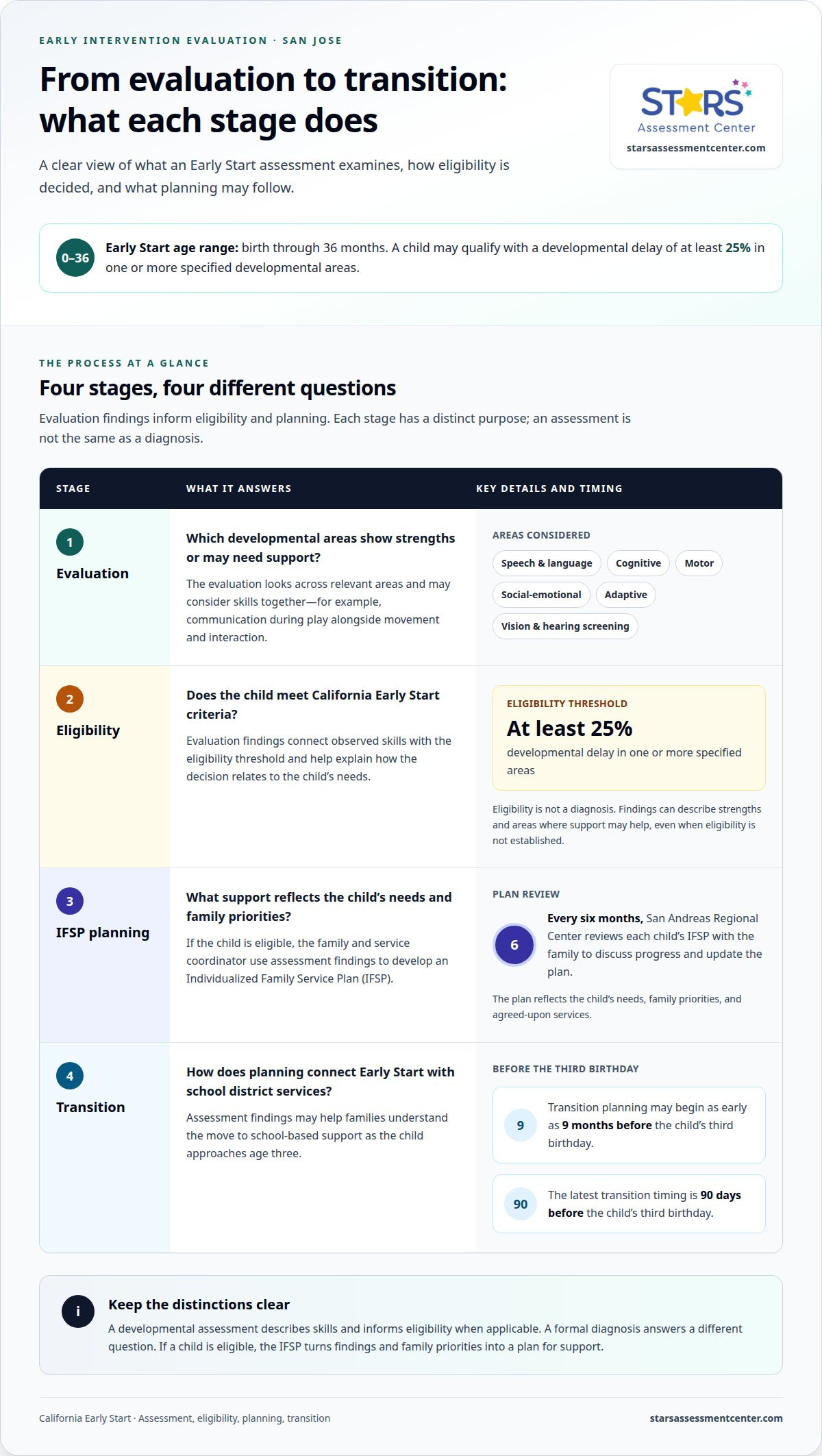
Assessment timing depends on the referral, the child’s developmental needs, and the Early Start process. Understanding each stage helps families know what the evaluation can determine and what follows.
Evaluation Components
An early intervention evaluation looks at a child’s development across relevant areas: speech and language, cognitive, motor, social-emotional, adaptive, and vision and hearing screening. Looking across these areas can show whether a concern relates to one skill or a broader developmental pattern. For example, the assessment may consider how a child communicates during play alongside movement and interaction, rather than relying on one observation.
Eligibility Decisions
Eligibility decisions use evaluation findings to determine whether a child meets California Early Start criteria. According to the California Department of Developmental Services, a child may qualify with a developmental delay of at least 25% in one or more specified developmental areas. The evaluation connects observed skills with that threshold, giving families a clearer explanation of how the decision relates to their child’s needs.
An assessment can describe a child’s strengths and areas where support may help, even if Early Start eligibility is not established. This is not a diagnostic assessment. Its findings help inform eligibility when applicable and give families a clearer understanding of their child’s development. A developmental assessment and a formal diagnosis answer different questions.
Next Steps and IFSP Creation
If a child is found eligible for Early Start, the family and service coordinator use the assessment findings to develop an Individualized Family Service Plan (IFSP). The plan reflects the child’s needs, family priorities, and agreed-upon services to support development. San Andreas Regional Center reviews each child’s IFSP with the family every six months, creating a regular opportunity to discuss progress and update the plan.
Timing also matters near age three. Transition planning from California Early Start to school district services may begin as early as 9 months before a child’s third birthday. The latest transition timing is 90 days before the child’s third birthday. Starting the discussion early gives families time to understand how assessment findings may inform the move to school-based support.
The rules behind Early Start include federal regulations. According to the Office of the Federal Register, National Archives and Records Administration, final federal regulations for IDEA Part C became effective in March of 1999 and are found in Title 34, Code of Federal Regulations, Part 303. Knowing this framework can help families understand why evaluation, eligibility, and planning are distinct stages, rather than one decision made during a single appointment.
California Early Start eligibility and services
If you disagree with an evaluation or eligibility decision, tell the service coordinator which findings concern you and ask how the conclusion was reached. Share examples from your child’s daily routines and ask how those observations can be considered in the discussion.
California Early Start serves infants and toddlers from birth through 36 months, according to the California Department of Developmental Services. Within that age range, a child may qualify based on a developmental delay of at least 25% in one or more specified developmental areas, according to the same department. The assessment connects a child’s observed skills with these eligibility criteria.
Eligibility is not the same as a diagnosis. Early Start uses developmental information to decide whether a child qualifies for its services. Families can request an assessment if they have questions about communication, movement, learning, or social-emotional development. The findings help inform eligibility when applicable.
It helps to distinguish identifying a developmental need from deciding what support may fit. An assessment may identify communication as an area of concern while other skills show a different pattern. The findings give families a basis for discussing priorities rather than relying on one isolated observation.
When a child is found eligible, an Individualized Family Service Plan, or IFSP, guides the services and supports. The plan reflects the child’s needs and the family’s priorities. California’s Early Start system is coordinated through community-based regional centers, and a Local Education Agency, which may be the local school district or San Andreas Regional Center, arranges or purchases needed early intervention services for an eligible child.
Early Start focuses on helping families and caregivers support learning and development through everyday opportunities. An assessment may consider how a child communicates during play, takes part in routines, or engages with caregivers. These observations can help connect findings to family priorities and the support discussed in the IFSP.
Evaluation, assessment, and service coordination have no cost for children determined eligible for Early Start. Families can ask whether any fees apply to their circumstances. These program rules concern Early Start services; they don’t determine the price of a separate private evaluation.
Eligibility can feel difficult to interpret when a child’s skills vary across settings or activities. Stars explains assessment results in clear, simple language, helping families understand which developmental areas were considered and what questions to discuss next.
How to request an Early Start assessment in San Jose and surrounding counties
For families in Santa Clara and Santa Cruz counties, the Early Start assessment request line is 1-844-700-9889. Families can request an assessment through the Stars Assessment Program. Calling is a direct starting point when a parent has concerns about a child’s development and wants to understand the assessment process.
When you contact the Stars Assessment Program, explain what prompted your request. You might describe concerns about your child’s words, responses during play, or participation in everyday routines. You don’t need to diagnose the concern before calling. If something does not feel right, you do not have to wait for certainty to act.
Before the initial consultation, consider your child’s age, the skills that concern you, and specific examples from home or childcare. For instance, note when communication concerns arise, such as during meals or play. These observations give the team a practical starting point for discussing the assessment.
Parents in San Jose can also make their preferred language clear at the first contact. If Spanish is the family’s preferred language, say so when requesting an assessment and ask how communication during the evaluation will be supported. Families who use another language can name that preference as well. This helps bring language access into the conversation early, rather than after assessment arrangements are underway.
During the initial consultation, share what you have noticed about your child’s everyday development: what they do independently, what takes support, and where you see differences. A child may communicate differently with familiar caregivers than in a new setting, so examples from both situations can provide useful context.
Parents may also want to distinguish an Early Start assessment from a school district evaluation or a private developmental evaluation. These routes can answer different questions, including program eligibility, educational planning, or a more focused look at developmental skills. If the immediate question is whether a young child may qualify for early intervention evaluation San Jose services, make that purpose clear during the request conversation.
For families across the designated counties, the key starting details are the referral contact, the child’s developmental concerns, and the family’s communication needs. A short description is enough to begin the conversation. More detailed examples can help explain what the family hopes the assessment will clarify and which everyday situations matter most.
What assessments are included in an early intervention evaluation?
An early intervention evaluation looks across a child’s development rather than relying on one skill or moment. Stars’ multidisciplinary assessment covers speech and language, cognitive, motor, social-emotional, adaptive, and vision and hearing screening. For example, a toddler’s gestures during play may add context to how they respond to spoken language.
Communication includes how a child understands and expresses messages. An evaluator may consider spoken words, sounds, gestures, and responses to familiar directions. A parent’s example of a child pointing to request a snack can help explain communication outside the assessment setting. Looking at both understanding and expression helps describe a child’s practical communication skills, not just the words they use.
Physical development includes movement and coordination used in daily activities. An evaluator may observe how a child reaches for a toy, changes position, or moves around a familiar space. These examples can help clarify whether a concern involves a specific movement or affects several routines. The purpose is to understand the child’s abilities and needs, not to judge how they perform one task.
Cognitive development involves learning, attention, memory, and problem solving through play. An assessment may consider how a child explores a toy or tries different actions during play. These observations provide context for how the child learns and help identify strengths and areas where support may be helpful.
Social-emotional development includes bonding, eye contact, play, expressing feelings, and settling. The assessment may consider how a child engages with a caregiver or responds during interactions. Family observations help connect what happens during the assessment with the child’s everyday experiences.
Some evaluations focus on a particular developmental question, while a multidisciplinary assessment considers multiple areas together. If communication is the main concern, the assessment can examine understanding and expression in greater depth. If parents describe concerns across communication, movement, and social interaction, a broader view can show how those skills relate. The findings help explain what was assessed and what the observations suggest.
You can help make the assessment more informative by sharing concrete examples from play, meals, or transitions. Describe what your child does independently and where support is needed. This gives the evaluator context for interpreting observations and helps the discussion reflect your child’s everyday development, not just one structured activity.
What happens after an early intervention evaluation and how is an IFSP created?
After the assessment, the findings can help inform Early Start eligibility when applicable and clarify developmental areas that may need attention. If your child is eligible, you and the service coordinator can use the assessment information to shape an Individualized Family Service Plan, or IFSP. The plan connects the findings with priorities for your child’s everyday life.
The IFSP is more than a list of services. It gives the family and team a shared framework for supporting a child’s development. Family priorities matter because useful goals connect with real routines, such as communicating during meals or taking part in play. Assessment findings help identify which skills and situations to address.
Planning conversations consider a child’s strengths, developmental needs, and the support that may fit. For example, if the assessment identifies communication as a concern, the family and team can discuss its effect on daily routines and what progress the family hopes to see. The plan reflects this discussion, not just one assessment result.
For a child eligible for Early Start, the local education agency arranges or purchases needed early intervention services. The agency may be the local school district or San Andreas Regional Center. The IFSP connects planning decisions with services intended to support the child, while keeping family priorities central.
After the IFSP is in place, it remains a working plan. San Andreas Regional Center reviews each child’s IFSP with the family every six months. These reviews provide an opportunity to discuss progress, current needs, and whether the plan still reflects family priorities. Changes in a child’s skills or routines can inform the conversation.
Age three also makes transition planning relevant. Planning from California Early Start to school district services may begin as early as 9 months before a child’s third birthday, and the latest transition timing is 90 days before that birthday. The family can use the transition discussion to understand how the child’s developmental information relates to the next setting.
To prepare for an IFSP conversation, families can connect evaluation findings with specific daily examples. A parent might describe how a child requests a favorite toy, joins a familiar game, or responds during a routine. Those details help make goals meaningful and clarify what progress would look like at home. If communication concerns remain a focus, discuss your child’s communication needs as you consider next steps.
Stars Assessment Program: Speech and Language Evaluation
Stars Assessment Program provides speech and language evaluations for families concerned about a child’s communication. The assessment considers how a child understands language and uses sounds, words, and gestures. Share the situations that raise questions, such as difficulty expressing needs during play or daily routines.
If questions extend beyond speech and language, a Social-Emotional Assessment or Multidisciplinary Developmental Assessment may provide a broader view of your child’s development. The right focus depends on the concerns you want to understand and the areas being assessed.
For support understanding your child’s communication development, contact Stars Assessment Program.
Take the Next Step With a Clearer Picture
Your child’s everyday experiences can help shape a focused conversation about development. Notice which situations raise questions, what your child communicates or attempts, and where support seems helpful. These observations can guide discussion of the assessment areas relevant to your concerns.
For families considering an early intervention evaluation in San Jose, Stars Assessment Program offers Speech and Language Evaluation, Social-Emotional Assessment, and Multidisciplinary Developmental Assessment. Each can help explore a different part of a child’s development, from expressing needs to interacting with others or understanding a broader pattern of skills.
You don’t need to have every concern resolved before taking a next step. If something does not feel right, you do not have to wait for certainty to act. Share what you have noticed with Stars to begin understanding your child’s development.
Contact Stars Assessment Program to discuss an assessment for your child. Your careful attention and willingness to ask questions are meaningful steps toward understanding how to support their growth.
Frequently Asked Questions
Do you know where my child can be tested for a diagnosis?
Stars Assessment Program assesses developmental skills and screens for concerns such as Autism or Down syndrome, but this is not a diagnostic assessment. If you have questions about communication, play, or learning, an evaluation can describe your child’s developmental profile. A developmental assessment and a formal diagnosis answer different questions.
What does early intervention mean?
Early intervention refers to support for infants and toddlers with developmental delays or concerns, helping families address needs in daily routines. In California, Early Start serves children from birth through 36 months, according to the California Department of Developmental Services. For example, a family concerned about a toddler’s communication can seek an assessment to better understand development and whether Early Start eligibility criteria are met.
What insurance do you accept?
No insurance is needed to pay for a Stars developmental assessment because there is no cost to families. That applies to the assessment itself, not necessarily to separate medical or therapy services. The assessment is not a diagnostic assessment, and it doesn’t determine insurance coverage for other care. Families can use the evaluation to better understand developmental concerns and discuss appropriate next steps.
Which agency provides early intervention evaluations for San Jose residents?
Stars Assessment Program provides developmental assessments for families in Santa Clara, Santa Cruz, and San Benito counties, including San Jose, Santa Clara, Milpitas, Gilroy, and Morgan Hill. Stars works alongside San Andreas Regional Center in the Early Start process. The assessment findings may help inform Early Start eligibility when applicable.
How do I request an early intervention evaluation in San Jose?
Families can contact Stars directly; no referral is needed. Call (844) 700-9889 and describe the developmental concern, such as limited gestures or difficulty expressing needs. Assessments are conducted in your preferred language. Share your child’s age and examples from everyday activities, so the team understands what prompted your request. An assessment helps inform Early Start eligibility when applicable, but it isn’t a diagnostic assessment.
How long does it take to get an early intervention evaluation in Santa Clara County?
The time from requesting an assessment to the appointment depends on scheduling and the child’s needs. The assessment visit itself depends on the child’s age and attention; it’s structured and paced to the child. For example, the evaluator can adjust activities if a toddler needs a break or isn’t ready to engage. Families can describe any communication or access needs when arranging the visit.
Is the early intervention evaluation free, and are services covered by insurance?
Early Start developmental assessments are provided at no cost to families. For children determined eligible, evaluation, assessment, and service coordination also have no cost. An annual family program fee may apply in some circumstances for Early Start services. The Local Education Agency arranges or purchases needed services for eligible children, so the assessment’s no-cost status shouldn’t be treated as a statement about insurance coverage for unrelated care.
What are the California timelines for early intervention evaluations and starting services?
California transition planning from Early Start to school district services may begin as early as 9 months before a child’s third birthday, and transition must occur no later than 90 days before that birthday. These milestones concern transition planning, not a guaranteed appointment date for an evaluation. The assessment-to-service process depends on evaluation findings, eligibility, family priorities, and the services included in the child’s plan.


