

By age two, most toddlers say about 50 to 100 words and use several two-word phrases, so a smaller spoken vocabulary may raise questions about expressive language delay in a 2 year old. Expressive language is how a child uses words, sounds, and gestures to communicate; understanding what others say is a separate part of language development.
It’s understandable to wonder whether a child is simply developing at their own pace or could use extra support. A language delay doesn’t point to one cause, and it doesn’t mean you’ve done anything wrong. This article explains common signs, how expressive delays differ from receptive delays, and what physical, hearing, developmental, and environmental factors may play a role.
You’ll also learn why an assessment considers both what a toddler says and what they understand, and how a developmental assessment can help your family understand your child’s communication and next steps.
Key Takeaways
- Notice whether your toddler is adding words, combining them, and using gestures to share needs and ideas.
- Separate challenges with speaking from difficulty understanding words, directions, or gestures.
- Consider how hearing, development, health, and family history may relate to a child’s communication.
- A speech and language evaluation can clarify your child’s strengths and support needs.
- Learn how early intervention and a developmental assessment can help guide next steps.
What Is Expressive Speech Delay?
Expressive speech delay means a child has difficulty using words, phrases, or gestures to communicate. At age two, a speech and language evaluation can compare a toddler’s communication with typical milestones and explore what support may help.
Age-Two Speech and Language Milestones
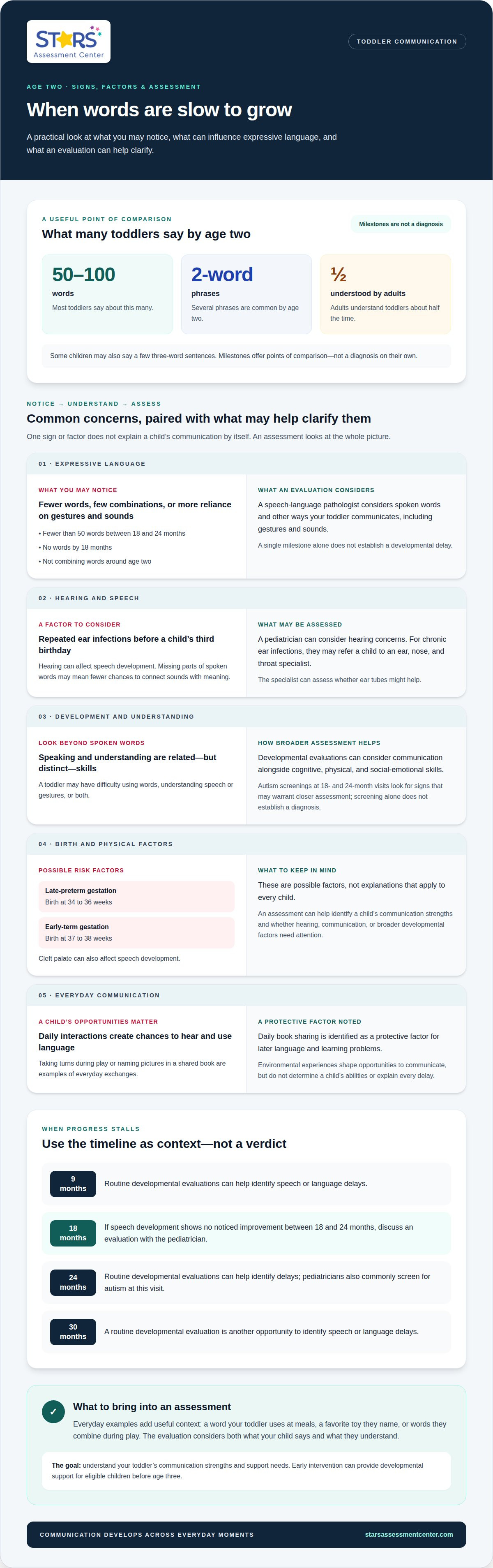
By age two, most toddlers say about 50 to 100 words and use several two-word phrases. Some may also say a few three-word sentences, and adults understand them about half of the time. These milestones offer useful points of comparison, not a diagnosis. Looking at how a child communicates across everyday situations helps describe their language development more fully.
Signs and Criteria for Delay
Possible signs include using fewer than 50 words between 18 and 24 months, having no words by 18 months, or not combining words around age two. A toddler may rely on gestures or sounds instead of words, or struggle to name familiar people and objects. These signs can prompt an evaluation; a single milestone alone doesn’t establish a developmental delay.
An expressive language delay in a 2-year-old may become noticeable between 18 months and 3 years. During an evaluation, a speech-language pathologist considers the child’s spoken words and other ways they communicate. They may also assess how the child understands speech and gestures, since understanding and expressing language are related but distinct skills.
Your observations can make an assessment more specific. Note whether your toddler says “more” at meals, names a favorite toy, or combines words during play. These examples show how your child communicates in familiar settings and give context to what specialists observe during an assessment.
A pediatrician can discuss concerns about speech and language development and consider whether further assessment is appropriate. If a child is 18 to 24 months old and speech development shows no noticed improvement, a pediatrician might refer them to a speech pathology specialist. Autism spectrum disorder and other developmental concerns may also be considered as part of a broader developmental evaluation.
Speech therapy sessions for toddlers typically last 30 to 60 minutes and may be provided 1-2 times per week. A session can focus on communication goals through interaction and practice, with activities suited to the child’s abilities. The evaluation helps identify which skills need attention, while progress over time helps guide the support.
Common physical, hearing, developmental, and environmental causes
Parents should seek a speech and language assessment when a toddler’s communication concerns persist or progress stalls. If you notice little improvement between 18 and 24 months, discuss an evaluation with the child’s pediatrician.
Some factors begin before birth. Late-preterm gestation means birth at 34 to 36 weeks, while early-term gestation means birth at 37 to 38 weeks; both are identified as possible risks for delayed expressive language. Cleft palate, an opening or difference in the roof of the mouth that may also affect the upper lip and gum line, can affect speech development.
Hearing is another part of the picture. Repeated ear infections before a child’s third birthday can affect hearing and speech development. A toddler who misses parts of spoken words may have fewer chances to connect sounds with meaning. A pediatrician can consider hearing concerns during an evaluation and refer a child with chronic ear infections to an ear, nose, and throat specialist to assess whether ear tubes might help.
Developmental differences can also affect communication. Pediatricians commonly screen children for autism spectrum disorder at the 18- and 24-month office visits, according to the American Academy of Pediatrics. A screening looks for signs that may warrant closer assessment; it does not, by itself, establish a diagnosis. Broader developmental evaluations can consider communication alongside cognitive, physical, and social-emotional skills.
Environmental experiences shape opportunities to communicate, but they don’t determine a child’s abilities or explain every delay. Everyday exchanges, such as taking turns during play or naming pictures in a shared book, give toddlers chances to hear and use language. Daily book sharing is identified as a protective factor for later language and learning problems.
Communication differences may affect more than spoken words. A child who struggles to express a need during play may find it harder to join exchanges with other children, which can influence social and emotional experiences. Longer-term outcomes also deserve attention: children identified with late language emergence may score lower on complex language skills, including story narration, at age five. This possibility supports understanding a child’s needs early, not assuming a particular outcome.
Routine developmental evaluations at 9, 18, and 30 months can help identify speech or language delays. An assessment can clarify whether hearing, communication, or broader developmental factors need attention. If you’re concerned about your toddler’s speech, a speech and language evaluation can help identify communication strengths and needs.
Early intervention for children under age three
Early intervention can connect young children with support for communication and other developmental needs. Starting with a clear understanding of eligibility and family priorities helps make the next steps more manageable.
Early Intervention Services
Early intervention provides developmental support for eligible children before age three, when communication, learning, and other skills are growing. According to the U.S. Department of Education, children younger than three may be referred to an early intervention program.
A child’s needs may involve more than speech. Developmental assessments can consider speech and language, cognitive, motor, social-emotional, adaptive, vision and hearing screening. For example, if your toddler has difficulty expressing needs, it may also be helpful to understand how they comprehend language and take part in everyday routines.
For a qualifying child, an Individual Family Service Plan guides the services the child receives until age three, according to the U.S. Department of Education. The plan connects identified needs with agreed services and family priorities. The Individuals with Disabilities Education Act of 2004 gives families the opportunity to share concerns and priorities that may guide or influence treatment.
Eligibility for Services
You do not need to wait for a diagnosis before requesting an assessment. No referral needed. Families can contact Stars directly. The assessment helps inform eligibility for Early Start when applicable, but it does not guarantee eligibility. This is not a diagnostic assessment.
Assessments consider how a child communicates and functions in daily activities, alongside other developmental skills. If a toddler has difficulty using words, evaluators may consider communication in play, routines, and interactions. Eligibility is reviewed periodically every 6 months and annually, allowing services to reflect a child’s changing needs.
An assessment can help you understand how your child communicates during everyday activities and what next steps may be appropriate. Stars explains results in clear, simple language so families can better understand their child’s strengths and support needs.
Toddler speech therapy pricing depends on the child’s needs and service plan; a price is provided after a quote request, with evaluation needs and service scope among the cost factors. Insurance coverage depends on the benefits and terms of the family’s plan, so coverage differs between plans and services.
Early intervention programs typically last 6-12 months, and support can be reviewed as a child develops. For families, an evaluation can clarify whether a toddler may qualify, which developmental areas need attention, and how family priorities can shape the plan. These steps help turn a concern about communication into an informed support plan.
Expressive and receptive language delay
Expressive language is how a child communicates ideas; receptive language is how they understand words, directions, and gestures. Considering both helps clarify whether a toddler is having difficulty expressing themselves, understanding others, or both.
A child with expressive communication difficulties may understand familiar directions but use few words to answer or make a request. For example, they might bring a cup when asked but point instead of saying “drink.” A child with receptive difficulties may struggle to follow the same request, even when familiar objects and routines provide context. These examples help describe different skills, but don’t establish a diagnosis.
At age two, most toddlers can follow a one-step command without a gesture. “Bring me your shoes” is one example. Observing whether a child responds to a familiar instruction can offer information about receptive language, especially when the adult gives the direction without pointing or demonstrating.
Understanding language also changes with context. A toddler may follow “sit down” during a familiar meal routine but find a new direction harder to understand. An assessment considers how the child responds across activities, rather than relying on one moment. It can also examine whether gestures, tone, or familiar surroundings help the child understand what’s being said.
Receptive and expressive skills don’t always develop at the same pace. A toddler may understand more words than they can say, or have difficulty both understanding and using language. For context, one prevalence estimate was 19.1% when expressive language alone was considered, compared with 13.4% when both receptive and expressive language were considered. These figures describe groups, not an individual child’s abilities.
By age three, children usually have a vocabulary of 200 to 1,000 words and should ask for things by name. These milestones offer additional context when considering a child’s progress, but they don’t replace observing their communication at home, during play, or with familiar people. A child who says “that” while reaching for a toy may be communicating a clear request, even without naming it.
A developmental assessment considers what a child communicates and understands. Specialists may observe responses to speech, gestures, and communication during play. Your examples can add useful context: does your child understand a familiar request, point to a named picture, or use words to ask for help? The assessment considers speech and language alongside other developmental areas.
Changes in both understanding and communication can help describe a toddler’s development. If your child uses few spoken words but understands familiar language, that difference is useful context. If both understanding and speaking seem difficult, considering both areas can give a fuller picture of your child’s communication needs.
Possible causes of expressive language delay
Expressive language delay can have more than one contributing factor, and a risk factor doesn’t identify the cause for an individual toddler. Family history is one clue: late language emergence was estimated at 23% among children with a positive family history, compared with 12% among children with no reported history. These figures describe groups, not a child’s diagnosis.
Birth and early development can also matter. Children born earlier than 37 weeks of gestation have been found at higher risk for late language emergence. One study finding identified higher risk among children born at less than 85% of their optimum birth weight. These are associations, not proof that early birth or weight alone caused a speech delay.
Sex differences appear in group estimates, too: boys are 3 times more likely than girls to exhibit late language emergence. That statistic can’t predict whether a particular boy will have speech problems, or explain why an individual child communicates differently. An evaluation considers a toddler’s communication profile and development, rather than using sex as a diagnosis.
Oral anatomy is another factor families may wonder about. A short frenulum, the tissue connecting the tongue to the floor of the mouth, doesn’t necessarily cause speech impairment. Speech delay can also occur with a normal frenulum. This distinction matters because noticing a physical feature alone cannot explain a child’s talking or establish the need for a specific treatment.
Some toddlers have a clear associated developmental, hearing, or medical concern, while others don’t have one obvious explanation. A family history, birth history, hearing concerns, and the child’s communication across daily routines can each add context. For example, a toddler who struggles to name toys at home and communicate needs during preschool may need a broader look at speech and language skills.
Possible effects reach beyond words. If a child can’t easily express “help,” “stop,” or “my turn,” participating in play with peers may become harder. At preschool or school, communication challenges can affect asking for assistance or joining group activities. These examples describe practical needs, not a prediction of a child’s learning or emotional development.
A speech and language evaluation can help distinguish a communication delay from other developmental concerns and identify the child’s strengths. The assessment draws on how the toddler communicates and understands others, alongside relevant family and developmental history. That fuller view can guide decisions about support, including whether speech therapy or broader developmental assessment is appropriate.
Take the next step in understanding your child’s communication through an evaluation that considers their individual developmental profile.
Stars Assessment Program: Speech and Language Evaluation
Stars Assessment Program offers a Speech and Language Evaluation to help families understand a toddler’s communication strengths and support needs. It considers how a child uses language and communicates, providing a clearer picture when spoken words or phrases are a concern.
If you have concerns about other areas of development, Stars also offers a multidisciplinary developmental assessment that considers speech and language, cognitive, motor, social-emotional, adaptive, vision and hearing screening. Social-emotional assessments and autism screenings are also available. This is not a diagnostic assessment; results help families understand development and consider appropriate next steps.
If you’re concerned about your child’s speech or development, contact Stars Assessment Program to discuss an assessment.
Take the Next Step Toward Clearer Communication
Noticing a possible expressive language delay in a 2-year-old can bring up many questions, but you don’t have to sort through them alone. A useful next step is to share your observations with someone who can help you understand your child’s communication and developmental needs.
If something does not feel right, you do not have to wait for certainty to act. A developmental assessment can help you understand how your toddler communicates, consider other areas of development, and get clear guidance about next steps. Stars serves families in San Jose, Santa Clara, Santa Cruz, Salinas, Milpitas, Gilroy, and Morgan Hill.
Stars Assessment Program offers Social-Emotional Assessment, Multidisciplinary Developmental Assessment, and Speech and Language Evaluation. If you’re ready to discuss your child’s needs, contact Stars Assessment Program. Every child has their own way of communicating, and understanding that starting point can help your family move forward with greater clarity.
Frequently Asked Questions
What are typical language milestones for a 2-year-old?
At age two, many toddlers use words to name familiar people and objects and may combine words to share simple ideas, such as “more juice” or “Daddy go.” Understanding matters too, so notice how your child responds during everyday routines. Milestones are comparison points, not a complete measure of communication. Gestures, interaction, and how your child communicates in different settings also provide context.
What are the signs of expressive language delay in a 2-year-old?
Possible signs include a limited spoken vocabulary, few word combinations, or relying on pointing and sounds to communicate needs. For instance, a toddler may reach for a snack without attempting a word or phrase. Consider whether your child is gaining new ways to communicate over time, including words and gestures. A speech-language evaluation can help distinguish a concern about spoken expression from differences in understanding or broader development.
How many words should a 2-year-old say, and should they use two-word phrases?
By age two, most toddlers say about 50 to 100 words and use several two-word phrases. Examples include “want ball” and “mommy up.” Count meaningful words your child uses consistently, not only clear adult-like pronunciation. A word approximation can still communicate meaning. If your toddler has few spoken words or isn’t combining words, discuss your observations with a professional rather than relying on a word count alone.
What causes expressive language delay in toddlers?
There isn’t one explanation for every toddler’s speech delay. Possible contributors include hearing differences, family history, premature birth, or broader developmental differences. A factor may raise the value of an evaluation without identifying the cause for an individual child. For example, repeated ear infections can affect hearing, while a short frenulum doesn’t necessarily cause speech impairment. A developmental and communication assessment considers the child’s overall profile.
How is expressive language delay evaluated in a 2-year-old?
A developmental assessment considers how a toddler communicates and understands language, not just how many words they use. Specialists may observe play, gestures, responses to speech, and attempts to request or share attention. Your examples from meals, reading, and play can add helpful context. The assessment also considers speech and language, cognitive, motor, social-emotional, adaptive, vision and hearing screening. This is not a diagnostic assessment.
How can parents get a free early intervention evaluation for a toddler in the United States?
For families in Santa Clara or Santa Cruz County, Stars Assessment Program accepts direct requests for assessments for children under 3 years; no referral is needed. There’s no cost to families. This is not a diagnostic assessment, but it can help inform Early Start eligibility when applicable. Assessment in your preferred language is available, and results are explained in clear, simple language. Call (844) 700-9889 to discuss an assessment.
What speech therapy helps expressive language delay in 2-year-olds?
You can encourage communication during play and daily routines by responding to your child’s gestures, sounds, and words. For example, when your toddler points to a toy, name it and add a simple word such as “red car.” Follow your child’s interest and give them time to respond. An assessment can help you understand your child’s communication strengths and what next steps may be appropriate.
What can parents do at home to encourage a 2-year-old’s speech?
Build language into ordinary moments: name foods while preparing a snack, describe actions during play, and share picture books together. Pause after speaking to give your child time to respond, rather than answering for them immediately. When your toddler points to a toy, you can say its name and add a simple word, such as “red car.” Follow the child’s interest and treat gestures, sounds, and words as communication.


