
You have spent hours watching your little one play, perhaps wondering if the way they struggle with certain toys or their quiet nature is just a phase or something that needs extra attention. It's completely natural to feel a mix of deep love and lingering anxiety when milestones don't seem to align with the charts you see online. You want the best for your child, but the technical language surrounding early start eligibility California can feel like a barrier when you're already feeling overwhelmed.
We understand that you're looking for clarity, not more confusion. This guide is designed to be your steady ally, showing you exactly how your child can qualify for support and how to move forward with confidence. We'll walk you through the 2026 eligibility rules, including the 25% developmental delay threshold and established risk factors. You'll also find a clear roadmap for securing a professional multidisciplinary assessment in Santa Clara County, ensuring your family has the dedicated guidance you deserve.
Key Takeaways
- Identify the critical window for early intervention, which supports infants and toddlers from birth through 36 months of age.
- Learn the specific 2026 early start eligibility California criteria, including the updated 25% developmental delay threshold across key growth domains.
- Understand the difference between an "Established Risk" medical diagnosis and a "Developmental Delay" that is identified during a professional screening.
- Follow a clear roadmap for the assessment process, beginning with a direct referral to your local Regional Center without needing a doctor’s note.
- Discover how families in San Jose and Santa Clara County can access specialized multidisciplinary evaluations and social-emotional support.
What is the California Early Start Program?
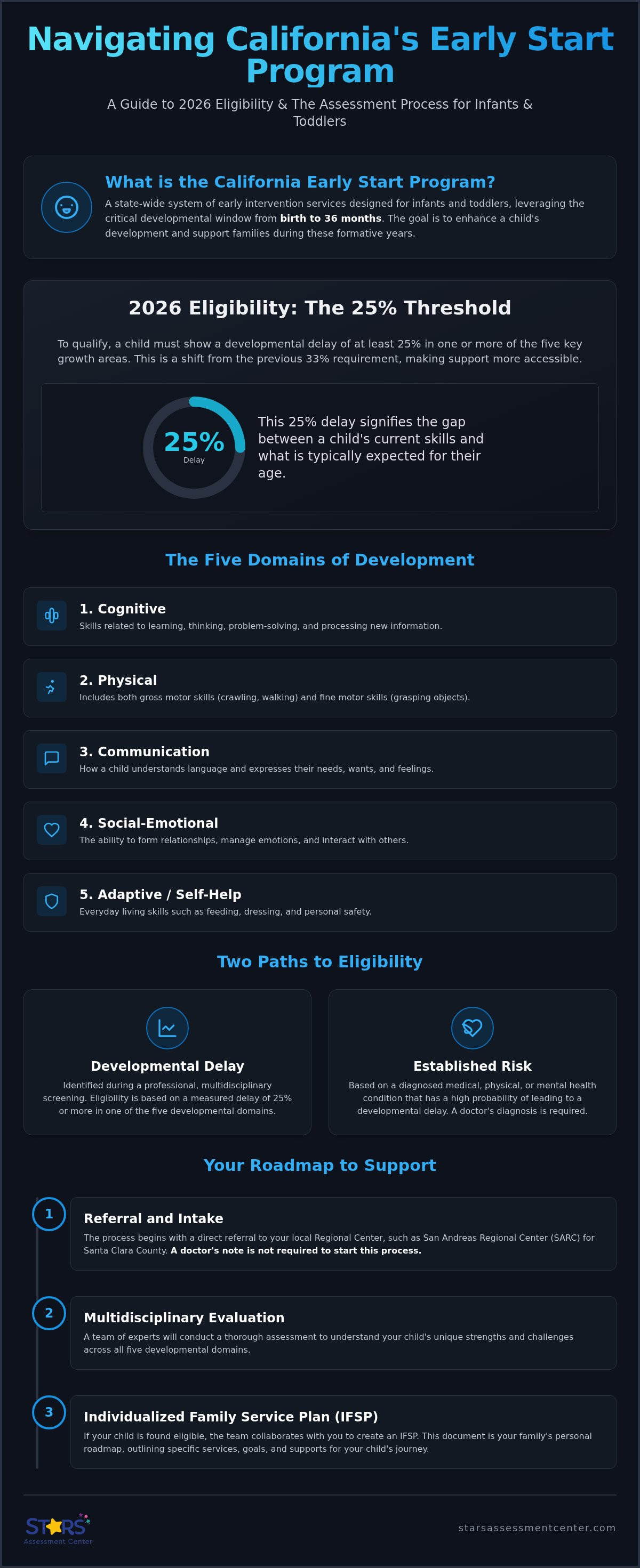
When you first notice your child might be developing differently than their peers, it's natural to feel a sense of urgency. The California Early Start program exists to meet that urgency with professional care and structured support. It is the state's comprehensive system of early intervention services, specifically designed for infants and toddlers from birth through 36 months of age. This period is widely recognized by developmental specialists as the most critical window for growth. By focusing on this early stage, the program aims to enhance your child’s development and provide your family with the tools needed to thrive during these formative years.
This program isn't a single office; it's a collaborative effort between the California Department of Developmental Services (DDS) and local education agencies. Together, they ensure that families across the state have access to coordinated services. Whether your child needs help with speech, social-emotional growth, or physical milestones, understanding early start eligibility California is the first step toward accessing a network of experts dedicated to your child's success. The ultimate goal is to create a partnership where you feel heard and your child feels supported.
The Importance of the First Three Years
The reason we emphasize the age range of birth to three is rooted in neuroplasticity. During these first few years, a child's brain is incredibly adaptable, forming millions of new neural connections every second. Early intervention is considered the gold standard because it takes advantage of this high level of brain flexibility. Addressing developmental delays early can often reduce the need for more intensive special education services later in life. Much like the federal Early Head Start initiatives, California's program focuses on the "whole child," viewing a developmental assessment not as a label, but as a proactive investment in your child's future potential.
Who Governs Early Start in California?
The Department of Developmental Services (DDS) serves as the lead agency for Early Start, overseeing the state's response to federal mandates for early intervention. Locally, the program is administered through a network of Regional Centers, such as the San Andreas Regional Center (SARC) serving our community. These centers act as a hub for families, coordinating the various specialists your child might need. The process typically moves through several key stages:
- Referral and Intake: A simple process to begin the conversation about your child's needs.
- Multidisciplinary Evaluation: A thorough look at your child's strengths and challenges by a team of experts.
- The IFSP: If your child meets early start eligibility California requirements, the team creates an Individualized Family Service Plan (IFSP). This document serves as your personal roadmap, outlining the specific services and goals tailored to your child’s unique journey.
Understanding Early Start Eligibility Criteria in California
Determining if your child qualifies for support can feel like trying to solve a puzzle with missing pieces. The early start eligibility California guidelines are designed to identify infants and toddlers who would benefit most from early intervention. Eligibility generally falls into three categories: developmental delay, established risk, or high risk. By understanding these criteria, you can better advocate for the services your child needs to reach their full potential.
In 2026, the state adjusted the threshold for eligibility to make support more accessible to families. A child is now eligible if they demonstrate a developmental delay of at least 25% in one or more areas of growth. This is a significant shift from previous years when a 33% delay was required in a single domain. These percentages are determined through a multidisciplinary developmental assessment, where professionals compare your child's current skills to what is typically expected for their age. This process ensures that even subtle delays are caught early when intervention is most effective.
The Five Domains of Development
When specialists evaluate your child, they look at five specific "domains" or areas of growth. Each one plays a vital role in how your child interacts with the world. These domains include:
- Cognitive: This involves how your child learns, thinks, and solves problems. It's about their natural curiosity and how they process new information.
- Physical: This covers both gross motor skills, like crawling or walking, and fine motor skills, such as grasping a spoon. It also includes vision and hearing.
- Communication: Specialists look at both receptive language (what your child understands) and expressive language (how they communicate their needs).
- Social-Emotional: This domain focuses on how your child relates to others, plays, and expresses their feelings.
- Adaptive: These are "self-help" skills, such as eating or dressing, that show how a child is gaining independence.
High Risk for Developmental Delay
Some children are eligible for services immediately because of an "established risk" condition. These are diagnosed medical conditions that have a high probability of resulting in a developmental delay. Examples include genetic disorders like Down syndrome, significant hearing loss, or fetal alcohol syndrome. If your child has a confirmed diagnosis, they often qualify for California's Early Start Program without needing to prove a specific percentage of delay first.
Additionally, a child may be eligible if they are at "high risk" due to a combination of biomedical factors. This might include a history of prematurity (less than 32 weeks gestation), very low birth weight, or significant birth injuries. Clinical judgment from a team of professionals is essential here. They look at the whole picture of your child's health to ensure no one who needs help falls through the cracks. This comprehensive approach ensures that the early start eligibility California process remains a supportive gateway rather than a clinical barrier.
Developmental Delay vs. Established Risk: What’s the Difference?
While the ultimate goal is always the same, which is getting your child the right support at the right time, the path to entry often looks different depending on your child's medical history. Understanding the distinction between a developmental delay and an established risk condition helps clarify why the assessment process might focus on different areas for different children. Regardless of which category your child falls into, early start eligibility California is designed to be a supportive gateway rather than a bureaucratic hurdle.
Established risk refers to infants and toddlers who have a diagnosed medical condition of known origin. These conditions, such as Down syndrome or Fragile X syndrome, have a very high probability of resulting in a developmental delay. For these families, the "risk" is already documented by a physician. You can review the official California Early Start eligibility criteria to see how the state categorizes these specific medical diagnoses.
In contrast, the developmental delay pathway is for children who don't have a specific medical label but are struggling to meet typical milestones. This is often the path for families who notice their child isn't talking, crawling, or interacting with others as expected for their age. In these cases, the multidisciplinary assessment is used to measure the depth of the delay and determine if it meets the state's 25% threshold for services.
When a Diagnosis Already Exists
If your child was diagnosed with a condition like Down syndrome at birth, the assessment process shifts its focus. Instead of trying to prove a delay exists to "qualify" for help, the team works with you to identify which specific services will be most beneficial. Even when a diagnosis is clear, specialists still evaluate all five domains of development. This holistic view ensures that we don't just focus on the most obvious challenges, but also support your child's social-emotional health and adaptive skills from day one.
When You Just Have a 'Feeling' Something is Different
Many parents describe a "gut feeling" that something isn't quite right, even if their pediatrician suggests waiting a few months. It's important to know that your intuition is a valid and powerful tool. Subtle delays, especially in social-emotional development or communication, can sometimes be missed in a brief office visit. Specialized screenings for Autism or social-emotional assessments are specifically designed to catch these nuances. By seeking a multidisciplinary evaluation, you're moving from uncertainty to a clear, professional understanding of your child's unique growth pattern. You don't need a doctor's referral to start this process; your observation as a parent is enough to begin the conversation.
The Multidisciplinary Assessment Process: What to Expect
The journey toward support often begins with a single phone call. While the term "assessment" can sound clinical or intimidating, the actual experience is designed to be a gentle, supportive discovery of your child's strengths and needs. It is important to remember that in California, the core services of evaluation, assessment, and service coordination are provided at no cost to families, regardless of your income level. This ensures that early start eligibility California remains an accessible resource for every family seeking clarity about their child's growth.
The process generally follows four key steps to ensure your child receives a thorough and fair review:
- Step 1: Referral. You don't need a doctor's note or a medical diagnosis to start. You can contact your local Regional Center directly to express concerns about your child's development.
- Step 2: Intake and Screening. A service coordinator will meet with you to gather information about your child’s history. This initial screening helps determine if a full, formal evaluation is the right next step.
- Step 3: The Multidisciplinary Evaluation. This is the heart of the process. A team of experts observes your child across all five developmental domains to see how they learn, move, and communicate.
- Step 4: The Eligibility Meeting and IFSP. If your child qualifies, the team meets with you to create an Individualized Family Service Plan (IFSP). This is your roadmap for the specific services and support your family will receive.
Who is on the Multidisciplinary Team?
A "multidisciplinary" team simply means that experts from different fields work together to see the whole picture of your child. This team might include Speech and Language Pathologists, Child Development Specialists, and other professionals trained in infant growth. Having multiple perspectives ensures that the assessment isn't based on just one person's opinion. However, the most important member of this team is you. Your observations and deep knowledge of your child's daily life provide the essential context that clinical tools cannot capture alone.
What Happens During the Evaluation?
For a toddler, an evaluation looks a lot like play. Specialists use toys, games, and natural interactions to observe how your child solves problems or expresses their needs. They aren't looking for "right" or "wrong" answers; they're looking at how your child processes the world. One of the biggest worries parents have is that their child might "fail" the assessment. It's helpful to reframe this. There is no failing; there is only identifying. The evaluation is a tool designed to unlock the right support. If you're ready to take this proactive step for your child, a multidisciplinary developmental assessment can provide the professional clarity you need to move forward with confidence.
How Stars Assessment Program Guides Families in Santa Clara County
Living in Santa Clara County, you have access to a wealth of resources, but finding the right starting point for your child can still feel like a challenge. The Stars Assessment Program is here to serve as your local guide. We specialize in providing the multidisciplinary evaluations that help determine early start eligibility California. Our team understands that behind every referral is a family looking for answers. We prioritize a process that feels like a partnership rather than a bureaucratic requirement. From our base in San Jose, we help families across the region move from a place of uncertainty to one of clear, actionable insight.
Our approach is built on professional warmth and a deep respect for the parent’s perspective. We know that you are the expert on your child’s daily life. Our role is to provide the clinical expertise that complements your observations. By focusing on the "whole child," we ensure that every evaluation is thorough, culturally sensitive, and community-oriented. Whether you are in Milpitas, Gilroy, or San Jose, we are committed to being a steady ally throughout your early intervention journey.
Specialized Evaluations for Peace of Mind
We provide a range of specialized services designed to give you a comprehensive view of your child's developmental profile. Our multidisciplinary team includes specialists who are deeply experienced in identifying the nuances of early growth. We offer targeted evaluations that address specific concerns, including:
- Speech and Language Evaluation: Assessing how your child understands and uses communication to interact with their world.
- Social-Emotional Assessment: Focusing on how your child relates to others and manages their feelings, which is a vital part of early start eligibility California.
- Autism and Down syndrome screenings: Providing expert, sensitive evaluations for children who may have an established risk or show early signs of developmental differences.
- Multidisciplinary Developmental Assessment: A holistic look at all five domains of development to ensure no area of need is overlooked.
By bringing together different experts, we provide a more accurate and fair assessment than a single screening could offer. This collaborative environment allows us to highlight your child's unique strengths while identifying exactly where they need a little extra help.
Next Steps for Your Family
If you have questions about your child's milestones or the assessment process, you don't have to find the answers alone. We are here to provide the clarity you need to make the best decisions for your family's future. Our commitment to advocacy means we don't just provide a report; we provide a roadmap. We take the time to explain our findings in everyday language, ensuring you feel empowered and prepared for the next steps in the Early Start process.
Contact Stars Assessment Program today to learn more about our developmental services.
Empowering Your Child's Next Steps
Taking the first step toward a developmental assessment is an act of deep care and proactive advocacy. It's important to remember that the 2026 guidelines for early start eligibility California have been expanded to include the 25% delay threshold, ensuring that more families can access vital support during these formative years. You don't need a medical diagnosis or a doctor's referral to begin this journey; your intuition as a parent is a valid and powerful starting point.
Since 1988, our employee-owned ESOP organization has served as a steady ally for families in San Jose and throughout Santa Clara County. Our specialized multidisciplinary team is dedicated to providing professional warmth and clarity, helping you move from uncertainty to a clear roadmap for your child's future. We believe that every child deserves the opportunity to thrive, and we're here to ensure you have the expert guidance needed to make that happen.
If you're ready to gain a professional perspective on your child's growth, we're here to help. Schedule a Consultation with our Santa Clara County Assessment Team today to learn more about how we can support your family. You aren't alone in this process; we're ready to walk alongside you every step of the way.
Frequently Asked Questions
How do I apply for Early Start in California?
You can apply by contacting the Regional Center that serves your local community directly. In Santa Clara County, this is typically the San Andreas Regional Center (SARC). The application begins with a simple intake call where you'll share your concerns about your child's development. You don't need a formal application form or a doctor's recommendation to start this conversation, as the process is designed to be accessible for every family.
Is there a cost for an Early Start eligibility assessment?
There is no cost to families for the initial evaluation, assessment, or service coordination. These core services are provided for free to all California residents, regardless of their family's income or insurance status. While some specific ongoing services may involve a sliding-scale fee for higher-income families who don't qualify for Medi-Cal, the process of determining early start eligibility California is always provided at no charge to ensure every child has a fair start.
What if my child is found ineligible for Early Start?
If your child doesn't meet the current eligibility criteria, you still have several supportive options available. You can request a second opinion, file an appeal, or look into community-based programs that offer developmental support. Many families also choose to seek a private multidisciplinary assessment to gain a deeper understanding of their child's unique growth. We can help you identify these alternative paths to ensure your child still receives the guidance they need.
Can I request a specific assessment, like an Autism screening, through Early Start?
Yes, you should share any specific concerns you have during the initial intake process. Whether you're noticing signs related to Autism, Down syndrome, or speech delays, the multidisciplinary team will tailor their evaluation to address those areas. The goal is to provide a comprehensive view of your child's strengths and challenges. By being open about your observations, you help the specialists choose the most effective tools for your child's assessment.
What happens to Early Start services after my child turns three?
Services through the Early Start program end on your child’s third birthday, but the support doesn't stop there. As your child approaches this milestone, a transition process begins to move their care to the local school district. This ensures there's no gap in support as they move from early intervention to preschool-age services. Your service coordinator will walk you through every step of this transition to make the move as smooth as possible for your family.
How long does the eligibility determination process take in California?
The entire process from your initial referral to the completion of the Individualized Family Service Plan (IFSP) must be finished within 45 days. This strict timeline is a federal requirement designed to ensure that children receive support as quickly as possible. During these 45 days, the team will complete the intake, perform the multidisciplinary evaluation, and hold a meeting with you to discuss the results and create a plan for moving forward.
Do I need a pediatrician's referral to start the Early Start process?
No, a referral from a pediatrician is not required to begin the early start eligibility California process. While many doctors do refer families when they notice a delay, you have the right to self-refer if you have concerns about your child's milestones. Your intuition as a parent is a powerful tool. If you feel something isn't quite right, you can contact your local Regional Center today to request an evaluation and start getting the answers you deserve.


