
You're at a local park in San Jose, watching your two year old play alongside others, and you notice a peer chatting away while your little one relies mostly on gestures. It's in these quiet, observant moments that the question "is my toddler developmentally delayed" often begins to take root. It's completely natural to feel a mix of worry and confusion, especially when online milestone charts seem to offer more contradictions than clarity. You want the best for your child, but the fear of a potential label or the complexity of finding help in Santa Clara County can feel overwhelming.
We understand that every child grows at their own pace, and we're here to help you navigate these feelings with empathy and professional expertise. This article will help you discover the specific signs of developmental delay in toddlers and learn the gentle steps to take for early support. You'll gain a clear understanding of developmental ranges, including the CDC's updated 75% milestone standards which help make missing a goal more actionable. We also provide a practical checklist to bring to your pediatrician and a guide to local assessment resources, ensuring you have a steady ally on this journey toward your child's success.
Key Takeaways
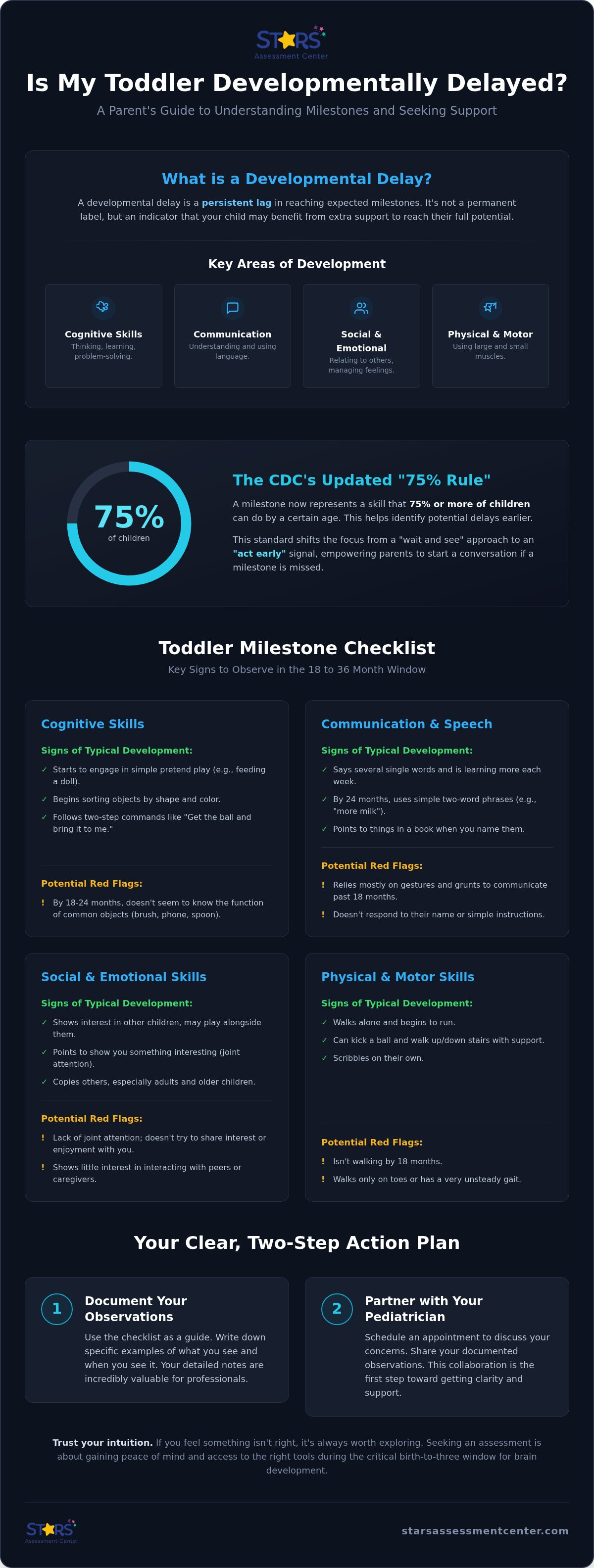
- Understand the "75% rule" to see why milestones represent what most children do by a certain age, helping you distinguish between a temporary difference and a persistent delay.
- Use our domain-based checklist to help determine if your toddler is developmentally delayed, specifically focusing on physical and motor skills during the critical 18 to 36-month window.
- Learn to identify "invisible" social-emotional signs, such as a lack of joint attention, which serve as the essential foundation for your child's future learning.
- Get a clear, two-step plan for documenting your observations and partnering with your pediatrician to ensure your concerns are addressed with clarity and care.
- Explore how a multidisciplinary team approach in Santa Clara County provides a comprehensive view of your child's growth through specialized social-emotional and speech evaluations.
Understanding Developmental Ranges: Is It a Delay or a Difference?
Parenting often feels like a constant game of comparison. You might find yourself watching other children at the park and wondering, "is my toddler developmentally delayed" because they aren't using as many words as their peers. It's important to know that a developmental delay is a persistent lag in reaching expected milestones within specific areas of growth. It isn't a permanent label or a diagnosis that defines your child's future; it's simply a description of where they are today and an indicator that they may need extra support to reach their full potential.
To get a complete picture of a child's progress, specialists look at five primary domains of child development stages. These areas include physical skills, cognitive learning, communication, and social and emotional growth. Because these domains are interconnected, a delay in one area, like speech, can sometimes impact another, such as social interaction. Understanding these categories helps us move away from general worry and toward specific, helpful observations.
The way we measure these milestones has also changed to be more helpful for parents. As of 2026, the CDC sets milestone markers based on the 75% rule. This means a milestone represents what 75% or more of children can do by a certain age. This shift was designed to move away from a "wait and see" approach. If your child hasn't reached a specific goal by the expected age, it's a clear signal to start a conversation with a professional rather than wondering if they're just on the later side of average.
Milestones vs. Deadlines: Why the Range Matters
Milestones are ranges, not rigid deadlines. For example, one child might take their first steps at 10 months, while another waits until 15 months. Both children are often within a healthy developmental window. For families with children born prematurely, we use an "adjusted age" to track these windows fairly. This accounts for the time they missed in the womb and provides a more accurate reflection of their progress. Recognizing these ranges helps clarify the question of "is my toddler developmentally delayed" by providing much needed context for their individual journey.
The "Wait and See" Myth
Well meaning friends or family might suggest that your child is simply a "late bloomer." While some children do catch up on their own, waiting too long can mean missing the critical birth to three window. This period is a time of incredible brain plasticity, where early intervention has the most significant and lasting impact. Seeking an assessment isn't about looking for a problem. It's about gaining peace of mind and the right tools. Your parental intuition is a powerful guide. If you feel something isn't quite right, that feeling is always worth exploring with a compassionate, professional team.
The Toddler Milestone Checklist: Signs by Developmental Domain
The 18 to 36 month window is a vibrant time of discovery. It's also the period when developmental differences often become more apparent as children begin to interact more with the world. If you've found yourself asking "is my toddler developmentally delayed," using a structured observation tool can provide the clarity you need. This checklist isn't meant for self-diagnosis. Instead, it's a way to help you describe your child's current strengths and challenges to a professional. Identifying these patterns early allows for the most effective support during these foundational years.
Cognitive milestones are the building blocks of problem solving and curiosity. By age two, many toddlers start to use their imagination through simple pretend play. They might pretend to drink from an empty cup or push a block like it's a car. They also begin to sort shapes and colors. If your child doesn't seem to understand the purpose of everyday items like a brush or a phone by 18 to 24 months, it's a good idea to seek a multidisciplinary developmental assessment to see how they process information and interact with their environment.
Communication and Speech Checklist
Language development is often the first area where parents notice a lag. It's helpful to distinguish between expressive language, which is the ability to speak and use words, and receptive language, which is the ability to understand what others are saying. Sometimes a child understands perfectly but struggles to form the words themselves. Key signs to watch for include:
- Not using at least a few single words by 15 to 18 months.
- Not using simple two-word phrases (like "more milk") by age two.
- Lack of "joint attention," such as pointing to show you something interesting.
- Limited eye contact or not responding to their name by 12 to 15 months.
The CDC milestone checklist provides a comprehensive look at these communicative goals to help you track progress over time and share specific details with your pediatrician.
Physical and Motor Skill Red Flags
When wondering is my toddler developmentally delayed, parents often look at physical milestones first. Physical growth includes both gross motor skills, like walking and jumping, and fine motor skills, like using fingers to pick up small objects. While every child has their own rhythm, certain patterns are worth a closer look. Gross motor signs might include not walking steadily by 18 months or falling very frequently after age two. For fine motor skills, watch for difficulty using a pincer grasp (thumb and forefinger) to pick up a small piece of food by 18 months or struggling to hold a spoon. A specific sign to discuss with a specialist is "asymmetry," which is when one side of the body seems significantly stronger or more active than the other. If movements seem unusually stiff or floppy, documenting these moments can be very helpful for your next appointment.
Social-Emotional Signs: The "Invisible" Developmental Milestones
While milestones like crawling or speaking first words are easy to spot, social-emotional development happens more quietly. It's the foundation for every other area of growth. A child who feels secure and understands how to connect with others is better prepared to learn cognitive and communication skills later on. When parents ask, "is my toddler developmentally delayed," they are often looking for physical signs, but the way a child shares their world with you is just as revealing. These "invisible" milestones tell us a lot about how a child's brain is processing social information and emotional cues.
One of the most critical behaviors to watch for is "joint attention." This occurs when your toddler points at a bird in the sky and then looks back at you to make sure you see it too. It's a shared moment of interest that shows they understand connection. If a child consistently lacks interest in other children or doesn't look at you for a reaction when they discover something new, it's a signal that they might benefit from a specialized social-emotional assessment. Our team specializes in evaluating these subtle but vital behaviors during the birth to three window to ensure no child's needs go unnoticed.
Interaction and Play Patterns
During the toddler years, play is a child's work. You can use CDC's developmental milestone checklists to track how your child engages with others. By 12 months, most children are "social smiling" and responding to their name. It's also normal for toddlers to engage in "parallel play," where they play near other children but not necessarily with them. However, certain patterns may warrant an early autism screening. These include a total lack of interest in peers, avoiding eye contact, or engaging in repetitive behaviors like lining up toys for hours or flapping their hands when excited. Recognizing these signs early allows for more targeted support.
Emotional Regulation and Attachment
Every toddler has tantrums, but the frequency and intensity can sometimes indicate a need for extra help. You might wonder if your toddler is developmentally delayed if they have frequent, inconsolable meltdowns that seem completely out of sync with their age or the situation. Signs of extreme difficulty with transitions or changes in a daily routine are also important to note. While some children are naturally more sensitive, others may struggle with "self-soothing" and require professional guidance to learn how to regulate their big feelings. A social-emotional evaluation helps identify a child’s unique temperament and provides a roadmap for parents to support their regulation in a way that feels safe and encouraging.
Taking Action: How to Get a Professional Evaluation
Moving from observation to action is a significant step. It’s often the moment when the abstract question of "is my toddler developmentally delayed" turns into a concrete plan for support. This transition doesn’t have to be frightening. Instead, think of it as opening a door to a deeper understanding of how your child learns. Taking proactive steps ensures that if a delay exists, your child receives the right help during the most critical years of brain growth. Here is a clear path forward to help you navigate the process with confidence.
The first step is to gather your thoughts. Use the checklists provided in the previous sections to document specific behaviors you’ve noticed at home. Once you have these notes, schedule a "well-child" visit with your pediatrician. Doctors rely on your daily observations to supplement their clinical screenings. During this visit, be direct about your concerns. If you feel your child isn't meeting certain goals, ask for a referral for a Multidisciplinary Developmental Assessment. This team-based approach is often more comprehensive than a single doctor’s visit because it brings together multiple specialists to look at the "whole child" at once.
The Local Pathway in Santa Clara County
In California, families have unique resources available through the Regional Center system. For children under age three, you don't actually need a doctor’s referral to begin the process. You can self-refer your child for an evaluation if you have concerns. In Santa Clara County, the San Andreas Regional Center partners with local specialists to provide these services. Whether you live in San Jose, Milpitas, Gilroy, or Morgan Hill, local support is available to guide you through the "Early Start" program. When you speak with a coordinator, it’s helpful to have a list of questions ready:
- What specific developmental domains will the team evaluate?
- How long is the current timeline from referral to the first assessment?
- What documents or medical records should I have ready?
- How will the results be explained to me after the evaluation?
What Happens During a Multidisciplinary Assessment?
A high-quality evaluation should feel like a partnership, not a clinical trial. At the Stars Assessment Program, we utilize a team that may include speech therapists, child psychologists, and developmental specialists. This multidisciplinary team works together to observe your child’s physical, communicative, and social-emotional skills. The process is entirely play-based. Specialists use toys, games, and gentle interactions to see how your child solves problems and connects with others. This low-stress environment allows your child to show their true abilities. Most importantly, you remain the expert on your child. You’ll be an active part of the team, providing context that only a parent can offer. This collaborative approach ensures the final plan is perfectly tailored to your child’s unique temperament and needs.
The Stars Assessment Program: Your Partner in Early Growth
When you first began asking, "is my toddler developmentally delayed," you were seeking more than just a checklist; you were looking for a path forward. At the Stars Assessment Program, we specialize exclusively in the critical window from birth to age three. We know that this period is a time of rapid brain growth and incredible potential. Our role is to act as a steady ally for families in Santa Clara County, providing the clarity you need to move from uncertainty to a proactive plan of support. We don't just look at a list of milestones. We look at your child as a unique individual with their own strengths and temperament.
Our program is built on a multidisciplinary team approach. Instead of visiting several different clinics, you'll find a collaborative group of specialists who work together to understand the "whole child." This team may include experts in speech and language, child development, and social-emotional health. By evaluating your child through multiple lenses simultaneously, we create a more accurate and compassionate picture of their needs. This integrated process ensures that every recommendation we make is cohesive and focused on your family's specific goals.
Specialized Screenings for Autism and Down Syndrome
For many parents, the fear of a specific diagnosis can be the biggest hurdle to seeking help. Our team provides expert clarity through specialized screenings for conditions such as Autism and Down Syndrome. We approach these evaluations with profound professional warmth, ensuring that the process remains supportive rather than clinical. An early, accurate screening is the most powerful tool you have for creating a personalized support plan. By identifying specific needs early, we can help you access the right resources through the Regional Center and other local services. A key part of this journey often begins with a Social Emotional Assessment for Toddlers, which helps us understand how your child connects with you and the world around them.
Next Steps for Your Family
If you live in San Jose, Milpitas, or the surrounding Santa Clara area, you don't have to navigate this journey alone. We've designed our process to be a "safe harbor" for families, offering a clear transition from the initial assessment to the start of early intervention services. We are here to answer your questions with patience and to provide a reliable roadmap for your child's success. Your intuition brought you here, and taking the next step is a powerful act of advocacy for your little one's future. We invite you to reach out and experience a partnership rooted in expertise and human connection. Schedule a consultation with the Stars Assessment team today.
Empowering Your Child’s Brightest Future
Navigating the early years of your child's life is a journey filled with wonder and occasional worry. By understanding that milestones are ranges and recognizing the importance of the 75% rule, you've already taken a massive step toward clarity. Remember that the birth to three window is a unique time of growth; early support isn't about labels, it's about providing the right environment for your toddler to thrive. If you're still asking "is my toddler developmentally delayed," trust that your intuition is a powerful tool for your child's success.
You don't have to walk this path alone. Our multidisciplinary team of child development specialists is here to act as a steady ally for families in San Jose, Santa Clara, and throughout our local communities. We offer specialized programs for infants and toddlers from birth to age three, ensuring that every assessment is play based and family centered. Take the next step toward peace of mind today. Request a Multidisciplinary Developmental Assessment for Your Child and let us partner with you in supporting your child’s unique potential. You are your child's best advocate, and we're here to help you every step of the way.
Frequently Asked Questions
Will my child eventually outgrow a developmental delay?
Many children catch up to their peers with the right support, but a developmental delay isn't something a child simply outgrows on their own. It's a sign that they need specific tools to help them bridge the gap. Early intervention during the birth to three years takes advantage of incredible brain plasticity to make these gains more likely and lasting.
What is the difference between a developmental delay and a developmental disability?
A developmental delay describes a child who is slower to reach milestones than 75% of their peers, while a developmental disability is a chronic condition likely to continue indefinitely. Delays can often be resolved or significantly improved with early support. Disabilities, such as Autism or Down Syndrome, are lifelong conditions that require ongoing management and specialized strategies to help the child thrive.
How do I qualify for early intervention services in California?
Eligibility for California's Early Start program is determined through a formal evaluation that shows a significant lag in at least one developmental area. This usually means a 25% delay in domains like communication, physical growth, or social-emotional skills. Children with certain diagnosed conditions or those at high risk due to medical factors also qualify for these state-funded support services.
Does my toddler need a speech evaluation if they aren’t talking yet?
A speech evaluation is highly recommended if your child isn't using single words by 15 months or simple phrases by age two. It's a proactive way to check if your toddler is developmentally delayed in their communication skills. These assessments look beyond just speaking; they also evaluate receptive language and non-verbal cues like pointing or eye contact to see how your child connects.
What is a multidisciplinary developmental assessment?
A multidisciplinary developmental assessment is a comprehensive evaluation performed by a team of specialists rather than a single provider. This team often includes speech therapists, child psychologists, and developmental experts who observe your child through different lenses. By working together, they provide a holistic view of your child’s growth and create a more accurate, unified plan for support that considers the whole child.
Is a developmental assessment the same as an autism screening?
A developmental assessment is a broad look at all areas of growth, while an autism screening focuses specifically on social communication and repetitive behaviors. While they aren't the same, a comprehensive evaluation often includes autism-specific tools if social-emotional delays are noted. The goal of the broader assessment is to identify any area where a child might need extra guidance to reach their potential.
How much does a developmental evaluation cost for toddlers?
Under the federal Individuals with Disabilities Education Act (IDEA) Part C, every state is required to provide developmental evaluations for children under age 3 at no cost to the family. This means you can access a professional assessment through your local Regional Center regardless of your income or insurance status. While private evaluations are an option, the state-mandated pathway ensures that every child can receive a professional look at their growth.
Can I refer my own child for an assessment in Santa Clara County?
You can absolutely refer your own child for an assessment in Santa Clara County without a doctor's note. Parents have the right to contact the San Andreas Regional Center directly to request an evaluation if they have concerns. This self-referral process is a vital tool for parents who are wondering is my toddler developmentally delayed, ensuring that you don't have to wait for a pediatrician's appointment to begin the journey.


