
You're watching your little one play, but a small part of you is wondering if their reactions or social cues are quite where they should be. It's common to feel a sense of anxiety when you're trying to figure out if an infant social emotional assessment Santa Clara County is the right next step for your family. You aren't alone in these feelings, and wanting a clear picture of your baby's growth is a sign of your deep commitment as a parent. We understand that navigating developmental systems can feel overwhelming when you just want answers.
This article will help you understand how social-emotional screenings serve as a supportive tool to identify your child's unique needs and strengths. We'll explore how these evaluations work, the local resources available through the Early Start program, and the steps you can take to connect with empathetic specialists. You'll gain a clear roadmap for the 45-day assessment process, helping you move from a place of uncertainty to a path of confidence and growth for your child.
Key Takeaways
- Understand why the first three years are the most critical window for building your child's social-emotional foundation through proactive monitoring.
- Learn to identify subtle signs that may suggest a need for support, such as persistent difficulties with self-soothing or limited interest in social play.
- Discover how an infant social emotional assessment Santa Clara County is designed to be a gentle, play-based experience that prioritizes your child's comfort.
- Get a clear roadmap for navigating local resources, including the San Andreas Regional Center (SARC) and family support networks in San Jose.
- See how a multidisciplinary team of specialists can partner with your family to provide clarity and a personalized path forward.
What is Social-Emotional Development Screening for Infants?
Parenting often feels like a series of observations. You notice the first time your baby reaches for a toy or pushes themselves up. While these physical milestones are easy to see, your child is also growing in ways that are less visible but equally vital. Social-emotional screening is a proactive way to monitor how children learn to express their emotions, manage their feelings, and build meaningful relationships with the people around them. It's about looking at the "heart" of your child's growth. Social-emotional screening is a collaborative tool that allows parents and specialists to work together to understand a child's inner world and interpersonal growth.
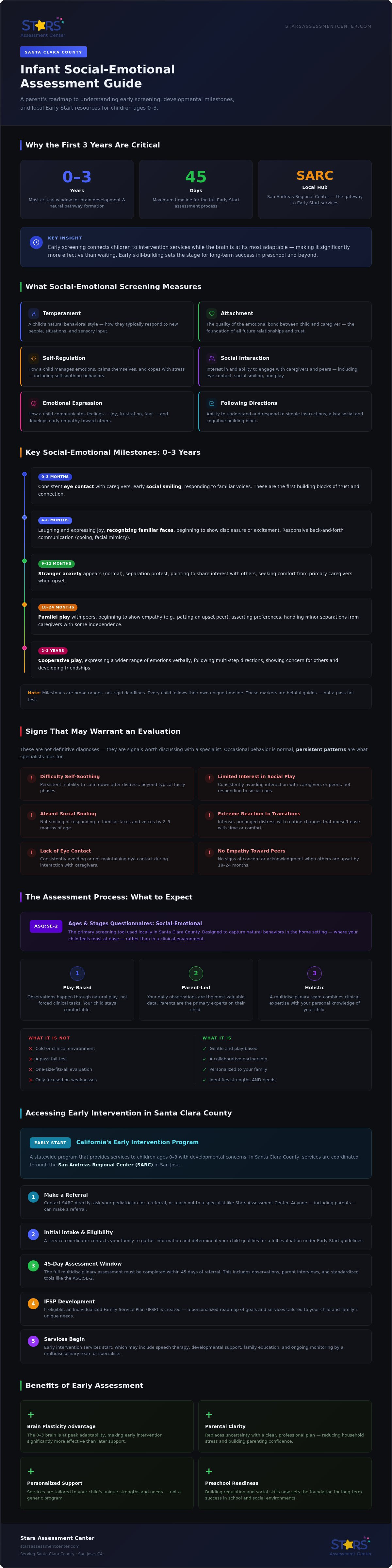
The first three years of life represent a critical window for this foundation. During this 0-3 period, the brain is developing at a rapid pace, forming neural pathways that dictate how a child will eventually handle stress and connect with others. While a general developmental screening might focus on motor skills or language, a focused infant social emotional assessment Santa Clara County takes a deeper look at temperament, attachment, and self-regulation. It helps distinguish between typical "fussy" phases and areas where a child might need a little extra support to feel secure.
Key Milestones in the First Three Years
Understanding social-emotional development involves recognizing how children transition from simple reactions to complex social interactions. In early infancy, you might look for consistent eye contact, social smiling, or how your baby responds to the sound of your voice. These are the building blocks of trust. As they move into toddlerhood, milestones often include showing empathy, such as patting a peer who is upset, or engaging in parallel play. It's helpful to remember that "milestones" are actually broad ranges rather than rigid deadlines. Every child follows their own unique timeline; some may be more reserved while others are naturally outgoing. We view these markers as helpful guides rather than a pass-fail test.
Why Early Screening Matters for Santa Clara Families
Choosing to pursue an infant social emotional assessment Santa Clara County can be a transformative step for your family. Early screening allows us to connect children to intervention services while their brains are at their most adaptable. This early start makes a significant difference in how effectively a child learns to regulate their emotions. Beyond the child's growth, these assessments provide much-needed professional clarity for parents. Replacing uncertainty with a clear plan can lower household stress and help you feel more confident in your parenting journey. Building these regulation skills now sets the stage for long-term success in preschool and beyond, ensuring your child has the tools they need to thrive in a social world.
The Social-Emotional Assessment Process: What to Expect
The idea of an "assessment" often brings to mind cold, clinical settings and intimidating clipboards. However, an infant social emotional assessment Santa Clara County is intentionally designed with the opposite approach. It is a gentle, play-based experience that prioritizes your child's comfort and emotional safety. We want to see your child as they truly are, which is why we focus on natural interactions rather than forced tasks. Specialists carefully observe how your baby or toddler engages with you and explores their surroundings. This observation is part of a broader framework of Infant and Toddler Development, Screening, and Assessment that looks at the whole child rather than just a checklist of behaviors.
You are the primary expert on your child's life. While our specialists bring years of clinical knowledge, your daily observations provide the most valuable data we can collect. Your input helps us understand behaviors that might not happen during a single visit, such as how your child reacts to a specific routine at home or how they interact with siblings. By combining your deep personal knowledge with our professional observations, we create a holistic picture of your child's unique strengths and specific needs. This partnership ensures that the final plan feels right for your family's culture and daily reality.
Common Screening Tools Used Locally
In Santa Clara County, we frequently utilize the ASQ:SE-2 (Ages & Stages Questionnaires: Social-Emotional). This tool is specifically designed to capture behaviors in the natural home setting where your child feels most at ease. Instead of a one-size-fits-all test, these questionnaires allow you to report on essential areas like how your child self-soothes, their ability to follow simple directions, or how they express interest in others. In a multidisciplinary setting, these parent reports are balanced with standardized observations from our team. This dual approach ensures that we don't miss the subtle nuances of your child's social-emotional growth.
Step-by-Step Walkthrough
Understanding the sequence of events can help lower your stress before you arrive. The process typically follows three clear, methodical steps:
- Step 1: Initial intake. We begin with an empathetic discussion about your specific concerns and your child's developmental history.
- Step 2: Play-based observation. Your child interacts with developmental specialists in a "safe harbor" environment where the focus is on natural engagement and curiosity.
- Step 3: Collaborative planning. We review the findings together and create a clear roadmap for next steps.
The assessment is a snapshot of your child's current skills, not a permanent label. If you're feeling uncertain about where to start, you can learn more about our multidisciplinary developmental assessment process to see how we support local families.
Recognizing Signs That May Warrant an Evaluation
Every parent has moments where they wonder if their child's behavior is just a "tough day" or something more. It's natural to feel a bit of anxiety when you're noticing patterns that don't seem to match what you see in other children. While every baby has their own personality, persistent patterns in how they react to the world can be meaningful. Often, the most accurate early indicator isn't a score on a test; it's the "gut feeling" a parent has that something isn't quite right. Trusting that intuition is the first step toward getting the clarity you deserve.
Professionals look for specific clusters of behavior when considering an infant social emotional assessment Santa Clara County. We might see a child who has extreme difficulty self-soothing, even with significant support from a caregiver. You might also notice a lack of interest in the social games that usually spark joy, like peek-a-boo or waving goodbye. These interactions are the foundation of early communication. To help identify these patterns accurately, specialists use evidence-based Social Emotional Development Screening Instruments that provide a structured way to look at a child's unique emotional landscape. This helps us move beyond guesswork and toward a shared understanding of your child's needs.
Social Interaction Cues
By the time a child reaches 12 months, we typically expect to see consistent eye contact and a response when their name is called. If your child seems to prefer playing alone or doesn't look to you to share enjoyment, like pointing at a bird in the sky to show you, it might be time to look closer. These cues show us how a child is beginning to connect their world with yours. Difficulty sharing enjoyment or a lack of social "checking in" can sometimes indicate that a child needs extra support in building these early social bridges.
Emotional Regulation Indicators
Emotional regulation is about how a child handles big feelings and manages transitions. Indicators that might warrant a conversation include:
- Inconsolable distress. Frequent tantrums that feel significantly out of proportion to the situation and are very difficult to soothe.
- Rigidity in routines. Intense distress caused by even minor changes to a daily schedule or environment.
- Withdrawal. A lack of emotional response or a "shutdown" behavior in stimulating situations like a busy playground.
- New environment challenges. Persistent, significant difficulty adjusting to new people, even after a long period of warming up.
Seeing these signs in your child doesn't mean they've been given a permanent label. Instead, it's an opportunity to start an infant social emotional assessment Santa Clara County to understand how they process the world. This insight allows us to partner with you to create a supportive environment where your child feels safe to grow and express themselves.
Accessing Early Intervention in Santa Clara County
Once you've decided to seek support, the next step is understanding the local systems designed to help your family. In our community, the San Andreas Regional Center (SARC) serves as the primary gateway for California's Early Start program. This statewide initiative provides services for infants and toddlers from birth to 36 months of age. For children who meet eligibility criteria, the cost for evaluation, assessment, and service coordination is free. This ensures that every family, regardless of their financial situation, can access a professional infant social emotional assessment Santa Clara County when they have concerns about their child's growth.
Navigating these systems can feel like learning a new language, but you have clear rights as a parent. Under the Early Start program, the entire process, from your initial contact to the determination of eligibility and the creation of a service plan, must be completed within 45 days. Local hubs like the First 5 Santa Clara Family Resource Centers offer additional support in San Jose and surrounding areas. Whether you're in Milpitas, Gilroy, or Morgan Hill, these centers provide a welcoming space to find information and connect with other parents who are on a similar journey.
The Local Support Network
Various local initiatives and community organizations are dedicated to supporting inclusion across our region. These entities often collaborate to provide screenings and ensure that early intervention is accessible in natural environments like your home or childcare center. Because our county is beautifully diverse, it's essential to find assessment options that are culturally sensitive and multilingual. We believe that every family deserves to be heard and understood in their preferred language, ensuring that the assessment truly reflects the child's life and the family's values.
Next Steps After a Screening
If a screening suggests that your child could benefit from extra help, the next step is determining eligibility for Early Start. Generally, an infant or toddler is eligible if they show a developmental delay of at least 25% in one or more areas, including social-emotional or communication skills. Once eligibility is confirmed, a team will work with you to develop an Individualized Family Service Plan (IFSP). This plan acts as a roadmap, outlining the specific services and goals tailored to your child's unique needs. Acting early is the best way to maximize your child's developmental gains and provide them with a strong foundation for the future.
If you're ready to take that first step toward clarity, you can contact our team today to learn more about starting the evaluation process for your child.
The Stars Assessment Approach: Empathy Meets Expertise
When you first notice a subtle shift in your child's behavior, the path ahead can feel unclear. We've designed our program to bridge the gap between that initial concern and the real-world support your family deserves. Choosing an infant social emotional assessment Santa Clara County means choosing a team that sees your child as a whole person, not just a set of data points. We prioritize a "Safe Harbor" environment where your feelings are validated and your child's comfort is our first priority. Our goal is to replace the weight of uncertainty with the lightness of professional clarity and a steady hand to guide you.
Our multidisciplinary team is at the heart of this approach. We bring together certified developmental specialists with expertise in speech and language, motor development, and social-emotional growth. By working together in a single evaluation, we can see how different areas of development influence one another. For example, a delay in communication can often lead to frustration or social withdrawal. By having all these experts in one room, we provide a more accurate and comprehensive picture of your child's needs than a single-discipline screening could ever offer.
A Family-Centered Philosophy
We believe that parents are the primary experts on their own children. You've spent every day observing your child's unique personality, and your insights are the most valuable part of our evaluation process. Our team doesn't just focus on the child; we support the emotional needs of the entire family unit. We know that this journey can be taxing, so we offer a single point of contact for complex evaluations. This streamlined approach reduces the need for you to repeat your story to multiple people, allowing you to focus your energy on what matters most: your child's growth and well-being.
Serving Our Local Community
Santa Clara County is a beautifully diverse region, and our assessments are tailored to reflect that cultural landscape. We're committed to providing multilingual support for our neighbors, ensuring that every family feels heard and understood in their preferred language. We're proud to serve families across the region, providing evaluations and support in:
- San Jose: Accessible support in the heart of the city.
- Milpitas: Localized expertise for families in the north county.
- Gilroy and Morgan Hill: Dedicated care for our south county neighbors.
- Surrounding Areas: Extending our reach to ensure no family is left without a roadmap.
If you're ready to find answers and begin a partnership built on trust and expertise, we're here to help. Please contact the Stars Assessment Program to discuss your child's milestones and take the first step toward a clearer future for your family.
Taking the Next Step Toward Clarity
You've taken a vital step today by learning how to support your child's emotional wellbeing. Understanding the signs and the process for an infant social emotional assessment Santa Clara County transforms uncertainty into a clear, actionable plan. We've seen how early intervention, backed by a collaborative partnership between parents and specialists, creates a strong foundation for lifelong regulation and connection. You don't have to navigate these complex systems alone; local resources and expert guidance are ready to help you every step of the way.
Our team brings together certified developmental specialists who provide a family-centered, multidisciplinary approach tailored to your child's unique world. We're proud to offer multilingual support for our diverse neighbors, ensuring every family feels heard and validated throughout the evaluation. If you're ready to move from questioning to knowing, we invite you to Schedule a Compassionate Developmental Evaluation Today. Your child's growth is a journey, and we're here to be your steady ally in fostering their success and happiness.
Frequently Asked Questions
What is the difference between a developmental screening and a full assessment?
A developmental screening is a brief check to see if a child is meeting typical milestones, while a full assessment is a comprehensive, multidisciplinary deep dive into their specific strengths and needs. Screenings often use parent questionnaires like the ASQ to identify potential concerns quickly. If a screening indicates a need for more information, a full assessment involves professional observations and standardized tools to create a detailed roadmap for support.
Is there a cost for a social-emotional assessment in Santa Clara County?
For children from birth to 36 months who are eligible for the Early Start program, there is no cost for evaluation, assessment, and service coordination. This ensures that every family in our community can access professional support regardless of their financial situation. These services are part of California's statewide commitment to early intervention, providing a "safe harbor" for parents seeking clarity on their child's growth and development.
How do I know if my child's behavior is a delay or just a 'phase'?
You can distinguish between a phase and a delay by looking at the persistence and intensity of the behavior over time. While all children have "off" days, a developmental delay often involves a pattern that interferes with daily routines or social connections. If your "gut feeling" as a parent suggests something is more than a temporary stage, an infant social emotional assessment Santa Clara County can provide the professional clarity you need.
Can a social-emotional assessment diagnose autism in infants?
Yes, a social-emotional assessment is a critical component of identifying autism in infants and toddlers. Our multidisciplinary team looks for specific social communication markers, such as eye contact, joint attention, and shared enjoyment. While the assessment provides a clear picture of these behaviors, it's part of a broader multidisciplinary developmental assessment that helps determine the most appropriate support and intervention services for your child's unique profile.
What happens if my child is too shy to interact during the assessment?
We expect children to be shy in new environments, so we use gentle, play-based methods to help them feel at ease. Our specialists are trained to observe natural interactions between you and your child, which often tells us more than forced tasks. We prioritize your child's emotional safety and will never rush the process. We want to see their true personality in a setting that feels secure and supportive for them.
Do I need a doctor's referral to get my child screened?
You don't need a doctor's referral to begin the screening or assessment process in Santa Clara County. Parents and caregivers can contact the Stars Infant Program or the San Andreas Regional Center directly to express concerns about their child's development. While your pediatrician is a great partner in your child's health, California's Early Start program allows families to initiate the referral process themselves to ensure timely access to support.
How long does a multidisciplinary evaluation typically take?
The physical evaluation appointment typically takes between one and two hours, depending on your child's comfort level and the complexity of their needs. However, the entire process, from your initial contact to the final service plan, is designed to be completed within 45 days. This methodical pace allows our team to be thorough while ensuring that your family doesn't have to wait long for the answers and support you need.
What should I bring to my child's first assessment appointment?
Please bring items that help your child feel comfortable, such as a favorite toy, a familiar blanket, and plenty of snacks. It's also helpful to have any previous medical records or notes from your pediatrician regarding your developmental concerns. Our goal is to make the infant social emotional assessment Santa Clara County as stress-free as possible. Having familiar items on hand helps your child stay regulated while we observe their natural cues.


