
You’re sitting at Morgan Hill’s Community Park, watching your toddler play, but something feels just a little bit different today. Perhaps they aren’t making eye contact as often as their peers, or maybe they seem more interested in spinning the wheels of a toy than playing with the other children. It’s natural to wonder if these behaviors are just a passing phase or if they are early signs of autism in toddlers Morgan Hill parents should monitor. You want the best for your child, yet the uncertainty of what comes next can feel overwhelming and lonely.
We believe that every parent’s intuition is valuable. It's common to feel a mix of love and anxiety when developmental milestones don't align with expectations. This guide will help you identify subtle red flags and explain how a multidisciplinary developmental assessment can provide the answers you need. We'll walk through the specific resources available in Santa Clara County so you can move from confusion to a clear plan of action. You don't have to walk this path alone; we're here to offer the expert partnership and peace of mind your family deserves.
Key Takeaways
- Learn to recognize specific clusters of social and communicative behaviors that may indicate early signs of autism in toddlers Morgan Hill parents should observe during the first three years.
- Understand how autism-related delays differ from typical developmental milestones to help you decide when it is time to seek professional guidance.
- Discover the benefits of a multidisciplinary assessment, which offers a comprehensive view of your child’s unique strengths and needs beyond a standard screening.
- Get a clear roadmap for starting the evaluation process through local resources like the San Andreas Regional Center and your family's pediatrician.
- Learn how a specialized partnership can provide the clarity and support you need to navigate your child's developmental journey with confidence and hope.
Recognizing Early Signs of Autism in Toddlers (12-36 Months)
Watching your child grow is a journey filled with wonder and, at times, a few quiet questions. During the critical "Birth to Three" window, development happens at a lightning-fast pace. While every child follows their own timeline, parents often notice subtle patterns that don't quite align with what they see in other children. Identifying the early signs of autism in toddlers Morgan Hill families encounter isn't about looking for a single "red flag." Instead, it's about observing a cluster of behaviors that might suggest your child experiences the world differently through autism spectrum disorder.
One of the most helpful ways to understand these early indicators is to look at what a child isn't doing yet. We often expect developmental concerns to look like "difficult" behavior, but in many toddlers, the signs are much quieter. It might be the absence of a social smile, the lack of a reaching gesture, or a preference for playing alone. Social-emotional development serves as our primary compass here. It's the foundation of how your child connects with you and the rest of the world. When these connection points are inconsistent, it's a signal to pause and look closer.
Social and Communication Red Flags
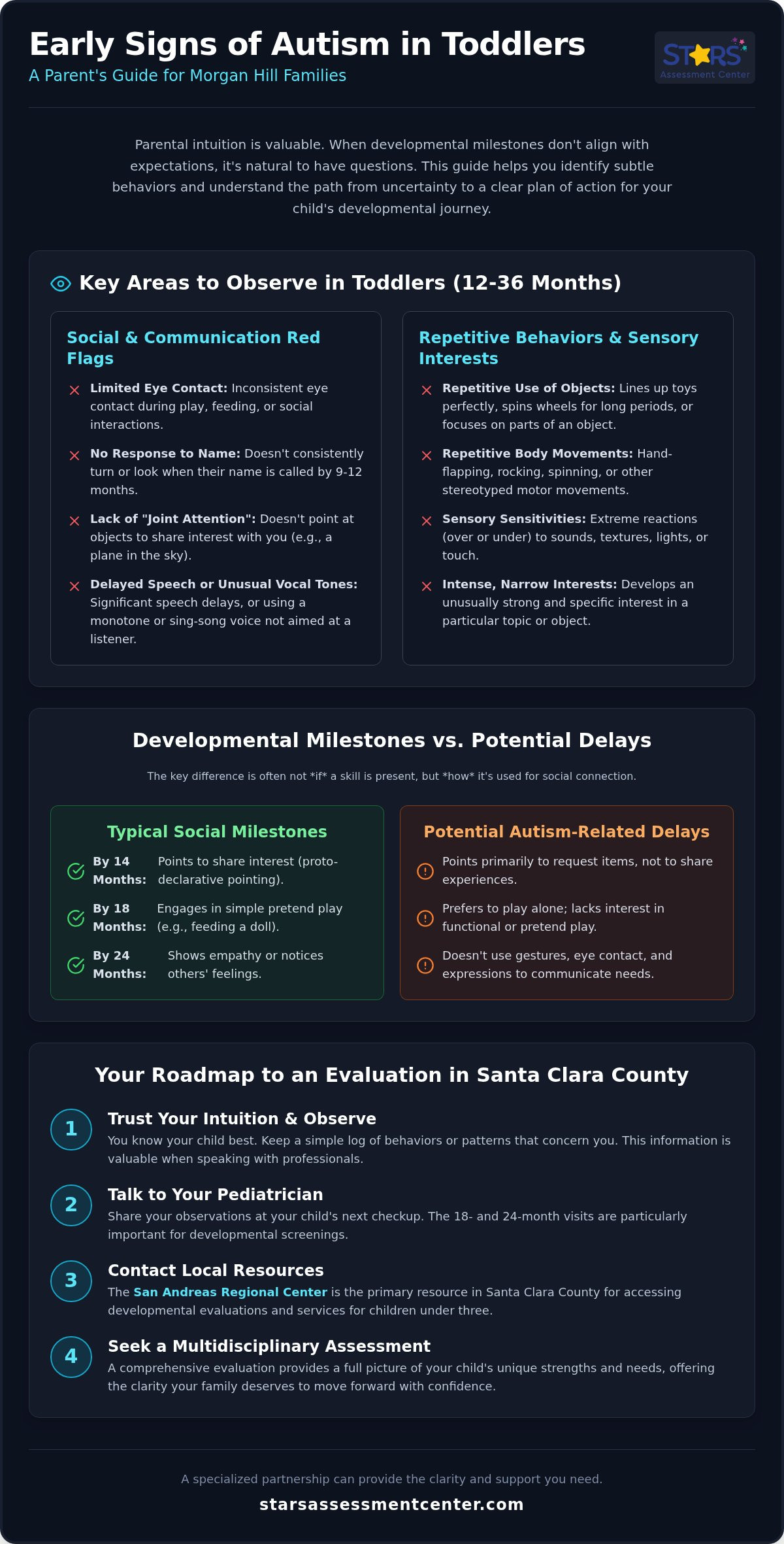
Communication starts long before a child says their first word. It lives in the way they look at you while you're reading a book or how they point to a bird in the sky. You might notice your toddler has limited or inconsistent eye contact during play or feeding. Another common sign is when a child doesn't respond to their name by 9 to 12 months of age, even when they're not distracted. A lack of "joint attention," which is when a child doesn't point to show you something interesting, is also a key indicator. Speech may be delayed, or you might hear unusual vocal tones, such as monotone sounds or repetitive babbling that doesn't seem aimed at a listener.
Repetitive Behaviors and Sensory Interests
Toddlers are naturally repetitive, but children with autism often use objects or their bodies in very specific, ritualized ways. You might see your child lining up cars in a long, perfect row instead of "driving" them across the floor. They might develop an intense focus on specific parts of a toy, like spinning a wheel for several minutes. Repetitive body movements, such as hand-flapping, rocking, or spinning in circles, are also common. Sensory experiences can feel different for these children, too. They might have an extreme reaction to the sound of a blender, or they might seem to not hear you at all when the TV is on. These patterns aren't "bad" behaviors; they are simply the ways your child is currently processing their environment.
Developmental Milestones vs. Potential Delays
Developmental milestones aren't strict deadlines; they're more like a wide window of time where certain skills usually appear. It's common for a toddler to walk early but talk late, or vice versa. However, when we talk about the early signs of autism in toddlers Morgan Hill parents should look for, we are often looking at the quality of social engagement rather than just physical milestones. While a general speech delay might mean a child isn't talking yet, an autism-related delay often involves a child not using gestures, eye contact, or facial expressions to communicate their needs.
The 18 month and 24 month checkups are significant milestones in any child's life. By 18 months, most children are beginning to explore how to influence the world around them. By 24 months, they are starting to show a clear interest in the people around them. If these social "sparklers" are missing, it can be a sign that your child’s development is taking a different path. While well-meaning friends might suggest a "wait and see" approach, this can sometimes lead to missed opportunities for support. Early intervention takes advantage of the incredible brain plasticity present in these first three years, making it the most effective time to provide help.
Key Social-Emotional Milestones
Social milestones are the building blocks of connection. One of the most important is "proto-declarative" pointing, which usually emerges by 14 months. This is when a child points at something just to show it to you, like a dog in the park, rather than pointing because they want you to give them something. By 24 months, you should also see the beginnings of empathy, such as a child looking concerned if they see someone crying. Functional play, like pretending to feed a doll or "talking" on a toy phone, is another crucial indicator of social-emotional growth. You can find more details on these specific behaviors in the CDC's official list of signs and symptoms.
When to Move Beyond Milestone Checklists
Checklists are helpful, but they don't tell the whole story. One of the most significant signs to watch for is "regression," or the loss of skills your child once had. This might look like a child who used to say a few words but has stopped talking, or a toddler who used to wave goodbye but no longer does. Distinguishing between a "late bloomer" and a developmental delay requires a professional eye. If your parental intuition is telling you that something is different, that feeling is worth exploring. A multidisciplinary developmental assessment can provide the clarity you need to understand your child's unique developmental profile and replace uncertainty with a clear path forward.
Why a Professional Autism Evaluation is Essential
When you first notice that your child’s development seems to be taking a different path, the uncertainty can feel heavy. You might have already completed an online checklist or mentioned your concerns during a brief checkup. While a pediatrician's screening is a helpful first step, it’s often just a "snapshot" in time. To truly understand the early signs of autism in toddlers Morgan Hill parents are observing, a comprehensive evaluation is necessary. This process moves beyond a simple "yes or no" regarding developmental delays and provides a deep, meaningful look at how your child interacts with their world.
The transition from "suspected delay" to having a clear, actionable plan is often the moment when parents feel the most relief. Clarity is a powerful tool. It replaces the anxiety of the unknown with a structured roadmap for support. Instead of wondering if you should be doing more, a professional evaluation gives you the confidence of knowing exactly what your child needs to thrive during these formative years. This isn't about giving your child a "label"; it's about opening the right doors to the specialized resources available here in Santa Clara County.
The Multidisciplinary Approach Explained
A single perspective rarely captures the full picture of a child’s growth. This is why a multidisciplinary team is considered the gold standard for assessing toddlers. In this approach, different specialists work together to look at your child from every angle. A speech-language pathologist evaluates how your child uses sounds and gestures to communicate, while developmental specialists assess cognitive and social-emotional milestones. By combining these different areas of expertise, we can create a 360-degree view of your child’s unique strengths and challenges. This collaborative method ensures that no detail is missed and that the resulting support plan is as individual as your child.
What to Expect During a Toddler Evaluation
We know that the word "evaluation" can sound clinical or even stressful, but the reality is much more natural. For a toddler, the process looks and feels like play. We use play-based assessment techniques, using toys, games, and social interactions to see how your child naturally explores and responds. You are an essential part of this process. Since you are the expert on your child’s history and daily life, parent interviews are a cornerstone of our work. We follow a "gentle guide" philosophy, ensuring the environment is calm, supportive, and entirely focused on your child’s comfort. Our goal is to make the experience a positive step forward for your entire family.
Accessing Autism Evaluation Services in Morgan Hill
Knowing where to turn when you have concerns about your child's growth is the first step toward finding peace of mind. In our community, the path to answers usually begins with a visit to your local pediatrician. While they are a vital resource for general health, they often serve as the "gatekeeper" to more specialized services. During your appointment, be specific about the behaviors you have observed. Instead of general concerns, share clear examples of how your child plays, communicates, and interacts with others. This helps your doctor understand why a deeper look is necessary.
For families in Santa Clara County, the San Andreas Regional Center (SARC) is a primary resource for children under age three. If you are noticing early signs of autism in toddlers Morgan Hill programs are designed to be accessible. You don't actually need a formal diagnosis or even a doctor’s referral to contact SARC for an initial screening. You can "self-refer" by calling their intake line and explaining that you have concerns about your child’s development. This triggers a process where your child’s needs are evaluated to see if they qualify for early intervention services.
Many parents worry about the cost of these evaluations, but there are several ways to access funding. In California, regional centers provide assessments at no cost to families if a developmental delay is suspected. Additionally, most private insurance plans in our state are required to cover developmental evaluations. Our team can help you understand how to use these resources so that financial concerns don't stand in the way of your child’s progress.
Local Resources for Morgan Hill Families
Living in South County means you have access to a dedicated network of specialists who understand our local community. Beyond the regional center, Morgan Hill has a growing community of parents who share similar journeys. Connecting with local support groups can provide emotional reassurance and practical tips for managing the early signs of autism in toddlers Morgan Hill families often face. As your child moves through the assessment process, we work closely with local providers to ensure a seamless transition from the initial evaluation to the start of personalized services.
Preparing for Your Child's Appointment
Preparation can help you feel more in control during the evaluation. We recommend keeping a simple log or "developmental journal" for a week or two before your visit. Note down specific moments that caught your attention, such as how your child reacts to their name or how they use their toys. Gathering previous medical records or notes from childcare providers also helps create a complete picture for the assessment team. Bringing along a familiar toy or a favorite snack can help your toddler feel grounded and safe during their visit.
If you are ready to take the next step, you can request a multidisciplinary developmental assessment to get the clarity your family needs.
The Stars Assessment Program: Your Partner in Discovery
At Stars Assessment Program, we understand that seeking answers about your child’s development is a deeply personal and sometimes emotional journey. Our commitment to families in San Jose, Morgan Hill, and Gilroy goes beyond providing a clinical service. We see ourselves as your dedicated partner in discovery. If you have been observing the early signs of autism in toddlers Morgan Hill parents often worry about, you deserve a team that truly listens to your story. We value your intuition as a parent and use it as a cornerstone of our evaluation process.
Our multidisciplinary team approaches every child with professional warmth and a gentle heart. We don't believe in a "one size fits all" approach to developmental health. Instead, we bring together specialists in speech and language evaluation and social-emotional assessment to create a comprehensive view of your child’s unique world. Families choose Stars because we bridge the gap between clinical expertise and human connection. We provide a steady hand to hold as you move from the initial stages of concern toward a bright and supported future.
The path from an assessment to receiving real-world help should be as smooth as possible. Once an evaluation is complete, we don't simply hand you a report and say goodbye. We help you understand how our findings connect to early intervention resources within Santa Clara County. Whether it's coordinating with the San Andreas Regional Center or finding local specialists, we ensure you have a clear roadmap. Our goal is to replace your uncertainty with a proactive plan that honors your child's potential.
Our Specialized Social-Emotional Evaluations
We focus on the "whole child" rather than just a list of developmental milestones. Our specialized evaluations are designed to be a "safe harbor" for parents who may feel overwhelmed by the assessment process. We create a calm, play-based environment where your toddler feels safe to explore and be themselves. When the process is finished, we provide results that are clear, practical, and jargon-free. We define every concept through its impact on your child's daily life, ensuring you feel empowered to take the next steps with confidence.
Take the Next Step Toward Support
You don't have to navigate these questions alone. As a key part of the Santa Clara County developmental services ecosystem, we are here to provide the clarity and expertise your family needs. Whether you are looking for a formal multidisciplinary developmental assessment or a specialized speech evaluation, our team is ready to guide you. Taking action early is the best gift you can give your child's developing brain. If you are ready to find answers and start a partnership built on trust, you can Schedule a Compassionate Assessment for Your Toddler today.
Empowering Your Child’s Developmental Journey
Recognizing the early signs of autism in toddlers Morgan Hill parents observe is a courageous first step toward unlocking the specific support your child needs. By focusing on social-emotional clusters and moving beyond simple checklists, you can gain a clearer understanding of your child's unique path. A multidisciplinary evaluation provides the 360-degree view necessary to turn uncertainty into a structured, actionable plan for growth. It's about moving from a place of questioning to a place of informed partnership.
Since 1988, we've served Santa Clara County families with a compassionate, family-centered approach. Our specialized multidisciplinary team focuses exclusively on children under age three, ensuring that your experience is gentle and supportive. You don't have to navigate these milestones alone; we're here to be your steady ally and expert guide. We're dedicated to providing the clarity you need to move forward with confidence and hope.
Connect with our Morgan Hill Assessment Team to take the next step toward clarity and peace of mind. Your child has an incredible potential for growth, and we're honored to partner with you in discovering it.
Frequently Asked Questions
What are the very first signs of autism in a 12-month-old?
The earliest signs at 12 months usually involve a lack of social connection rather than the presence of "difficult" behaviors. You might notice your child doesn't consistently respond to their name or fails to make eye contact when you are play-acting or feeding them. They may also lack "social smiling," which is when a baby doesn't smile back at you when you smile at them.
These social-emotional indicators are often more telling than physical milestones at this age. If your child isn't reaching out to be picked up or doesn't use simple gestures like waving "bye-bye," it's worth mentioning to a specialist. Early observation allows for a more proactive approach to your child's growth.
Can a toddler be diagnosed with autism if they are still talking?
Yes, a toddler can be diagnosed with autism even if they have a large vocabulary or meet their speech milestones. Autism is a spectrum that affects social communication, which includes how a child uses their words to interact with the people around them. Some children speak clearly but struggle with the "back and forth" rhythm of a typical conversation.
You might notice a child repeating phrases from their favorite show instead of using their own words to ask for a snack. They may also talk "at" people rather than "with" them, or they might not use facial expressions that match what they are saying. Speech is only one piece of the developmental puzzle we look at during an evaluation.
How do I get an autism evaluation in Morgan Hill for a child under three?
To get an evaluation for a child under three in our community, you can start by contacting the San Andreas Regional Center (SARC) for an intake screening. You also have the option to reach out to a private provider for a multidisciplinary developmental assessment. Identifying the early signs of autism in toddlers Morgan Hill parents notice allows you to access these specialized local resources during the most critical developmental window.
What is the difference between a screening and a full diagnostic evaluation?
A screening is a brief tool, often a checklist, used to see if a child might be at risk for a delay, while a full evaluation is a deep, comprehensive investigation. During a full diagnostic evaluation, a team of specialists observes your child's behavior, communication, and social skills over several hours. This provides a formal understanding of your child's needs.
While a screening can tell you that a delay might exist, a full evaluation explains the "why" and "how" behind your child's development. This 360-degree view results in a specific roadmap for support that a simple screening cannot offer. It moves your family from a place of questioning to a place of clear action.
Does insurance cover autism assessments in Santa Clara County?
Most private insurance plans in Santa Clara County are required by California law to cover developmental assessments when a provider suspects a delay. Additionally, the San Andreas Regional Center provides evaluations at no cost to families for children who qualify for their intake process. This ensures that every child in our community has a path toward the help they need.
Our team can help you navigate the specifics of your coverage to ensure your child receives care without unnecessary financial stress. We believe that every family deserves access to expert answers. We work closely with parents to coordinate between insurance requirements and regional center funding paths.
What should I do if my pediatrician says to 'wait and see' but I'm worried?
If your pediatrician suggests waiting but you feel that something is different, it's important to trust your parental intuition. You don't need a doctor's referral to contact the regional center for a screening or to seek a private multidisciplinary assessment. Early intervention is most effective when started as soon as possible, and waiting can sometimes lead to missed opportunities for support.
How long does a multidisciplinary developmental assessment take?
A multidisciplinary developmental assessment typically takes between two and four hours of direct observation and parent interviewing. Sometimes these sessions are split over two days to ensure your toddler doesn't become too tired or overwhelmed. This thorough approach allows the team to see the early signs of autism in toddlers Morgan Hill families report in a natural, play-based setting.
By taking this time, the specialists can see how your child interacts in different situations and with different types of play. We move at your child's pace to ensure we get the most accurate picture of their strengths and challenges. This patient, methodical process is designed to be as stress-free as possible for both you and your toddler.


