
You're sitting on the living room floor, watching your little one play, but your mind is racing with questions that weren't there a few months ago. Perhaps you've noticed they don't always meet your gaze, or they seem to prefer spinning their blocks rather than stacking them. When a pediatrician suggests a formal evaluation, it's natural to feel a rush of anxiety about the unknown. You might find yourself searching for answers to one central question: what does an infant autism assessment involve? It is a heavy question to carry, but it is also the first step toward finding the clarity and peace of mind your family deserves.
We know that many parents worry an assessment will be a cold, clinical experience that boils their child down to a label. In reality, a professional evaluation is a gentle, play-based journey designed to celebrate your child's unique personality while identifying where they need a little extra help. This guide will walk you through the specific steps of the multidisciplinary process. You will learn the difference between a quick screening and a full diagnosis, and discover how this process helps you access vital early intervention services through programs like Early Start in Santa Clara County. By the end, you'll see this isn't just a medical appointment; it's a partnership to help your child thrive.
Key Takeaways
- Understand the vital differences between milestone monitoring and a formal evaluation to clarify exactly what does an infant autism assessment involve for your child.
- Discover how a multidisciplinary team of specialists works together to provide a compassionate, comprehensive look at your infant's social and emotional growth.
- Learn why play-based observations are the heart of the evaluation, ensuring your little one feels safe and comfortable throughout the entire process.
- Identify the specific steps to access early intervention services in Santa Clara County, including how to partner with the San Andreas Regional Center.
- See how the final assessment report acts as a supportive roadmap, guiding your family toward the right resources and therapies for your child's success.
Understanding the Path: Monitoring vs. Screening vs. Assessment
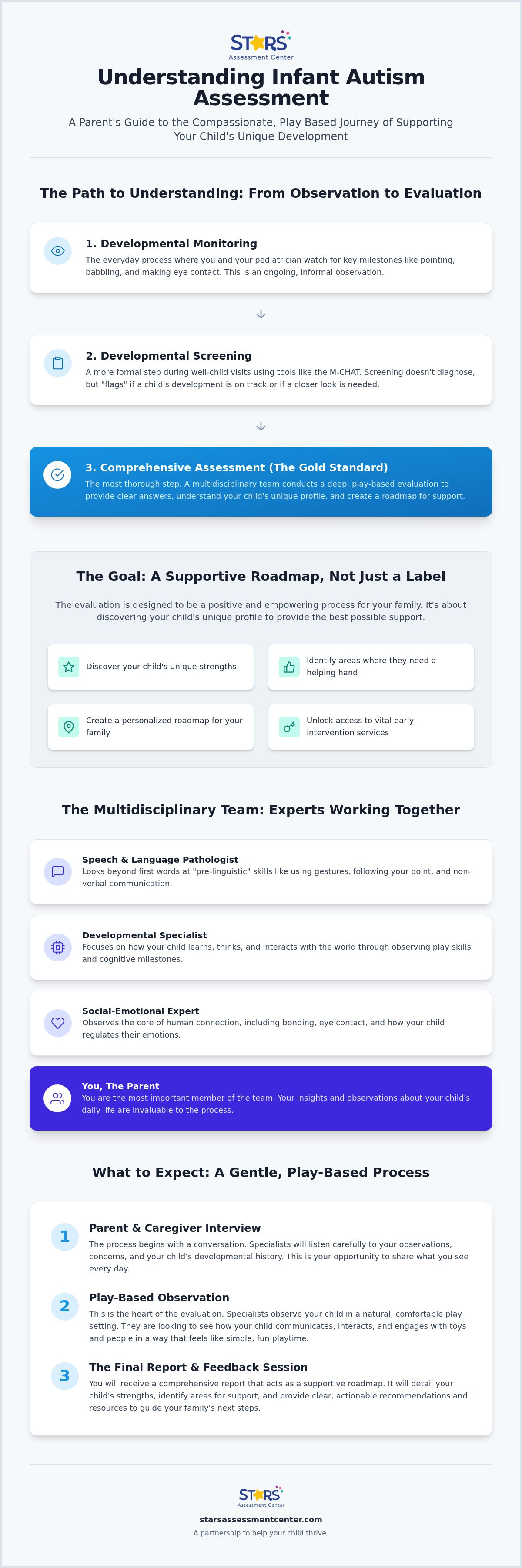
The journey toward understanding your child's development often begins with a simple feeling in your gut. This path usually follows three distinct stages: monitoring, screening, and assessment. Monitoring is the everyday process where you and your pediatrician watch for milestones like pointing, babbling, or making eye contact. Screening is more formal. It happens during well-child visits using tools like the M-CHAT to see if a child is on track. However, parents often wonder, what does an infant autism assessment involve when those initial screenings show a potential delay?
An assessment is the most thorough step in this journey. While monitoring and screening "flag" a concern, the comprehensive assessment provides answers. It is the gold standard for the Diagnosis of autism and is conducted by a team of specialists who look at every angle of a child's growth. Moving quickly to this stage is vital. We now know that "waiting and seeing" can waste precious time during the birth-to-three window, a period when a child's brain is most receptive to learning new ways of communicating. This window is a time of incredible neuroplasticity that shouldn't be overlooked.
When is a full assessment necessary?
You might need a full evaluation if your child shows persistent "red flags" in their social-emotional or communicative growth. These signs can be subtle in infants. Perhaps they don't look at you when you call their name, or they don't use gestures like waving "bye-bye." If a pediatrician's screening indicates a potential delay, it's a clear signal to move forward. Early action takes advantage of the brain's amazing ability to form new connections. By starting the process before age three, you're giving your child the best possible foundation for future success.
The goal of the evaluation process
It's important to remember that the goal of this process isn't just to apply a label. Instead, it's about discovering your child's unique strengths and identifying exactly where they need a helping hand. A multidisciplinary developmental assessment creates a personalized roadmap for your family. For those living in Santa Clara County, this evaluation is the key that unlocks local resources like the Early Start program. It ensures you aren't walking this path alone, but are instead partnered with experts who can guide you toward the right interventions and support systems for your little one.
The Multidisciplinary Team: Who Evaluates Your Child?
When you're trying to understand your baby's unique development, you might expect a single doctor to provide all the answers. However, a single viewpoint rarely captures the full picture of an infant’s growth. This is why a team approach is so vital. When considering what does an infant autism assessment involve, the answer lies in the collaboration of several experts who see your child through different specialized lenses. This ensures that every aspect of your child's physical, communicative, and social-emotional health is considered.
Specialists involved in the assessment
A comprehensive evaluation brings together professionals with distinct areas of expertise. Speech and Language Pathologists don't just listen for first words; they watch for "pre-linguistic" skills like how a baby uses gestures or follows your point. Developmental Specialists focus on how your child learns and interacts with the world, observing play skills and cognitive milestones. Finally, Social-Emotional Experts look at the core of human connection, including bonding, eye contact, and how a child regulates their emotions when they're frustrated or excited.
The power of a multidisciplinary view
A holistic evaluation is the best way to ensure an accurate finding. By following CDC guidelines on autism screening and diagnostic standards, a team can distinguish between autism and other developmental delays. For instance, a child might have a motor delay that makes social interaction difficult, or a sensory processing issue that looks like social withdrawal. When families ask what does an infant autism assessment involve, they're often relieved to learn it isn't a cold, clinical test, but a warm, team-based observation that prevents misdiagnosis.
The Stars Assessment Program approach centers on the belief that the most important member of this team is you. You see your child every day in their natural environment. Your insights into their history and habits provide the context that specialists need to make an informed evaluation. This concludes with a collaborative meeting where findings are synthesized into one clear, supportive plan. If you're in the San Jose area, our multidisciplinary developmental assessment team is ready to partner with you to find the best path forward for your family.
Key Components of an Infant Autism Assessment
Understanding the specific elements of a developmental evaluation can help replace fear with a sense of prepared partnership. If you're wondering what does an infant autism assessment involve, it's helpful to think of it as a multi-layered look at how your child experiences the world. It isn't a single test. Instead, it's a collection of observations and conversations that build a complete picture of your little one's growth.
The process usually begins with a caregiver interview. This detailed conversation is a foundational part of what does an infant autism assessment involve, as it provides the context for everything the specialists observe later. You know your baby better than anyone else. Your insights into their history, from early sleeping patterns to how they react to new faces, are essential. Following this, the team engages in structured play-based observation. Rather than sitting at a desk, the specialists join your child on the floor. They use specific toys to see how the infant interacts with both objects and people in a natural, low-stress environment.
To ensure accuracy, the team utilizes standardized testing tools specifically validated for children under age three. These might include instruments like the ADOS-2, which provides a consistent way to observe social communication in toddlers. Additionally, a sensory profile review helps the team understand how your child processes their surroundings. They look at whether your baby is particularly sensitive or under-responsive to light, sound, or touch. These factors often influence a child's comfort levels and behavior in ways that aren't immediately obvious.
Evaluating social and emotional milestones
A core focus of the assessment is joint attention. This is the ability to share an interest in something with another person, like when a baby points at a bird and looks back at you to make sure you see it too. The team also watches for social reciprocity, which is the natural back-and-forth flow of smiles, sounds, and gestures. Finally, they observe emotional regulation. They note how your child handles small frustrations or transitions between different activities, looking for how they seek comfort or return to a calm state.
Communication and physical skill checks
Specialists look closely at non-verbal communication, such as eye gaze and reaching, which often develop long before first words. They also assess receptive language, which is how well your infant understands their own name or simple directions like "give it to me." While the focus is often on social skills, the team also checks fine and gross motor development. How a child moves their body often affects how they explore their surroundings and engage with others during play, making physical milestones a key part of the overall developmental puzzle.
Step-by-Step: What to Expect During the Evaluation Appointment
Walking into a specialist's office often feels like a significant milestone in itself. You've likely spent weeks preparing for this moment. When families ask what does an infant autism assessment involve on a practical level, they're often relieved to find the environment is far from clinical. The day is structured to be flexible, prioritizing your baby’s comfort and natural behavior above all else. It is a process designed to see your child as they truly are, not just as a set of symptoms.
The appointment begins with a period of acclimation. We don't expect your child to perform on command. Instead, the team gives them time to explore the space and feel safe in their new surroundings. During this "Warm-Up," specialists observe how your child naturally engages with toys or looks to you for reassurance. This low-pressure start allows the specialists to see the child’s baseline behaviors before any direct interaction begins.
Once your child is comfortable, the team introduces interactive tasks. These are gentle prompts designed to see how they respond to social cues. For example, a specialist might blow bubbles to check for shared joy or use a toy to see if the infant follows a gaze. It feels like play to the child, but it provides the team with vital data on social communication. The session concludes with a brief wrap-up. While a final diagnosis requires a deep review of all data, the team often shares initial impressions before you leave. They will also provide a clear timeline for the final report, ensuring you aren't left wondering about the next steps.
Preparing your child (and yourself) for the day
Your child will be most themselves when they are well-rested and fed. Try to schedule the appointment around their usual nap times and bring plenty of familiar snacks. It’s also helpful to pack a "comfort kit" with a favorite toy or blanket. Remember that your primary role is to be a calm presence for your baby. Managing your own anxiety is important; this isn't a test for you to pass or fail, but a way to find the right support. If you're ready to take this step, you can schedule a multidisciplinary developmental assessment with our compassionate team today.
The environment of a specialized center
A child-friendly clinic is intentionally designed to look like a playroom rather than a hospital. These spaces use specific lighting, soft textures, and engaging toys to elicit natural social behaviors. In some cases, the team may use video recording with your consent. This allows every specialist to review the interactions later, ensuring the most accurate and thorough findings possible. This collaborative review is a key part of what does an infant autism assessment involve, as it allows for a consensus among experts.
Beyond the Assessment: Early Intervention in Santa Clara County
Once the evaluation concludes, the focus shifts from gathering information to taking action. You will receive a comprehensive report that translates every observation from the assessment into a clear, actionable roadmap. This document marks the moment where the question of what does an infant autism assessment involve transforms into a strategy for your child's growth. The report isn't just a collection of clinical scores. It's a supportive guide that highlights your child's unique strengths while identifying the precise areas where they need a helping hand.
For families living in Santa Clara County, this report serves as the essential bridge to the San Andreas Regional Center (SARC). SARC is the local hub responsible for coordinating early intervention services for infants and toddlers. If your child is found eligible for services, the team will work alongside you to develop an Individualized Family Service Plan (IFSP). This plan is a legal document that outlines the specific therapies and supports your family will receive. It ensures that every intervention is tailored to your child’s needs and your family’s daily routines.
The Stars program remains deeply committed to your family long after the evaluation is complete. We don't just provide a diagnosis and send you on your way. Instead, we act as a steady ally, helping you understand the findings and helping you prepare for the next steps in your early intervention journey. When parents ask what does an infant autism assessment involve, they're often looking for the light at the end of the tunnel; this final phase is where that light becomes a clear path forward.
Next steps for families in San Jose and Santa Clara
Navigating the local system in the South Bay can feel like a lot to manage, but the process is designed to be supportive. The assessment results help you access targeted referrals for speech therapy or social-emotional support right here in San Jose. You can also tap into local community resources, such as parent support groups, where you can share experiences with other families. Once the assessment is finalized, the timeline for starting services is usually quite efficient, often beginning within 45 days to maximize the benefits of early intervention.
A message of hope for the future
Early identification is a powerful gift for your child’s long-term success. Our modern understanding of neurodiversity emphasizes family-centered care, focusing on how to help your child thrive as their authentic self. This journey is about empowerment and providing the tools your little one needs to navigate the world with confidence. You've already taken the hardest step by seeking answers. If you're ready to find the clarity your family deserves, schedule a compassionate developmental assessment today.
Empowering Your Child's Future Today
Navigating your child's developmental journey can feel overwhelming, but you've already taken the most important step by seeking information. You now know that a formal evaluation isn't a stressful test for your baby to pass. Instead, it's a supportive, play-based collaboration between your family and a specialized multidisciplinary team focused on children under age three.
Gaining a clear understanding of what does an infant autism assessment involve allows you to move forward with confidence. This process identifies your child's unique strengths and serves as the essential gateway to early intervention services. Whether you need expert guidance through the Regional Center referral process or a comprehensive look at social-emotional growth, local support is available right here in San Jose, Santa Clara, and our surrounding communities.
You don't have to walk this path alone. Our team is here to act as a steady ally, providing the clarity and hope your family needs to thrive. Start your child’s journey with a compassionate evaluation today. Your proactive care is the greatest gift you can give your little one, and we're honored to partner with you in their success.
Frequently Asked Questions
How early can an infant be assessed for autism?
Reliable autism diagnoses can often be made by age 2, though many developmental specialists can identify early signs in children as young as 12 to 18 months. Identifying these signs early takes advantage of the brain's high level of neuroplasticity during the first three years of life. If you have concerns about your infant's social or communicative milestones, seeking an expert opinion early provides the best opportunity for supportive intervention.
What is the difference between a screening and a diagnostic assessment?
A developmental screening is a brief, formal check used to see if a child is learning basic skills on time, while a diagnostic assessment is a comprehensive, in-depth review. Think of a screening as a "red flag" system that indicates a potential concern. The assessment is the detailed follow-up conducted by a team of specialists to determine the exact nature of those concerns and identify specific needs.
Does an autism assessment mean my child will definitely get a diagnosis?
No, the evaluation is a neutral process designed to understand your child's unique developmental profile, not to force a specific label. The goal is to determine why certain milestones might be delayed and to see if those delays meet the criteria for autism or another developmental condition. In many cases, the assessment helps rule out autism while identifying other areas where your child might simply need extra support.
How long does a multidisciplinary developmental evaluation take?
The in-person portion of the evaluation typically takes between two and four hours, depending on the child's age and needs. When parents ask what does an infant autism assessment involve regarding time, it's important to remember that this includes the "warm-up" period, play-based observations, and the caregiver interview. This thoroughness ensures the team sees a complete picture of your child's social-emotional and communication skills.
Will my insurance cover an infant autism assessment in California?
Yes, California state law (SB 946) mandates that state-regulated insurance plans cover diagnostic services for autism. Most families with private insurance can receive coverage for these evaluations, though you should always contact your provider to understand your specific benefits. Many organizations also provide a "superbill" that you can submit to your insurance company for potential reimbursement of out-of-network costs.
How can I prepare my toddler for a developmental evaluation?
The best way to prepare your child is to ensure they are well-rested and have a full stomach before the appointment. You don't need to "practice" any skills with them; the specialists want to see their natural, everyday behavior. Bringing along a favorite comfort toy, a familiar blanket, or preferred snacks can help your toddler feel safe and relaxed in the new environment.
What happens if the assessment shows my child is developmentally delayed?
If a delay is identified, the assessment report becomes your primary tool for accessing early intervention services through the California Early Start program. This report helps specialists create an Individualized Family Service Plan (IFSP) tailored to your child's needs. These services are designed to support your child's growth in their natural environment, such as your home or a local childcare center.
Do I need a referral from my pediatrician for a Stars assessment?
While many families are referred by their pediatrician after a routine screening, you can contact the Stars program directly to begin the process. We work closely with families to navigate the referral and assessment steps for the Early Start program in Santa Clara County. You don't have to wait for a doctor's suggestion if you feel in your gut that your child needs extra support.


