
A medical diagnosis tells you the name of your child's condition, but it doesn't provide the personal roadmap for their daily life. For many families, receiving the initial results of a Down syndrome screening Santa Clara County can feel like standing at the edge of a vast, complex system without a compass. You might feel overwhelmed by the intake process at the San Andreas Regional Center or deeply worried that your little one is falling behind. It's completely natural to feel this way when you're trying to advocate for your child's future in a system that often feels more clinical than human.
We believe that every parent deserves a steady ally who provides clarity and hope during these moments of uncertainty. This guide will help you discover how a multidisciplinary developmental evaluation bridges the gap between a medical diagnosis and the early intervention services your child deserves. We'll walk through the specific steps to understand your child's unique social-emotional and communicative profile. By the end, you'll have a clear roadmap to the local support available in San Jose, ensuring you have the tools to help your child reach their full potential.
Key Takeaways
- Learn why a medical diagnosis identifies a condition, while a multidisciplinary evaluation identifies the specific tools and supports your child needs to thrive.
- Understand the next steps to take after a Down syndrome screening Santa Clara County to ensure your child is connected with the right local specialists.
- Explore how assessing communication, social-emotional, and physical milestones creates a personalized blueprint for your child's unique developmental journey.
- Navigate the San Andreas Regional Center (SARC) system with confidence using a clear roadmap to access funded early intervention services.
- Discover how a strengths-based, family-centered partnership empowers you to be the most effective advocate for your child’s growth and success.
Medical Diagnosis vs. Developmental Evaluation: Navigating the First Steps
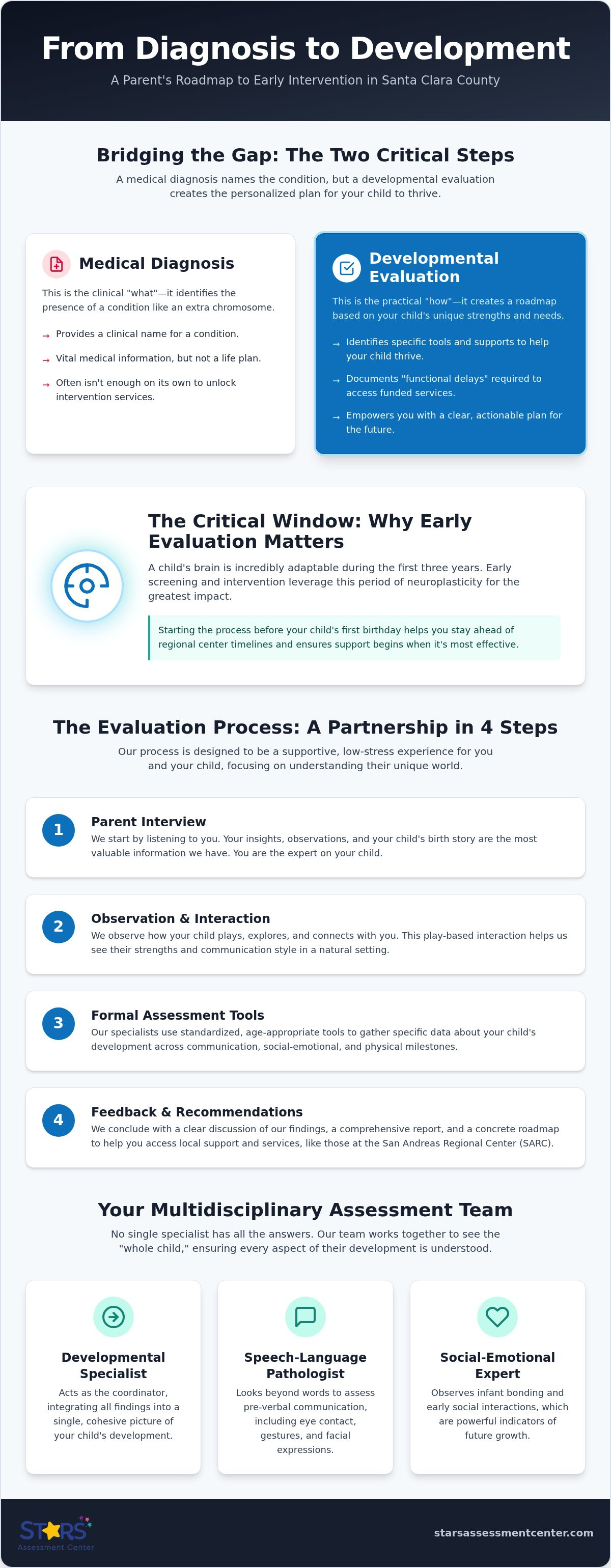
Receiving a medical diagnosis for your child is a significant moment that often brings a mix of clarity and questions. A medical diagnosis identifies the presence of an extra chromosome, providing a clinical name for your child's condition. While this information is vital, it doesn't describe your baby's unique personality or their specific path forward. A developmental evaluation is different. It's a comprehensive look at how your child interacts with their environment, moves their body, and communicates their needs. While a Down syndrome screening Santa Clara County provides the medical "what," the evaluation provides the practical "how" for your child's daily life.
In California, a medical diagnosis alone isn't always enough to unlock the full range of Part C Early Intervention services. The system specifically looks for a "functional delay." This term refers to how a child performs certain tasks compared to typical developmental milestones. To secure the funding and support your child deserves, you need an evaluation that documents these specific needs across multiple areas of growth. The Stars Assessment Program serves as a bridge for families in San Jose, helping you move from the uncertainty of a new diagnosis to a clear, actionable plan for your child's future.
The Purpose of a Multidisciplinary Screening
A multidisciplinary screening looks at the "whole child" instead of focusing on a single medical label. Our team observes how your child connects with you socially and emotionally, as these early bonds are powerful indicators of future growth. By identifying these strengths early, we can build a supportive environment that encourages progress. Establishing this baseline in Santa Clara County allows us to track small victories with precision, ensuring that no part of your child's potential is overlooked.
The Referral Path in Santa Clara County
Most families begin their journey with a referral from a pediatrician or a specialist in the NICU. If your healthcare provider has discussed a Down syndrome screening Santa Clara County, the next logical step is connecting with a developmental expert. Early screening, ideally before your child reaches their first birthday, is essential because of neuroplasticity. A child's brain is incredibly adaptable during these first three years. Starting the evaluation process early in San Jose helps you stay ahead of regional center timelines and ensures that intervention begins when it can have the greatest impact.
The Multidisciplinary Evaluation Process: What Parents Should Expect
While a Down syndrome screening Santa Clara County provides a diagnostic starting point, the evaluation process is where your child's individual story begins to take shape. Unlike a quick checklist or a brief medical exam, a multidisciplinary assessment brings together experts from different fields to look at every angle of your child's development. This team approach ensures we aren't just looking at a list of symptoms; we're looking at a whole person with unique strengths and specific needs. If you're feeling uncertain about the next steps, our team at Stars Assessment Program is here to guide you through each phase of the process with care and expertise.
Who Makes Up the Assessment Team?
Our team is built around the idea that no single specialist has all the answers. A Developmental Specialist leads the way, acting as a coordinator to ensure all findings are integrated into one cohesive picture. Speech-Language Pathologists play a vital role, even for the youngest infants. They look beyond spoken words to assess pre-verbal communication, such as how your baby uses eye contact, gestures, or facial expressions to connect with you. Additionally, Social-Emotional experts join the team to observe infant bonding and early social interactions. This holistic view helps us understand how your child relates to their world, which is just as important as their physical milestones.
A Typical Day at the Assessment Center
We've designed our process to be as low-stress as possible for both you and your child. We want this to feel like a supportive partnership, not a cold clinical appointment. The day is structured in four clear steps:
- Step 1: Parent Interview: We start by gathering your child's birth story and history in a comfortable setting. You're the expert on your child, and your observations are the most valuable data we have.
- Step 2: Naturalistic Play: We observe your child's functional skills through play. By watching how they reach for a toy or respond to a game of peek-a-boo, we see their true abilities in a relaxed environment.
- Step 3: Adapted Assessment Tools: We use standardized tools specifically adapted for infants with Down syndrome. These help us measure progress accurately without placing unnecessary demands on your little one.
- Step 4: Immediate Feedback: We conclude with initial impressions and reassurance. You won't be left wondering; we discuss what we've seen with empathy and clarity before you leave.
This thorough approach ensures that the results of your Down syndrome screening Santa Clara County are translated into a practical, supportive plan. By seeing your child's skills through the lens of play and connection, we can identify exactly which services will help them flourish. We're here to make sure you leave the center feeling empowered, informed, and ready for the next step in your journey.
After you've moved past the initial results of a Down syndrome screening Santa Clara County, our team shifts the focus to your child's unique developmental profile. We don't just look for what is missing; we look for how your child is currently engaging with their environment. This involves a deep dive into four key areas: communication, physical motor skills, cognitive exploration, and social-emotional connection. By understanding these specific domains, we can create a plan that feels manageable and hopeful for your family.
Cognitive growth at this early age is all about curiosity and discovery. We watch how your infant explores objects, perhaps by shaking a rattle or passing a toy from one hand to the other. These small actions are early signs of problem-solving and mental processing. In the social-emotional domain, we track the "spark." This includes eye contact, social smiles, and how your baby responds to your voice. Many infants with Down syndrome have a natural gift for social connection. We love to use these social strengths to encourage growth in other, more challenging areas of development.
Communication and Early Language
Communication is much more than just speech. We assess receptive language, which is how your baby understands your words, and their use of gestures or early signs. Supporting these skills early is essential to reduce the frustration that often occurs when a child can't yet vocalize what they need. We focus on the building blocks: babbling, imitating sounds, and joint attention. We also integrate hearing health into this profile, as clear hearing is the foundation for all language learning.
Physical Milestones and Hypotonia
Most babies with Down syndrome have hypotonia, or low muscle tone. This means their muscles are more relaxed, which can make milestones like sitting up, crawling, or rolling over take a bit more time. It's not a lack of effort; it's simply a different physical starting point. During the evaluation, we identify specific strategies to support gross motor development in those first twelve months. Since physical movement leads to more cognitive exploration, helping your child move their body is a key part of supporting their overall learning.
Accessing Early Intervention in San Jose and Santa Clara County
Moving from a medical diagnosis to actual services can feel like entering a bureaucratic maze. In our community, the San Andreas Regional Center (SARC) is the primary gateway for families seeking funded early intervention. While SARC provides the coordination, they rely on detailed data to determine which services your child qualifies for. This is why a multidisciplinary evaluation is such a powerful tool. By providing a comprehensive report that details your child's functional delays and unique strengths, we help streamline your intake process at SARC. Our goal is to ensure you don't just get into the system, but that you get the right support for your family's specific needs.
Once eligibility is established, you'll work with SARC to develop an Individualized Family Service Plan (IFSP). This isn't just a clinical document; it's a collaborative agreement that outlines your child's goals and the services they'll receive. Whether you live in Milpitas, Gilroy, or Morgan Hill, this plan is designed to meet your child exactly where they are. If you're ready to begin this journey and want a clear picture of your child's needs, you can schedule a developmental assessment to create the foundation for your child's IFSP.
The Regional Center Referral Process
Starting the process is straightforward, though it requires patience. You can self-refer to SARC by calling their intake line, or your pediatrician can send a referral on your behalf. In 2026, California remains deeply committed to Part C Early Intervention, ensuring that children with Down syndrome receive priority support. While timelines for initial intake can vary, having the results of a private Down syndrome screening Santa Clara County ready often helps clarify your child's needs during the regional center's assessment window. This proactive step ensures no time is lost during these critical early years of brain development.
Building Your Support Network
You don't have to walk this path alone. Beyond clinical services, Santa Clara County has a vibrant community of families who understand exactly what you're going through. Connecting with the Down Syndrome Association of Central California provides access to a wealth of shared experience and local knowledge. You can also find parent-to-parent support groups in nearby areas like Santa Cruz and Salinas. A local assessment center understands the specific landscape of our region, from the best parks for inclusive play to the most supportive preschools in San Jose. This community connection turns a clinical process into a lifetime of belonging and support.
The Stars Approach: A Safe Harbor for Your Child’s Growth
At Stars, we understand that you aren't just looking for a clinical report; you're looking for a future. While the results of a Down syndrome screening Santa Clara County provide the initial medical context, our approach focuses on the person behind the diagnosis. We believe parents are the most important members of our team. You know your child's favorite songs, the way they like to be held, and the small smiles that light up a room. By combining your deep personal knowledge with our clinical expertise, we create an evaluation that is both technically precise and deeply human.
We use a strengths-based perspective in everything we do. It's common for medical systems to focus solely on what a child cannot do yet. Our team flips that script. We identify what your child can do and use those abilities as the foundation for growth. Whether it's a strong social drive or a curious nature, these are the tools we'll use to build their roadmap. In a community as diverse as ours, we prioritize cultural sensitivity. We ensure that every family in San Jose and the surrounding areas feels heard, respected, and supported in their own unique context.
Why Specialized Infant Assessment Matters
The first 36 months of life are a period of incredible neuroplasticity. During this window, your baby's brain is highly receptive to new patterns and learning. This is why a specialized assessment is so critical. Instead of a "wait and see" approach, professional clarity allows you to act with confidence. This certainty is often the best antidote to parental stress. When you have a clear understanding of the "why" behind your child's developmental path, the "how" of daily support becomes much less intimidating. This clarity builds a long-term roadmap for success that carries your child through school and beyond.
Partnering with Stars Assessment Program
Choosing a partner for your child's developmental journey is a significant decision. We offer a blend of professional warmth and clinical excellence that serves as a safe harbor for families. We're here to help you move from the initial shock of a diagnosis to the empowerment of a life-changing intervention plan. Our team is dedicated to providing the guidance you need to navigate the local service landscape with ease. If you're ready to take the next step, we invite you to Schedule a Compassionate Evaluation for Your Child Today. Together, we can build a foundation of support that honors your child's unique potential.
Taking the Next Step Toward Your Child’s Bright Future
The journey following a Down syndrome screening Santa Clara County doesn't have to be a path you walk alone. By moving beyond a simple medical label and embracing a comprehensive developmental evaluation, you're providing your child with a personalized blueprint for success. You've seen how a multidisciplinary team identifies functional delays to secure critical SARC services and how focusing on your child's unique strengths creates a steady path for growth.
Since 1988, our multidisciplinary team of infant specialists has supported families across San Jose and Santa Clara County. We bring deep expertise in Regional Center eligibility, ensuring your child receives every resource they deserve during these vital early years of development. If you're ready to move from uncertainty to a clear, actionable plan, we're here to be your steady ally.
Request a Multidisciplinary Developmental Assessment
Your child has a world of potential waiting to be discovered. With the right partners and a clear roadmap, you can feel confident and empowered as you guide them toward their very best future.
Frequently Asked Questions
What is the difference between a screening and a diagnostic test for Down syndrome?
A screening test identifies the likelihood of a condition, while a diagnostic test confirms its presence. For example, a prenatal Down syndrome screening Santa Clara County might indicate a higher probability of a chromosomal difference, but it doesn't provide a definitive "yes" or "no" answer. Diagnostic tests, such as amniocentesis or CVS, are used to confirm the diagnosis. Screening is a non-invasive first step that helps families decide if they want to pursue further testing or begin planning for early support services.
Does my infant need a referral for a developmental evaluation in Santa Clara County?
You don't need a formal doctor's referral to begin the developmental evaluation process in our community. While many families come to us through a recommendation from their pediatrician or a specialist in the NICU, you have the right to self-refer. You can contact the Stars Assessment Program directly or reach out to the San Andreas Regional Center to start the intake process. This direct access ensures that you can advocate for your child's needs as soon as you have concerns about their growth.
How long does a multidisciplinary assessment typically take?
A multidisciplinary assessment usually takes between 90 minutes and two hours to complete. We structure this time to be as low-stress as possible, allowing for plenty of breaks for snacks, diaper changes, or simply a moment of rest for your baby. This duration gives our team of specialists enough time to observe your child's natural play, social interactions, and physical movements in a relaxed setting, which results in a much more accurate developmental profile.
Will my child qualify for services if they already have a medical diagnosis?
A medical diagnosis is an important piece of the puzzle, but eligibility for California's Early Intervention services often depends on the presence of a functional delay. Even with a confirmed diagnosis, the evaluation must document how your child is currently performing in areas like communication, motor skills, or social-emotional growth. Our team specializes in identifying these specific needs during a Down syndrome screening Santa Clara County to help you secure the funding and support your child deserves through the Regional Center system.
What should I bring to my baby’s evaluation appointment?
Please bring your child's recent medical records, any previous screening results, and items that help your baby feel comfortable and secure. We recommend bringing favorite toys, familiar snacks, a bottle, and extra diapers. When your child feels at home in our assessment center, they're more likely to show us their true abilities. These comfort items help our specialists observe your baby's most authentic behaviors during our play-based assessment sessions.
Are the evaluations at Stars Assessment Program covered by insurance or the Regional Center?
Most evaluations at Stars are funded through our partnership with the San Andreas Regional Center (SARC) for families who meet eligibility criteria. If you're seeking a private evaluation outside of the Regional Center system, we suggest contacting your insurance provider to understand your specific benefits and coverage. We're committed to helping you understand the different paths available so your child can receive a high-quality assessment with as much financial clarity as possible.
What happens if the evaluation shows my child is meeting all milestones?
If the evaluation shows your child is meeting their milestones, it provides a valuable baseline and professional peace of mind for your family. We celebrate these victories with you and provide a detailed report documenting your child's current strengths. In these situations, we might suggest a schedule for periodic monitoring. This proactive approach ensures that if any needs arise later, they're identified quickly while your child's brain is still in a period of rapid, adaptable growth.
How soon after the assessment will we receive the final report?
You'll receive a comprehensive final report within two to three weeks of your child's assessment date. While our team provides initial impressions and reassurance on the day of the evaluation, the written document takes time to compile. We carefully integrate observations from our speech, motor, and developmental specialists into one cohesive roadmap. This report is a vital tool for your family, providing the clear evidence needed to build an effective intervention plan with the Regional Center.


