
You are at a park in San Jose, watching your two year old play alongside others. While the child next to them is chatting away, your little one relies on gestures and single words. You might find yourself wondering if they're just a late bloomer or if it's time to seek a speech evaluation under age three.
It's completely natural to feel a mix of worry and confusion when your child's communication doesn't seem to match the milestones you've read about. You want to do what's best, but the conflicting advice from relatives can make the decision to seek help feel overwhelming. You aren't alone in this anxiety. Your desire for answers is a sign of your deep dedication as a parent.
This guide will show you how an early evaluation provides clarity and a path to support for your child’s communication journey. We'll provide a roadmap for getting help in Santa Clara County and explain how these assessments work to empower your family.
By understanding the process, you can move from uncertainty to action. We'll explore speech milestones and the multidisciplinary approach that ensures your child receives the thorough, gentle care they deserve.
Key Takeaways
- Learn to identify specific communication "red flags" at 12, 18, and 24 months to help you decide when professional guidance is needed.
- Understand how a speech evaluation under age three uses play-based techniques to assess your child’s skills in a natural, stress-free setting.
- Discover the vital difference between speech and language delays so you can gain a clearer perspective on your child’s unique development.
- Gain a clear roadmap for accessing early intervention services through the San Andreas Regional Center (SARC) in Santa Clara County.
- Learn how a multidisciplinary team provides a "safe harbor" for families, turning uncertainty into a structured path toward progress.
Recognizing the Signs: When to Seek a Speech Evaluation Under Age Three
Many parents feel a tug of uncertainty when they compare their toddler’s talking to other children at the park or in daycare. It’s common to hear well-meaning friends say that every child develops differently, but a Language delay involves more than just being a late talker. Research indicates that approximately 15% of children experience some form of language delay. It’s helpful to distinguish between speech, which is the physical act of making sounds, and language, which is the ability to understand and use words to share ideas. If you notice your child struggling to connect with others or follow simple requests, a speech evaluation under age three can provide the clarity you need.
Choosing to act early isn't about looking for a problem or applying a label. It’s about giving your child the right tools during their most critical window of brain development. While the "wait and see" approach was common in the past, we now know that early intervention can significantly improve long-term communication outcomes. Addressing small hurdles now prevents them from becoming larger barriers to learning and social connection as your child enters preschool.
Communication Milestones: 12 to 24 Months
Watching for specific milestones helps you decide if a professional look is necessary. You can look for these key indicators as your child grows:
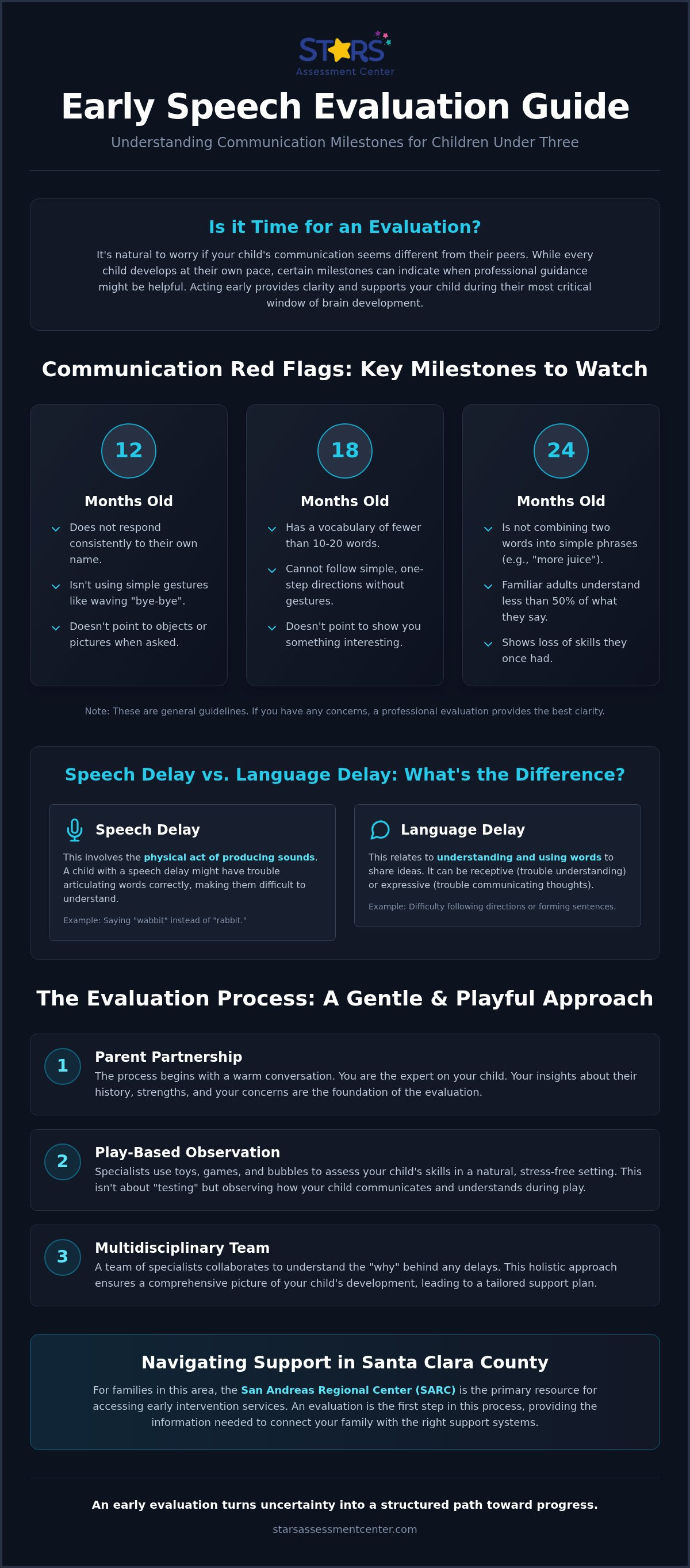
- 12 Months: Responding to their name and using simple gestures like waving "bye-bye" or pointing to things they want.
- 18 Months: Using a vocabulary of at least 10 to 20 words and following one-step directions without needing a gesture.
- 24 Months: Combining two words to form simple phrases like "my ball" or "more juice." At this stage, familiar adults should understand about half of what the child says.
If these milestones feel out of reach or if your child seems to lose skills they once had, a speech evaluation under age three is a proactive next step to ensure they have the support they need.
Social Cues and Non-Verbal Communication
Communication is about much more than spoken words. Non-verbal cues, such as consistent eye contact and "joint attention"—where a child points to a dog and looks at you to make sure you see it too—are foundational skills for toddlers. When a child doesn't use these cues, they often feel a deep sense of frustration because they can't make their needs known. This frustration might manifest as behavioral outbursts or withdrawal from social play. Because communication is so closely tied to how children relate to others, a social emotional development screening is often integrated into the assessment process. This holistic approach ensures we support the whole child, recognizing that their social-emotional well-being and their ability to speak are deeply interconnected.
The Evaluation Process: What Happens During a Toddler Speech Assessment?
Walking into a clinic with a toddler can feel daunting. You might worry your child won't "perform" for a stranger or will be too shy to show their true abilities. Rest assured, a speech evaluation under age three is designed with a child's natural behavior in mind. It starts with a warm conversation between you and the specialist. Since you know your child best, your insights into their history and your specific concerns are the foundation of the entire process. You aren't just a bystander; you're an essential partner in helping the team understand your child's daily life.
Play-Based Observations and Standardized Tools
Testing a two year old doesn't involve flashcards or sitting still at a desk. Instead, it happens on the floor with blocks, dolls, and bubbles. Specialists use these toys to measure receptive language, which is what a child understands, and expressive language, which is how they use words or gestures. By observing how your child interacts with these items, clinicians can compare their skills to the CDC Milestones for 2-Year-Olds. Play-based assessment is a non-intimidating way to gather clinical data.
The Multidisciplinary Team Approach
A simple screening might tell you if a child is behind, but it rarely explains why. This is where the multidisciplinary advantage comes in. By involving a team of specialists, we can determine if a delay is purely related to speech sounds or if it's connected to other areas like cognitive growth. This holistic view ensures that no detail is missed. Integrating multidisciplinary developmental assessment findings allows for a more accurate roadmap for support. We look at the "whole child" to ensure the path forward is as thorough as possible.
During the evaluation, you provide the context that a one hour session cannot capture. You can explain how your child communicates at home or with siblings, which helps the team see the full picture. This collaboration ensures the results reflect your child’s true strengths and needs rather than just a snapshot in time. If you're ready to gain this clarity for your family, you can learn more about our evaluation process and how we support children in Santa Clara County.
Understanding the Results: Speech Delay vs. Language Delay
Receiving the results of a speech evaluation under age three is often the moment when a parent’s quiet worry transforms into a clear, actionable plan. While the terms can feel technical, our goal is to provide a safe harbor of information that makes sense for your family. Understanding the difference between a speech delay and a language delay is the first step in that journey. A speech delay involves the physical mechanics of sound production. Your child might know exactly what they want to say but struggle with the coordination required to form those specific sounds clearly. In contrast, a language delay relates to how a child understands information or uses words to share their thoughts.
Expressive vs. Receptive Language
Receptive language refers to what your child takes in. Can they follow a simple request like "put the block in the bucket" without a visual cue? Expressive language is what they put out into the world. It’s very common for toddlers to have a gap between these two skills, often understanding much more than they can currently say. This distinction is a core part of any comprehensive Overview of Early Intervention, as it dictates which specific strategies will help your child most. When we identify this gap, we can focus on building the specific bridge your child needs to express their inner world.
When Speech is a Symptom of Other Delays
Sometimes, communication challenges are a symptom of other developmental factors. Our team looks at the whole child to see if there are underlying hearing concerns or social-emotional hurdles. In some cases, speech delays can be early indicators of conditions like Autism or Down syndrome. If our specialists notice these patterns, we guide you through the next steps, such as explaining the nuances of autism screening vs evaluation for toddlers. By identifying these factors early, we ensure the support your child receives is precisely tailored to their needs. This thoroughness is what allows us to move beyond simple labels and focus on your child's unique growth potential.
At Stars Assessment Program, we prioritize clarity over clinical jargon. We want you to leave the evaluation feeling empowered, not overwhelmed. You'll receive a roadmap that explains not just the "what," but the "why" behind your child's communication style. This ensures you feel confident in the path forward, knowing you have a dedicated ally in your child's development.
Navigating the System: Early Intervention and Regional Centers in Santa Clara County
Understanding the administrative side of support can feel like learning a new language. In California, the system is designed to be accessible and supportive for every family. If you live in San Jose or Salinas, the San Andreas Regional Center (SARC) is your primary point of contact for early services. This agency manages the Early Start program, which is the state's implementation of the federal Individuals with Disabilities Education Act (IDEA) Part C. This law ensures that infants and toddlers with disabilities or delays have a protected right to early intervention services. It's a safety net designed to catch concerns early, when support has the greatest impact.
The Referral Process in Santa Clara County
Anyone can make a referral, including parents, doctors, or childcare providers. Once you contact SARC to request a speech evaluation under age three, a specific timeline begins. By law, the regional center has exactly 45 days to complete the assessment, determine eligibility, and develop an Individualized Family Service Plan (IFSP) if your child qualifies. To be eligible for these free services, a child must typically show a developmental delay of at least 25% in one or more areas, such as communication, social-emotional, or cognitive skills. This structured roadmap ensures your child doesn't get lost in a waiting list during these formative years.
Early Intervention: Support in the Natural Environment
If your child is eligible for support, services are provided in what specialists call the "natural environment." This means therapy often happens at your home, a local park, or a daycare center in Milpitas, Gilroy, or Morgan Hill. The focus is not just on the therapist working with the child; it's on coaching you as the parent. Since you're with your child every day, you're the best person to help them practice new communication skills during daily routines like bath time or dinner. For families specifically seeking a Down syndrome assessment in Santa Clara County, this home-based model provides a familiar and comfortable space for specialized support and family guidance.
Navigating these steps can feel heavy, but you don't have to do it alone. Many families find that having a professional ally makes the process much smoother and less intimidating. Our team at Stars Assessment Program is here to guide you through these transitions and ensure your child receives the thorough, multidisciplinary attention they deserve. If you're ready to start this process, contact us today to learn how we can help your family find the right path forward in Santa Clara County.
Taking the Next Step: How the Stars Assessment Program Supports Your Family
Deciding to seek a speech evaluation under age three is a brave first step toward understanding your child's unique world. It’s the moment you move from quiet worry to active partnership. At Stars Assessment Program, we view ourselves as a safe harbor for families in San Jose and across Santa Clara County. We know that the period between noticing a delay and getting professional answers can feel like an emotional limbo. Our goal is to bridge that gap with professional warmth and clear, actionable insights that empower you to help your child thrive.
Our multidisciplinary team brings together experts who specialize in early childhood development. This means we don't just look at whether your child is making specific sounds. We look at their social-emotional growth, their cognitive patterns, and their overall communication style. This thoroughness ensures that the guidance we provide is deeply personal and technically precise. You aren't just another appointment to us; you're a family seeking a steady ally, and we take that responsibility to heart.
A Partnership Centered on Your Child
We believe that an evaluation should be a gentle experience for both the child and the parent. Our assessments for children from birth to age three are designed to feel like a playdate rather than a medical exam. We use age-appropriate toys and games in a warm, welcoming environment to observe your child’s natural communication. This approach allows us to see their true strengths and challenges without the stress of a clinical setting. To prepare for your first visit, we suggest bringing a favorite toy or a familiar snack to help your little one feel at home. We also encourage you to write down your specific questions so we can address every concern you have during our time together.
Beyond the Evaluation: A Roadmap for Growth
Once the assessment is complete, we provide you with more than just a list of scores. We deliver a comprehensive roadmap that explains your child's communication style in plain, family-friendly language. This documentation is essential for accessing Regional Center services and building an Individualized Family Service Plan (IFSP). We help you translate clinical findings into daily strategies you can use at home in Milpitas or Salinas. An evaluation is the start of a supportive partnership, not just a one-time report. Our team remains a resource for you as you navigate the next steps of your child’s journey, ensuring you never feel like you're walking this path alone. By choosing a speech evaluation under age three, you are giving your child the best possible foundation for a lifetime of connection and confidence.
Empowering Your Child’s Voice
Your child’s communication journey is unique, and your dedication to finding answers is their greatest asset. By understanding the difference between speech and language delays and knowing the milestones to watch for, you’ve already begun the process of building a stronger foundation for their future. Seeking a speech evaluation under age three isn’t about looking for a diagnosis; it’s about gaining the clarity and support your family deserves.
Our multidisciplinary team of experts is specialized in birth-to-three development and is dedicated to serving families across Santa Clara and Santa Cruz counties. We’re here to guide you through the local systems and provide a roadmap that focuses on your child’s strengths. You don’t have to navigate this path alone. We’re ready to act as your steady ally and provide the professional warmth your family needs during this time of growth.
Schedule a Compassionate Evaluation for Your Child today and take the next step toward a clearer path forward. You’re doing the right thing for your little one, and we’re honored to support you every step of the way.
Frequently Asked Questions
Is my two-year-old just a late talker, or do they need an evaluation?
It can be hard to tell the difference between a "late talker" and a child with a true delay without professional insight. A speech evaluation under age three helps determine if your child is hitting milestones like combining words or following simple directions. While some children do catch up naturally, acting early ensures they have the support they need during their most critical years of brain development. We provide the clarity you need to move forward confidently.
How much does a speech evaluation for a toddler cost in California?
In California, evaluations provided through the Early Start program are free of charge for eligible infants and toddlers. This includes assessment and service coordination through local agencies like the San Andreas Regional Center. For private services, costs can vary significantly based on the complexity of the assessment and whether your insurance covers developmental screenings. We recommend checking with your provider or local regional center to understand the specific resources available to your family in Santa Clara County.
Can a speech evaluation help identify autism in children under three?
Yes, a comprehensive evaluation is a vital tool for identifying early signs of Autism. At Stars Assessment Program, our multidisciplinary team looks at communication, social-emotional cues, and repetitive behaviors. Because we specialize in birth-to-three development, we can spot subtle indicators that a general screening might miss. Identifying these patterns early allows families in San Jose and Salinas to access specialized support that makes a meaningful difference in their child's daily life.
What happens if my child is shy and won’t talk during the evaluation?
Our specialists are experts at working with shy or hesitant toddlers. We use a play-based approach that feels like a fun session on the floor rather than a formal test. Even if your child doesn't speak much during the visit, we gather valuable data by observing their gestures, eye contact, and how they interact with toys. Your insights as a parent also play a major role, helping us understand how your child communicates in their most comfortable environment.
How long does a multidisciplinary developmental assessment take?
A typical session at our center usually lasts between one and two hours. However, the complete process for early intervention in California follows a specific timeline. Once a referral is made to a regional center, the assessment, eligibility determination, and creation of an Individualized Family Service Plan (IFSP) must be completed within 45 days. This structured schedule ensures that families in Milpitas and Morgan Hill receive timely answers and a clear path to support without unnecessary delays.
What is the difference between a screening and a full evaluation?
A screening is a brief check to see if a child is at risk for a delay, while a full evaluation is an in-depth analysis. During a speech evaluation under age three, a team of specialists uses standardized tools and observations to measure specific skills in detail. While a screening might suggest a "red flag," the evaluation provides the formal documentation needed to qualify for services and helps us understand the root cause of any communication hurdles.
Do I need a doctor’s referral to get my child evaluated at Stars?
You don't necessarily need a doctor’s referral to begin the process. In California, parents have the right to self-refer their child to the San Andreas Regional Center if they have concerns about development. While your pediatrician is a great resource for initial conversations, you can contact the regional center directly to request an assessment. Our team at Stars Assessment Program works closely with families throughout Santa Clara County to help them navigate these entry points and access thorough evaluations.
What should I bring to my child’s first speech assessment?
We recommend bringing items that help your child feel safe and comfortable, such as a favorite toy, a comfort blanket, or familiar snacks. It’s also helpful to have a list of your specific concerns and any medical or birth records you have available. If your child uses specific gestures or has a small vocabulary of "home words," jotting those down helps our team see the full picture of how they communicate in their natural environment.


