
You've noticed your toddler isn't hitting milestones at the same pace as other children, and now you're holding a referral that mentions a regional center referral assessment. It's a moment often filled with a heavy mix of questions; you might feel anxious about a stranger evaluating your child or worried that they'll be denied the support they need. It's completely natural to feel overwhelmed by the technical language of the Early Start program and the fear of your child being labeled so early in life.
We understand these concerns because we see the heart behind them. You're looking for a steady ally to help you understand your child's unique growth. This guide is designed to be a safe harbor for your family, showing you how the assessment process is actually a supportive partnership rather than a clinical interrogation. We'll explain how our multidisciplinary team works together to identify your child's strengths and needs, focusing specifically on children from birth to age three.
By the end of this article, you'll have a clear roadmap of the 45 day assessment timeline and a better understanding of how we secure vital early intervention for infants and toddlers. We'll demystify the steps involved so you can move forward with confidence, clarity, and hope for your child's future.
Key Takeaways
- Understand that a regional center referral assessment is the essential first step to accessing California’s Early Start program for children under age three.
- Learn how a multidisciplinary team of speech and cognitive specialists provides a more holistic and accurate picture of your child’s unique developmental journey.
- Discover the 45 day roadmap from your initial referral to the creation of an Individualized Family Service Plan (IFSP).
- Get practical tips for preparing your toddler for their evaluation to ensure they feel comfortable and can demonstrate their true skills in a natural environment.
- Find out how a family centered approach in the Santa Clara County area can turn a clinical process into a supportive "safe harbor" for your family.
What is a Regional Center Referral Assessment?
A regional center referral assessment is the first welcoming step for families who suspect their infant or toddler might need extra support. In California, this process serves as the vital gateway to the Early Start program, ensuring that young children receive help during their most critical years of brain development. The California Department of Developmental Services (DDS) oversees this system, but the journey often begins at the community level. It's a collaborative effort meant to replace uncertainty with a concrete plan for your child's growth.
Referrals don't just come from medical professionals. While a pediatrician often initiates the process after a checkup, a daycare provider or a parent can also request an evaluation. If you've noticed your child isn't meeting milestones like sitting up, babbling, or responding to their name, you have the right to ask for a regional center referral assessment. This system is similar in its supportive mission to the federal Early Head Start Program, which focuses on enhancing the development of very young children through community based services.
The legal foundation for these services is the Lanterman Act. Simply put, this law establishes that Californians with developmental disabilities have a right to the services they need to live independent lives. Recent updates to the act emphasize person-centered language, shifting focus to the individual rather than a diagnosis. For families with children under three, this means the state is legally committed to providing early intervention without the burden of family fees, which were repealed as of July 1, 2024.
The Goal of the Evaluation
The primary purpose of this evaluation is to identify developmental delays as early as possible. By catching these delays now, we can maximize your child's future potential. The assessment helps our team determine if your child is eligible for state funded services and creates a baseline for the Individualized Family Service Plan (IFSP). This plan isn't just a document; it's a roadmap that outlines the specific supports your family will receive to help your child thrive.
Who Qualifies for Early Start?
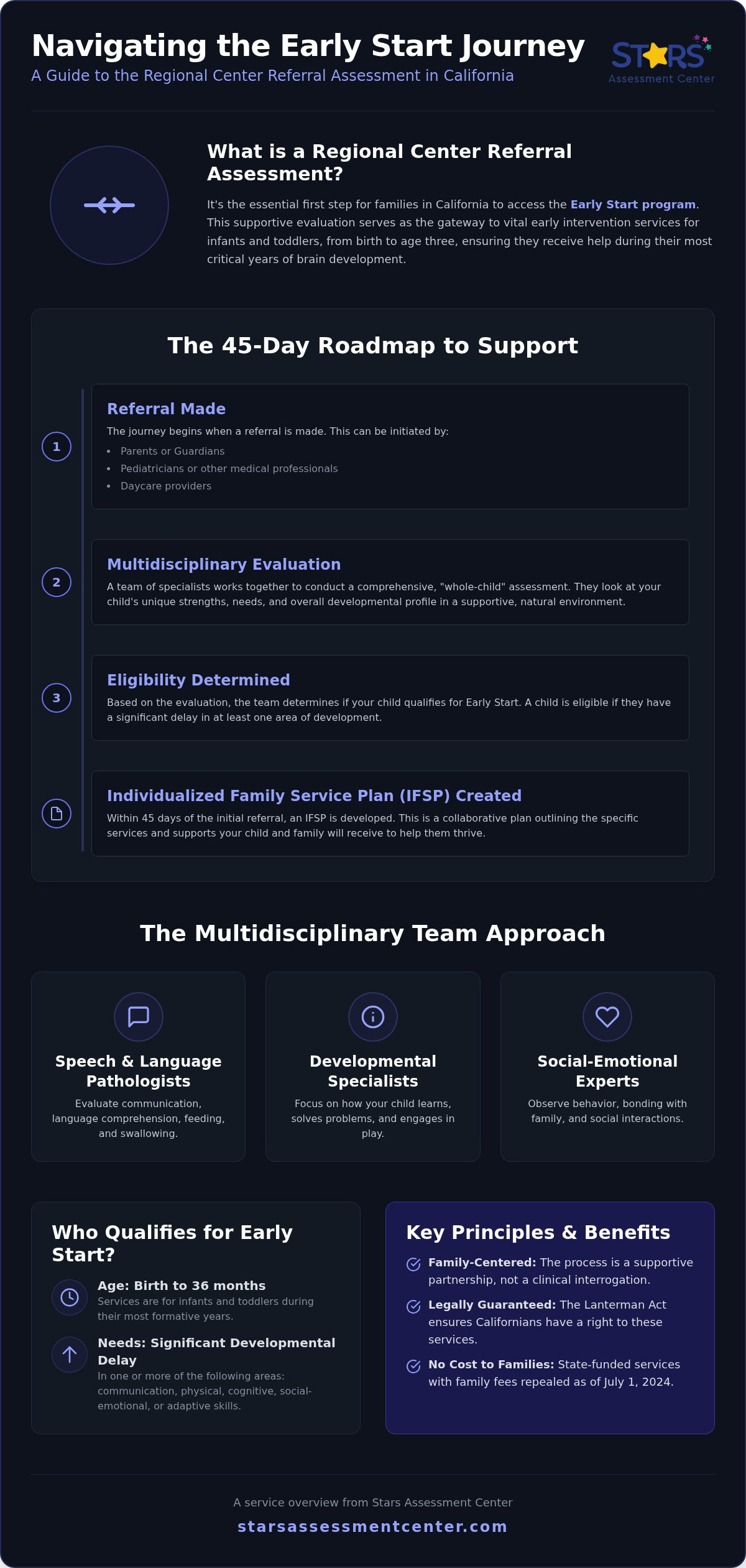
Early Start is specifically for children from birth to 36 months of age. To qualify, a child must show a significant delay in at least one area of development, such as communication, physical skills, or social-emotional growth. In Santa Clara County, local centers like the San Andreas Regional Center coordinate these evaluations. They ensure that families in San Jose and surrounding areas can access a regional center referral assessment quickly, adhering to a strict 45 day timeline from the initial referral to the completion of the IFSP.
The Multidisciplinary Team Approach
When you arrive for a regional center referral assessment, you might feel a bit like you’re under a microscope. It’s a common worry for many parents. However, the true purpose of a multidisciplinary team isn’t to scrutinize your child, but to see them through several different expert lenses at once. By bringing together specialists from various fields, we ensure that no part of your child’s growth is overlooked. This collaborative synergy creates a much more accurate and compassionate picture during the regional center referral assessment process than any single person could provide on their own.
At the Stars Assessment Program, we carefully select our evaluation teams to match the specific needs of each family in the San Jose and Santa Clara regions. We believe in a "whole-child" perspective. This means we look at how a child’s physical health, communication skills, and social bonds all influence one another. As an employee-owned organization, our team is deeply invested in being a steady ally for your family. If you're feeling uncertain about your child's milestones, you can learn more about our supportive evaluation process to see how we can help.
Specialists Involved in the Assessment
Our team approach is built on the expertise of several key professionals who work together to understand your child's unique developmental profile:
- Speech and Language Pathologists: These specialists don't just look at first words; they evaluate how your child understands language and even how they handle feeding and swallowing.
- Developmental Specialists: These experts focus on how your child learns, solves problems, and engages in play.
- Social-Emotional Experts: They look at the inner world of the child, focusing on behavior, bonding, and how your toddler interacts with you and others.
This multidisciplinary developmental assessment serves as a core pillar of our work. It ensures we understand every nuance of your child's early journey before they reach 36 months of age.
Specialized Screenings
Sometimes, a general look isn't enough. Within California's Early Start Program, we provide specialized screenings tailored to specific conditions. For toddlers, this often includes autism screenings to identify early behavioral markers that might otherwise be missed. We also provide Down syndrome developmental assessments, which focus on the unique physical and cognitive support these children need to thrive. By focusing on the social-emotional assessment as well, we can address the "why" behind certain behaviors, providing you with clarity rather than just a list of symptoms.
Navigating the California Referral Process
Starting the journey toward support can feel like a heavy responsibility, but you don't have to carry it alone. Once a referral is made, a specific legal timeline begins to ensure your child receives timely care. In California, the entire process from the initial referral to the completion of the Individualized Family Service Plan (IFSP) must be finished within 45 days. This window is designed to move your family from uncertainty to action without unnecessary delays.
You can request a regional center referral assessment yourself; you don't need to wait for a doctor's recommendation if your "gut feeling" tells you something is different. Parents are often the first to notice subtle shifts in development, and your observations are a vital part of the data we collect. If you're wondering how these steps look in practice, you can review how different agencies manage Regional Center Early Start Services to see the consistent standards held across the state. While the paperwork might seem daunting, it's simply the mechanism that secures your child's right to help.
A common fear for many families is the possibility that their child won't qualify for services. If an assessment shows your child doesn't meet the specific state criteria, it doesn't mean your concerns weren't valid. It simply means your child's current needs might be better met through other community resources or monitored through "prevention" services. We're here to help you find the right path, regardless of the initial eligibility outcome.
The Intake Interview
The process usually begins with an intake interview. This is your first meeting with a Service Coordinator who will act as your guide. During this conversation, you'll share your child's medical history, pregnancy details, and birth story. It's a chance to explain what a typical day looks like and where you see your child struggling. This meeting isn't a test; it's a way to set the stage for the formal evaluation day so the specialists know exactly which areas to focus on.
Understanding Eligibility Criteria
To qualify for Early Start, California uses a "33% delay" rule. In family friendly terms, this means that if your 24 month old is communicating at the level typically expected of a 16 month old, they meet the criteria for a significant delay. Some children qualify automatically due to "high-risk" factors, such as extreme prematurity or established conditions like Down syndrome. If you ever disagree with the results of a regional center referral assessment, you have the right to request a second opinion or a fair hearing to ensure your child's needs are fully understood.
Preparing for the Evaluation: A Guide for Families
The day of a regional center referral assessment often carries a mix of hope and nervous energy. We want you to know that your child doesn't need to "perform" or "pass" a test. The goal is simply to see who they are in their most natural state. To help this go smoothly, try to ensure your child is well-rested and has had a meal or snack before the team arrives. If the assessment happens at home, keeping the environment familiar and low-stress allows your little one to feel safe enough to demonstrate their true skills.
You are the most important member of the team during this process. While specialists bring their expertise in development, you bring the deep knowledge of your child's personality and history. Gathering medical records and results from previous screenings beforehand can help the team see the full picture. During the evaluation, you serve as your child's voice; if they are having an "off" day or doing something differently than usual, don't hesitate to speak up. Your insights help us understand what is typical for your child versus what might be a one-time behavior. If you want to discuss your child's specific milestones before the big day, you can connect with our developmental specialists for guidance.
What to Expect on Evaluation Day
It might look like the specialists are just playing games with your child, but there is a purpose behind every interaction. We use observation through play to see how your child solves problems, uses their hands, and interacts with others. Along with these "games," we use standardized testing tools specifically designed for infants and toddlers. These tools help us measure growth across communicative, physical, and social-emotional domains. Our specialists are trained to build comfort first, often sitting on the floor and following your child's lead to create a "safe harbor" atmosphere during the regional center referral assessment.
Questions to Ask Your Evaluation Team
You should leave the assessment feeling empowered and informed. Don't be afraid to ask the team questions that help you process the experience. Consider asking: "What specific strengths did you see in my child today?" to keep the focus on their potential. It's also helpful to ask, "When will we receive the written report?" and "How do these findings impact our daily routine?" These answers will help you transition from the assessment into the next steps of the Early Start journey with a clear sense of direction.
The Stars Assessment Program Difference
Choosing the right partner for your child's regional center referral assessment is a decision that impacts your family's entire journey. In the San Jose and Santa Clara County community, the Stars Assessment Program stands as a dedicated guide for families with infants and toddlers. We don't see ourselves as a distant medical entity; we are your neighbors, committed to providing a "safe harbor" where your concerns are validated and your child is celebrated for who they are. Our approach is led by empathy, ensuring that the evaluation process feels like a supportive partnership rather than a bureaucratic hurdle.
One unique aspect of our organization is our employee-owned (ESOP) structure. Because our staff members are owners, they have a personal stake in the success of every family we serve. This leads to a higher level of care, reliability, and patience. Our specialists aren't just checking boxes; they are deeply invested in seeing your child thrive. This commitment is especially evident in our social emotional assessment expertise, where we look closely at behavioral markers and bonding to provide the clarity you need during these early years.
Serving Our Local Neighborhoods
We understand that traveling long distances with a toddler can be stressful. That's why we prioritize local access across Milpitas, Gilroy, Morgan Hill, and Salinas. By keeping our services close to home, we make it easier for you to focus on what matters: your child's development. Our team also values cultural sensitivity, recognizing that every family has a unique background and set of values. We respect your family's traditions and language, ensuring that the regional center referral assessment reflects your child's life accurately within your specific cultural context. We treat parents as equal members of our team, valuing your voice as much as our clinical data.
Next Steps After the Assessment
Once the evaluation is complete, our support doesn't simply end. We take the time to help you translate the technical report into actionable early intervention strategies you can use immediately. Our team guides you through the transition into the Individualized Family Service Plan (IFSP) process, making sure you understand how the findings lead to specific supports. We bridge the gap between the initial concern and the start of services, acting as a steady ally every step of the way. If you're ready to take the next step, reach out to our multidisciplinary team directly to learn how the Stars Assessment Program can support your child's Early Start journey.
Empowering Your Child’s Brightest Future
Navigating the early years of your child's life can feel like a series of unknowns, but you've already taken the most important step by seeking answers. Understanding the regional center referral assessment process turns anxiety into a clear plan for support. You now know that this evaluation is a collaborative partnership designed to identify your child's strengths and unlock their full potential through the Early Start program.
Our multidisciplinary team of experts focuses exclusively on infants and toddlers from birth to age three, ensuring every milestone is understood within the context of your child's unique personality. We take pride in serving San Jose and Santa Clara County families with a heart-centered approach that values your observations as much as our clinical findings. You don't have to walk this path alone; we're here to be your steady ally.
If you're ready to move forward with clarity and hope, we invite you to reach out today. Begin your journey with a compassionate Stars Assessment and give your child the foundation they deserve.
Frequently Asked Questions
How do I get a referral for a regional center assessment?
You can obtain a referral by contacting your local regional center directly or by asking your pediatrician to submit a request on your behalf. In the San Jose and Santa Clara regions, parents often call the San Andreas Regional Center to start the process. You don't need to wait for a professional's recommendation if you have concerns about your child's growth. Once the center receives your request, they'll assign a coordinator to guide your family.
Does a referral assessment mean my child has a permanent diagnosis?
No, a regional center referral assessment is primarily used to determine eligibility for early intervention services rather than providing a lifelong medical diagnosis. For children under age three, the focus is on identifying current developmental delays that require support. Many children receive help through the Early Start program and eventually catch up to their peers. The goal is to provide immediate assistance during the most critical years of brain development, not to label your child permanently.
Is there a cost for the regional center referral assessment?
There is no cost to families for the initial diagnosis and eligibility assessment provided by the regional center. Under California law, these evaluations are state funded to ensure every child has access to necessary support regardless of family income. Additionally, several family fee programs were repealed between 2024 and 2025, making most early intervention services free for children birth to age three. This ensures that financial barriers don't prevent your child from receiving a multidisciplinary evaluation.
How long does the entire evaluation process take in California?
The entire process from the moment of referral to the completion of the Individualized Family Service Plan (IFSP) must be finished within 45 days. This strict legal timeline ensures that infants and toddlers in Santa Clara County don't face long wait times for vital services. During these 45 days, the center will conduct the intake, complete the multidisciplinary assessment, and meet with your family to discuss the results and next steps for your child's care.
What happens if the assessment shows my child is not delayed?
If the assessment finds your child doesn't meet the state's eligibility criteria, you'll still receive a detailed report of their current developmental levels. The team will often provide you with community resources or refer you to local programs in Milpitas or Salinas that offer general developmental support. You can also request a re-evaluation in six months if your concerns persist. This outcome simply means your child's current skills are within the range expected for their age.
Can I choose who performs my child’s developmental assessment?
While the regional center coordinates the process, they'll often partner with specialized agencies like the Stars Assessment Program to conduct the actual evaluation. You can express a preference for a specific provider within the center's network that serves your local neighborhood, such as Gilroy or Morgan Hill. Our multidisciplinary team works closely with regional centers to provide empathy-led evaluations that respect your family's cultural background and specific needs for infants and toddlers.
What is the difference between a screening and a full evaluation?
A screening is a brief snapshot used to see if a child might need more help, while a full evaluation is a comprehensive process used to determine legal eligibility for services. During a full assessment, specialists look deeply at speech, social-emotional development, and physical skills. A screening might happen at a pediatrician's office in Santa Cruz, but it's the regional center referral assessment that creates a state-funded service plan for your child.
Do I need a doctor’s note to start the referral process?
You don't need a doctor's note or a formal medical referral to begin the process with a regional center. Parents have the legal right to refer their own child if they suspect a delay in development before the age of three. While medical records can be helpful during the intake interview, your own observations as a parent are sufficient to trigger the evaluation. This ensures that families can act quickly as soon as they notice their child might need extra support.


