
You are at a park in Willow Glen, watching other toddlers climb and run while your little one seems a bit more hesitant or struggles with movements that appear easy for their peers. It's that quiet, nagging feeling in your chest that asks if they are just a late bloomer or if something more is happening. Seeking a toddler motor skills evaluation San Jose families can trust is often the first step toward replacing that worry with a clear, actionable plan.
It's completely natural to feel overwhelmed by the conflicting advice from well-meaning friends or the complex paperwork of the California early intervention system. You want the best for your child, and the uncertainty can feel like a heavy weight. We understand that every parent needs a steady ally when it comes to their child's development.
This guide will show you how a professional evaluation provides the clarity you need to support your child's growth and connects your family with vital resources right here in Santa Clara County. You'll discover how a partnership with experts can turn confusion into confidence.
We will walk through the difference between typical milestones and true delays, explain how the local assessment process works, and provide a roadmap for accessing the support your toddler deserves during these critical early years.
Key Takeaways
- Learn why the period from birth to age three is the most impactful time to address developmental delays and support your child's physical growth.
- Understand the vital link between physical coordination and social-emotional health, ensuring your child can fully engage with their peers and environment.
- Discover the specific steps for securing a toddler motor skills evaluation San Jose parents need to transition from uncertainty to a clear plan of action.
- Explore how a multidisciplinary team approach provides a holistic view of your child's strengths and identifies the right early intervention resources in Santa Clara County.
- Gain clarity on the next steps after an assessment, including how an Individualized Family Service Plan (IFSP) serves as your family's roadmap for success.
Understanding Toddler Motor Skills: When to Seek an Evaluation
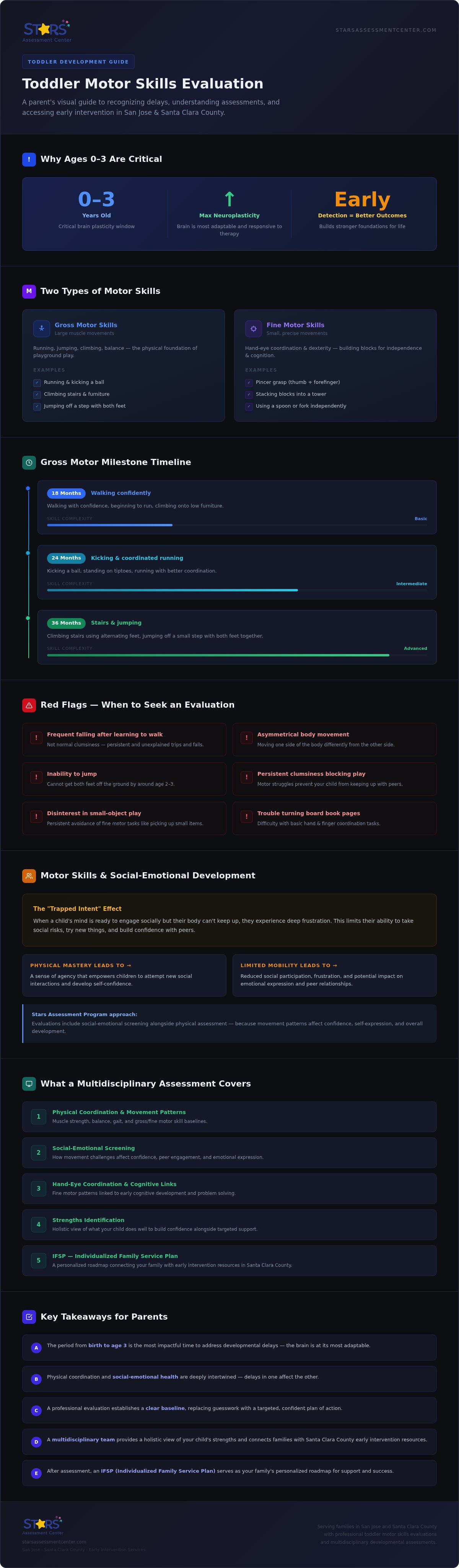
Every child follows a unique developmental path, but sometimes a little extra guidance helps ensure they're moving in the right direction. A motor skills evaluation is a professional assessment of your child’s physical coordination, muscle strength, and movement patterns. This process isn't about clinical labels; it's about understanding how your child interacts with their world. The period from birth to age three represents a critical window for growth. During these years, a child’s brain is incredibly adaptable. Identifying a delay early allows us to use that natural plasticity to build stronger foundations for the future.
A toddler motor skills evaluation San Jose specialists provide helps establish a clear baseline. This baseline allows families to stop guessing and start supporting their child’s specific needs with confidence and clarity.
Gross Motor Milestones for Toddlers
Gross motor skills are the foundation of toddler play, encompassing the large muscle movements required for running, jumping, and navigating the playground. As your child grows, their ability to control these large muscle groups should become more refined. Here is what you might typically observe:
- 18 Months: Most toddlers are walking with confidence and may even begin to run or climb onto low furniture.
- 24 Months: You'll likely see your child kicking a ball, standing on tiptoes, and beginning to run with more coordination.
- 36 Months: By this age, many children can climb stairs using alternating feet and jump off a small step with both feet together.
There are certain signs that might suggest an evaluation would be beneficial. If you notice your toddler falling frequently after they've already learned to walk, or if they move one side of their body differently than the other, professional insight can help. An inability to jump or a persistent clumsiness that prevents them from playing with others can also be an indicator that they need a bit of extra support.
Fine Motor Milestones and Hand-Eye Coordination
While gross motor skills cover the big moves, fine motor skills focus on the small, precise tasks that require hand-eye coordination. These skills are closely tied to early cognitive growth because they allow children to manipulate objects and solve physical puzzles. Key indicators include the pincer grasp (using the thumb and forefinger to pick up small items), stacking blocks into a tower, and beginning to use a spoon or fork during mealtime.
Hand strength and dexterity are essential for more than just play; they're the building blocks for future independence. If a toddler shows a persistent lack of interest in small-object play or struggles significantly with tasks like turning the pages of a board book, it's worth exploring why. A professional evaluation ensures that these delicate movements are developing appropriately to support your child’s growing curiosity and daily life skills.
The Connection Between Motor Skills and Social-Emotional Growth
Movement is the primary way toddlers explore their world and connect with others. For a young child, physical ability isn't just about reaching milestones; it's the gateway to social participation. When a child struggles to keep up on the playground or finds it hard to manipulate toys, it can lead to a sense of "trapped" intent. This is the deep frustration a toddler feels when their mind is ready to engage with peers, but their body isn't yet able to follow through. A toddler motor skills evaluation San Jose specialists conduct looks beyond just movement; it explores how that movement shapes your child’s world.
Choosing a toddler motor skills evaluation San Jose families trust ensures that these subtle connections aren't overlooked. At Stars Assessment Program, we recognize that physical development and social-emotional health are deeply intertwined. That's why our multidisciplinary approach includes social-emotional screening alongside physical checks. We want to see how your child's movement patterns affect their confidence and their ability to express themselves. Physical mastery often leads to a sense of agency that allows a child to take social risks and try new things.
Physical Delays and Social Interaction
Limited mobility can often lead to social withdrawal. If a child finds it physically taxing to join a group activity, they might choose to sit on the sidelines instead. Over time, this can manifest as behavioral outbursts or a lack of communicative intent. These outbursts aren't simply "bad behavior"; they're often a child's only way to express the frustration of being unable to join in. By evaluating the "whole child," we can determine if a toddler's social struggles are actually rooted in a physical delay. For example, once a child gains the core strength to sit upright comfortably, they often show a sudden increase in their desire to interact and play with others because they no longer have to exert all their energy just to stay upright.
Parental Peace of Mind and Partnership
Watching your child struggle can take a significant emotional toll. It's common for parents to feel a mix of anxiety and confusion when they see their child falling behind. You might wonder if you're overreacting or if "wait and see" is the right approach. Professional clarity is the best tool for reducing this family stress. Our team is committed to a family-centered evaluation process that feels like a partnership rather than a clinical appointment. We provide a safe harbor for your concerns and a clear path forward.
If you're noticing these frustrations in your child's daily play, our Multidisciplinary Developmental Assessment can provide the answers and support your family needs to move forward together. We focus on providing hope and tangible steps for every family we serve in Santa Clara County, ensuring that you never have to walk this path alone.
What is a Multidisciplinary Developmental Assessment?
A multidisciplinary developmental assessment is far more than a simple checklist or a single specialist's opinion. It's a collaborative process where a team of professionals looks at your child’s growth from multiple angles at once. At Stars Assessment Program, we believe this integrated approach is the gold standard for understanding a child's unique needs. This thoroughness is why a toddler motor skills evaluation San Jose families rely on is often the turning point in a child's developmental journey. While a single screening might flag a concern, a full evaluation by a team of speech, physical, and behavioral specialists provides a complete picture of your child's strengths and challenges.
Accuracy is the primary goal of this team-based model. By working together, our specialists can identify if a physical delay is an isolated issue or a symptom of an underlying condition like Autism or Down syndrome. This prevents the "wait and see" approach that can sometimes delay essential support during the critical birth-to-three window. This depth is what makes a toddler motor skills evaluation San Jose parents choose so effective in providing lasting clarity.
The Benefit of Integrated Expertise
When specialists collaborate, they often spot connections that might be missed in isolation. For instance, a speech specialist might notice that a toddler’s difficulty with certain sounds is actually rooted in motor-related feeding issues, such as weak jaw coordination. Similarly, a behavioral expert can help determine if a child is avoiding a physical task because of a motor delay or because of sensory processing needs. This distinction is vital for creating an effective support plan. To understand how these initial checks lead to deeper support, you can read our Early Childhood Developmental Screening: A Parent’s Guide to Growth and Support.
Specialized Screenings Within the Evaluation
A comprehensive evaluation also allows for targeted screenings that address specific developmental paths. For toddlers showing motor delays, an Autism screening may be included if secondary signs like unusual gait or posture are observed. For children with a diagnosis of Down syndrome, the evaluation is tailored to their specific physiological needs, such as managing low muscle tone. Understanding the nuances between these steps is crucial for families. You can learn more about the differences in our guide on Autism Screening vs. Evaluation for Toddlers. This level of specialized care ensures that your child isn't just another number, but a unique individual receiving a roadmap designed specifically for them.
Navigating the Evaluation Process in San Jose and Santa Clara County
Understanding the steps toward support doesn't have to be overwhelming. Finding a toddler motor skills evaluation San Jose families can access often starts with a single conversation with your pediatrician. They are your first partners in identifying whether your child's movement patterns warrant a closer look. If there are concerns, the next step involves the San Andreas Regional Center (SARC), which is the dedicated hub for early intervention in our region. SARC coordinates services for children from birth to age three, ensuring that every family in Santa Clara County has a path to the right resources.
Once SARC determines that an evaluation is needed, they often refer families to a specialized program like Stars. This is where our multidisciplinary team steps in to conduct a thorough assessment. On the day of the evaluation, you and your toddler will meet with our experts in a setting designed to feel like a playroom rather than a doctor's office. You'll be right there with your child, acting as their most important support person while we observe how they move, play, and interact.
Local Resources for San Jose Families
The San Andreas Regional Center (SARC) is a vital partner for families throughout the South Bay and surrounding areas. Our team at Stars Assessment Program works closely with local agencies to provide support for families in Salinas, Milpitas, and Gilroy. We understand that travel can be a challenge for parents of young children. If you are seeking specialized care in Santa Cruz or Morgan Hill, local referral paths through SARC ensure your child receives the same high level of multidisciplinary attention close to home.
Preparing Your Child for the Evaluation
Preparing for a toddler motor skills evaluation San Jose experts provide is mostly about ensuring your child feels comfortable and relaxed. We want this experience to be gentle and positive for your little one. You can help by telling your child they are going to a special "play date" where they'll get to try out new toys. It's helpful to bring along any medical history, milestone logs, or even short videos of your child's movements at home. Your personal observations are just as valuable as our clinical tools. Remember, this is a safe, supportive space. We aren't just looking for what your child can't do; we are looking for their unique strengths and how we can best support their growth. If you are ready to begin, you can learn more about our Multidisciplinary Developmental Assessment process today.
Next Steps After Your Toddler's Motor Skills Evaluation
Once the assessment is complete, the focus shifts from gathering information to taking meaningful action. We don't just hand you a clinical report and send you on your way. Instead, our specialists sit down with you to walk through the findings in a way that makes sense for your family's daily life. A toddler motor skills evaluation San Jose families complete with us is designed to be the start of a clear, supported journey. We translate medical observations into practical insights, helping you understand how your child’s unique movement patterns influence their ability to play, learn, and interact with the world around them.
The most critical document you'll receive following an assessment is the Individualized Family Service Plan (IFSP). Think of the IFSP as your family's personalized roadmap for early intervention. It outlines specific goals for your child and details the services they'll receive to reach those milestones. This plan is a living document, created in partnership with you to ensure it reflects your child's needs and your family's priorities. It transforms clinical data into a strategy for growth.
Accessing Early Intervention Resources
In Santa Clara County, the results of your assessment are used to determine eligibility for state-funded support through the San Andreas Regional Center. If your child qualifies, these resources provide access to specialists who work with your toddler in their natural environment, such as your home or daycare. This transition from evaluation to intervention is seamless when you have the right team behind you. For families managing specific diagnoses, our Down Syndrome Early Intervention: Santa Clara County Assessment Guide offers deeper insights into the tailored support available for your child's physical and social growth.
The Stars Program Approach to Long-Term Success
We see ourselves as a "safe harbor" for families during what can be an emotional time. The period following a toddler motor skills evaluation San Jose can feel like a whirlwind of new information, but you don't have to navigate it alone. Our goal is to empower you to be your child’s most effective advocate. We provide the clarity and expertise you need to feel confident in the decisions you're making for your child’s future.
Whether your child needs a little extra help to catch up or requires more intensive support, we're here to guide you through the "what happens next" phase. You've already taken the bravest step by seeking answers. Now, let’s work together to build the foundation your child deserves. If you're ready to take the next step toward clarity, schedule a consultation with our multidisciplinary team today and let us help your family find the path forward.
Empowering Your Child’s Developmental Journey
Choosing to pursue a toddler motor skills evaluation San Jose is a proactive step toward understanding your child's unique needs. We have seen how physical coordination acts as a bridge to social play and emotional mastery. By acting during the vital window between birth and age three, you're utilizing your child's natural adaptability to build a stronger foundation for their future. You've already done the important work of noticing your child's needs; now it's time to find the answers they deserve.
At Stars Assessment Program, our multidisciplinary team of specialists provides more than just a clinical report. We provide a partnership. As collaborators with the San Andreas Regional Center, we ensure your family is connected to the right local resources in Santa Clara County. We're here to offer a safe harbor and clear guidance as you navigate these early years. You don't have to manage this process alone.
If you're ready to replace worry with a clear plan of action, we encourage you to Request a Developmental Assessment for Your Toddler. Let us help you find the path forward with confidence, clarity, and hope.
Frequently Asked Questions
What is the difference between a screening and a motor skills evaluation?
A screening is a high-level "check-up" that identifies if a child might be at risk for a delay. In contrast, a toddler motor skills evaluation San Jose families receive at our center is a deep dive. Our multidisciplinary team performs a thorough assessment of physical, cognitive, and social-emotional domains. This comprehensive approach determines specific eligibility for early intervention services rather than just flagging a potential concern for future monitoring.
How long does a toddler motor skills evaluation take?
Most evaluations are completed within a single morning or afternoon session, typically lasting between two and three hours. We move at a patient, child-led pace to ensure your toddler feels comfortable and safe. This timeframe allows our specialists to observe play, movement, and interaction without rushing. We prioritize accuracy over speed, ensuring our team has enough time to gather a complete picture of your child's unique developmental profile.
Does my child need a referral from a pediatrician to visit Stars Assessment Program?
Most families arrive at Stars Assessment Program through a referral from the San Andreas Regional Center (SARC). While you can certainly discuss your concerns with your pediatrician first, SARC acts as the primary gateway for early intervention services in Santa Clara County. They coordinate the initial intake and then partner with specialized programs like ours to conduct the actual multidisciplinary assessment for children from birth to age three.
Is the evaluation covered by insurance or state programs in San Jose?
Early intervention evaluations are typically provided at no cost to families through state-funded programs like the San Andreas Regional Center. In California, the Early Start program ensures that infants and toddlers with suspected delays receive the assessments they need regardless of family income. Our team works closely with regional center coordinators to help families navigate these state programs, ensuring that financial barriers don't stand in the way of your child’s developmental support.
What happens if the evaluation shows my child is meeting their milestones?
If the results show your child is meeting their milestones, it provides valuable peace of mind and a clinical baseline for future growth. We celebrate these developmental wins with you and explain the findings in detail. Even if a formal delay isn't identified, our specialists can offer gentle guidance on activities to support continued mastery. Having a professional baseline ensures that you have a clear record of your child's progress as they grow.
Can a motor skills delay be a sign of autism in toddlers?
Motor delays can sometimes be a secondary indicator of Autism, which is why our multidisciplinary approach is so important. While Autism is primarily characterized by social and communicative challenges, many toddlers on the spectrum also show differences in coordination, gait, or muscle tone. By including behavioral specialists in our toddler motor skills evaluation San Jose process, we can determine if physical delays are isolated or part of a broader developmental pattern.
How do I know if my toddler's clumsiness is normal or a delay?
Normal toddler clumsiness usually involves occasional trips as they master new terrain, but persistent issues may signal a delay. You should consider an evaluation if your child falls frequently without an obvious cause, moves one side of their body differently than the other, or hasn't reached major milestones like walking by 18 months. Our experts look for patterns in muscle strength and coordination that go beyond the typical "wobbliness" of early childhood.
What cities in Santa Clara County does the Stars Assessment Program serve?
We proudly serve families throughout Santa Clara County and the surrounding regions. Our primary service areas include San Jose, Santa Clara, Milpitas, Gilroy, and Morgan Hill. We also extend our specialized multidisciplinary assessments to families in Salinas and Santa Cruz. Our goal is to provide a convenient and supportive "safe harbor" for parents across the South Bay and Central Coast who are seeking expert guidance for their child's earliest years.


