
You’re sitting on the living room floor watching your toddler play, but instead of just enjoying the moment, you’re quietly counting. You’re counting the words they haven't said yet or the milestones that seem to be just out of reach. That heavy feeling in your chest isn't just curiosity; it's a deep, parental desire to ensure your child has every advantage. If you've been searching for an infant developmental assessment Santa Clara County families trust, you're already taking the most important step toward peace of mind. It’s natural to feel a mix of hope and "what if" as you look for answers.
We understand that the path to a potential diagnosis like Autism or Down syndrome feels daunting, and the referral process often looks like a maze. You aren't alone in this journey. This article will show you how a specialized multidisciplinary assessment provides the clarity your family deserves. We’ll walk through what to expect during an evaluation, how our team of specialists supports your child’s unique social-emotional needs, and the exact steps to access early intervention services in your community. You'll discover how a compassionate partnership can turn uncertainty into a clear, supportive roadmap for your child’s future.
Key Takeaways
- Trusting your parental intuition is the first step toward getting your child the support they deserve during their most critical years of growth.
- A multidisciplinary infant developmental assessment Santa Clara County team ensures your child is seen as a whole person, rather than just a checklist of milestones.
- Specialized screenings for social-emotional health and speech help families identify early signs of Autism or Down syndrome with professional precision.
- Navigating local resources like the San Andreas Regional Center (SARC) becomes much simpler once you understand the specific referral steps for toddlers under age three.
- Choosing a compassionate assessment partner provides a "safe harbor" for your family, offering the expert guidance needed to move forward with confidence.
Recognizing the Need for an Infant Developmental Assessment
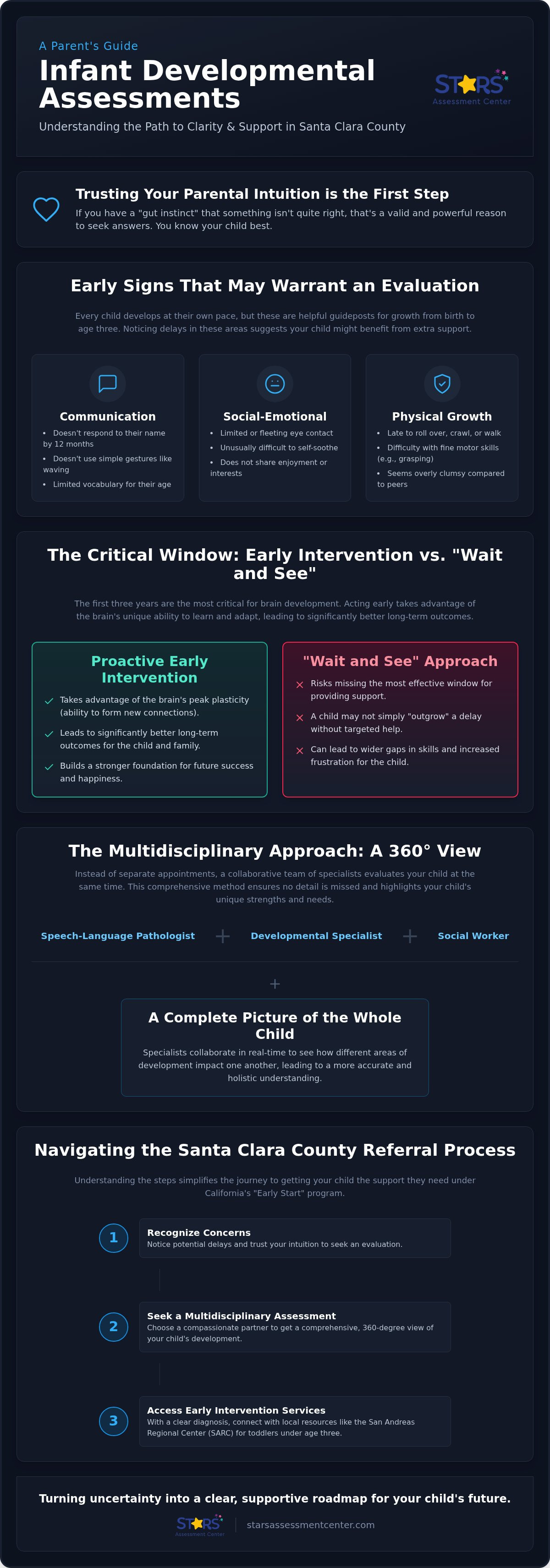
An infant developmental assessment is more than just a series of tests. It's a comprehensive, warm look at how your child, from birth to age three, is growing across all areas of life. While your pediatrician performs routine screenings during well-child visits, those are often brief snapshots meant to flag general concerns. A specialized assessment is a deeper exploration conducted by a multidisciplinary team that looks at the whole child. Many parents feel a "gut instinct" that something isn't quite right, even if they can't put it into words yet. We want you to know that your intuition is a valid and powerful reason to seek an infant developmental assessment Santa Clara County families use to find answers. In California, these services fall under the "Early Start" program, designed to ensure that every child has the opportunity to reach their full potential during their most formative years.
Common Signs That May Warrant an Evaluation
Every child develops at their own pace, but there are specific milestones that serve as helpful guideposts for growth. You might consider an evaluation if you notice your child isn't reaching these markers within a typical timeframe. In the area of communication, a sign of concern could be a child who doesn't respond to their name or use simple gestures like waving by 12 months. Social-emotional development is also a key focus; you may notice your toddler has limited eye contact or finds it unusually difficult to self-soothe when compared to peers. Physical growth matters too. Motor delays, such as being late to crawl or walk, are often the first things parents notice. These signs don't always mean there's a permanent challenge, but they do indicate that your child might benefit from some extra support to keep moving forward.
The "Wait and See" Approach vs. Early Intervention
It's common for well-meaning friends or family to suggest that a child will simply "outgrow" a delay. However, the first three years are the most critical period for brain development. During this time, a child’s brain is incredibly plastic, meaning it's uniquely capable of forming new connections and learning new skills. Choosing early intervention over a "wait and see" approach allows us to take advantage of this window of opportunity. Research consistently shows that providing support as soon as a delay is identified leads to significantly better long-term outcomes for the child and the family. By acting now, you aren't just addressing a current struggle; you're building a stronger foundation for your child’s future success and happiness. Getting an infant developmental assessment Santa Clara County parents trust is the first step in replacing "wait and see" with a proactive plan of action.
The Multidisciplinary Approach: Why a Team Matters
When you seek an infant developmental assessment Santa Clara County families often wonder why so many specialists are involved in a single evaluation. Instead of visiting different offices over several weeks, a multidisciplinary approach brings everyone together. Our team includes speech-language pathologists, developmental specialists, and social workers who collaborate in real-time. This isn't just about efficiency. It's about seeing your child from every possible angle at once. When these experts work side-by-side, they can see how a delay in one area, like communication, might be impacting another, like social interaction. This 360-degree view ensures that no detail is missed and that your child's strengths are highlighted alongside their needs.
This level of dedicated care is rooted in our organizational culture. As an employee-owned organization (ESOP), every member of the Stars team has a personal stake in your family’s success. We aren't just providing a medical service; we’re acting as a steady ally and a knowledgeable mentor. This partnership ensures that the evaluation is thorough, compassionate, and deeply human. You can learn more about how our multidisciplinary team supports local families by providing a safe harbor during times of uncertainty.
Key Domains Evaluated During the Assessment
We look at the whole child by focusing on three primary areas of growth during the first three years of life:
- Cognitive skills: This involves how your child learns, solves problems, and explores their environment. It’s about their curiosity and how they process information through play.
- Communication skills: We evaluate both receptive language, which is what your child understands, and expressive language, which is how they use words or gestures to speak.
- Social-emotional development: This focuses on how your child interacts with others, expresses their feelings, and builds connections with caregivers and peers.
Specialized Screenings for Autism and Down Syndrome
Our multidisciplinary evaluation is also designed to identify specific conditions that require specialized early intervention. We provide targeted screenings for children with a Down syndrome diagnosis to help tailor their support plan from the very beginning. For families concerned about social communication or repetitive behaviors, we offer clear distinctions between an Autism Screening vs. Evaluation for Toddlers. By integrating these screenings into the broader infant developmental assessment Santa Clara County parents rely on, we provide clarity without the stress of scheduling multiple separate appointments.
Specialized Social-Emotional and Speech Evaluations
In the early years, social-emotional health and communication are deeply intertwined. For many toddlers, the frustration of not being able to express a want or need often manifests as a behavioral challenge. This is why a comprehensive infant developmental assessment Santa Clara County families receive focuses so heavily on these two domains. Social-emotional health is the bedrock of all future learning; it’s how your child learns to manage big feelings, build trust with caregivers, and eventually play with peers. When a child feels understood and supported emotionally, they are much better equipped to tackle the challenges of learning new words and sounds.
Speech and language evaluations go far beyond checking for "late talking." Our specialists look at the entire communication system, which includes how a child understands what is being said to them and how they use non-verbal cues to connect. In a diverse community like San Jose, Milpitas, or Gilroy, we recognize that many families speak multiple languages at home. We provide multilingual support to ensure that every child is evaluated in the language they hear most often. This cultural sensitivity is vital because a child’s true potential is best seen when they feel comfortable and understood in their own family context.
What a Social-Emotional Assessment Looks Like
Rather than a cold medical exam, this assessment feels more like a structured play session. We observe how your child interacts with you, how they explore new toys, and how they react when they encounter a small obstacle. We look at attachment patterns and the way they regulate their emotions during transitions. This process is designed to help you understand your child’s unique temperament and build an even stronger bond with them. For more details on what to watch for at home, you can read our guide on Understanding Social Emotional Milestones in Infants.
Speech and Language Evaluation Basics
Early communication starts long before the first word is spoken. Our evaluation tracks early vocalizations, babbling, and the use of gestures like pointing or waving. We also assess receptive language, which is your child's ability to follow simple directions or recognize familiar names. The ultimate goal of these evaluations is to give every child a "voice," whether that is through spoken words, signs, or other communication tools. If you’re wondering if your child’s speech is on track, our Santa Clara County Toddler Speech Evaluation Guide offers a deeper look at the specific milestones we look for in children aged zero to three.
Navigating the Santa Clara County Referral Process
The referral process in California is designed to be accessible, but it can still feel overwhelming when you’re first starting. If you have concerns about your child’s development, you don’t have to wait for a doctor’s recommendation to take action. The primary gateway for support is the San Andreas Regional Center (SARC). This organization coordinates the Early Start program for our region, ensuring that every family has access to the resources they need. Once you connect with SARC, they may partner with us at the Stars Assessment Program to conduct your child’s evaluation. This collaborative relationship ensures that your infant developmental assessment Santa Clara County process is handled with both technical expertise and a gentle, family-centered heart.
The San Andreas Regional Center (SARC) Connection
SARC serves families across San Jose, Milpitas, Morgan Hill, and Gilroy. One of the most empowering things to know is that parents can self-refer. You simply contact SARC and share your observations. They will guide you through the initial intake and determine if a multidisciplinary evaluation is the right next step. By removing the need for a formal medical referral, the system prioritizes early intervention, allowing you to find answers faster. We work closely with SARC coordinators to ensure that the transition from your first phone call to the actual assessment is as seamless and stress-free as possible.
What to Expect During the Assessment Day
We’ve designed our assessment day to feel like a "safe harbor" rather than a clinical exam. The environment is warm, inviting, and filled with age-appropriate toys to help your child feel at ease. You play a vital role in this process because you are the true expert on your child. While our specialists observe and interact with your little one, we’ll also spend time listening to your stories and observations. Most evaluations take about two hours. We focus on creating a patient, methodical rhythm that allows your child to show us their true self. Shortly after the visit, we provide you with a clear understanding of your child’s needs and a supportive roadmap for the future.
To help the day go smoothly, we suggest bringing a few essentials to keep your child comfortable:
- Favorite comfort items, such as a blanket or a specific toy.
- Snacks and a drink to keep energy levels up.
- Any previous medical records or notes from your pediatrician.
- A list of questions or specific milestones you've been thinking about.
If you’re ready to take the first step toward clarity, you can contact the Stars Assessment Program team to learn more about how we partner with local agencies to support your family's journey.
Finding Clarity and Support at Stars Assessment Program
The conclusion of an evaluation isn't the end of our relationship; it’s the beginning of a clearer path forward for your family. At Stars Assessment Program, we believe that an infant developmental assessment Santa Clara County families receive should do more than just identify delays. It should provide a profound sense of relief. Our commitment to professional warmth and partnership means we don't just hand you a report and send you on your way. Instead, we work with you to interpret the findings and create a personalized roadmap for early intervention. We focus exclusively on children from birth to age three because we know how transformative these early years are. By specializing in this specific age group, we ensure our expertise is tailored to the unique way infants and toddlers learn, grow, and communicate.
A Safe Harbor for Your Family
We know that the possibility of a diagnosis can feel heavy. That’s why our clinical team maintains a non-alarmist, supportive personality. We aren't here to label your child; we’re here to understand them. Our organization is deeply community-oriented, valuing the rich cultural diversity found throughout San Jose and the surrounding areas. We advocate for every family we serve, ensuring that cultural nuances and personal connections are respected throughout the process. This patient, human-centered delivery of care is what makes us a safe harbor for families in transition. For those specifically looking for resources regarding chromosomal conditions, our Down Syndrome Early Intervention: Santa Clara County Assessment Guide provides additional local insights.
Next Steps: Scheduling an Initial Screening
You don't need to wait until a concern feels "big enough" to seek help. Even small observations about your child's eye contact, play patterns, or early babbles are worth exploring. Reaching out early is the kindest thing you can do for your child and your own peace of mind. The process starts with a simple conversation with our intake team. We can help you understand how to move forward through the San Andreas Regional Center (SARC) pathway we discussed earlier. We’re here to be your steady ally, providing the clarity and hope you need to see your child thrive. If you're ready to move from uncertainty to understanding, Reach out to Stars Assessment Program today and let us guide you through the next steps of your journey.
Moving Forward with Confidence and Clarity
You've taken a significant step today just by seeking information. Understanding the difference between a simple screening and a comprehensive team-based evaluation helps you advocate for your child’s unique needs. By focusing on the critical window between birth and age three, you’re giving your little one the best possible start. Whether you're navigating the San Andreas Regional Center (SARC) referral process or looking for a deeper understanding of social-emotional milestones, you don't have to walk this path alone.
An infant developmental assessment Santa Clara County families trust is built on a foundation of partnership and professional expertise. Our multilingual specialist team is here to serve as your dedicated guide, providing a safe harbor as you seek answers. We’re proud to be a trusted partner of the San Andreas Regional Center, ensuring every family in our community feels heard and supported. It's time to replace uncertainty with a clear, actionable plan. Schedule a Compassionate Developmental Assessment Today and discover the support your child needs to thrive. Your child’s future is bright, and we’re honored to help you navigate the way.
Frequently Asked Questions
How do I know if my child needs a developmental assessment?
You might consider an infant developmental assessment Santa Clara County families utilize if you notice your child isn't reaching milestones like responding to their name by 12 months or making eye contact. Your parental intuition is one of the most reliable indicators that an evaluation is needed. If you feel that your child's social-emotional or communication skills aren't progressing as expected, it's always better to seek clarity early. Our team focuses on children from birth to age three to provide the most effective support.
What is the difference between a screening and a full evaluation?
A screening is a quick snapshot often performed by a pediatrician to see if a child is on track. In contrast, a full multidisciplinary evaluation is a deep dive conducted by a team of specialists, including speech-language pathologists and developmental experts. This comprehensive approach provides a 360-degree view of your child's cognitive and social-emotional growth. While a screening flags potential concerns, a full evaluation at Stars provides the clarity needed to create a roadmap for support.
How much does a developmental assessment cost in Santa Clara County?
In Santa Clara County, many developmental assessments are funded through the state’s Early Start program for eligible children. Because the Stars Assessment Program partners with the San Andreas Regional Center (SARC), the financial aspect is handled through the regional center system. We suggest contacting SARC to discuss your specific situation and eligibility. Our goal is to ensure that families in San Jose and Gilroy can access expert evaluations without the burden of navigating complex billing on their own.
Does my toddler need to be referred by a pediatrician?
Your toddler does not need a formal referral from a pediatrician to receive an infant developmental assessment Santa Clara County services provide. In California, parents have the right to self-refer their child to the San Andreas Regional Center if they have concerns about milestones. While doctors often suggest an evaluation, your own observations as a parent are enough to start the process. This ensures that families can access early intervention support as quickly as possible during these critical early years.
What happens if the assessment shows my child has a delay?
If an evaluation identifies a delay, our team works with you to build a personalized plan for early intervention. This isn't a "label" but rather a key to unlocking the right resources for your child. We help connect you with specialists who focus on communication, social-emotional health, or cognitive growth. The goal is to provide a "safe harbor" where you feel supported as a partner in your child's success, ensuring they have every opportunity to thrive as they grow.
How long is the waitlist for an infant assessment in San Jose?
Wait times for an assessment in San Jose and surrounding areas can vary based on the current number of referrals and the specific needs of each family. We understand that waiting can be a source of anxiety for parents. Our team at Stars Assessment Program strives to move through the process as efficiently as possible while maintaining our thorough, multidisciplinary approach. We encourage you to reach out to our intake team or SARC for the most current information on scheduling and availability.
Can the assessment be conducted in a language other than English?
Yes, we offer assessments in multiple languages to support the diverse families living in Santa Clara County. Our multilingual specialist team ensures that your child is evaluated in the language they hear and speak most often at home. This cultural sensitivity is vital for an accurate assessment, as it allows your child to feel comfortable and show us their true abilities. We believe that every family deserves to feel heard and understood throughout this important journey toward clarity and support.
What is the "Early Start" program in California?
The "Early Start" program is California's response to the federal requirement for early intervention services for infants and toddlers with delays. It's a statewide system designed specifically for children from birth to age three. The program is coordinated through Regional Centers like SARC. It provides a range of services, including multidisciplinary assessments and family support, to ensure that children with delays in areas like speech or social-emotional development receive help during their most formative years of brain development.


