
You've watched your child struggle with a meltdown that feels a bit too big, or perhaps you've noticed they find it harder to join in with playmates than other toddlers. It's completely normal to feel a wave of anxiety when a professional suggests an evaluation. You might worry about your child "failing" a test or feel overwhelmed by the thought of a clinical label. We know how much you care, and it's okay to feel uncertain about this next step.
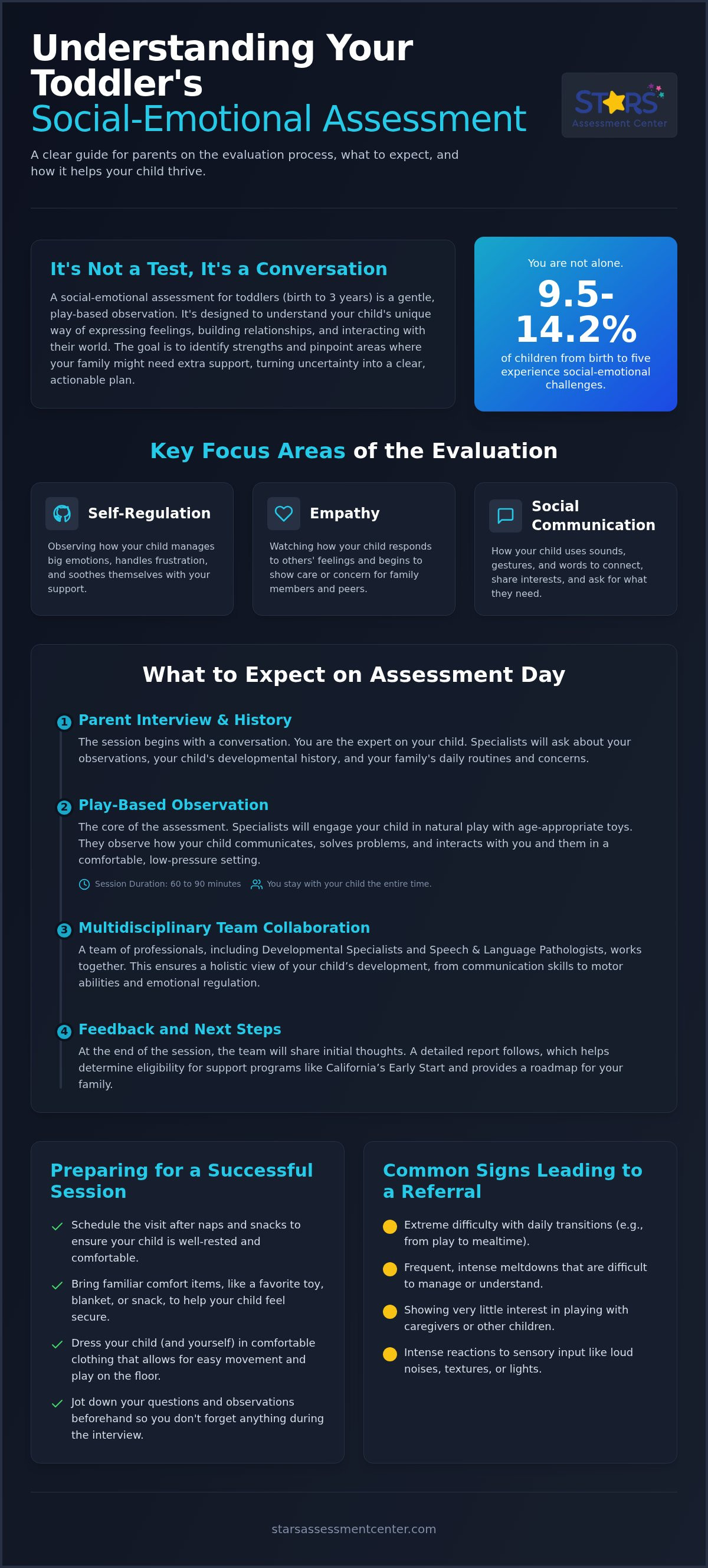
The truth is that an assessment isn't a pass-fail exam; it's a way to understand your child's unique world. This guide explains exactly what to expect during a toddler social emotional assessment so you can replace that worry with a sense of calm and preparation. Research shows that between 9.5% and 14.2% of children from birth to five years old experience social-emotional challenges. You aren't alone in this journey, and seeking clarity is the most supportive thing you can do for your family.
We'll provide a clear roadmap of the assessment day, from gentle play-based observations to the parent interviews that value your expertise as a caregiver. You'll learn how these results translate into a helpful plan, ensuring you have the tools and next steps needed to help your child thrive.
Key Takeaways
- Understand how a social-emotional assessment focuses on your child's natural way of building relationships and managing feelings rather than "testing" them.
- Meet the multidisciplinary team of specialists who use play-based methods to create a holistic picture of your toddler's unique development.
- Learn exactly what to expect during a toddler social emotional assessment, including why you stay with your child for the entire 60 to 90-minute session.
- Discover simple ways to prepare your child for a successful session, such as timing the visit after naps and bringing familiar comfort items.
- Gain clarity on the next steps after the evaluation, including how the results help determine eligibility for California’s Early Start program.
What is a Toddler Social-Emotional Assessment?
A toddler social-emotional assessment is a professional, gentle evaluation designed to understand how your child expresses feelings and builds relationships. It isn't a high-stakes exam where your child can fail. Instead, it's a collaborative process specifically for infants and toddlers from birth to age three. When you're curious about what to expect during a toddler social emotional assessment, think of it as a snapshot of your child's daily world. This assessment identifies their natural strengths and pinpoints specific areas where your family might need extra support to help your little one thrive.
Specialists focus on three main pillars: self-regulation, empathy, and social communication. They look at how your child manages big emotions and how they interact with the people they love. Understanding social-emotional development helps us see how a child processes the environment around them. This holistic view ensures that every recommendation we make is grounded in your child's unique personality and developmental stage. It's a way to turn uncertainty into a clear, actionable plan for growth.
Why Social-Emotional Development Matters
These early skills form the foundation for all future learning and school readiness. In San Jose schools, educators often find that a child's ability to relate to others and follow routines is just as vital as early literacy. Strong social-emotional health impacts behavior, sleep quality, and even the overall harmony of your home. If a developmental delay is present, identifying it early leads to much more effective and natural interventions. We believe that early support isn't just about the child; it's about giving the whole family a sense of peace and a predictable path forward.
Common Signs That Lead to a Referral
Many parents find their way to an evaluation because they've noticed patterns that feel a bit more intense than the typical toddler "big feelings." It's common to feel a mix of worry and hope when you decide to seek help. You might notice your child has extreme difficulty with daily transitions or struggles to self-soothe even with your comfort. Other common signs that might lead to a referral include:
- Showing very little interest in playing with caregivers or peers.
- Having intense reactions to sensory input, like loud noises or specific textures.
- Frequent meltdowns that feel difficult to manage or understand.
- Difficulty adapting to small changes in their daily routine.
If these signs feel familiar, an assessment can provide the clarity you've been searching for. Knowing what to expect during a toddler social emotional assessment helps you walk into the appointment feeling like a prepared partner in your child's care. It's the first step toward understanding your child's needs and finding the right resources right here in Santa Clara County.
The Multidisciplinary Team: Who Will You Meet?
Understanding what to expect during a toddler social emotional assessment begins with knowing who will be in the room with you. When you walk through our doors, you aren't just meeting one professional; you're joining a circle of support. A multidisciplinary team works together to create a holistic view of your child's world. This group usually includes developmental specialists, speech and language pathologists, and family advocates. Each person brings a unique lens to the evaluation, ensuring we capture the small details that make your child who they are.
This team based approach is designed to be a calming presence. We know that clinical environments can feel intimidating, so our specialists prioritize professional warmth and empathy. By working as a collective, we can look at your child's growth from every angle, from their physical movements to the way they connect with you. This collaborative spirit is a core part of our multidisciplinary developmental assessment services here in Santa Clara County.
The Role of the Developmental Specialist
Developmental specialists are experts in the science of early childhood growth for children from birth to age three. They spend time observing how your child solves problems, interacts with toys, and navigates their environment. Because social-emotional and cognitive milestones are deeply intertwined at this age, they assess both areas simultaneously. The developmental specialist serves as a guide for the child's natural curiosity. By watching your child play, they can see how they manage frustration or seek out connection with others.
Collaborating with Speech and Language Experts
Communication is the bridge to social connection. Our speech and language pathologists look beyond just spoken words to see how your toddler shares their world with you. They evaluate non-verbal cues like pointing, eye contact, and gestures. Often, what looks like a social-emotional challenge is actually a result of a child being unable to express their needs. Understanding the link between language delays and emotional frustration is a key part of our process. If you have specific concerns about your child's communication, you can read our Santa Clara County Toddler Speech Evaluation Guide for more detail.
We also include family advocates who support parents through the administrative process. They help you understand the paperwork and ensure your voice is heard throughout the journey. Learning what to expect during screening tests can significantly lower your stress levels before the day arrives. Knowing what to expect during a toddler social emotional assessment helps you feel like a prepared partner rather than just an observer. We are here to be your steady ally, providing clarity and hope for your family's next steps.
Step-by-Step: What Happens During the Evaluation?
Entering an assessment room shouldn't feel like walking into a cold medical office. Instead, imagine a child-friendly space filled with age-appropriate toys, soft colors, and a welcoming team. A typical session lasts between 60 and 90 minutes, which is a timeframe carefully chosen to move at your child's natural pace without causing exhaustion. One of the most reassuring parts of what to expect during a toddler social emotional assessment is that you will remain with your child throughout the entire process. Your presence provides the security they need to show us their true personality.
We use observation as our primary tool, though to your child, it will simply feel like a guided play session. While the team interacts with your little one, they may use standardized tools like the Ages & Stages Questionnaires: Social-Emotional, Second Edition (ASQ:SE-2). These tools aren't a "test" for your child to pass or fail. Rather, they provide a structured framework to guide our conversation and ensure we capture a complete picture of their development from birth to age three.
The Parent Interview and History
Your journey with your child is the most valuable piece of data we have. During the assessment, we'll spend time discussing your child's birth history and the milestones they've already reached. We want to hear about your daily life at home, including mealtime routines, sleep patterns, and any specific behaviors that have caused you concern. Your input is essential because you see your child in their most natural state every day. We view you as an expert partner in this process, and your observations carry significant weight in our final evaluation.
Play-Based Observation Activities
While we talk, a specialist will engage your child in activities using bubbles, blocks, or books. These items are carefully selected to elicit specific social responses. For example, we observe how your child reacts to a new person or how they seek your comfort when they encounter something unfamiliar. Understanding what to expect during a toddler social emotional assessment means knowing that these interactions are purposeful yet gentle. We look for "joint attention," which is your child's ability to share an experience with you, such as pointing at a picture in a book and looking back at your face to see your reaction. These small, beautiful moments tell us a detailed story about their social-emotional world.
Preparing Your Child for a Successful Session
Preparing for an appointment with a toddler can feel like a complex logistical puzzle. You want everything to go smoothly, but toddlers are naturally unpredictable. Part of knowing what to expect during a toddler social emotional assessment is understanding how to set the stage so your child feels safe and comfortable. By taking a few simple steps before you arrive, you can help ensure the team sees a true representation of your child's daily life. We are here to support you through every part of this process, starting with the moment you walk through our doors.
To help the session feel more like a natural part of your day, consider these practical tips:
- Time it right: Schedule the assessment around your child's best time of day. For most toddlers, this is usually in the morning after breakfast or immediately following a solid afternoon nap.
- Pack comfort items: Bring along a favorite stuffed animal, a well-loved blanket, or a specific snack. These familiar items provide a sense of security in a new environment.
- Frame the visit: Instead of using clinical language, explain the visit as a "playdate with new toys." This simple shift in wording can significantly reduce a child's anxiety.
- Gather your notes: If you have previous reports from a pediatrician or notes about specific behaviors at home, bring them with you. This information helps our team build a more complete picture of your child's growth.
Managing Your Own Expectations
It's completely normal to feel a bit of "performance anxiety" as a parent. You might worry that your child will have a tantrum or refuse to interact with the specialist. If this happens, please take a deep breath and know that it is perfectly okay. Our evaluators are experts in early childhood development from birth to age three; they expect to see the "real" child, not a perfect performance. In fact, seeing how a child handles frustration or a difficult transition provides valuable insight into their social-emotional needs. As we often tell our families, "The assessment is a snapshot, not the whole story of your child."
Logistics for Santa Clara County Families
We want your arrival to be as stress-free as possible. If you are visiting our San Jose or Milpitas locations, we recommend arriving about ten minutes early to find parking and allow your child to get used to the new surroundings. Remember to bring a well-stocked diaper bag, extra snacks, and any specific communication tools or devices your child uses at home. For more detailed advice on how these evaluations support your child's growth, you can read our Early Childhood Developmental Screening: A Parent’s Guide.
If you feel ready to gain more clarity about your child's development, we are ready to help. You can take the first step toward support by contacting us to schedule a social-emotional assessment today. Knowing what to expect during a toddler social emotional assessment is the first step toward feeling empowered and supported as a parent.
Next Steps: Understanding the Results and Support
Once the play-based activities and parent interviews are finished, our multidisciplinary team meets to review every observation and data point collected. This collaborative review is a vital part of what to expect during a toddler social emotional assessment. We don't just look at isolated behaviors; we look at how your child's emotions, communication, and physical growth work together. Within a short time, you'll receive a comprehensive report that translates these professional insights into a clear, supportive roadmap for your family's future.
This document is more than just a summary of a session. It's a tool designed to help you access the right resources right here in Santa Clara County. For many families, this report serves as the primary evidence for eligibility for California's Early Start program. We work closely with the San Andreas Regional Center (SARC) to ensure that if your child needs ongoing support, the transition from assessment to intervention is as smooth and stress-free as possible. The Stars Assessment Program is dedicated to bridging this gap, acting as your steady ally throughout the entire administrative journey.
Interpreting the Assessment Report
We know that clinical reports can sometimes feel overwhelming or confusing. That's why we prioritize explaining results in plain, everyday English. You'll see terms like "standard scores," which compare your child's skills to a national average, and "developmental age," which describes the age level at which your child is currently functioning. We focus heavily on identifying your child's specific strengths, such as their persistence or their ability to seek comfort, so you have a solid foundation to build upon at home. If you're wondering how this process differs from other types of check-ups, you might find our article on Autism Screening vs. Evaluation for Toddlers helpful for extra context.
Accessing Early Intervention in San Jose and Beyond
In San Jose and surrounding areas, this assessment is the first step toward qualifying for state-funded support. If your child is found eligible for services, the next milestone is the creation of an Individualized Family Service Plan (IFSP). This is a personalized document that outlines exactly what support your child will receive and what goals we'll work toward together. We believe that your voice is the most important part of this plan. Understanding what to expect during a toddler social emotional assessment means knowing that you're never just a number in a system; you're a partner in a community-oriented circle of care.
If you're ready to find the clarity and support your family deserves, we're here to guide you. You can contact the Stars Assessment Program to begin your journey and take the first step toward a brighter, more predictable path forward for your child.
Empowering Your Child’s Social-Emotional Journey
Navigating your child's early growth can feel like a significant responsibility, but you don't have to do it alone. Understanding what to expect during a toddler social emotional assessment helps you move from a place of uncertainty to one of empowerment. You now know that this process is built on gentle play, parent partnership, and the expertise of a multidisciplinary team dedicated to your family's success. By focusing on your child's natural way of relating to the world, we can identify the best ways to support their unique development.
Since 1988, we've served families in San Jose and across Santa Clara County as a steady ally. Our specialized care for children under age three ensures that every evaluation is age-appropriate and focused on your child's strengths. Identifying needs early opens the door to meaningful support and a clearer path forward for everyone involved. We are here to provide the clarity you need and the compassion you deserve as you advocate for your little one.
Take the next step toward understanding your child's world today. Schedule a Social-Emotional Assessment for Your Toddler with our expert team. You've already done the hardest part by seeking answers; let us help you find the way forward with confidence and hope.
Frequently Asked Questions
How long does a social-emotional assessment typically take?
A typical session lasts between 60 and 90 minutes. We've found this is the "sweet spot" for toddlers under age three. It's long enough for our team to observe natural interactions but short enough to avoid overwhelming your little one. We move at your child's pace, allowing for transitions between play activities. This timing ensures we gather thorough data while respecting your child’s energy levels and attention span.
Will my child be separated from me during the evaluation?
No, your child will remain with you throughout the entire process. We believe that toddlers show their most natural behaviors when they feel safe and secure with their primary caregiver. Your presence is actually a vital part of the evaluation because we observe how your child seeks your comfort or shares experiences with you. We want this to be a supportive experience for both of you, not a stressful separation.
What happens if my child is tired or hungry during the assessment?
We prioritize your child's comfort above all else. If your toddler gets hungry, we encourage you to take a snack break, and if they become too tired to continue, we can pause or reschedule the session. Knowing what to expect during a toddler social emotional assessment includes understanding that we want to see your child in their typical state. We'll work with you to ensure your child feels settled and supported during our time together.
Does a social-emotional delay mean my child has autism?
A social-emotional delay does not automatically mean a child has autism. While social challenges can be a sign, they can also relate to language delays, sensory processing needs, or environmental changes. Our multidisciplinary team performs specialized screenings to differentiate between various developmental paths. Our goal is to provide clarity on your child’s specific needs so we can connect your family with the most effective early intervention resources in San Jose.
How much does a toddler assessment cost in Santa Clara County?
The cost can vary depending on your insurance coverage or if you've been referred through a state-funded program like Early Start. Many families in Santa Clara County find that these essential evaluations are covered through specific regional center pathways. We recommend contacting our family advocates, who can help you navigate the administrative process and identify the funding options available for your specific situation. We are here to help remove barriers to care.
What should I tell my child about where we are going?
We suggest keeping the explanation simple and positive. You can tell your child you're going to a "playdate" to see some new toys and meet some friendly people. Avoid using words like "doctor," "test," or "exam," which might cause unnecessary anxiety. Our child-friendly environments in San Jose and Milpitas are designed to look like playrooms, so your child will feel right at home as soon as they walk through the door.
How soon will I get the results after the session?
You can usually expect to receive a comprehensive report within a few weeks of your session. This timeframe allows our multidisciplinary team of specialists to collaborate and review every observation thoroughly. We want to ensure the final report is accurate, detailed, and provides a clear roadmap for next steps. Once the report is ready, we'll schedule a time to go over the results with you and answer any questions.
Can my child 'fail' this assessment?
It's impossible for a child to "fail" a social-emotional assessment. This isn't a pass-fail test; it's a professional observation of how your child connects with others and manages their feelings. Every piece of information we gather, including meltdowns or periods of shyness, helps us understand your child's world better. The goal is simply to identify where your child is today so we can provide the right support for their tomorrow.


