
What if your child's most challenging behaviors aren't "defiance" at all, but a form of communication that simply needs a translator? Seeking an assessment for 2 year old behavior is a brave step for any parent who's feeling overwhelmed by intense tantrums or an unsettling sense of social withdrawal. It's exhausting to stay caught between a pediatrician's "wait and see" advice and your own deep intuition that your little one needs extra help. You're likely looking for answers that go beyond a simple checklist, hoping for a way to truly understand your child's unique world.
We're here to tell you that you don't have to figure this out alone. This guide will show you how a multidisciplinary assessment can decode your toddler's needs and provide a clear, supportive path toward developmental growth. We'll explore what a comprehensive evaluation looks like, how it differs from a basic screening, and how you can partner with a dedicated team to access the right resources. By the end, you'll have the clarity and actionable steps needed to become your child's strongest advocate and a confident partner in their progress.
Key Takeaways
- Understand how to view your child's tantrums or withdrawal as a form of communication rather than just defiance.
- Learn why a multidisciplinary team provides a more accurate and holistic picture of your child’s growth than a single provider.
- Discover the critical differences between a developmental screening and a comprehensive assessment for 2 year old behavior.
- Preview the gentle, play-based evaluation process designed to keep your child comfortable while gathering vital developmental insights.
- Identify the specific steps to connect with local resources like the San Andreas Regional Center to begin your early intervention journey.
Understanding Behavior as Communication in 2-Year-Olds
Behavior is a toddler's primary way to talk to us before they have the words to say "I'm overwhelmed" or "I need a break." When a two-year-old throws a tantrum or retreats into themselves, they're often trying to meet a sensory or emotional need that they can't yet express. A professional assessment for 2 year old behavior doesn't look for what's "wrong" with your child. Instead, it looks for the patterns and triggers that explain how they experience the world. By viewing these actions as signals rather than defiance, we can build a bridge to the support they need.
Understanding child development is essential during this stage because the link between social-emotional growth and outward behavior is so strong. A behavioral assessment focuses on how a child regulates their emotions, how they interact with caregivers, and how they solve small problems during play. Identifying these patterns early allows families to address hurdles before they become larger social or learning challenges later in life. It's about giving your child the tools to navigate their environment with more ease and less frustration.
Social-Emotional Milestones at Age Two
Typical development at this age includes a shift toward more complex social interactions. You'll likely see your child engage in "parallel play," where they play alongside peers without necessarily playing together. They're also starting to show the very early signs of empathy, like looking concerned if another child is crying. However, self-regulation is still very much a work in progress. When these "big feelings" become so intense that they disrupt daily life or prevent your child from connecting with you, professional observation can offer the clarity you've been seeking. Our approach focuses on these social-emotional nuances to ensure your child feels understood.
Common Behavioral Red Flags
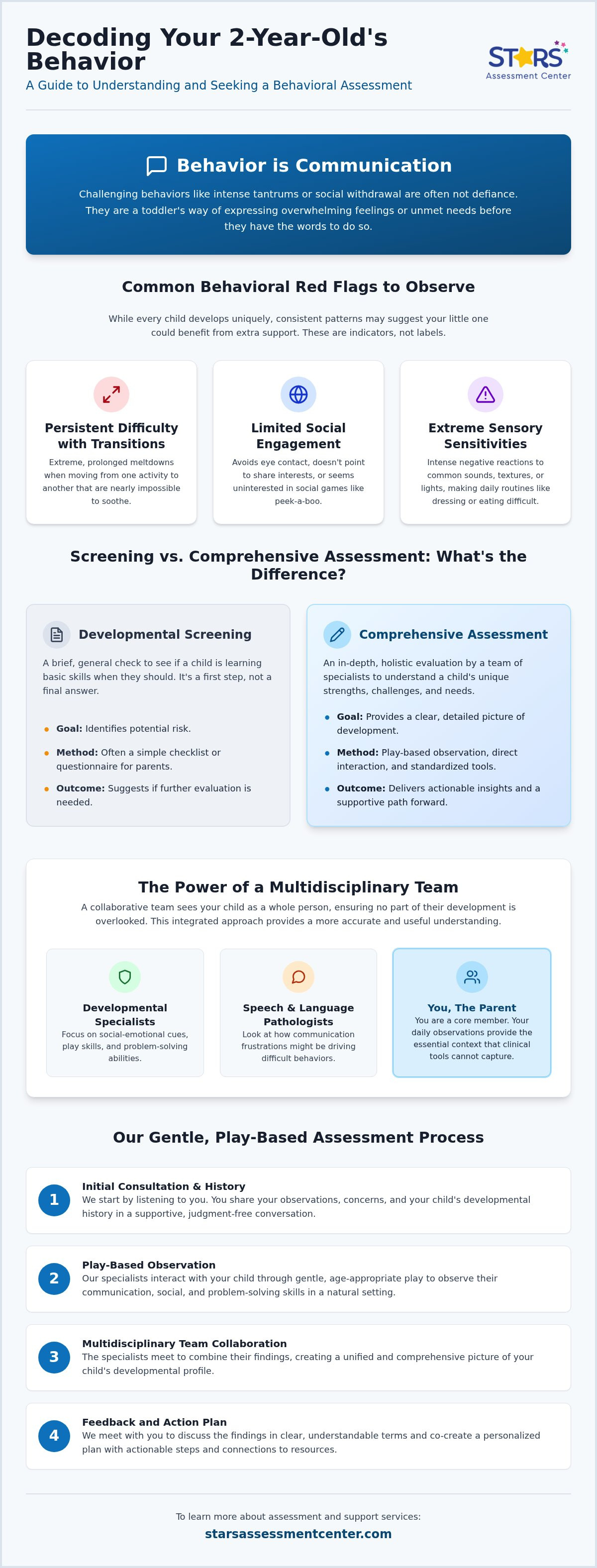
While every child develops at their own pace, certain patterns might suggest a need for a closer look. These aren't definitive labels; they're indicators that your child might benefit from extra guidance. If you notice these behaviors consistently, an assessment for 2 year old behavior can help determine if they're a part of typical growth or a sign of a developmental delay.
- Persistent difficulty with transitions: This goes beyond a simple whine when it's time to leave the park. It's an inability to move from one activity to another without an extreme, prolonged meltdown that seems impossible to soothe.
- Limited social engagement: You might notice your child avoids eye contact, doesn't point to show you things, or seems disinterested in social games like peek-a-boo or simple back-and-forth play.
- Extreme sensory sensitivities: This includes intense reactions to common sounds, textures, or lights that make daily routines like dressing, bathing, or eating very difficult for the whole family.
Recognizing these signs isn't about finding a problem, but about finding a path forward. Early identification is a gift that allows for tailored support during the most flexible years of a child's brain development.
What is a Multidisciplinary Behavioral Assessment?
A multidisciplinary approach is more than just a buzzword; it's a commitment to seeing your child as a whole person. Instead of a single provider looking at a checklist in isolation, this method brings together a team of specialists who collaborate in real time. Choosing a multidisciplinary assessment for 2 year old behavior ensures that no part of your child's development is overlooked. By combining different perspectives, the team can distinguish between a simple speech delay and a more complex social-emotional need, giving you a much more accurate picture of your child's strengths and challenges.
Specialists often use developmental milestones for 2-year-olds to establish a baseline. However, the true value of a team evaluation lies in how these experts interpret what they see. Instead of receiving several disconnected reports, you get one unified story that explains how your child communicates, learns, and interacts with their world. This collaborative spirit turns a stressful medical process into a supportive partnership for your family.
The Specialists Involved in Your Child's Care
Speech and Language Pathologists are key members of the team. They don't just evaluate how many words your child says; they look at how communication frustrations might be driving difficult behaviors. Developmental Specialists focus on social-emotional cues and how your child uses play to explore their environment. Perhaps most importantly, you are a core member of this team. Your daily observations and history provide the context that clinical tools can't capture on their own. We rely on your expertise as a parent to guide our understanding.
Why Multidisciplinary Evaluations Matter
Looking at a child through only one lens can sometimes lead to an incomplete picture or an inaccurate conclusion. For example, a child might appear to have social delays when they actually have an underlying speech delay that makes it hard to engage with peers. By identifying these overlapping issues, a multidisciplinary assessment for 2 year old behavior helps avoid misdiagnosis. It allows the team to see how one area of development influences another, which is vital for creating an effective roadmap for support.
At Stars Assessment Program, we integrate all these findings into a cohesive plan that is easy for families to follow. This comprehensive approach serves as a bridge, helping you move from uncertainty toward the right early intervention services. If you're looking for clarity on your child's next steps, you can learn more about our multidisciplinary developmental evaluation process.
Screening vs. Evaluation: Which Does Your Toddler Need?
It's helpful to think of a developmental screening as a smoke detector. It's designed to alert you that something might be happening, but it can't tell you exactly where the fire is or how to put it out. Many parents start with a screening at their pediatrician's office when they first feel that something isn't quite right. However, if that screening raises a flag, the next step is a comprehensive assessment for 2 year old behavior. This deeper dive is what provides the answers you need to move from a place of worry to a place of action.
Moving from "noticing a concern" to "getting an answer" is a journey that requires the right partnership. If your child’s screening indicates a potential delay, a formal assessment for 2 year old behavior provides the diagnostic evidence needed to unlock specialized support. This transition can feel like a lot to handle, but it’s a vital step in ensuring your child receives the right help at the right time. We're here to guide you through that shift with patience and expertise.
The Screening Process
Pediatricians often use brief tools like the Ages and Stages Questionnaires (ASQ-3) or the M-CHAT during well-child visits. These are excellent for a quick overview of developmental milestones, but they have inherent limitations. Because they rely on short checklists and parent-reported data, they may not capture the subtle complexities of a child's social-emotional world or sensory needs. A screening is meant to be a "first look" rather than a final conclusion. For a deeper look at how these tools work, you can read our Early Childhood Developmental Screening: A Parent’s Guide.
The Full Diagnostic Evaluation
A full diagnostic evaluation is the gold standard for families seeking a clear path forward. Unlike a quick screening, this process includes standardized tools and in-depth clinical observations by a multidisciplinary team. This level of detail is essential for accessing support through organizations like the San Andreas Regional Center (SARC). They require comprehensive data to determine if a child qualifies for early intervention services. It's also helpful to understand the difference between a medical diagnosis and educational eligibility; you can find more detail on this in our article about Autism Screening vs. Evaluation for Toddlers. Our team ensures that every evaluation is thorough enough to meet these high standards while remaining gentle and play-based for your child.
How the Assessment Process Works for Families
The journey toward understanding your child's needs shouldn't feel like a cold medical procedure. At Stars Assessment Program, we've designed our process to be a supportive partnership from the very first conversation. A comprehensive assessment for 2 year old behavior begins with a thorough intake. We listen to your family history and your specific concerns about your child's development. We want to know what you see at home, during mealtime, and at the park. This context is just as vital as the clinical data we gather because you know your child best.
After the initial intake, we move into the observation phase. This isn't a sit-down exam; it's a play-based experience tailored specifically for the birth-to-three age group. We use standardized tools designed for toddlers to measure cognitive, social, and emotional growth through natural interactions. Our goal is to see how your child explores their world when they feel safe and engaged. Finally, we hold a results meeting to translate clinical findings into a family-centered plan. This plan provides clear, actionable steps so you know exactly how to support your child's progress moving forward.
Preparing Your Toddler for the Visit
Transitions can be tricky for two-year-olds, so preparation is key to a successful visit. Try to keep your child's routine as consistent as possible on the day of the assessment. Make sure they're well-rested and have had a recent meal. You should bring along favorite toys, familiar snacks, and any comfort items that help your child feel secure in a new environment. When explaining the visit, use simple, positive terms. You might say, "We're going to a special playroom to meet some new friends and play with some fun toys today."
What to Expect During Clinical Observation
During the visit, specialists use play as a primary tool to measure cognitive and social skills. We might watch how your child builds with blocks, how they respond to their name, or how they use gestures to communicate a need. This naturalistic observation is the most effective way to conduct an assessment for 2 year old behavior because it captures how your child actually functions in real-world scenarios. It's normal for parents to feel anxious during this time, but remember that there's no "wrong" way for your child to behave. We're here to observe their unique personality and strengths, not to judge your parenting. You remain the expert on your child, and your presence provides the "safe harbor" they need to show us who they are.
If you're ready to gain a clearer understanding of your child's development, you can request a multidisciplinary assessment to begin your journey with a team that truly cares.
Accessing Support in Santa Clara County and San Jose
Finding the right path for your child in a large county like Santa Clara can feel daunting. However, you aren't alone in this process. For families in San Jose and the surrounding areas, the San Andreas Regional Center (SARC) serves as the vital gateway to early intervention services. SARC oversees the Early Start program, which is specifically designed for children from birth to age three. One of the most empowering things for parents to know is that you don't need a doctor's referral to contact SARC. If you have concerns, you can self-refer your child to begin the process of securing an assessment for 2 year old behavior.
Stars Assessment Program acts as a dedicated partner within this local ecosystem. We work closely with families in San Jose and Salinas to provide the multidisciplinary evaluations that SARC requires for eligibility. Our team understands the local requirements and the specific needs of our community. We see ourselves as a bridge, helping you move from the initial feeling that something is "off" to having a concrete plan of action that brings peace of mind to your household.
Local Resources for Families
Whether you're living in Milpitas, Gilroy, or Morgan Hill, the referral pathways remain focused on early identification. Under California's Early Start program, your child has a right to receive an evaluation if a developmental delay is suspected. This program is built on the understanding that the birth-to-three window is a critical time for brain plasticity. If your primary worry is related to how your child expresses themselves, you might find our Santa Clara County Toddler Speech Evaluation Guide helpful for understanding communication-specific hurdles.
The Stars Program Approach to Emotional Growth
Our commitment to your family goes beyond clinical data. We prioritize culturally sensitive and family-centered care, ensuring that every parent feels heard and respected throughout the evaluation. We know that receiving the results of an assessment for 2 year old behavior is a significant emotional milestone. That's why we don't just hand you a report and send you on your way. We guide you through the transition from assessment to services, explaining how to use your findings to advocate for your child's needs within the Early Start system.
As an employee-owned organization, every member of our team is deeply invested in the success of the families we serve. We're here to provide a safe harbor and a clear path forward for your little one. If you're ready to take the next step toward clarity, Contact Stars Assessment Center today to discuss your concerns.
Empowering Your Child’s Developmental Journey
Recognizing that your toddler's behavior is a form of communication is the first step in moving from confusion to clarity. Whether you're navigating intense tantrums or social withdrawal, a comprehensive assessment for 2 year old behavior provides the roadmap your family needs. By choosing a multidisciplinary approach, you gain the expertise of speech and developmental specialists who see your child as a whole person, ensuring no detail is overlooked.
Our specialized multidisciplinary team is dedicated to birth-to-three development, proudly serving families in San Jose, Salinas, and the surrounding areas. We're here to act as your steady ally, helping you bridge the gap between noticing a concern and accessing the right early intervention services. If you're ready to find answers and support your child's growth, Schedule a Consultation with our Santa Clara County Specialists.
You've already taken the most important step by seeking information. It’s a brave choice to advocate for your child’s needs, and we're honored to guide you through every stage of their progress. Your child’s potential is limitless, and with the right support, you can help them navigate their world with confidence.
Frequently Asked Questions
Is it just the 'terrible twos' or something more serious?
Distinguishing between typical milestones and concerns depends on the frequency and intensity of the behavior. While most toddlers test boundaries, patterns like extreme withdrawal or inconsolable meltdowns that disrupt every routine might signal a need for support. We look at the whole child to see if these actions are a form of communication for an unmet developmental need. It's about finding clarity so you can support your child's natural growth.
How do I know if my 2-year-old needs a behavioral assessment?
You should consider an assessment for 2 year old behavior if your child consistently struggles with social engagement, eye contact, or transitions between activities. Other signs include extreme sensitivities to sounds or textures that interfere with daily life. If your gut feeling tells you that your child's reactions are more intense than their peers, seeking a professional opinion provides the peace of mind and actionable steps you deserve.
What happens during a multidisciplinary evaluation?
During a multidisciplinary evaluation, a team of specialists like speech pathologists and developmental experts observe your child through play. Instead of clinical tests, we use toys and games in a gentle environment to see how your child interacts and solves problems. We gather information about their communicative, cognitive, and social-emotional skills. This collaborative approach ensures we capture a complete picture of your child's development rather than looking at skills in isolation.
Can a 2-year-old actually be diagnosed with a behavioral delay?
Yes, a toddler can be identified with a developmental or social-emotional delay during this critical window. The goal isn't just to provide a label, but to determine eligibility for early intervention services that make a real difference. Identifying these hurdles before age three takes advantage of incredible brain plasticity. This early support helps your child build the foundational skills they need for future success in school and social settings.
How long does the assessment process take at Stars?
The process at Stars Assessment Program is methodical and thorough to ensure your family feels supported. It typically begins with an initial intake to understand your history, followed by the observation phase where our specialists interact with your child. We conclude with a results meeting where we translate clinical data into a clear, family-centered plan. We move at a pace that allows for thorough understanding without rushing your family through the process.
Do I need a referral from my pediatrician to start the process?
You don't need a formal referral from a pediatrician to begin the process in Santa Clara County. California’s Early Start program allows parents to self-refer to the San Andreas Regional Center if they have concerns about their child's development. Our team at Stars can help guide you through these local pathways. We're here to be your partner, making sure you have the information needed to advocate for your child's early support.
Is the assessment covered by insurance or the Regional Center?
In Santa Clara County, many assessments are funded through the San Andreas Regional Center for children who qualify for the Early Start program. This ensures that families can access vital evaluations without financial barriers. We work closely with SARC to provide these multidisciplinary services to toddlers in San Jose, Salinas, and surrounding cities. Our team can help explain how these local resources work so you can focus on your child's growth.
What if my child is shy or won't cooperate during the evaluation?
It's completely normal for a child to be shy or hesitant in a new environment. Our specialists are experts in birth-to-three development and use a gentle, play-based approach that allows your child to warm up at their own pace. We prioritize naturalistic observation, meaning we watch how they play and interact with you. Your presence as a "safe harbor" helps us see your child's true personality and skills even if they're feeling a bit quiet.


