
You're watching your toddler play at a park in San Jose, and you can't help but notice how the other children are interacting. While you know every child grows at their own pace, a small voice in your head wonders if your little one is hitting the milestones they should. It's completely natural to feel a sense of worry when you think your child might be falling behind. You want the best for them, but the complex California healthcare and regional center systems often feel like a maze of clinical jargon and paperwork. Seeking a cognitive assessment for toddlers Santa Clara County doesn't have to be a source of stress. It's actually the first step toward finding the peace of mind you deserve.
We believe that every parent deserves a steady ally in this journey. This guide will show you how professional multidisciplinary evaluations help families identify cognitive delays and access vital early intervention support for children under three. We'll explain the difference between a developmental phase and a delay, while providing a clear path to local South Bay support. By understanding the process, you can move from uncertainty to a confident partnership that focuses on your child's unique potential.
Key Takeaways
- Learn to distinguish between typical toddler developmental phases and persistent delays by understanding how your child explores and solves problems.
- Discover why a play-based, multidisciplinary cognitive assessment for toddlers Santa Clara County is the most effective way to evaluate your child's growth in a stress-free environment.
- Understand the specific roles of general screenings and diagnostic evaluations when identifying specialized needs like Autism or Down syndrome.
- Gain a clear roadmap for navigating local early intervention services, from initial pediatrician conversations to partnering with the San Andreas Regional Center (SARC).
- Explore how the "Safe Harbor" philosophy of the Stars Assessment Program provides families with a compassionate, expert guide during the critical birth-to-three developmental window.
Understanding Cognitive Development: Milestones vs. Concerns for Toddlers
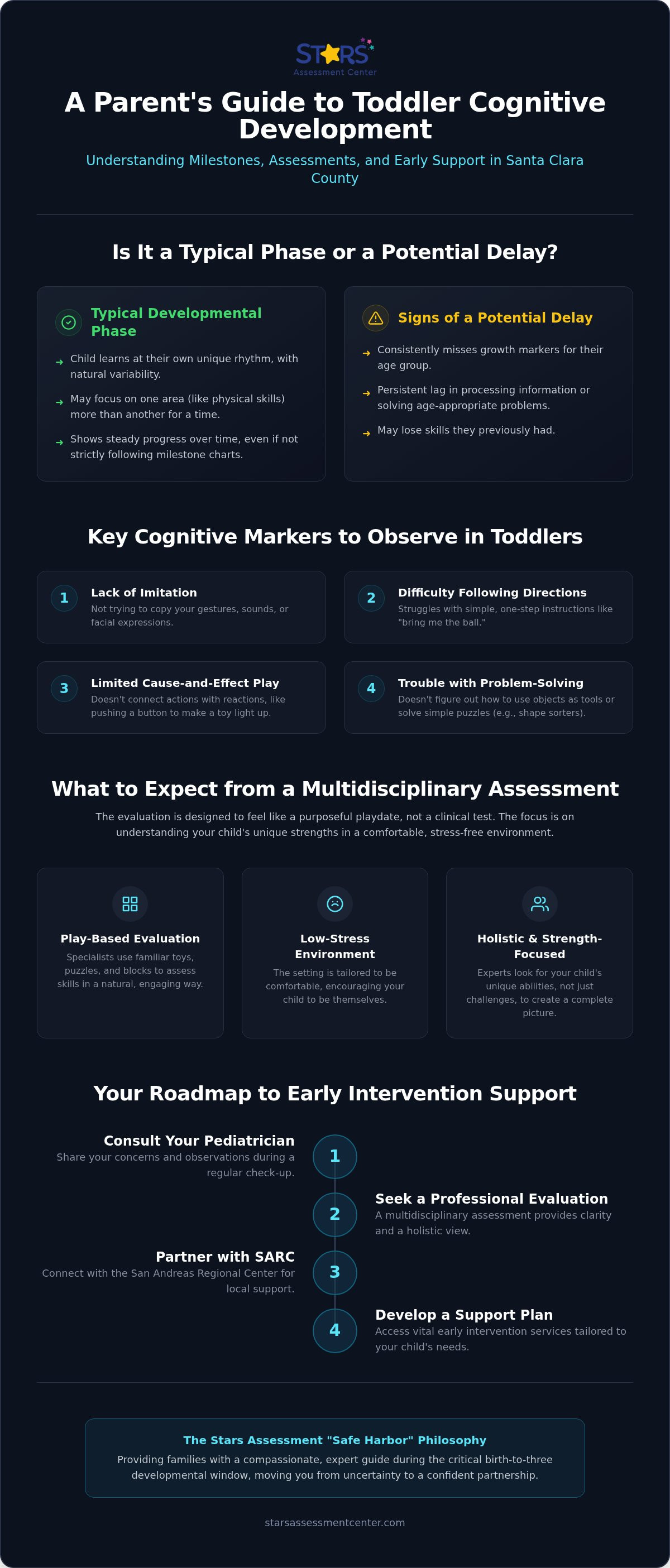
Cognitive development is the process of how your child learns to think, explore, and solve problems in their everyday world. It's the way they figure out that a square block won't fit in a round hole or how they remember where their favorite toy is hidden. While milestones provide a helpful map, every child has a unique rhythm. Some toddlers might focus on physical skills first, while others dive straight into problem-solving. This natural variability is normal. However, when certain growth markers are consistently missed, it may indicate a persistent delay rather than a temporary phase. Understanding cognitive development helps us see that these early years aren't just about learning facts; they're about building the infrastructure for all future learning.
The birth-to-three window is a uniquely sensitive time for brain development. During these first 36 months, the brain is incredibly adaptable, making it the most critical period for intervention. Choosing an early childhood developmental screening isn't about labeling your child. It's a tool for empowerment. It provides you with the data needed to unlock specialized support during the years when it can make the greatest impact. If you've noticed your child struggling with foundational tasks, seeking a cognitive assessment for toddlers Santa Clara County can provide the clarity your family needs.
Cognitive Red Flags in Children Under Age Three
While every child is different, certain behaviors suggest a child might benefit from professional observation. You might notice a lack of imitation, such as a toddler not trying to copy your gestures or facial expressions. Another common sign is difficulty following simple, one-step directions like "bring me the ball." We also look closely at "cause and effect" play, which is a cornerstone of early cognitive health. This includes behaviors like pushing a button to make a toy pop up or dropping a spoon to see where it lands. When parents pursue a cognitive assessment for toddlers Santa Clara County, our team looks for these specific markers to understand how the child is navigating their environment. A cognitive delay for toddlers is a persistent lag in a child's ability to process information, solve age-appropriate problems, or understand basic concepts compared to their same-aged peers.
The Link Between Cognitive and Social-Emotional Growth
A child's ability to process information is deeply intertwined with how they relate to the people around them. If a toddler finds it hard to understand social cues or the "rules" of a simple game, they may pull away from others. This is why we often recommend a social emotional assessment for toddlers alongside cognitive testing. Social engagement serves as a vital window into a child's internal processing. When a child engages with you, they're using their cognitive skills to interpret your intent and respond appropriately. Identifying these connections early ensures we're supporting the "whole child" rather than just isolated skills.
What to Expect During a Multidisciplinary Cognitive Assessment
The idea of an evaluation might bring up images of clinical rooms and rigid testing. For a toddler, this couldn't be further from the truth. A multidisciplinary cognitive assessment for toddlers Santa Clara County is designed to feel like a purposeful playdate. Our specialists observe your child in a setting that encourages them to be themselves. We aren't just looking for what they can't do; we're looking for their unique strengths. This holistic view ensures that every family leaves with a clear, supportive roadmap for their child's future. It's about finding answers, not just labels.
The Play-Based Evaluation Process
Toddlers learn through exploration. That's why we use familiar items like colorful blocks, puzzles, and interactive toys to assess memory and problem-solving skills. By watching how a child interacts with these objects, we gain insights into their cognitive processing in a way that formal testing simply can't capture. The environment is carefully tailored to be low-stress and engaging. This "natural play" approach is a key component of California's Early Start program, which prioritizes accessible and family-friendly evaluations. When a child is comfortable, they show us their true capabilities. This process allows us to see how they handle frustration, how they celebrate a win, and how they think through a challenge.
The Power of a Multidisciplinary Team
A single perspective can sometimes miss the bigger picture. Our team brings together specialists from different fields, such as child psychology and speech pathology, to look at the "whole child." For example, a speech and language evaluation for toddlers often provides vital context for cognitive findings. If a child isn't responding to a prompt, is it a language barrier or a cognitive challenge? By working together, our specialists prevent narrow or inaccurate findings. This collaborative approach is a hallmark of the Stars Assessment Program, ensuring that no detail of your child's development is overlooked.
Your insights are just as important as our professional observations. During the parent interview, we gather real-world data about how your child behaves at home, during meals, or at the park. Combining your expertise with our clinical tools creates the most accurate picture possible. If you're ready to gain a deeper understanding of your child's growth, we invite you to learn more about our team and how we support South Bay families through the cognitive assessment for toddlers Santa Clara County process.
Identifying Specialized Needs: Autism and Down Syndrome Screenings
For many parents, the possibility of a specific diagnosis like Autism or Down syndrome feels heavy. It's important to remember that these terms aren't meant to limit your child; they are keys that unlock specialized California state resources. A cognitive assessment for toddlers Santa Clara County often serves as the first formal step in understanding these unique needs. While a general screening might identify a potential concern, a comprehensive diagnostic evaluation provides the detailed roadmap necessary for personalized intervention. We view these "labels" as tools for better understanding and support, ensuring your child receives the specific care they deserve.
The CDC emphasizes the importance of Developmental Monitoring and Screening as a way to catch delays early. By identifying these patterns before a child turns three, we can take advantage of the brain's incredible neuroplasticity. This early identification ensures that families in the South Bay aren't just waiting for milestones to happen, but are actively supporting their child's growth. When we pinpoint a specific need, it allows us to bridge the gap between a child's current abilities and their future potential.
Early Autism Screening for South Bay Families
Families in San Jose and Milpitas often come to us wondering if their child’s quiet nature is just a personality trait or something more. Our specialists are trained to differentiate between general cognitive delays and autism spectrum disorder. We look for specific social-communication patterns, such as how a child uses eye contact or shares enjoyment with others. Catching these markers early can fundamentally change a child’s long-term trajectory. It allows us to implement strategies that help them connect with their world more effectively and builds a foundation for social success.
Support for Down Syndrome and Physical Delays
For infants with Down syndrome, development involves a delicate balance of cognitive and physical markers. Our specialized Down syndrome assessment process is tailored specifically for the birth-to-three window. We integrate cognitive support with physical developmental monitoring, recognizing that how a child moves often influences how they explore and learn. The Stars Assessment Program has extensive experience supporting children with diverse chromosomal conditions. We understand that while the journey may look different, the goal of a cognitive assessment for toddlers Santa Clara County remains the same: ensuring every child has a compassionate, expert guide by their side.
Navigating the Early Intervention Roadmap in Santa Clara County
Finding the right support for your child can feel like trying to solve a puzzle with missing pieces. In California, the path to early intervention is structured to ensure no child is left behind, but the steps aren't always clear to families. The process usually begins with a simple conversation. You might talk to your pediatrician about your concerns, or you can reach out to a specialist directly to discuss a cognitive assessment for toddlers Santa Clara County. Once a concern is identified, the journey follows a specific set of milestones designed to get your child the help they need as quickly as possible.
The roadmap typically follows these five steps:
- Initial Consultation: Discussing your observations with a professional who understands birth-to-three development.
- SARC Referral: Contacting the San Andreas Regional Center to begin the formal intake process.
- Assessment Phase: Completing a multidisciplinary evaluation at the Stars Assessment Program to look at the "whole child."
- Eligibility Determination: Reviewing results to see if your child meets the California Early Start criteria, which generally requires a developmental delay of at least 25% in one or more areas.
- Plan Implementation: Creating and starting a personalized support plan tailored to your child's unique strengths.
Working with the San Andreas Regional Center (SARC)
The San Andreas Regional Center is the primary agency for early intervention services in our area. They serve families across San Jose, Milpitas, and Gilroy, acting as a central hub for coordination. SARC often partners with private programs to conduct a cognitive assessment for toddlers Santa Clara County, ensuring evaluations are thorough and timely. When you prepare for your first meeting, it's helpful to bring any notes about your child's daily routine or specific milestones that have caused concern. Being organized helps the SARC team understand your child's needs from day one. They are there to be your advocate, not just a bureaucratic gatekeeper.
Accessing Local Resources in San Jose and Beyond
You don't have to walk this path alone. Santa Clara County has a rich network of local support groups where you can connect with other parents who have shared similar experiences. The Stars Assessment Program serves families throughout the South Bay and Salinas, providing a "Safe Harbor" for those in the middle of the evaluation process. We encourage you to be a proactive advocate for your child within the healthcare system. If you feel a concern isn't being addressed, don't hesitate to ask for a second opinion or a more detailed screening. If you're ready to start this process, you can contact our team directly to discuss how we can support your family's next steps.
The Stars Assessment Program: A Safe Harbor for Your Child’s Future
When you're searching for a cognitive assessment for toddlers Santa Clara County, you're looking for more than just a clinical provider. You're looking for a partner who understands the weight of your concerns and the importance of your child's future. The Stars Assessment Program serves as a "Safe Harbor" for families, providing a supportive environment where expertise meets empathy. We know that the birth-to-three window is a precious time, and our goal is to ensure you have the clarity needed to make the most of it. Our approach is designed to be a calming presence during a time that often feels overwhelming.
Our organization is unique because we are an employee-owned organization (ESOP). This means our specialists aren't driven by corporate metrics or volume; instead, we're focused entirely on family outcomes and the well-being of the children we serve. Since 1988, we've built a reputation in Northern California for being community-oriented advocates. When you walk through our doors, you're meeting with professionals who are personally invested in the success of every family. We prioritize identifying delays early because we know that the right support today changes the trajectory of a child's tomorrow.
Our Multidisciplinary Team in Santa Clara County
Our team in San Jose and surrounding local offices brings together a wealth of specialized knowledge. We believe that a child's development is interconnected, so our evaluations are never conducted in isolation. Instead of receiving several disjointed reports, you receive one comprehensive document that reflects the combined insights of our psychologists and speech specialists. This collaborative approach ensures that we see your child as a whole person rather than a collection of scores. Serving the South Bay for over three decades has allowed us to refine a process that is as thorough as it is gentle for your little one.
Next Steps for Your Family
It's common to feel a mix of hope and hesitation when considering a professional evaluation. We want to remind you that your intuition as a parent is a powerful tool. If you feel that something isn't quite right, seeking a professional opinion is a proactive way to support your child's potential. Early identification is the most effective way to maximize progress before a child turns three. You aren't "looking for problems"; you're looking for the best way to help your child thrive.
Contacting the Stars Assessment Program is a simple, stress-free process. We're here to answer your questions and guide you through the initial steps of the referral pathway. You don't have to navigate the complexities of the system alone. Our team is ready to provide the expert partnership and peace of mind your family deserves. Take the first step toward clarity and support today.
Schedule a developmental assessment with the Stars team today.
Empowering Your Child's Growth Journey
Understanding your child's developmental path is the greatest gift you can provide during these foundational years. By choosing a professional cognitive assessment for toddlers Santa Clara County, you move beyond worry and into a space of clarity. These evaluations aren't about labels. They're about creating a personalized roadmap that celebrates your child's strengths while addressing their unique needs.
Since 1988, our employee-owned team has served as a steady ally for families in San Jose and across the South Bay. We specialize exclusively in the birth-to-three window. We offer a compassionate, play-based environment where your child can truly be themselves. Our multidisciplinary specialists work together so you don't have to face the complex California healthcare system alone. We're committed to being the "Safe Harbor" your family needs during this time of growth.
Request a Multidisciplinary Assessment for Your Toddler and take the first step toward peace of mind. You're your child's best advocate, and we're here to ensure you have the expert support needed to help them shine. Together, we can build a bright and confident future for your little one.
Frequently Asked Questions
What is the difference between a cognitive assessment and an IQ test for a toddler?
Cognitive assessments look at how a child thinks and solves problems through play; while IQ tests are standardized measures of intelligence often used for older children. In toddlers, we focus on developmental milestones rather than a static number. It's about seeing how they explore their world and interact with objects. We evaluate their memory and reasoning skills in a way that respects their age and unique developmental stage.
Does my child need a referral from a pediatrician to get an assessment?
You don't always need a formal referral to start the process. While many families talk to their pediatrician first, you can contact our specialists directly or reach out to the San Andreas Regional Center (SARC). We're here to help you navigate the entry points for a cognitive assessment for toddlers Santa Clara County. Taking the initiative ensures your child receives support during the critical birth-to-three window.
How long does a multidisciplinary developmental evaluation usually take?
A typical multidisciplinary evaluation takes about 1.5 to 2 hours of direct observation. This time allows our team to see your child in various play-based scenarios without causing fatigue. We move at your child's pace to ensure they remain comfortable and engaged throughout the session. Our specialists work together during this window to gather all the necessary data for a comprehensive report for your family.
What should I do if my pediatrician tells me to "wait and see" but I am still worried?
Trust your intuition as a parent. If you're still worried, seeking a second opinion or a professional screening is a proactive step. Early intervention is most effective during the birth-to-three window, so waiting can sometimes mean missing a critical period for support. We provide a safe harbor to explore your concerns and offer clarity on whether your child's growth is a phase or a delay.
Can a cognitive assessment identify Autism in a child under age three?
Yes, specialized screenings can identify early markers of Autism in children under age three. Our team looks for social-communication patterns and behavioral signs that are evident even in very young toddlers. Identifying these needs early allows for immediate access to specialized California state resources. Early detection helps us build a foundation for social success and ensures your child gets the specific guidance they need to thrive.
Is the assessment covered by insurance or state programs in Santa Clara County?
Many assessments are provided through state-funded programs like California's Early Start, often coordinated by SARC. For private evaluations, coverage varies by provider and plan. We recommend checking with your insurance or contacting SARC to understand the specific pathways available to families in San Jose and the South Bay. Navigating a cognitive assessment for toddlers Santa Clara County is often the first step toward accessing these vital services.
What happens if my child is found to have a cognitive delay?
Finding a delay is the first step toward getting your child the right support. In California, eligibility for the Early Start program generally requires a developmental delay of at least 25% in one or more areas. You'll receive a comprehensive report and a personalized plan. This leads to early intervention services, which can include speech therapy or social-emotional support tailored to your child's specific developmental needs.
How can I prepare my toddler for their assessment day at the center?
Keep the day as normal as possible for your child. Make sure they're well-rested and have had a snack before arriving. You don't need to "practice" anything; we want to see their natural play. Bringing a favorite toy or comfort item can help them feel secure in a new environment. Our team focuses on creating a warm, play-based setting where your toddler feels safe to explore and learn.


