

Did you know that 75% of 2-year-olds have at least one temper tantrum every month? When you are standing in a grocery store aisle while your child screams because you chose the "wrong" box of crackers, it's easy to feel like the only parent struggling. You might find yourself wondering if for a 2 year old tantrums all the time is it normal or if there is something deeper happening with their social-emotional development. The exhaustion from constant power struggles is real, and the worry about long-term behavioral issues can feel overwhelming when you just want the best for your child.
You deserve a steady ally who meets your concerns with empathy rather than judgment. We understand that these outbursts are often a child's first attempt at complex communication. This article will help you discover the difference between typical toddler behavior and signs of social-emotional delays. We'll provide clear criteria for normal development and explain when seeking professional support, such as a multidisciplinary developmental assessment, can offer the reassurance you need. You will gain a clearer perspective on your child's growth and a practical path forward to bring peace back to your home.
Key Takeaways
- Understand why for a 2 year old tantrums all the time is it normal and how these outbursts serve as a vital communication tool during rapid neurological growth.
- Learn the science behind the "big feelings, small body" phenomenon and why your child's brain isn't yet equipped to manage intense emotions alone.
- Identify specific red flags in frequency, duration, and aggression levels to help you distinguish typical toddler behavior from social-emotional delays.
- Discover practical co-regulation strategies and the HALT method to lower stress levels and manage daily power struggles with confidence.
- Explore how a multidisciplinary developmental assessment provides a clear path forward and the reassurance that your family is not alone.
Is It Normal for a 2-Year-Old to Have Tantrums All the Time?
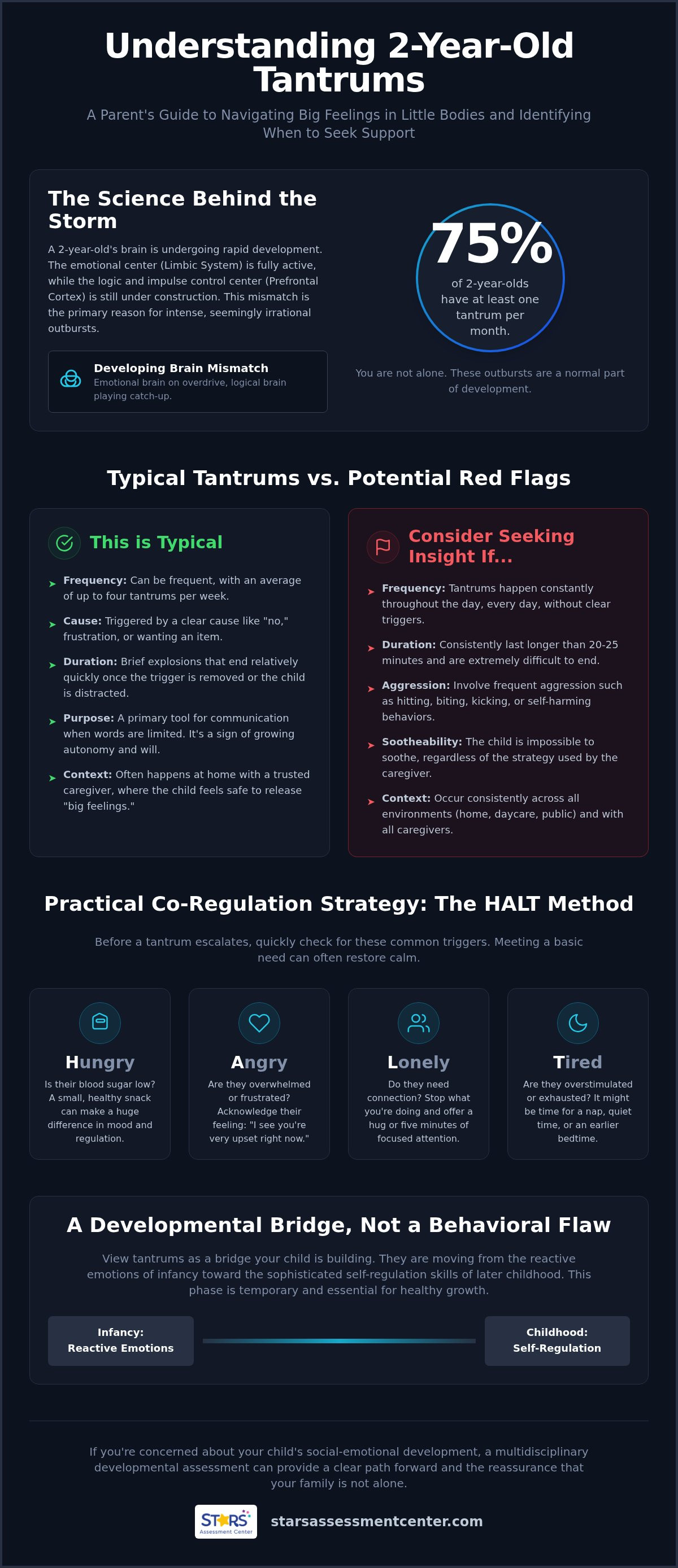
The "Terrible Twos" represents a period of profound neurological growth. Your toddler’s brain is currently building the foundation for emotional intelligence, but that construction site is often messy. During these months, the brain's limbic system, which processes emotions, is highly active. Meanwhile, the prefrontal cortex, the part responsible for logic and impulse control, is still very much under construction. This mismatch is why a minor inconvenience, like a broken banana, can feel like a genuine emergency to a toddler. Many parents worry that because their 2 year old tantrums all the time is it normal to feel this way, especially when every day feels like a battle of wills.
It's completely valid to feel drained by the constant negotiation that comes with this stage of life. While the average of four tantrums a week provides a general developmental baseline, every child's temperament is unique. You aren't just looking for a statistic; you're looking for peace of mind. Understanding that these outbursts are a primary tool for communication at this age can help lower your own stress levels. When a child lacks the words to express a complex feeling, their body takes over to deliver the message.
The Frequency vs. Intensity Debate
Exhaustion often makes it feel like the screaming never stops, but "all the time" is frequently a subjective reflection of a parent's fatigue. When we analyze what tantrums are, we distinguish between how often they happen and the nature of the emotional release. A standard tantrum is typically a brief explosion of frustration that ends relatively quickly once the trigger is removed or the child is distracted. It's usually tied to a clear cause, such as being told "no" or being asked to leave the park.
If the outbursts are becoming more intense, lasting longer than twenty minutes, or involving frequent aggression, it's natural to seek more clarity. The context of these moments is what matters most. For example, a child who only has tantrums at home with a trusted caregiver is often showing they feel safe enough to release their "big feelings." However, if the behavior is consistent across all environments and seems impossible to soothe, it may be a sign that the child needs extra support in developing regulation skills.
Tantrums as Developmental Milestones
These difficult moments are actually evidence of your child’s growing autonomy. They are beginning to realize they have their own will, which is a vital milestone in forming a healthy, independent identity. Much of this friction stems from language frustration. A two year old often understands far more than they can say, leading to a communication gap that results in tears. When they can't explain that they wanted to put on their own shoes, the tantrum becomes their loudest way to exert control. A tantrum acts as a developmental bridge that helps a child move from the reactive emotions of infancy toward the sophisticated self-regulation skills of later childhood.
Why 2-Year-Olds Struggle: The Science of Emotional Regulation
Understanding why your child reacts so strongly starts with the "big feelings, small body" phenomenon. At age two, a child experiences the same intensity of anger or frustration as an adult, but they possess none of the neurological tools to manage it. Their prefrontal cortex, which serves as the brain’s control center for logic and impulse control, is still very early in its development. This means that when a toddler is overwhelmed, they physically cannot "think" their way out of it. If you feel like your 2 year old tantrums all the time is it normal to look for deeper answers, especially if sensory triggers like loud noises or bright lights seem to set them off. High-stimulation environments can easily overload a young child’s developing system, leading to more frequent meltdowns.
Research suggests that 75% of toddlers have at least one tantrum a month, so you are certainly not alone in this experience. However, when the environment feels too loud, too bright, or too crowded, a child's internal alarm system can trigger an outburst that feels disproportionate to the situation. Recognizing these environmental factors is a key part of supporting your child's growth. We view these moments not as "bad behavior," but as a signal that the child's current environment has exceeded their ability to cope.
The Role of Communication Delays
A significant source of frustration for toddlers is the gap between what they understand and what they can say. When a child lacks expressive language, they often resort to physical outbursts to make their needs known. This is why children with speech delays may experience more intense or frequent tantrums; their behavior is quite literally their only voice. For families in San Jose or surrounding areas, reviewing a Santa Clara County toddler speech evaluation guide can help determine if a communication delay is fueling the fire.
Social-Emotional Milestones at Age Two
While tantrums are expected, we also look for specific social-emotional milestones that indicate healthy growth. By age two, most children should begin to show signs of empathy or seek comfort from a caregiver after they have calmed down. This "repair" phase is a critical part of development where the child learns that their relationship remains secure even after a difficult moment. Tracking these behaviors is often the first step in a social emotional assessment for toddlers.
If you notice your child isn't reaching these benchmarks, a social emotional development screening provides a clear picture of their progress. It's helpful to know when to seek professional insight so you can provide the right support early on. If you're feeling uncertain, a multidisciplinary team can help you navigate these complex early years with confidence and clarity.
Normal Toddler Behavior vs. Red Flags: When to Seek Professional Insight
Many parents reach a point where they feel their child is stuck in a loop of outbursts. You might worry if for your 2 year old tantrums all the time is it normal, especially when the behavior seems to go beyond a simple "no." While typical frustration is a fleeting reaction to a limit, atypical emotional dysregulation feels more like a storm that won't break. It's important to look at the consistency of these behaviors across different environments, like your living room versus the playground. If a child only struggles at home, it's often a sign of testing boundaries with a safe adult. However, if the behavior is equally intense at daycare, the grocery store, or the park, it suggests a deeper challenge with emotional regulation in toddlers.
Comparing these moments to a developmental baseline helps provide clarity. A child who is developing typically might scream for a few minutes but can eventually be distracted or comforted. When a child is facing a social-emotional delay, the outburst often feels disconnected from the original trigger and persists long after the problem has been solved. This is why we encourage families to look at the big picture rather than focusing on a single bad afternoon.
Behavioral Red Flags to Watch For
We often tell parents that the "how" and "how long" matter more than the "how many." While most toddlers average four tantrums a week, the following signs suggest a need for a professional social-emotional assessment:
- Outbursts that consistently last longer than 25 minutes and are difficult to de-escalate.
- Frequent physical aggression, such as hitting, biting, or kicking, directed at themselves or others during these moments.
- An inability to be "reset" or calmed by a primary caregiver, even after the original trigger is removed.
Standard behavioral phases usually have a clear end point once the child feels heard or the situation changes. Social-emotional delays, on the other hand, often manifest as a persistent inability to return to a calm state without significant intervention from an adult.
Signs That Overlap with Autism
It's common for parents to wonder if intense behavior is a sign of neurodiversity. A key distinction lies between a typical tantrum and a sensory meltdown. A typical tantrum is often goal-oriented; the child wants a cookie or a toy. A sensory meltdown is a total system shutdown caused by overwhelming input. During these emotional peaks, we look at social engagement. Does the child occasionally check in with your eyes to see your reaction, or do they seem completely disconnected from the world around them? Understanding the difference between an autism screening vs evaluation for toddlers is a vital step for families in Santa Clara County who need clarity. These evaluations look at the whole child to see if the behavior is a communication hurdle or a sign of something more.
Practical Strategies for Frequent Tantrums at Home
Managing the "terrible twos" requires a toolkit of patience and practical techniques. While you might still ask yourself if for your 2 year old tantrums all the time is it normal, having a plan helps you feel less like a bystander to the chaos. The most effective tool you have is co-regulation. Because your child’s brain cannot yet self-soothe, they rely on your calm nervous system to find their way back to a steady state. If you stay steady and composed, you provide the anchor they need to ride out the emotional storm.
Before a meltdown peaks, try the "HALT" method. Quickly check if your child is Hungry, Angry, Lonely, or Tired. Addressing these basic physical and emotional needs can often prevent an outburst before it starts. You can also reduce daily friction by creating a "Yes" environment. This involves setting up your home to minimize "no" encounters, such as keeping off-limits items out of sight or offering simple choices. For example, instead of a flat "no" to a snack, ask, "Do you want an apple or a pear?" This gives the child a sense of autonomy and control.
Knowing when to intervene is equally important. If a child is screaming specifically to get their way, sometimes a "planned ignoring" approach works best as long as they are safe. However, if they are genuinely overwhelmed by a sensory meltdown, they need physical comfort and a quiet space to reset. Your presence alone often does more than words ever could during these intense moments.
Building Emotional Vocabulary
Helping your child put words to their feelings reduces the frustration that leads to physical outbursts. You can name their emotions in real time by saying, "I see you're feeling sad because we have to leave the park." For children with communication delays, using picture cards or simple hand signs can bridge the gap between their big feelings and their ability to express them. We define emotional labeling as the practice of identifying and naming a child's feelings to build the foundation for long-term self-regulation skills.
Tracking Patterns for Your Pediatrician
Keeping a "Tantrum Log" is a simple way to identify recurring triggers. Record the time of day, what happened right before the outburst, and how long the episode lasted. This information is exactly what a specialist in San Jose or Santa Clara will need to see to differentiate between a bad week and a persistent developmental pattern. If you notice the same triggers causing intense reactions daily, it may be time for a professional perspective. You can start by scheduling a multidisciplinary developmental assessment to gain a comprehensive understanding of your child's unique needs.
How a Social-Emotional Assessment Provides Clarity for Families
If you've spent weeks wondering if for a 2 year old tantrums all the time is it normal, moving toward a formal assessment can feel like a significant weight lifted. It marks the transition from questioning your child's behavior to understanding their unique developmental profile. A social-emotional assessment isn't about labeling a child or finding fault; it's about providing a clear roadmap for their growth. This process provides the clarity needed to replace daily anxiety with a structured plan of action. By shifting the focus from "what is wrong" to "how can we help them thrive," we create a supportive environment where your child feels seen and understood. Instead of feeling judged during public outbursts, you gain the confidence that comes from knowing exactly what your child is trying to communicate through their behavior.
Age two is often called the "golden window" for developmental support. During these early years, a child's brain is incredibly adaptable, making it the ideal time to strengthen social-emotional foundations. Early intervention isn't just about addressing delays. It's about giving your child the tools they need to communicate effectively and regulate their emotions before they enter the complex social world of preschool. Providing support now can change the trajectory of your child's daily life, turning power struggles into moments of connection.
The Multidisciplinary Approach
A comprehensive evaluation at Stars Assessment Program involves more than just a single observation. We utilize a multidisciplinary team where speech and language specialists, social-emotional experts, and cognitive specialists work together. This team-based approach is significantly more accurate than a single screening because it looks at the child from multiple angles. By observing how your child interacts with different specialists in a play-based setting, we can identify whether a behavior is rooted in a communication gap, a cognitive challenge, or a social-emotional delay. We prioritize family-centered care, meaning your observations as a parent are treated as vital data. You know your child best, and your perspective is the heart of the assessment process.
Next Steps for Local Families
For families in Santa Clara County, navigating the path to support doesn't have to be a solo journey. Whether you are in San Jose, Milpitas, or Salinas, there are clear steps to gain the clarity you need. Many families start by navigating the San Andreas Regional Center referral process, which can sometimes involve wait times. Others choose to reach out directly for private evaluations to begin their journey toward support more quickly. If you are ready to move past the uncertainty and find a safe harbor for your family, you can schedule a gentle consultation with our assessment team today. We are here to listen, support, and help your child reach their full potential.
Finding Peace and Clarity for Your Child's Growth
The "terrible twos" can be one of the most exhausting seasons of parenthood. While many outbursts are a natural part of developing autonomy, it's vital to listen to your intuition if you feel something more is happening. We've explored the difference between typical neurological growth and potential social-emotional delays, providing you with the tools to track patterns and identify red flags. If you are still wondering if for your 2 year old tantrums all the time is it normal, gaining a professional perspective can offer the reassurance you deserve.
At Stars Assessment Program, our multidisciplinary team of early childhood specialists serves families across Santa Clara, Santa Cruz, and Monterey Counties. We take a family-centered approach to emotional growth, ensuring you are a partner in every step of the process. You don't have to navigate this uncertainty alone. Contact Stars Assessment Program for a multidisciplinary evaluation to discover how we can help your child thrive. Every child's journey is unique, and with the right support, you can move forward with confidence and hope.
Frequently Asked Questions
Is it normal for a 2-year-old to have 5 tantrums a day?
It's common for toddlers to have several outbursts a day depending on their temperament and daily environment. While the statistical average is four per week, five in a single day isn't necessarily a cause for alarm if they're brief and triggered by clear frustrations like hunger or transitions. You should look at the intensity and your child's ability to recover. If you're asking if for your 2 year old tantrums all the time is it normal, consistency across several weeks matters more than one difficult day.
How do I tell the difference between a tantrum and a sensory meltdown?
A tantrum is usually goal-oriented, meaning the child wants a specific outcome like a favorite toy or a snack. These outbursts often stop once the child gets what they want or finds a new distraction. A sensory meltdown is a total neurological overload where the child cannot stop the behavior even if they wanted to. Meltdowns are often triggered by lights, sounds, or crowds and require a quiet space to reset rather than a simple negotiation or boundary setting.
Can frequent tantrums be a sign of autism in 2-year-olds?
Frequent outbursts can be a sign of autism, but they are also a standard part of the "terrible twos." Specialists look for other indicators alongside behavior, such as:
- Limited eye contact during interactions.
- A lack of social pointing or sharing interest.
- Delayed speech and language milestones.
At what age should I be concerned if tantrums haven’t decreased?
Most children begin to show better emotional regulation as their language skills improve, typically around age three. If your child is approaching their third birthday and the frequency or intensity of outbursts remains very high, it's a good idea to seek a professional opinion. We focus specifically on children birth to age three to catch these patterns early. Addressing these challenges during this "golden window" allows for more effective support as your child prepares for preschool environments.
Does a social-emotional assessment mean my child will get a diagnosis?
An assessment is a tool for understanding your child's unique profile, not a guaranteed label. The goal of a social-emotional assessment is to identify specific strengths and areas where your child needs extra support to grow. While it can lead to a diagnosis like autism or a speech delay, it often simply provides a roadmap for parents to help their child thrive. It's about opening doors to resources that make daily life easier for your entire family.
What if my toddler is aggressive during their tantrums?
Occasional hitting or biting can happen when a toddler is overwhelmed, but frequent or severe aggression is considered a red flag. If your child regularly hurts themselves or others during an outburst, it suggests they're struggling to process intense emotions safely. This is a common reason parents ask if for a 2 year old tantrums all the time is it normal. Professional guidance can help you develop co-regulation strategies to keep everyone safe while building your child's emotional vocabulary and communication skills.
How long does a typical developmental evaluation take?
The duration of an evaluation depends on your child's specific needs and the complexity of your concerns. A multidisciplinary developmental assessment usually involves a team of specialists observing your child in a play-based environment over one or more sessions. This thorough process ensures we capture a complete picture of their communicative, social-emotional, and cognitive skills. We prioritize a methodical, patient rhythm to ensure your child feels comfortable and safe, typically concluding with a clear path forward for your family.
Are there local resources in San Jose for toddler behavioral support?
Yes, families in the San Jose area have access to several specialized resources for early childhood growth. You can explore:
- Stars Assessment Program for expert evaluations in Santa Clara County.
- San Andreas Regional Center for state-funded early intervention services.
- Local support groups in Milpitas, Gilroy, and Salinas for parents of toddlers.


