
Imagine your toddler, who just last week was excitedly pointing at the family dog and saying "puppy," suddenly stops using that word altogether. It's a heart-wrenching moment that often leads to late nights spent scrolling through conflicting advice, wondering if you've missed a critical sign. When you notice a 2 year old speech regression what to do becomes the most important question on your mind, and the weight of that uncertainty can feel incredibly heavy.
You're not alone in this experience. It's completely natural to feel a sense of panic or worry that a loss of skills might point toward a permanent developmental delay or an Autism diagnosis. We understand that you need more than just clinical definitions; you need a steady ally and a clear path forward. This article provides a compassionate look at why these regressions happen and offers a structured action plan to help you navigate this journey with confidence.
We'll walk through the common triggers for speech changes, share actionable strategies you can start at home today, and explain how to access a professional multidisciplinary evaluation right here in Santa Clara County. Our goal is to move from confusion to clarity, ensuring your child has the support they need to flourish.
Key Takeaways
- Learn the vital difference between a normal developmental plateau and clinical regression, including how environmental stressors can impact your toddler's communication.
- Follow a clear, compassionate action plan for a 2 year old speech regression what to do today, from starting a speech log to consulting with your pediatrician.
- Understand the importance of ruling out physical medical factors, such as hearing changes or chronic ear infections, before pursuing further developmental testing.
- Explore when a loss of words might signal a need for a more comprehensive social-emotional or multidisciplinary developmental assessment.
- Discover local resources in Santa Clara County that offer specialized, family-centered support for children from birth to age three.
Understanding Speech Regression in 2-Year-Olds
Speech regression is the loss of functional communication skills previously mastered by the child. For toddlers in the 24 to 36 month age group, language development is usually explosive, making any sudden reversal feel particularly jarring. If you're currently wondering about a 2 year old speech regression what to do, your concern is a natural reflection of your commitment to your child's growth. You aren't alone in this experience, and seeking clarity is the first step toward providing the right support.
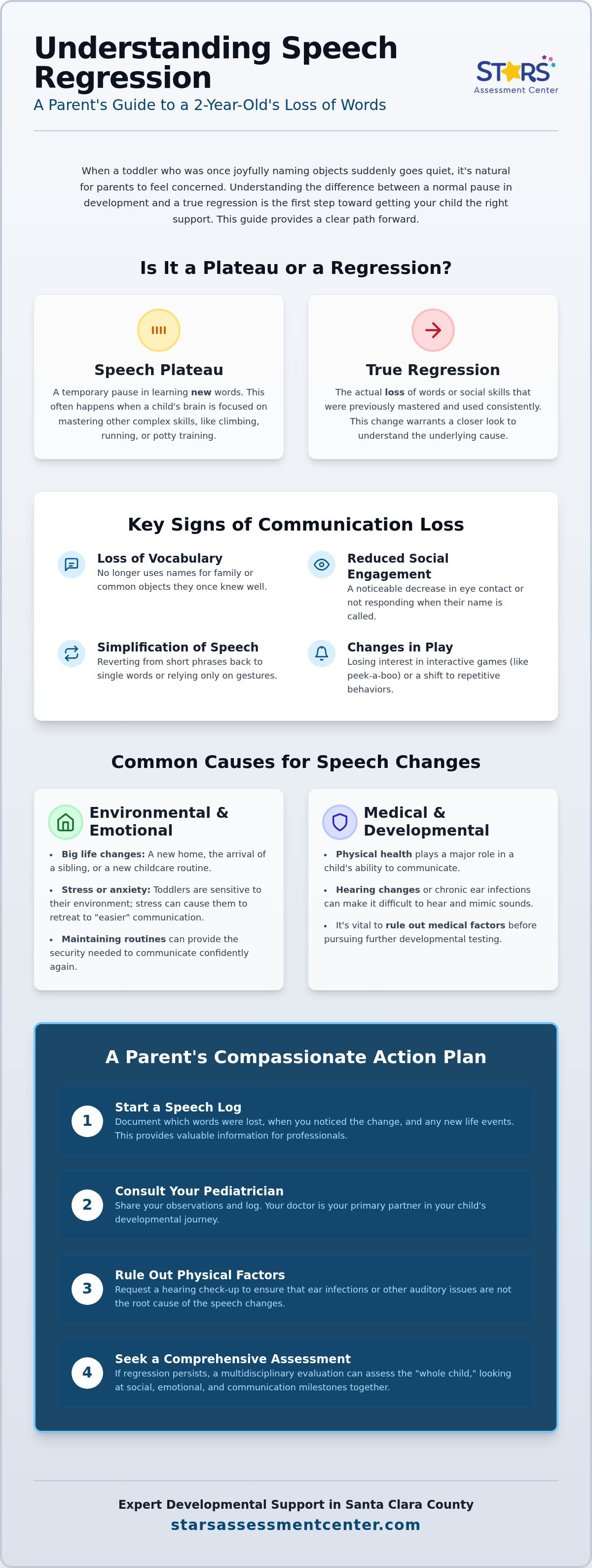
It's vital to distinguish between a "speech plateau" and a true regression. A plateau occurs when a child stops adding new words to their vocabulary for a short period. This often happens because they're busy mastering a different physical skill, like climbing or potty training. Regression, however, is the actual disappearance of words, sounds, or social behaviors that were once consistent. This type of Developmental Regression requires a closer look to understand the underlying cause and ensure your child's needs are met.
Signs of Communication Loss
Identifying regression early allows for more effective intervention. If you're observing a 2 year old speech regression what to do first is look for these specific changes in your child's daily interactions:
- Loss of specific vocabulary: Your child no longer uses names for family members or common objects they previously knew well.
- Reduced social engagement: You might notice a decrease in eye contact or a lack of response when you call their name.
- Simplification of speech: They might transition from using short phrases back to single words or start relying solely on pointing and gestures.
- Changes in play: A loss of interest in interactive games like peek-a-boo or a shift toward repetitive behaviors can sometimes accompany speech changes.
The "Whole Child" Perspective
We believe in looking at more than just the number of words a child speaks. Communication is a thread woven through every part of a child's life. It's intrinsically linked to their social-emotional development and physical milestones. When a child experiences a shift in their ability to talk, it often impacts how they interact with others and how they manage their emotions. Looking at the "whole child" helps us understand if the regression is a temporary response to a life change or something that requires professional attention.
This is why we advocate for a comprehensive approach. An early childhood developmental screening helps us see the full picture of your child's world. By observing social milestones alongside communicative ones, we can determine the best path forward. You don't have to figure this out alone; professional guidance acts as a safe harbor for your family during times of uncertainty.
Common Causes: Why is My Toddler Losing Words?
Understanding why your child has stopped using words is the first step toward finding peace of mind. Often, a "brain growth spurt" in one area of development can cause a temporary dip in another. For instance, if your toddler is suddenly focused on mastering complex motor skills like running or climbing stairs, their language development might briefly pause or shift backward. While this is a common part of the developmental process, it's important to monitor how long these changes last to determine the best path forward.
Environmental and Emotional Triggers
Toddlers are incredibly sensitive to their surroundings. "Big life changes" that feel manageable to adults can be overwhelming for a two-year-old. Common triggers for a temporary speech regression include moving to a new house, the arrival of a new sibling, or a change in their childcare routine. Stress and anxiety can cause a child to retreat into more familiar, "easier" forms of communication while they process these shifts.
To stabilize the home environment, try to maintain consistent routines as much as possible. Predictability helps a child feel safe, which in turn supports their social-emotional growth. If you are worried about a 2 year old speech regression what to do involves looking at these external factors first to see if a little extra reassurance helps them find their voice again. Simple, repetitive activities and focused one-on-one time can often provide the security they need to start communicating more confidently.
Medical and Developmental Factors
Physical health plays a significant role in how children process sound and language. Chronic ear infections or fluid in the middle ear can muffle sound, making it difficult for a child to hear and replicate words correctly. This is why a hearing screening is often the very first recommendation from a professional. You can check your child's progress against the Speech and Language Developmental Milestones provided by the NIDCD to see if their current skills align with typical growth patterns for their age.
In some cases, regression is a sign of a deeper developmental shift. We approach the topic of "regressive autism" with great care and sensitivity, as research indicates this occurs in approximately 20% to 30% of children diagnosed with Autism Spectrum Disorder. When a loss of speech is accompanied by changes in eye contact or social engagement, it may be time to look at an autism screening vs evaluation for toddlers to get a clearer picture of their specific needs. If you're feeling uncertain about these changes, a multidisciplinary developmental assessment can provide the clarity and support your family deserves.
What to Do Right Now: A Parent’s Action Plan
When you observe a 2 year old speech regression what to do first is gather clear, objective information. It's easy to feel overwhelmed by emotion, so grounding yourself in data can help lower your stress. Start by keeping a dedicated "speech log" for one week. Note which specific words have disappeared, any new gestures your child is using, and if you notice changes in their social engagement. This log becomes a vital tool when you speak with professionals, as it provides a concrete history of your child's communication journey.
Your next priority is ruling out physical barriers. Schedule a visit with your pediatrician to discuss a hearing screening. Even minor fluid buildup from past ear infections can muffle sound enough to disrupt language development. If physical issues are cleared, focus on your daily interactions. Increase face-to-face time and "narrate" your day. For families in Santa Clara County, the next logical step is seeking a specialized speech and language evaluation for toddlers. If you notice delays in other areas, like motor skills or social play, a multidisciplinary assessment offers the most comprehensive support.
At-Home Support Strategies
You can create a language-rich environment through simple, low-pressure techniques. Try "self-talk," where you narrate your own actions, like saying, "I am washing the apple. Now I am cutting the apple." Pair this with "parallel talk," where you narrate what your child is doing without demanding a response. Reducing screen time is also beneficial, as it opens up more opportunities for back-and-forth human interaction. Use play-based activities, like rolling a ball or playing with blocks, to keep communication fun and stress-free for both of you.
When to Seek Professional Help
Many parents hear the advice to "wait and see," but when it comes to a 2 year old speech regression what to do is act promptly. Research consistently shows that early intervention before age three is vital for the best developmental outcomes. Waiting can lead to missed opportunities for support during a period of rapid brain growth. Certain red flags require immediate attention, including a sudden loss of social skills, a lack of eye contact, or the emergence of repetitive behaviors. To prepare for your first consultation, bring your speech log and a list of your primary concerns. This proactive approach ensures you are seen as a partner in your child's care, moving you closer to the clarity and hope your family needs.
Speech Regression vs. Developmental Delay
When you're faced with a 2 year old speech regression what to do involves looking beyond the words themselves to see the broader developmental context. A temporary regression is often a short-term response to the environmental stressors we discussed earlier, such as a new home or a change in childcare. In these cases, a child might "pause" their language growth while they regain their emotional footing. A persistent developmental delay, however, typically involves a more consistent struggle to meet milestones across several areas, such as social interaction or cognitive processing.
Understanding the difference is a process of observation and partnership. We often hear from parents who ask the same heavy question: "Is it autism?" We want to address this concern with professional warmth and honesty. While regression is a documented symptom in some children on the spectrum, it's also a common occurrence for many other reasons. A social emotional assessment for toddlers is a vital step because it helps us look at how your child connects with the world, rather than just how many words they speak. Many children who experience a loss of skills go on to thrive and catch up when they receive the right support during these critical early years.
Identifying Social-Emotional Red Flags
Speech doesn't exist on an island. It's deeply connected to a child's desire to share experiences with others. When evaluating a 2 year old speech regression what to do includes watching for changes in "joint attention." This is when a child points to a bird in the sky and looks back at you to make sure you see it too. If a child is losing interest in this type of "people play" or stops responding to their name, these are social-emotional red flags that carry more weight than just a temporary loss of vocabulary. Identifying these signs helps us differentiate between a simple speech plateau and a more complex developmental shift.
The Importance of Multidisciplinary Evaluation
Looking at a child through a single lens often misses the bigger picture. If you only consult a speech specialist, you might get a great plan for language, but you might miss how a child's physical or cognitive skills are impacting their communication. A multidisciplinary team brings together experts from different fields to look at your child as a whole person. This collaborative approach ensures that every aspect of your child's growth is considered, from how they move their bodies to how they process social cues. This comprehensive view leads to a more accurate and effective support plan tailored specifically to your family's needs. If you're ready for a clearer understanding of your child's journey, we invite you to explore a multidisciplinary developmental assessment with our local team.
Expert Developmental Support in Santa Clara County
For families in San Jose, Milpitas, and Gilroy, finding local expertise is the most important part of the journey toward understanding your child's growth. If you're navigating a 2 year old speech regression what to do next shouldn't be a mystery or a source of isolated stress. The Stars Assessment Program serves as a dedicated resource for children from birth to age three, providing a supportive environment where your concerns are heard and validated. We don't just look at milestones in a vacuum; we look at the unique spirit of your child as they interact with the world around them.
Our team understands that communication is deeply connected to social-emotional and physical development. By bringing together specialists from different fields, we provide a comprehensive view that a single specialist might miss. We operate as a "safe harbor" for anxious parents, offering a steady hand and professional warmth. Our long-standing partnership with the San Andreas Regional Center ensures that families in Santa Clara County, including those in Morgan Hill and Salinas, have a clear, streamlined path to the support and early intervention services their children deserve.
Our Multidisciplinary Assessment Process
When you visit our Santa Clara County center, you'll find an environment designed to be gentle and non-intimidating for both you and your toddler. We believe that parents are the true experts on their children, so we involve you as a full partner in the evaluation process. During the visit, our specialists observe your child through play-based interactions to assess their communicative, social-emotional, and cognitive skills. This collaborative approach allows us to create a complete picture of your child's strengths and areas where they might need a little extra help. Following the assessment, we guide you through the results and help you understand the next steps for accessing early intervention.
Taking the Next Step for Your Child
If you're feeling overwhelmed by a 2 year old speech regression what to do is simply take the first step toward professional clarity. You don't need to have all the answers before you reach out to us. Whether you're seeking a social-emotional screening or a full multidisciplinary developmental assessment, we're here to guide you through the referral process. Early intervention is a powerful tool, and acting before age three can make a significant difference in your child's communication journey. You've already shown incredible dedication by seeking out information; now, let us help you find the path forward with confidence and hope. Contact Stars Assessment Program today to schedule a gentle screening for your toddler and gain the clarity your family needs.
Finding Clarity and Support for Your Child's Voice
Watching your toddler lose words they once used with ease is an emotional experience, but it is one you don't have to face alone. We have explored how identifying the difference between a temporary plateau and a clinical regression is the first step toward understanding your child's unique needs. By documenting changes and ruling out physical medical issues, you are already building a foundation for their success. When navigating a 2 year old speech regression what to do is often the most pressing question for a parent, and the answer lies in proactive, compassionate partnership.
Our specialized multidisciplinary team is dedicated to serving families in San Jose, Santa Clara, and across the South Bay. We focus exclusively on children under age three, providing expertise in social-emotional and communication screenings to ensure no part of your child's development is overlooked. If you're ready to move from uncertainty to a clear action plan, we're here to help. Please Contact Stars Assessment Program for a Compassionate Evaluation. Your child's communication journey is just beginning, and with the right support, they can find their voice once again.
Frequently Asked Questions
Is speech regression at 2 years old always a sign of autism?
No, speech regression isn't always a sign of autism. While it's a documented symptom for some children on the spectrum, many toddlers experience a loss of words due to environmental changes or medical factors like ear infections. If you're wondering about a 2 year old speech regression what to do, the first step is a professional screening. This helps differentiate between a temporary response to stress and a developmental shift that needs specialized support.
How long does a typical toddler speech regression last?
The duration of a regression depends entirely on the underlying cause. If the trigger is a temporary life change, like a family move, you might see improvements within a few weeks. However, if the regression is linked to a developmental delay or medical issue, it won't resolve without intervention. We generally recommend seeking a professional opinion if the loss of skills persists for more than two weeks to ensure your child stays on track.
Can a new baby in the house cause my 2-year-old to stop talking?
Yes, the arrival of a new sibling is a significant emotional event that can trigger a temporary loss of language. Toddlers often use regression as a way to process their changing role in the family or to seek the same level of attention the infant receives. While this is often a passing phase, it's essential to provide extra reassurance and monitor their progress to ensure they eventually return to their previous communicative milestones.
What is the difference between a speech delay and a speech regression?
A speech delay occurs when a child is meeting milestones later than expected but is still making steady progress forward. In contrast, speech regression is the actual loss of communicative skills that were once mastered and used consistently. While many two-year-olds may experience a delay, a regression is a more specific signal that requires a multidisciplinary look to understand why those mastered skills have suddenly disappeared from your child's repertoire.
Do I need a doctor’s referral for a speech evaluation in Santa Clara County?
You don't always need a formal referral to start the process in Santa Clara County, but it's a helpful starting point. Starting with your pediatrician in San Jose or Gilroy helps rule out physical issues like hearing loss first. From there, you can contact programs like ours directly or work through the San Andreas Regional Center to access a comprehensive multidisciplinary developmental assessment to determine if your child is eligible for early intervention.
What happens during a multidisciplinary developmental assessment?
During this assessment, a team of specialists evaluates your child's cognitive, communicative, and social-emotional skills through play-based observation. We look at the "whole child" rather than just their speech. At our center, we treat parents as vital partners in this process. This collaborative approach helps us identify specific delays and creates a clear, supportive path forward for your family, ensuring you have the resources needed to support your child's unique growth journey.
Will my child "grow out of" a speech regression on their own?
While some toddlers regain their skills as they adjust to life changes, "waiting it out" can be a missed opportunity. Early intervention is most effective before age three because of the brain's high plasticity during these years. If your child is experiencing a 2 year old speech regression what to do is act early. Professional guidance provides a safe harbor and ensures your child receives the right help if the regression isn't just a temporary phase.
How can I encourage my toddler to start using their words again at home?
Create a low-pressure environment by narrating your daily activities and using "parallel talk" to describe what your child is doing. Avoid "testing" them by asking them to repeat words, which can increase their anxiety. Instead, focus on face-to-face play and interactive games. When considering a 2 year old speech regression what to do at home, reducing screen time also helps by increasing the number of natural, back-and-forth communication opportunities between you and your toddler.


