
Imagine you are at a local park in San Jose, watching other toddlers point at a passing airplane or wave a happy goodbye to a new friend. When your 2 year old doesn't point or wave, those quiet moments can quickly fill with a heavy sense of worry. You might find yourself caught between the conflicting advice of friends and your own intuition, wondering if your child is just a late bloomer or if there is something more you should be doing. It's exhausting to carry that uncertainty alone, and it is completely normal to feel overwhelmed by the "what ifs" of your child's development.
We understand that you want the best for your little one, and seeking clarity is a proactive, positive choice for your family. This guide is designed to help you understand the significance of these social-communication milestones and provide the gentle reassurance you need. We will clarify the difference between reaching for an object and pointing to share interest, explain what current 2026 health guidelines suggest for developmental screenings, and show you how to take supportive next steps right here in Santa Clara County.
Key Takeaways
- Understand why pointing and waving are more than just gestures; they are essential building blocks for joint attention and social connection.
- Discover why it's important to seek a professional evaluation if your 2 year old doesn't point or wave, and learn how to distinguish between a simple delay and a broader developmental concern.
- Learn about the various factors that can impact non-verbal communication, including hearing issues, speech delays, or social-emotional gaps.
- Get a clear, manageable plan of action, including how to document your child's daily interactions to share with your pediatrician.
- Find out how families in San Jose and Santa Clara County can access multidisciplinary assessments to gain clarity and support for children under age three.
Understanding Why Pointing and Waving Matter at Age 2
You know your child better than anyone else. If you've noticed that your 2 year old doesn't point or wave, your observation is a powerful act of care. These gestures are more than just cute tricks. They are the primary way a toddler tells the world what they're thinking before they have the words to say it. When these milestones are missing, it's natural to feel a sense of uncertainty, but understanding the "why" behind these movements can help replace that anxiety with clarity.
The Power of Joint Attention
When a child points at a dog in the park, they aren't just identifying an animal. They are inviting you into their world. This is what specialists call "joint attention." It occurs when two people share an interest in the same object or event. Joint attention is the social glue of early development.
There is a subtle but important difference between pointing to get something and pointing to show something:
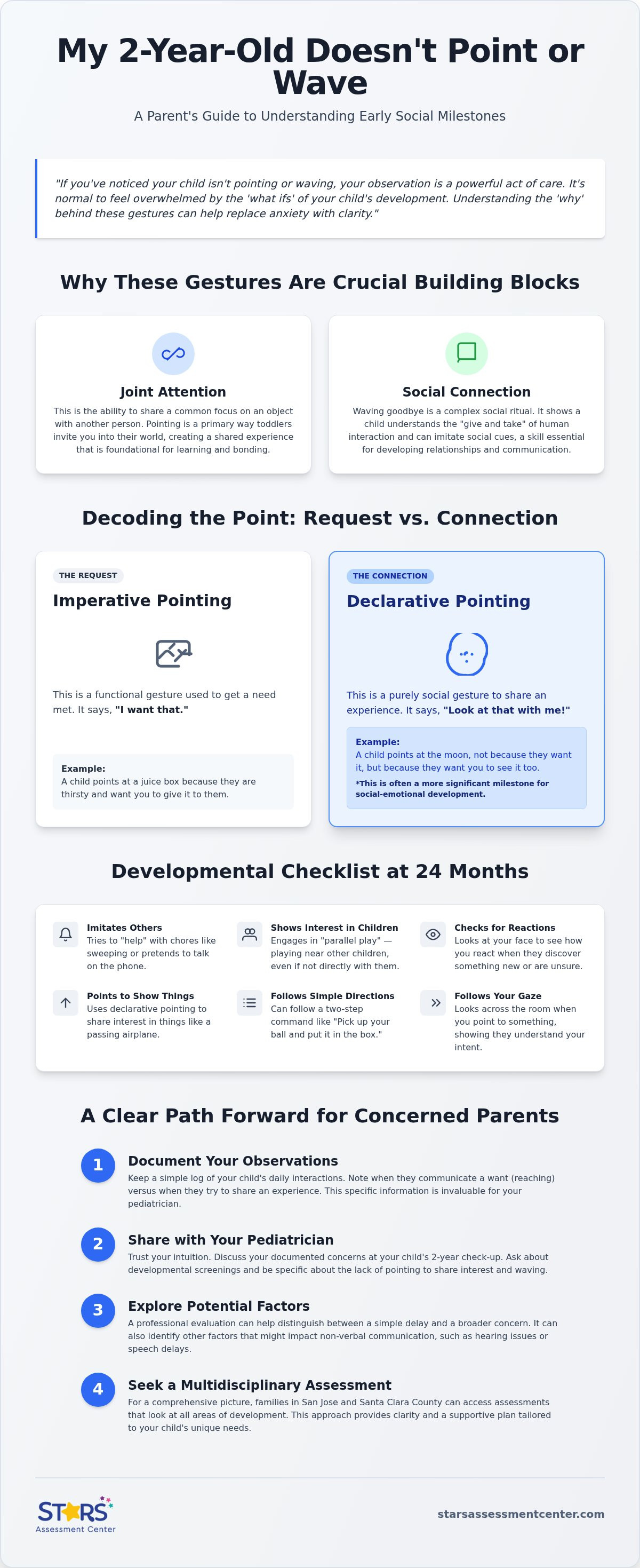
- Imperative Pointing: This is a request. Your child points at a juice box because they're thirsty and want you to give it to them.
- Declarative Pointing: This is purely social. Your child points at the moon just so you'll look at it too. This shows a desire to share an experience.
If your 2 year old doesn't point or wave to share these moments, it might mean they're struggling to build that bridge of shared experience. Declarative pointing is often the more significant milestone because it focuses on connection rather than just meeting a physical need.
Non-Verbal Communication vs. Verbal Skills
Many parents worry about word counts, but gestures are often a better predictor of future speech. Research into gestures in language acquisition shows that children typically use physical cues to bridge the gap while their verbal skills catch up. A wave goodbye is a complex social ritual. It shows that your child understands the "give and take" of human interaction and recognizes the beginning and end of a social encounter.
These milestones are deeply connected to imitation. When a child waves, they're copying a behavior they've seen you do. This ability to mirror others is the foundation for learning almost every social and linguistic skill they'll need later in life. By focusing on these non-verbal cues, you're looking at the very roots of how your child connects with the people around them. Noticing these missing cues is the first step in providing the gentle support your child may need to thrive.
Developmental Milestones: What Should a 24-Month-Old Be Doing?
At twenty-four months, your child is transitioning from a baby into a little person with a growing sense of independence. While it's true that every child follows a unique developmental path, pediatricians look for specific patterns of growth to ensure everything is on track. The 2-year-old milestones established by the CDC provide a helpful framework for understanding these changes. If you notice that your 2 year old doesn't point or wave, it is helpful to look at these actions as part of a larger set of social-emotional skills.
Most children begin using declarative pointing (pointing to show you something) between 12 and 15 months. By age two, this skill is usually well-established. A toddler should also be able to follow your finger when you point at something across the room, such as a bird in a tree or a toy on a high shelf. This "gaze following" shows they understand that you are trying to share information with them.
Social and Emotional Landmarks at Age Two
Beyond specific gestures, a 24-month-old typically shows growth in how they interact with the world and the people in it. You might see your child doing the following:
- Imitating adult actions: They might try to "help" you sweep the floor or pretend to talk on a phone.
- Parallel play: They show interest in other children and like to play near them, even if they don't yet play "with" them directly.
- Seeking connection: They look at your face to see your reaction when they are unsure or when they have discovered something exciting.
- Following simple instructions: They can usually follow two-step directions, like "pick up the toy and put it in the box."
When Reaching Isn’t the Same as Pointing
A common point of confusion for parents is the difference between reaching and pointing. Reaching is functional; it's a way for a child to say, "I want that." Pointing, however, is social. It's a way to say, "Look at that!" If your 2 year old doesn't point or wave, they might rely on "hand-leading" instead. This happens when a child takes your hand and physically moves it toward an object they want rather than pointing to it from a distance.
You can test for "protodeclarative" pointing at home by using a favorite toy. Hold the toy up, but out of reach, and wait. Instead of just reaching with an open hand or whining, does your child extend a single finger to show you the toy? If these social-emotional patterns feel missing or delayed, a multidisciplinary developmental assessment can help determine if your child needs extra support to bridge these gaps.
Addressing the Concern: Is It Autism or a Developmental Delay?
When you notice that your 2 year old doesn't point or wave, it's very common for your mind to jump toward a specific diagnosis. You might have spent late nights searching for answers, only to find alarmist articles that make you feel more anxious than when you started. We want to offer a different perspective. While missing these gestures can be a sign of Autism Spectrum Disorder (ASD), it is not the only explanation. Delays in pointing and waving can also stem from speech and language delays, hearing issues, or gaps in social-emotional development. Our goal is to partner with you to find the specific root cause so your child can receive the right kind of support.
Red Flags vs. Individual Variations
Developmental specialists look at the "whole child" rather than a single missing skill. If your child isn't pointing, we also look for other concurrent signs. For example, does your child make consistent eye contact? Do they respond when you call their name? A child who has an isolated delay in gesturing but is otherwise socially engaged may simply need help with communicative milestones. However, if multiple social-communication cues are missing, it may indicate a need for a deeper look. Understanding the difference between an Autism Screening vs. Evaluation for Toddlers is a helpful first step in navigating this process without feeling overwhelmed.
The Value of Early Screening
The American Academy of Pediatrics (AAP) recommends that all children receive specific autism screenings at their 18-month and 24-month well-child visits. These screenings are not meant to label your child; they are tools for empowerment. Between birth and age three, a child's brain has an incredible amount of plasticity. This means that early intervention can have a profound impact on their long-term growth and social success.
A "wait and see" approach can sometimes feel like the easier path, but being proactive ensures you don't miss the window for the most effective support. Screening provides a starting point for a conversation with professionals who can guide you on what to do if you are concerned about your child's progress. Remember, seeking an assessment is a positive choice that prioritizes your child's unique needs. It is about getting the clarity you deserve so you can move forward with confidence and hope. If your 2 year old doesn't point or wave, you don't have to wonder why in silence. We are here to help you understand the "why" and determine the best path forward for your family.
Steps to Take If You Are Concerned About Your Child’s Growth
When your 2 year old doesn't point or wave, taking the first step toward an answer is often the hardest part. You don't have to do it all at once. Start by spending a week simply observing and documenting your child’s daily routines. Write down specific moments where they use gestures and, more importantly, moments where they use other ways to communicate, like pulling you by the hand. This log provides a clear picture for your pediatrician and helps move past the "wait and see" phase with concrete data.
Monitoring Social Interaction at Home
You can try a few gentle "tests" at home to better understand your child’s social engagement. One effective method is the Bubbles Test. Blow some bubbles and watch your child’s reaction. A child with developing social communication will often point to the bubbles to make sure you see them, or look back at your face to share a smile. Notice if they bring objects to you just to show you, rather than just when they need help. These small interactions give us clues about their desire to share experiences with you.
In addition to home observations, it is vital to rule out physical barriers. Schedule a hearing test with an audiologist to ensure that auditory processing isn't the root of the delay. If hearing is normal, the next step is a comprehensive consultation with a developmental specialist who can look at the big picture.
Navigating Services in Santa Clara County
Families living in San Jose, Santa Clara, and surrounding areas have access to dedicated local resources. The San Andreas Regional Center is a key resource for early intervention, but navigating the system can feel complex. Learning more about a toddler developmental evaluation can help you understand what to expect during your first appointment. When you meet with a multidisciplinary team, you aren't just getting a checklist; you are entering a partnership designed to support your child’s unique path.
Preparing for your first appointment involves bringing your observation notes and being open about your concerns. This is a collaborative process where your expertise as a parent meets our clinical experience. If you are ready to gain professional clarity, scheduling a multidisciplinary developmental assessment is a proactive way to ensure your child receives the specific support they need.
How Stars Assessment Program Supports Local Families
If you've been searching for answers because your 2 year old doesn't point or wave, you've already taken the most important step toward supporting their growth. At Stars Assessment Program, we believe that no parent should have to navigate developmental uncertainty alone. We specialize in multidisciplinary evaluations for children from birth to age three, serving families throughout Santa Clara County with a deep sense of empathy and professional warmth. Our center is designed to be a safe harbor where your concerns are heard and your child’s unique potential is always the priority.
Our Multidisciplinary Evaluation Process
We don't look at milestones in isolation. Instead, we evaluate the "whole child" by bringing together a team of specialists in speech and language, social-emotional growth, and cognitive development. During a typical session at our center, you can expect a gentle, play-based environment where your child feels comfortable being themselves. This collaborative approach allows us to see how different areas of growth overlap and influence one another. We move beyond simple checklists to create a clear, actionable roadmap tailored to your child’s specific needs. Our goal is to ensure you leave with a sense of order and a predictable path toward progress.
Accessing Care in San Jose and Beyond
Our commitment to local families extends across the entire region. We are proud to support communities in San Jose, Santa Clara, Milpitas, Gilroy, Morgan Hill, and Salinas. Navigating the requirements for early intervention resources can be confusing, but we are here to help you determine eligibility and understand the next steps for your family. We see ourselves as your partner in this journey, providing the expertise and local connection needed to advocate for your child’s success. If you are ready for a clearer understanding of your child’s development, schedule a consultation with our compassionate team today.
Moving Forward With Confidence and Clarity
Noticing that your 2 year old doesn't point or wave is a significant moment in your parenting journey. It is the start of a proactive search for answers. We have explored how these gestures are the foundation of social connection and why seeking a multidisciplinary perspective can provide the reassurance you need. Whether the cause is a simple delay or a need for more specialized support, early intervention remains the most powerful tool for your child's future.
Since 1988, our expert team has specialized in children ages birth to three, offering a compassionate, family-centered approach to developmental clarity. We serve families throughout San Jose and Santa Clara County, providing a steady hand through every step of the evaluation process. You don't have to carry the weight of uncertainty alone. We are ready to help you find the right path forward.
Request a Developmental Screening for Your Child to begin this partnership today. Your child's growth is a journey, and we are here to ensure you navigate it with hope and professional expertise.
Frequently Asked Questions
Is it normal for a 2-year-old to reach for things instead of pointing?
While reaching is a functional way for a toddler to communicate a need, it is not the same as pointing to share interest. By age two, children should be using their index finger to "show" you things, not just "get" them. If your 2 year old doesn't point or wave but only reaches, it may suggest a delay in social-communication skills that warrants a closer look from a developmental specialist.
At what exact age should a child start waving goodbye?
Most children begin to wave goodbye between 9 and 12 months of age. By 24 months, this gesture should be a consistent and meaningful part of their social toolkit. Waving is a form of social imitation that shows a child understands the beginning and end of a human interaction. If this milestone is missing by age two, it is a good idea to discuss it with a professional team.
Can a child have a speech delay without having autism?
Yes, many children experience speech and language delays without being on the autism spectrum. Delays can be caused by various factors, including hearing issues, chronic ear infections, or late-blooming expressive language skills. A multidisciplinary developmental assessment can help distinguish between an isolated speech delay and a broader social-communication challenge, providing much-needed clarity for families in San Jose and the surrounding Santa Clara County area.
What should I do if my pediatrician says to "just wait" but I am still worried?
You are the expert on your child, and your intuition is a valid reason to seek a second opinion. If a "wait and see" approach doesn't feel right, you can contact a specialized assessment center directly. In California, parents have the right to request an evaluation through early intervention services or private multidisciplinary teams to ensure their child doesn't miss the critical window for early, proactive support.
How long does a developmental assessment typically take for a toddler?
A comprehensive evaluation usually takes between two to four hours, though this can vary based on your child's specific needs. Because we focus exclusively on children under age three, we structure these sessions to be play-based and low-stress. Our multidisciplinary team observes your child’s social-emotional, cognitive, and physical skills in a supportive environment, ensuring we gather a complete picture while keeping your little one comfortable and engaged throughout the process.
Does insurance cover multidisciplinary developmental evaluations in California?
Many private insurance plans in California do cover developmental evaluations, though coverage levels depend on your specific policy. Additionally, children under age three may be eligible for state-funded assessments through regional centers like the San Andreas Regional Center. We recommend checking with your provider to see if they cover "speech and language evaluations" or "multidisciplinary assessments" for suspected developmental delays in toddlers to help manage any potential costs.
What is the difference between a screening and a full diagnostic evaluation?
A screening is a quick "check-up" tool used to see if a child might be at risk for a delay. A full diagnostic evaluation is a much more in-depth process. It involves a team of specialists who use standardized tools to determine a specific diagnosis or eligibility for services. If your 2 year old doesn't point or wave, a screening might be the first step, while an evaluation provides the final roadmap for support.
How can I encourage my toddler to start pointing at home?
You can encourage pointing by modeling the behavior frequently during daily play. Point to pictures in books or interesting objects outside, like a passing airplane or a neighborhood dog. You can also place a favorite toy just out of reach and wait for your child to gesture toward it. Using bubbles or light-up toys can create natural opportunities for "joint attention," where your child feels motivated to share their excitement with you.


