
Last Tuesday, Sarah sat in her San Jose living room watching her two-year-old pull away from a playdate, feeling that familiar knot of worry that her child’s emotional world was a puzzle she couldn’t quite solve. Like many parents, she worried that seeking a social emotional assessment Santa Clara County might lead to a permanent label or a mountain of clinical paperwork. It’s exhausting to balance the fear of the unknown with the deep desire to give your toddler every possible advantage during these critical early years. You aren't alone in feeling this way, and your intuition as a parent is your greatest strength.
This guide will show you how a professional assessment provides a clear roadmap for early intervention, helping you move from confusion to a place of confident action. We'll break down the differences between San Andreas Regional Center (SARC) and private evaluations while explaining how to access specialized support in your community. You'll discover how understanding your child’s unique development unlocks the services they need to thrive. We are here to help you find the clarity your family deserves, ensuring you feel supported every step of the way.
Key Takeaways
- Understand why the "birth to three" developmental window is the most critical time for your child's brain growth and future emotional health.
- Learn how a multidisciplinary social emotional assessment Santa Clara County provides a complete picture of your toddler's world by involving a team of specialists.
- Discover the difference between a routine screening and a comprehensive evaluation so you can choose the right path for your family’s needs.
- Identify common social-emotional red flags, such as persistent difficulty with transitions or limited interest in peer interaction, that may signal a need for extra support.
- Gain a clear roadmap for navigating local resources and finding a "safe harbor" through specialized assessment programs designed for infants and toddlers.
What is a Social-Emotional Assessment for Toddlers?
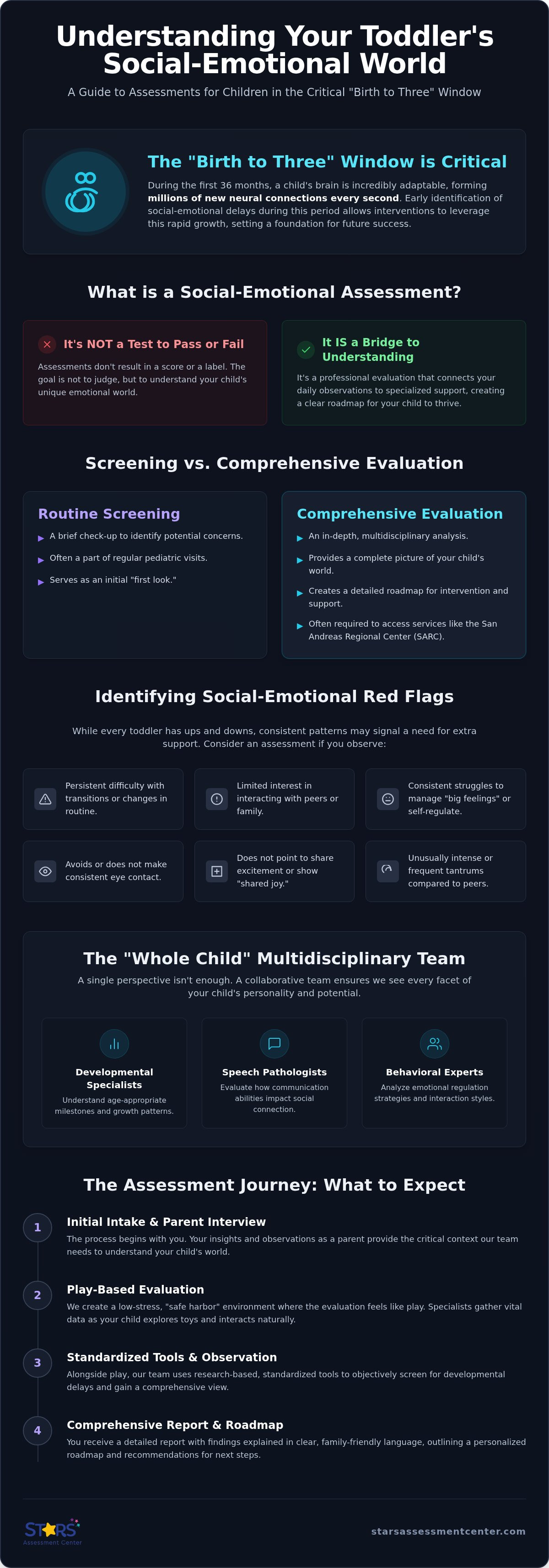
A social emotional assessment Santa Clara County is not a test for your child to pass or fail. Instead, it's a professional evaluation that looks at how your toddler expresses their feelings and builds connections with those around them. Think of it as a bridge between your daily observations at home and the specialized support your child might need to thrive. This process helps us understand your child's unique personality while identifying areas where they might need a little extra guidance.
The "Birth to Three" window is the most vital time for brain development. During these first 36 months, a child's brain is incredibly adaptable, forming millions of new neural connections every single second. When we identify a social-emotional delay during this period, we can provide interventions that take advantage of this rapid growth. It's much easier to support a child's development as it's happening than to try and correct deep-seated patterns later in childhood.
Many parents wonder if their child's behavior is just a typical "terrible twos" phase. While every toddler has tantrums, there is a difference between a child who is frustrated because they can't have a cookie and a child who consistently struggles to regulate their emotions or connect with others. An assessment provides a baseline that determines if your child is eligible for early intervention services in California, moving you away from the "wait and see" approach and toward a clear plan of action.
The Role of Social-Emotional Milestones
Social-emotional development involves learning how to manage "big feelings," a skill known as self-regulation. We look for specific milestones that show how your child is engaging with their world. This includes things like making consistent eye contact, pointing to share something exciting with you, and showing "shared joy" during play. These early milestones are the foundation for future academic and social success, helping children feel confident as they eventually enter a classroom setting.
Why Early Identification Matters in Santa Clara County
In our local community, a professional assessment is often the first step toward accessing services through the San Andreas Regional Center (SARC). Getting an early social emotional assessment Santa Clara County reduces long-term stress for your family by giving you answers and a roadmap. Social-emotional health is the bedrock of all learning. By identifying needs early, we can help you turn your home into a safe harbor where your child feels understood and supported.
The Multidisciplinary Assessment Process: What to Expect
Understanding your child's growth requires more than a single set of eyes. We embrace a "Whole Child" philosophy because a toddler's emotional, physical, and communicative development are deeply intertwined. When you schedule a social emotional assessment Santa Clara County, you aren't just meeting one doctor. You're partnering with a multidisciplinary team that includes:
- Developmental specialists who understand age-appropriate milestones and growth patterns.
- Speech pathologists who evaluate how communication impacts social connection.
- Behavioral experts who analyze emotional regulation and interaction styles.
This collaborative approach ensures that we see every facet of your child's personality and potential. The evaluation itself is designed to be a "safe harbor" for both you and your child. We know that a clinical, cold room can be intimidating for a two-year-old. That's why we create a low-stress environment where the evaluation feels like play. While your child is busy exploring toys or interacting with our team, our specialists are gathering vital data. The process of a social emotional assessment Santa Clara County moves from an initial intake to the evaluation session, concluding with a comprehensive report that explains our findings in clear, family-friendly language.
Step-by-Step Through the Evaluation Day
The day begins with careful observation. We watch how your child interacts with family members and new toys in a natural setting. We also use research-based standardized tools to screen for developmental delays. Your role is central to this process. During the parent interview, you provide the context only a primary caregiver can. This partnership is a key part of California's Early Start program, which relies on parental input to build an effective support plan for your family.
Specialized Screenings for Autism and Down Syndrome
Our assessments often involve specialized components. For example, a social-emotional evaluation frequently overlaps with early autism screening under three. We look for specific markers, such as social reciprocity and communication patterns. Similarly, we identify developmental markers for children with Down syndrome to ensure they receive appropriate support early on. These screenings are not medical diagnoses; they are tools to identify needs and open doors to services. If you have concerns about your child's milestones, you can learn more about our multidisciplinary team and how we support local families.
Screening vs. Comprehensive Evaluation: Choosing the Right Path
Many parents start their journey with a developmental screening during a routine wellness visit. It's often a quick snapshot, much like a check-engine light, designed to see if your child is on track or if something needs a closer look. However, a screening is only the first step and doesn't provide the full story. When concerns persist, a social emotional assessment Santa Clara County offers a deeper, more comprehensive evaluation. This in-depth look examines cognitive, physical, and communication skills to provide a complete picture of your toddler’s development, ensuring we don't miss the subtle details of their personality and growth.
While a screening identifies a possible risk, a comprehensive evaluation determines specific eligibility for California’s early intervention programs. These assessments are essential because they provide the clinical evidence needed to unlock state-funded support. By looking beyond a single symptom, we can see how your child’s emotional regulation impacts their ability to learn and interact with others. When you choose a social emotional assessment Santa Clara County, you are moving from a place of uncertainty toward a clear, actionable plan for your child's future.
When a Screening Isn’t Enough
Sometimes, parent-completed questionnaires like the Ages and Stages Questionnaire (ASQ) produce "borderline" results. These scores can leave families feeling stuck in a state of limbo. In these cases, expert clinical judgment becomes vital. A screening might tell you what is happening, but it often lacks the nuance to explain why it's happening. A comprehensive evaluation uses standardized tools and direct observation to bridge that gap. This process ensures that "borderline" results are explored thoroughly, giving you the answers you need to support your child's unique emotional world.
Navigating San Andreas Regional Center (SARC) Referrals
Finding your way through the local service system can feel overwhelming, but a professional assessment acts as your roadmap. Our evaluations help families prepare for critical eligibility meetings with the San Andreas Regional Center. In Santa Clara County, the Early Start program is the primary resource for infants and toddlers with developmental needs. Understanding the role of the SARC is essential, as they are responsible for coordinating and funding local services that help your child reach their full potential.
Identifying Social-Emotional Red Flags in Your Toddler
It's natural to wonder if your child's behavior is just a phase or something more. While every child grows at their own pace, certain behaviors can serve as early indicators that a professional social emotional assessment Santa Clara County could be beneficial. Recognizing these red flags isn't about finding fault; it's about finding the right tools to help your child flourish. Early identification allows us to build a bridge between where your child is now and where they can be with the right support.
We typically look for several key indicators during an evaluation. Difficulty with transitions is common, but we watch for excessive, prolonged distress when moving between simple daily activities. A limited interest in peers, such as consistently preferring to play alone or avoiding eye contact during social interactions, might suggest a need for extra support. Communication challenges often lead to intense frustration; if a toddler can't express their needs, they might resort to behavioral outbursts. Atypical play patterns, like repetitive motions or using toys in unusual ways instead of imaginative play, are also important markers. Finally, extreme sensory sensitivities, such as an overreaction to common noises, lights, or textures, can significantly impact a child's emotional state. These signs are often the brain's way of asking for a different kind of engagement.
Behavioral Patterns to Monitor in San Jose Families
Distinguishing between the "terrible twos" and persistent emotional dysregulation is a common challenge for parents in San Jose and surrounding areas. It's helpful to remember that speech and language delays can often mask as social-emotional issues. When a child struggles to be understood, their frustration can look like a behavioral problem. Additionally, the impact of social isolation or a lack of access to regular playgroups can sometimes slow a child’s social development. A social emotional assessment Santa Clara County helps tease these factors apart to find the root cause of the behavior.
The Importance of Parental Instinct
The old "wait and see" advice is often outdated for modern parents who have access to early intervention resources. You are the expert on your child. If your gut tells you something is "off," empower yourself to seek a second opinion. Start documenting your observations at home; note the time of day, the trigger, and your child's reaction. This data is incredibly helpful for your developmental specialist during an intake. If you're ready to move toward clarity, you can schedule a multidisciplinary evaluation to get the answers your family needs.
The Stars Assessment Program: Your Safe Harbor in Santa Clara County
The Stars Assessment Program serves as a steady ally for families throughout our community. We understand that the time between noticing a first concern and receiving a comprehensive report can feel like an eternity. Our team is dedicated to bridging that gap by providing a clear, supportive path forward. We offer a commitment to family-centered care that reaches from San Jose to Milpitas and beyond. As part of the Stars Behavioral Health Group, which was founded in 1988, we bring decades of experience in social services and behavioral health to every evaluation. We don't just provide a medical service; we offer a partnership rooted in professional warmth and clinical expertise.
Choosing to move forward with a social emotional assessment Santa Clara County is a brave step toward your child's success. We make the process as seamless as possible. To begin, you can contact our intake coordinator to discuss your concerns and schedule a visit. We typically ask parents to bring previous medical records, any screening results from your pediatrician, and a list of your child’s current milestones. Our goal is to ensure you feel heard and validated from the very first phone call. This proactive approach helps lower stress levels for both you and your toddler, creating a predictable path toward the services your family deserves.
A Family-Centered Evaluation Experience
We prioritize cultural sensitivity and personal connection in every interaction. Santa Clara County is a diverse community, and we believe every family deserves an evaluation that respects their unique background and values. After the assessment, we don't just hand you a report and say goodbye. We provide post-assessment support to help you understand the findings and determine the next steps for intervention. This includes connecting you to specialized resources like Down syndrome early intervention if your child requires that specific developmental path. We want you to leave our center feeling empowered, not overwhelmed.
Local Resources and Support Networks
Our work doesn't happen in a vacuum. We actively partner with First 5 Santa Clara and local Family Resource Centers to ensure a holistic support network for our clients. Whether you live in Gilroy, Morgan Hill, or Santa Cruz, our services are designed to be accessible and community-oriented. You are the best advocate for your child’s future. By seeking a social emotional assessment Santa Clara County, you are laying the groundwork for a lifetime of healthy emotional development. We are here to be your guide and your safe harbor during this journey.
Building a Brighter Future for Your Toddler
Identifying your child's needs early isn't about labels; it's about providing the right support during the most flexible stage of brain development. By choosing a social emotional assessment Santa Clara County, you move past the "wait and see" phase and gain access to vital resources through programs like Early Start and SARC. You've learned that a multidisciplinary team offers the most complete view of your child's world, ensuring no detail is overlooked and every strength is celebrated.
Since 1988, our team of specialists has provided an empathic, family-centered approach to help local families find clarity. We are here to act as your safe harbor, guiding you from initial concerns to long-term success. You don't have to navigate this journey alone, and you shouldn't have to struggle with clinical jargon when you just want answers for your child.
Schedule a Compassionate Assessment for Your Child Today and take the first step toward understanding your child's unique path. You are your child's best advocate, and we're here to support you every step of the way.
Frequently Asked Questions
How do I know if my child needs a social-emotional assessment?
You might consider an evaluation if your toddler shows persistent difficulty with transitions, limited interest in playing with others, or significant frustration when trying to communicate. These behaviors are often the brain's way of signaling a need for extra support. A professional assessment helps determine if these are typical developmental phases or indicators of a delay that requires early intervention during the critical birth to three window.
Does a social-emotional assessment mean my child has Autism?
Not necessarily. While an evaluation can identify markers for Autism or Down syndrome, its primary goal is to understand your child's unique emotional and social growth. We look at the "whole child" to see how they regulate feelings and build relationships. This process provides clarity and helps us create a tailored support plan that addresses your child's specific strengths and developmental needs.
What is the difference between SARC and a private assessment center?
The San Andreas Regional Center (SARC) is a state-funded agency that coordinates services for individuals with developmental disabilities. A private assessment program provides an independent, multidisciplinary evaluation by a team of specialists. Many families choose a private social emotional assessment Santa Clara County to gain a detailed understanding of their child's needs before meeting with SARC, which can help streamline the process for determining eligibility for state-funded services.
How much does a social-emotional assessment cost in Santa Clara County?
Costs for private developmental evaluations in the Bay Area vary based on the depth of the assessment and the specialists involved. Many families find that their insurance provider offers reimbursement for these services, and we can provide the documentation needed to submit those claims. Additionally, children who are eligible for California's Early Start program may receive assessments at no cost. We recommend checking with your specific provider to understand your coverage options.
How long does the evaluation process take from start to finish?
The timeline typically begins with an initial intake conversation to discuss your concerns. This is followed by the evaluation day, where our team observes your child through play-based interactions. After the evaluation, we compile a comprehensive report that explains the findings in clear, family-friendly language. This entire process, from your first phone call to receiving the final roadmap for support, usually takes a few weeks to complete.
Can I stay in the room with my toddler during the assessment?
We encourage parents to be present during the evaluation. You are the primary expert on your child's history and behavior, and your presence helps your toddler feel safe and comfortable. Our team creates a "safe harbor" environment where the assessment feels like play. Seeing how your child interacts with you provides our specialists with vital information that a clinical observation alone might miss.
What happens if the assessment shows a developmental delay?
If an evaluation identifies a delay, it serves as a gateway to vital support services. We provide you with a clear roadmap and connect you with local resources in San Jose, Milpitas, or Morgan Hill. This might include speech and language evaluations or specialized screenings for specific conditions. Our goal is to move your family from a place of uncertainty to a place of action, ensuring your child receives the intervention they need.
Do I need a referral from my pediatrician to visit the Stars Assessment Program?
You don't always need a formal referral from a doctor to begin the process. Parents can often self-refer if they have concerns about their child's milestones. A private social emotional assessment Santa Clara County is a direct resource for families looking for clarity. Reaching out early ensures that your child can access the multidisciplinary support they need without unnecessary delays in their care, helping them reach their full potential.


