
What if those quiet playtimes aren't just a sign of a "late bloomer," but a signal that your toddler is waiting for a different way to connect? It's natural to feel a heavy sense of worry when your child isn't meeting communication milestones as quickly as their peers at the park. You might find yourself caught between the advice of well-meaning relatives to "just wait" and your own gut feeling that something needs attention. Seeking a multidisciplinary developmental assessment for speech delay isn't about finding a label. It's about opening a door to understanding your child's unique growth pattern and ensuring they have the tools to thrive.
We understand how overwhelming the California early intervention system can feel, especially when you're already balancing the joys and challenges of raising a child under three. This guide provides the clarity you've been looking for. You'll discover how a comprehensive evaluation offers the support your child needs to find their voice while easing your own uncertainty. We will walk through the specific steps for families in San Jose and Santa Clara County, explaining the difference between speech and language and showing you how to access the local experts who serve as your steady allies in this journey.
Key Takeaways
- Learn to distinguish between typical "late blooming" and communication milestones that suggest your child would benefit from professional guidance.
- Understand how a multidisciplinary developmental assessment for speech delay evaluates communication, cognitive, and physical growth as a connected whole.
- Discover the gentle, play-based methods used during evaluations to ensure your toddler feels safe and comfortable while showing their natural skills.
- Gain a clear roadmap for navigating the Early Start program and San Andreas Regional Center (SARC) resources available to families in Santa Clara County.
- See how specialized screenings for Autism and Down syndrome provide the specific clarity needed to create a tailored support plan for your child’s future.
Recognizing the Signs: When to Seek a Developmental Assessment for Speech Delay
Watching your child grow is a journey filled with wonder, but it's also common to feel a quiet sense of concern when milestones don't arrive as expected. You might hear friends or family members use the term "late bloomer" to describe your toddler's quietness. While every child develops at their own pace, there's a significant difference between a brief plateau and a persistent developmental delay. A multidisciplinary developmental assessment for speech delay helps distinguish between these two paths, giving you the clarity needed to support your child's unique way of communicating.
The first three years of life represent a critical window of neuroplasticity. During this "Birth to Three" period, a child's brain is incredibly adaptable, forming connections at a rapid rate. Addressing communication gaps during this time allows us to work with your child's natural growth patterns. By looking at the whole child, we can see if a delay in talking is isolated or if it's part of a broader pattern involving social-emotional or cognitive growth. Common milestones for infants and toddlers include:
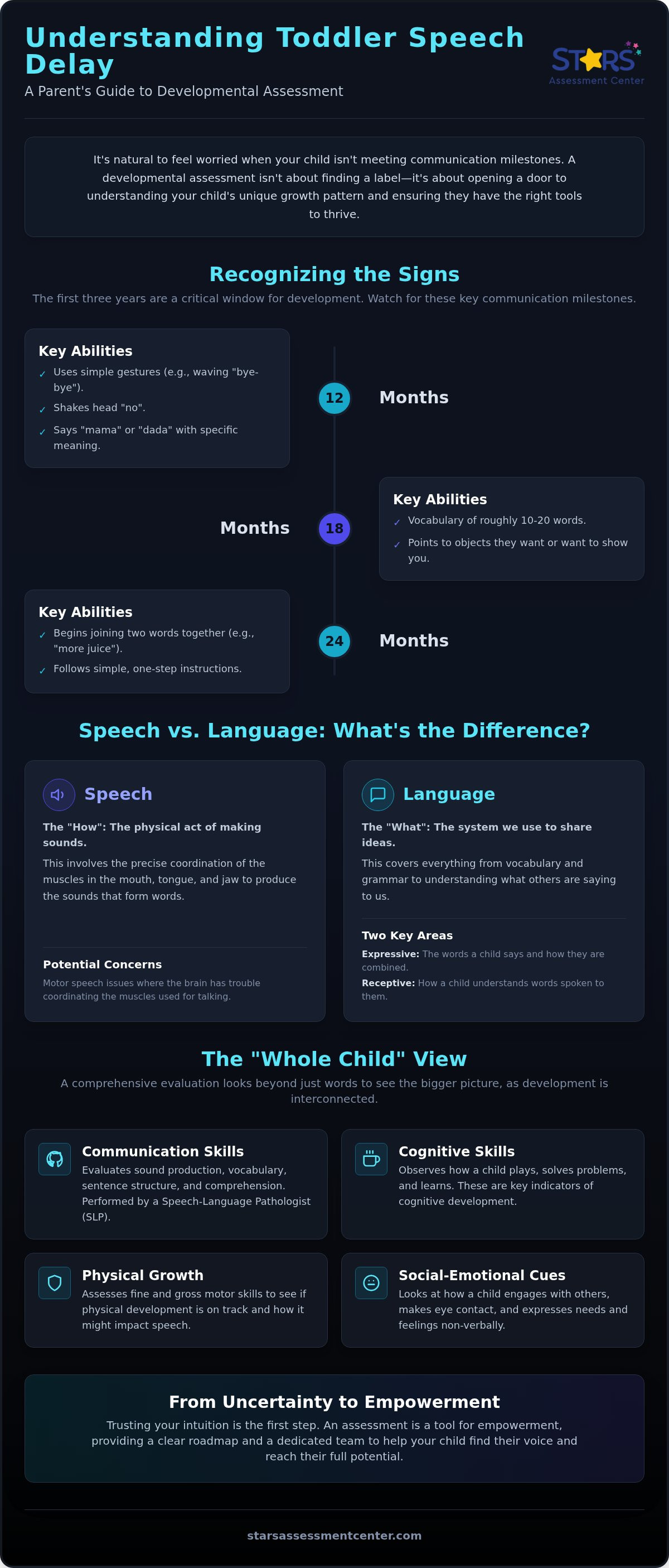
- 12 Months: Using simple gestures like waving "bye-bye," shaking their head "no," and saying "mama" or "dada" specifically to you.
- 18 Months: Having a vocabulary of roughly 10 to 20 words and pointing to objects they want or want to show you.
- 24 Months: Beginning to join two words together, such as "more juice" or "bye-bye dog," and following simple, one-step instructions.
Speech vs. Language: What is the Difference?
It helps to think of speech as the physical act of making sounds, while language is the system we use to share ideas. Some children struggle with expressive language, which involves the words they say and how they put them together. Others may have challenges with receptive language, or how they understand the words spoken to them. Sometimes, these difficulties are related to a Developmental language disorder (DLD), a condition that makes it harder for children to process and use language effectively. We also look for signs of motor speech concerns, where the brain has trouble coordinating the muscles used for talking, or social-emotional cues that impact how a child engages with others.
The Emotional Journey of Early Detection
Trusting your parental intuition is a powerful first step. You know your child better than anyone else, and if your gut tells you they need extra help, that feeling is valid. Moving from a state of uncertainty to taking action can feel heavy, but you don't have to do it alone. We view a developmental assessment for speech delay as a tool for empowerment. It isn't just about a diagnosis; it's about building a partnership that provides a clear roadmap. Instead of wondering "what if," you gain a team of specialists dedicated to helping your child find their voice and reach their full potential.
The Multidisciplinary Approach: Why a Comprehensive Evaluation Matters
A child's development is like a complex tapestry where every thread is connected. When a toddler isn't talking, it's easy to focus solely on their vocabulary count. However, a speech delay is often a signal that other areas of development might need a closer look. A multidisciplinary developmental assessment for speech delay is a collaborative process where a team of experts evaluates your child's communication, cognitive skills, and physical milestones simultaneously. This "whole child" view ensures we don't miss the bigger picture, as speech challenges can sometimes overlap with conditions like Autism or Down syndrome. By looking at all these areas at once, we can determine if your child's quietness is an isolated delay or part of a broader developmental pattern.
The Specialists on Your Child’s Team
In a multidisciplinary setting, you aren't just getting one opinion; you're gaining the combined expertise of a dedicated team. A Speech-Language Pathologist (SLP) conducts a comprehensive speech-language assessment to look at how your child produces sounds and understands instructions. Meanwhile, developmental specialists observe how your child plays and solves problems, which are key indicators of cognitive growth. Social-emotional screenings are also integrated into the process. These screenings help us understand how your child interacts with others and regulates their feelings, providing a more complete map of their development than a single-specialty visit could offer.
Connecting the Dots: Speech and Social-Emotional Growth
There's a profound link between a child's ability to speak and their daily behavior. When a toddler has the ideas but lacks the words to express them, frustration often follows. This can lead to tantrums or withdrawal, which are sometimes misinterpreted as behavioral issues rather than communication gaps. By Understanding Social Emotional Milestones in Infants and toddlers, we can identify if these frustrations are impacting your child's confidence. Identifying these connections early allows for a more effective support plan that addresses the root cause of the delay.
If a child’s speech delay is tied to physical coordination or social engagement, a team-based approach ensures every need is met from the start. This holistic perspective is exactly what we provide through a multidisciplinary developmental assessment, helping families in Santa Clara County move forward with confidence and clarity.
What to Expect During Your Child’s Developmental Evaluation
Starting the process of a developmental assessment for speech delay can feel like a big step for any family. We strive to create a "safe harbor" where your toddler feels comfortable enough to be themselves. This isn't a rigid, clinical exam with right or wrong answers. Instead, we use a play-based approach because children under three communicate best through activity and interaction. By observing your child in a natural setting with familiar toys, our team can capture an authentic picture of their current skills and potential.
The timeline from the initial screening to the final report is designed to be efficient yet thorough. In the California Early Start system, the evaluation process is typically completed within 45 days of your initial contact. This structure provides a predictable path forward, moving you from a place of uncertainty to a clear plan of action. You'll gain a deep understanding of how your child processes the world and what specific tools will help them find their voice.
Step-by-Step Through the Assessment Day
The evaluation is a collaborative effort where your insights are just as important as our observations. Specialists will gently watch how your child interacts with toys and people, looking at how they solve problems or seek engagement. We then move into guided interaction, using specific play tasks to check communicative, cognitive, and physical milestones. Throughout this time, we conduct a parent interview to learn about your child's daily routines and history. This partnership ensures the final report reflects the child you see every day at home.
Demystifying the Results
Once the evaluation is complete, the process of turning observations into a clear roadmap begins. Receiving a developmental assessment for speech delay report can feel overwhelming due to the professional terminology, but we're here to walk through every page with you. We focus on identifying your child's unique strengths alongside the areas where they need extra support. Our goal is to provide findings with professional warmth, ensuring you leave the conversation feeling empowered rather than confused.
A good report doesn't just list what a child isn't doing yet. It highlights their "spark" and explains the "why" behind their communication patterns. Whether the results suggest a need for specialized speech support or indicate that your child is meeting milestones in their own way, you'll have a documented foundation to share with doctors and teachers. This clarity is the first real step toward ensuring your child gets exactly what they need to thrive.
Navigating Early Intervention in Santa Clara County
Navigating the local support system in Santa Clara County doesn't have to be a solo effort. For families in San Jose, Milpitas, or Salinas, the San Andreas Regional Center (SARC) is the central point of contact for the California Early Start program. This state-funded initiative is designed specifically for children from birth to age three. To qualify, a child typically needs to demonstrate a developmental delay of at least 25% in a key area like expressive language or social-emotional growth. While SARC provides vital services, the process can sometimes feel slow when you're looking for immediate clarity. Choosing a private developmental assessment for speech delay can often expedite this journey. By arriving at your regional center meeting with a professional, multidisciplinary report in hand, you provide the team with a clear foundation to build upon. This often helps move your child more quickly toward their Individualized Family Service Plan (IFSP), which is the document that officially secures the services and support your family needs.
Local Resources for Families
Community connection is a vital part of the early intervention journey. Finding a developmental specialist for infants in Milpitas or San Jose allows you to work with professionals who understand the local landscape. Beyond clinical evaluations, a formal developmental assessment for speech delay opens doors to specialized funding and community programs. Santa Clara County offers various parent support groups where you can share experiences with others navigating similar paths. Stars Assessment Program bridges the gap for local families by providing thorough, empathetic evaluations that meet the high standards required by regional centers. We act as a steady ally, ensuring that you aren't just another number in a database, but a valued partner in your child's success. If you're ready to take that first step toward clarity, you can schedule a multidisciplinary evaluation with our local team.
The California Early Start Program
Understanding your rights within the California Early Start Program is essential for effective advocacy. As a parent, you're a primary decision-maker in the assessment process. You have the right to a timely evaluation, clear communication in your native language, and a collaborative role in developing your child's goals. After you receive your Santa Clara County toddler speech evaluation, the transition to active support begins. You'll meet with a dedicated service coordinator who helps translate the assessment findings into daily activities and specialized therapies. This stage is where the "wait and see" approach ends and the focused, play-based support begins, giving your child the best possible start before they reach preschool age.
Starting the Journey with Stars Assessment Program
At Stars Assessment Program, we believe every child deserves to be heard and understood. Our commitment to multidisciplinary excellence ensures your child doesn't just see one specialist; they benefit from a team that views speech, cognitive, and social-emotional growth as a connected whole. This comprehensive approach is particularly vital when a developmental assessment for speech delay is the first step in identifying specialized needs. We provide a steady hand to guide you through the process, serving families across San Jose, Santa Cruz, and Salinas. Our team is specifically trained to provide specialized screenings for Autism and Down syndrome, ensuring that if your child requires a specific path of support, we identify it early and with the utmost care.
Choosing the right partner for your child's evaluation is a significant decision. We aim to be a "safe harbor" for families, offering a space where questions are welcomed and anxiety is replaced with actionable insights. By looking at the "whole child," we move beyond simple checklists to understand the unique "why" behind your child's communication patterns. This clarity allows us to build a roadmap that isn't just about meeting milestones, but about helping your child thrive in their daily life and interactions.
A Family-Centered Approach to Assessment
We are proud to be an employee-owned (ESOP) organization. This model is more than just a business structure; it means every professional you meet is deeply invested in your family's success. When the specialists providing the care are also the owners of the program, there's a profound level of dedication and personal connection. We've spent years supporting infants and toddlers in Santa Clara County, and we've seen how the right clarity changes a family's entire trajectory. Local parents often share that our evaluations weren't just clinical appointments; they were the moments they finally felt heard as partners in their child's growth.
Take the First Step Toward Clarity
Requesting a multidisciplinary developmental assessment shouldn't be a source of stress. We've streamlined our intake process to be as gentle and supportive as the evaluation itself. When you're ready to reach out, it helps to have your child's birth date and a few notes about your main concerns or observations from your pediatrician. We'll handle the logistics and guide you through the next steps, acting as your advocate in the early intervention landscape. You don't need to have all the answers before you reach out. Our role is to help you find them through a careful, play-based process. Schedule a gentle assessment for your child today to begin this journey with a team that truly cares.
Empowering Your Child's Future with Clarity and Support
Seeking a developmental assessment for speech delay is a courageous first step toward understanding your child's unique world. By moving beyond the "wait and see" approach, you gain the clarity needed to support their communication, cognitive, and social-emotional growth during these vital early years. You've learned that a multidisciplinary perspective doesn't just count words; it looks at the whole child to ensure no part of their development is left behind. This comprehensive view provides the most reliable foundation for your child's future success.
Since 1988, our multidisciplinary team of experts has specialized in supporting children from birth to age three throughout San Jose and the greater Santa Clara County area. We're here to act as your steady ally, helping you navigate local resources and the California Early Start program with confidence. You don't have to carry the weight of uncertainty alone. Our gentle, play-based evaluations are designed to be a safe harbor for your family, turning worry into a clear, actionable plan.
Request a Compassionate Developmental Assessment today and discover how the right support can help your child find their voice. Your intuition brought you here, and that same dedication will guide your child's journey forward.
Frequently Asked Questions
How do I know if my 2-year-old’s speech delay is serious?
A 2-year-old should typically use about 50 words and start joining them into two-word phrases like "more milk." If your child isn't meeting these milestones or seems frustrated when trying to communicate, it's a good idea to seek a professional opinion. A developmental assessment for speech delay helps determine if the delay is isolated or part of a broader pattern. Trusting your intuition early on ensures your child gets the support they need.
What happens during a multidisciplinary developmental assessment?
This evaluation brings together a team of specialists to look at your child's growth from multiple angles. Instead of just focusing on words, we observe play skills, problem-solving, and physical movements in a gentle, play-based environment. Specialists look at communicative, cognitive, and social-emotional domains simultaneously. You'll participate as an active partner, sharing your child's history and daily routines to help us build a complete and accurate picture of their unique development.
Is a speech evaluation the same as an autism screening?
While they are different, they often overlap during a comprehensive evaluation. A speech evaluation focuses specifically on how a child produces sounds and understands language. An autism screening looks at a wider range of social-emotional behaviors, repetitive patterns, and communication styles. Because speech delays can sometimes be a sign of autism, our multidisciplinary team includes specialized screenings to provide families with the most accurate and clear understanding of their child's needs during the assessment process.
How long does a developmental assessment take for a toddler?
The in-person portion of the assessment typically lasts between one and two hours, depending on your child's engagement and needs. We move at a pace that keeps your toddler comfortable, using play to gather information naturally. Within the California Early Start system, the entire process from your initial contact to the final report and meeting is designed to be completed within 45 days. This ensures your family receives a clear roadmap without any unnecessary waiting or stress.
Do I need a doctor’s referral for a speech evaluation in Santa Clara County?
You don't need a formal doctor's referral to begin the process in Santa Clara County. Parents, caregivers, or medical providers can all initiate a referral to the Early Start program. If you have concerns about your child's development, you can contact the Stars Assessment Program or the San Andreas Regional Center directly. Taking this proactive step allows you to access a developmental assessment for speech delay and start the journey toward clarity for your child's future.
What is the cost of a developmental assessment for speech delay?
For families eligible for the California Early Start program, the initial evaluation and assessment are provided at no cost. This service is designed to identify developmental needs for infants and toddlers from birth to 36 months. While private evaluations in California can vary in price, the public system ensures that every child has access to essential diagnostic services regardless of their family's financial situation. This removes the barrier to getting the clarity your child deserves.
Can my child "catch up" after a speech delay diagnosis?
Many children make significant progress when they receive focused support during the critical birth to three window of neuroplasticity. Early intervention is designed to bridge developmental gaps by providing toddlers with the specific tools they need to communicate effectively. While every child's journey is unique, identifying a delay early allows us to create a tailored plan that builds on their strengths. With the right partnership and guidance, your child can find their voice and reach their full potential.
What cities do you serve for developmental assessments?
Our team is dedicated to serving families throughout the South Bay and Central Coast regions. We provide comprehensive evaluations for children in San Jose, Santa Clara, and Milpitas, as well as those living in Gilroy and Morgan Hill. We also extend our support to families in Santa Cruz and Salinas. Our goal is to be a local, community-oriented advocate across these cities, providing a steady and reliable safe harbor for families navigating early childhood development.


