
Imagine you're at a park in San Jose, watching other two-year-olds chatter while your own little one relies on gestures and smiles to tell you what they need. It's a quiet moment that can spark a loud, persistent worry in your heart. You might find yourself wondering if this is just a "late bloomer" phase or if it's time to seek a toddler speech evaluation Santa Clara County experts provide. This uncertainty is something many parents face, especially when the path to getting help feels like a maze of clinical terms and confusing waitlists.
We understand that the transition from noticing a delay to seeking professional support can feel heavy. You want the best for your child, but the distinction between private evaluations and Regional Center services often adds unnecessary stress. This guide is designed to be your steady ally, offering a clear roadmap to understanding your child's communication level. You'll discover how to access specialized screenings for infants and toddlers under age three and learn how a multidisciplinary approach can support your family's journey. By the end of this article, you'll have a professional plan to foster your child's growth and the confidence to take the next step toward healthy development.
Key Takeaways
- Learn to recognize the specific communication milestones and signs that indicate your child may benefit from a professional assessment before their third birthday.
- Understand how a toddler speech evaluation Santa Clara County specialists provide uses a multidisciplinary approach to look at your child's social-emotional and communicative growth.
- Discover the difference between speech sounds and language meaning so you can clearly communicate your concerns to your early intervention team.
- Find your way through local resources with confidence by learning how private assessment centers and the San Andreas Regional Center work together to support your family.
- Get practical guidance on preparing your toddler for a stress-free evaluation, ensuring the process feels like a supportive partnership rather than a clinical test.
Understanding the Need for a Toddler Speech Evaluation in Santa Clara County
A professional speech and language evaluation for toddlers under three isn't a pass-fail exam. Instead, it's a comprehensive look at how your child connects with the world. For families in San Jose and surrounding areas, a toddler speech evaluation Santa Clara County specialists conduct involves observing how your little one uses sounds, gestures, and facial expressions to share their needs. It's a collaborative process that brings together your deep knowledge as a parent with clinical expertise to create a clear picture of your child's growth.
Parents often feel a tug of intuition long before they seek help. You might hear "they'll grow out of it" from well-meaning friends, but your perspective as the daily expert on your child is invaluable. Validating that feeling is the first step toward clarity. Seeking an evaluation early isn't about finding a label; it's about opening doors to the right support at a time when your child's brain is most receptive to learning new communication patterns.
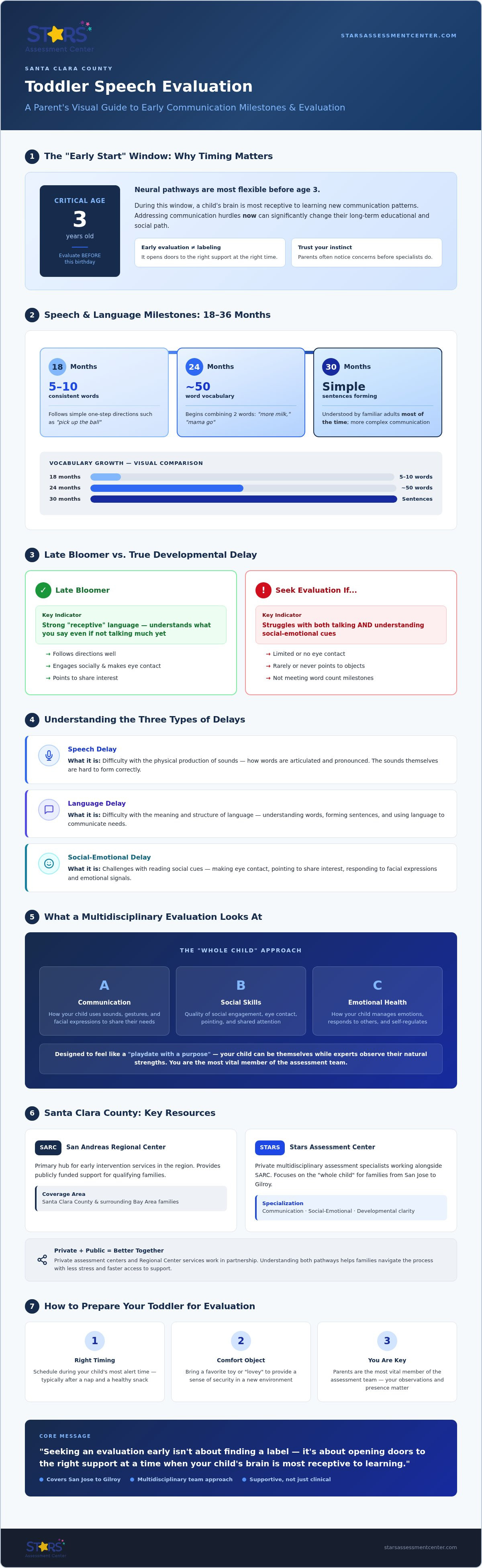
The "Early Start" window refers to the period before a child's third birthday. During these years, a child's neural pathways are incredibly flexible. Addressing communication hurdles now can significantly change their long-term educational and social path. By acting early, you're giving your child the tools they need to express themselves before frustration sets in.
Speech Milestones for Toddlers: 18 to 36 Months
While every child develops at their own pace, certain markers help us understand if a child is on track or might need a little extra help. Here is what we generally look for during these formative months:
- 18 Months: Your child should use at least 5 to 10 words consistently and follow simple, one-step directions like "pick up the ball."
- 24 Months: Most toddlers begin combining two words, such as "more milk" or "mama go," and have a vocabulary of about 50 words.
- 30 Months: Communication becomes more complex. You'll likely see your child using simple sentences and being understood by familiar adults most of the time.
It's vital to distinguish between "late blooming" and a true developmental delay. A late bloomer often has strong "receptive" language, meaning they understand everything you say even if they aren't talking much yet. If a child also struggles with social-emotional cues, like making eye contact or pointing to show you something interesting, a toddler speech evaluation Santa Clara County experts provide can help determine the best path forward.
Why Local Context Matters for Santa Clara Families
In our region, the San Andreas Regional Center (SARC) serves as a primary hub for early intervention services. Understanding how early childhood developmental screening works in the Bay Area helps you move through the process with less stress. Stars Assessment Center acts as a dedicated partner in this journey, providing specialized multidisciplinary teams that serve families from San Jose to Gilroy. We focus on the "whole child," ensuring that communication, social skills, and emotional health are all considered in our supportive evaluations.
What to Expect During Your Child's Multidisciplinary Evaluation
Walking into a clinic for the first time can feel daunting. You might worry about how your child will react to new faces or if they'll "perform" as they do at home. We want to reassure you that a toddler speech evaluation Santa Clara County families experience at our center is designed to feel like a playdate with a purpose. While the word "evaluation" might bring to mind clipboards and sterile rooms, the reality is much more inviting. It's a supportive space where your child can be themselves while experts observe their natural strengths.
Preparation starts with simple steps to keep your toddler comfortable. We recommend scheduling the appointment during your child's most alert time, usually after a nap and a healthy snack. Bringing a favorite toy or a "lovey" can provide a sense of security. Most importantly, remember that you are the most vital member of the assessment team. You'll be right there with your child, acting as their comfort source and providing the historical context that only a parent can give.
During the session, specialists use a blend of standardized tools and naturalistic play-based observations. We might blow bubbles to see how a child uses their mouth muscles or play with blocks to observe their problem solving and requests. If you're feeling uncertain about your child's milestones, reaching out for a professional developmental screening is a gentle first step toward getting the answers you need.
The Step-by-Step Evaluation Process
Every assessment begins with an intake process where we gather your child's developmental history. This isn't just paperwork; it's a conversation about your child's daily life, their favorite activities, and the specific hurdles you've noticed. Following this, the interactive session begins. We focus on engagement, watching how your child responds to social cues and how they attempt to share their world with others.
Once the play session concludes, we hold a post-evaluation feedback meeting. This is a dedicated time for you to ask questions and receive a clear explanation of our findings. Our goal is to ensure you leave not just with data, but with a sense of clarity and hope. We'll discuss a personalized plan that outlines exactly how to support your child's unique communication journey.
Multidisciplinary Insights: Looking Beyond Just Words
Communication doesn't happen in a vacuum. It's deeply connected to how a child thinks, moves, and relates to others. This is why a multidisciplinary developmental assessment is so valuable. Instead of looking only at speech sounds, our team evaluates how cognitive and physical skills are supporting or perhaps hindering language development. For example, a child's desire to communicate is often tied to their social-emotional growth.
By looking at the "whole child," we can identify specific needs that might otherwise be missed. This includes screenings for Autism or Down syndrome, ensuring that every area of development is carefully considered. This comprehensive approach allows us to create a more effective roadmap for early intervention, giving your family the tools to foster healthy growth in every domain of your toddler's life.
Differentiating Between Speech, Language, and Social-Emotional Delays
When you first consider a toddler speech evaluation Santa Clara County providers offer, you might think solely about the sounds your child makes. However, communication is a complex puzzle made of several different pieces. Understanding the difference between speech, language, and social-emotional development is the first step toward getting your child the right kind of support. While these areas are distinct, they are deeply interconnected, often influencing how a child interacts with their family and peers.
Speech refers to the physical mechanics of making sounds. It involves the coordination of the lips, tongue, and breath to produce clear words. Language, on the other hand, is about meaning. It's the system of symbols and rules we use to share ideas. A child might have perfect speech sounds but struggle with language, or vice versa. During an assessment, we look at how these two areas work together to help your child express themselves and understand the world around them.
Social-emotional development is the third, often overlooked piece of the communication puzzle. It's the "engine" that drives a child's desire to connect with others. If a toddler isn't yet pointing to show you a bird or looking at you to share a smile, their communication delay might be rooted in social-emotional patterns. This is why a social emotional assessment for toddlers is such a critical part of our multidisciplinary approach. It helps us identify if a child is showing early signs of Autism or other developmental patterns that require a specific type of guidance and empathy.
Receptive vs. Expressive Language Delays
We often categorize language into two main types: receptive and expressive. Receptive language is your child's ability to understand what is being said to them. You can check this at home by seeing if they can follow simple directions, like "find your shoes," without you pointing to them. Expressive language is how your child uses words, signs, or gestures to communicate their own thoughts and needs. Many children understand far more than they can say. A professional toddler speech evaluation Santa Clara County specialists conduct will pinpoint exactly where the "gap" lies, allowing us to build a bridge between understanding and speaking.
The Connection Between Communication and Behavior
It's very common for communication hurdles to manifest as behavioral challenges. When a child has a clear idea or a specific need but lacks the words to share it, frustration can quickly turn into a tantrum. These "big feelings" are often a form of communication themselves. By using social-emotional screenings, we can help you understand the root cause of these behaviors. We empower parents with practical strategies to lower frustration levels, helping your child feel heard while they are still developing their verbal skills. This approach creates a calmer home environment and builds your child's confidence.
Navigating Santa Clara County Early Intervention Resources
Finding the right path through the early intervention system can feel like learning a new language. In our region, the primary resource for families is the San Andreas Regional Center (SARC), which coordinates services for toddlers with developmental delays. Many families begin by seeking a toddler speech evaluation Santa Clara County specialists provide to gain a clear, professional baseline before navigating the broader public system. This specialized assessment can serve as a powerful tool when you begin your journey with public services, giving you a detailed report to share with your regional center coordinator.
Your right to these services is protected by federal law under the Individuals with Disabilities Education Act (IDEA) Part C. This law ensures that infants and toddlers with disabilities and their families receive early intervention services. Whether you live in Milpitas, Morgan Hill, or San Jose, these resources are designed to help your child reach their potential during these critical early years. To help you feel more prepared for these initial conversations, we recommend reviewing our Santa Clara County toddler speech evaluation guide, which breaks down the local landscape in detail.
Referral Paths: How to Get Started
You don't need a formal diagnosis or even a doctor's referral to begin the process. Parents in California can self-refer to their local regional center if they have concerns about their child's development. While your pediatrician can certainly provide a referral, your own observations are enough to start the intake. When you contact SARC, be ready to share your child's medical history and specific examples of your communication concerns, such as a lack of pointing or limited vocabulary.
Navigating waitlists can be one of the most stressful parts of this journey. This is where a private multidisciplinary assessment can be particularly helpful. By obtaining a professional evaluation independently, you can often gain clarity much faster and use that documentation to advocate for your child's needs. If you're ready to gain a deeper understanding of your child's growth, you can schedule a multidisciplinary developmental assessment with our expert team today.
Qualifying for Services in California
To qualify for Early Start services, a child must show a significant delay in one or more areas of development. If your child is found eligible, the next step is creating an Individualized Family Service Plan (IFSP). This is a collaborative document that outlines the specific goals and services your family will receive. A professional assessment report is a cornerstone of this process; it provides the clinical evidence needed to support your eligibility claim and ensures the IFSP goals are tailored to your child's unique communication and social-emotional profile.
The Stars Assessment Center: Your Partner in Developmental Clarity
At Stars Assessment Center, we believe that every child's communication journey is unique. We aren't just a clinical facility; we're a community-oriented advocate for families throughout the Bay Area. When you seek a toddler speech evaluation Santa Clara County experts provide at our center, you're entering a partnership built on trust and professional warmth. Our team focuses exclusively on infants and toddlers under age three. This specialization ensures that your child's earliest years are met with the highest level of expertise. We honor your child's strengths while identifying the specific supports they need to flourish.
Our mission is to provide more than just a report. We want to offer you a safe harbor during a time of uncertainty. By looking at the whole child, our multidisciplinary team ensures that social-emotional health and cognitive growth are evaluated alongside communication. This thoroughness allows us to guide you from the initial evaluation toward meaningful action. We help you connect with the right resources in San Jose, Santa Clara, and surrounding cities, ensuring you never feel alone in the process.
Why Families Choose Our Santa Clara County Specialists
Families trust us because we bring deep expertise to complex screenings, including specialized assessments for Autism and Down syndrome. As an employee-owned organization with deep roots in the local developmental services community, we treat every family with the care we'd want for our own. We understand the nuances of the regional center system and the specific needs of our diverse communities in Santa Clara, Santa Cruz, and Salinas. Our goal is to provide clarity so you can stop wondering "what if" and start moving forward with a professional plan. We focus on creating a welcoming environment where your child feels safe to explore and communicate.
Your Next Steps Toward Support
Taking the first step toward a toddler speech evaluation Santa Clara County families rely on is often the hardest part of the journey. When you're ready, reach out to a developmental specialist for an initial conversation. You might ask about the team's experience with your specific concerns or how they create a play-based environment for toddlers. Preparing a few notes about your child's daily routine, including their favorite toys and current communication methods, can help the specialist understand your needs from the very first call. We're here to help you bridge the gap between concern and action.
Contact Stars Assessment Center today for guidance. We're here to listen, support, and help your family find the path toward healthy, happy development.
Empowering Your Child’s Communication Journey
Taking the first step toward a toddler speech evaluation Santa Clara County families trust is an act of profound love and advocacy. You've learned that early intervention isn't just about sounds; it's about supporting your child's social-emotional and cognitive growth during the critical birth to three window. By understanding the local resources available and the role of a multidisciplinary team, you're now equipped to move from uncertainty to a professional plan for development.
Our expert team at Stars Assessment Center is here to serve families in San Jose, Santa Clara, and surrounding communities with a compassionate, family-centered heart. We focus on the "whole child" to ensure your little one has every opportunity to connect with the world around them. You don't have to navigate this path alone. We're ready to be your steady ally and provide the clarity your family deserves.
Schedule a Compassionate Evaluation for Your Toddler
Your child’s potential is limitless, and we’re honored to help you unlock it. Let's start this journey together today.
Frequently Asked Questions
What is the difference between a speech screening and a full evaluation?
A speech screening is a brief check to see if a child is hitting their milestones, while a full evaluation is a comprehensive, in-depth assessment. During a toddler speech evaluation Santa Clara County families receive, our multidisciplinary team looks at the child's whole communication profile. This includes sounds, gestures, and social-emotional engagement. While a screening identifies the need for more testing, an evaluation provides a professional plan for support and a clear understanding of your child's specific developmental level.
How long does a toddler speech evaluation usually take?
Most toddler speech evaluations typically take between one and two hours to complete. This timeframe allows our specialists to build a comfortable rapport with your child through play-based activities. We move at your toddler's pace to ensure they don't feel overwhelmed or tired. This patient approach helps us gather the most accurate observations of their natural communication style in a supportive, low-stress environment for both you and your little one.
Does my child need to be talking at all to have a speech evaluation?
No, your child doesn't need to be talking to have a speech evaluation. Communication involves much more than just verbal words, especially for toddlers under age three. We observe eye contact, pointing, facial expressions, and how your child uses gestures to share their needs. Our team evaluates these pre-linguistic skills to understand how your child is currently connecting with others. This helps us identify the best ways to support their transition into verbal language.
Will my insurance cover a multidisciplinary developmental assessment in Santa Clara County?
Coverage for a multidisciplinary developmental assessment depends on your specific insurance provider and plan. Many private insurance companies cover these evaluations, particularly when they're referred by a pediatrician. In Santa Clara County, families can also access public services through the San Andreas Regional Center if their child qualifies. We recommend contacting your insurance carrier directly to verify your benefits and any potential out-of-pocket costs before scheduling your appointment with our team.
What happens if the evaluation shows my child has a significant delay?
If an evaluation identifies a significant delay, it opens the door to specialized support and early intervention services. In California, this often leads to the creation of an Individualized Family Service Plan (IFSP). This plan outlines specific goals for your child and the services your family will receive to meet them. Our team acts as a dedicated guide during this transition, helping you understand the results and connecting you with local resources in San Jose or Milpitas.
How do I know if my child needs an autism screening specifically?
You might consider an autism screening if you notice your child struggles with social-emotional cues rather than just speech sounds. Signs can include limited eye contact, not responding to their name, or a lack of interest in playing with others. Our multidisciplinary team evaluates these social-emotional patterns alongside communication. This comprehensive look helps us determine if a specialized screening is necessary to provide your child with the most effective, personalized developmental support.
Can I get an evaluation if my child is bilingual or speaks a language other than English?
Yes, assessments are designed to be inclusive of children who are bilingual or speak languages other than English. We understand that growing up in a multilingual home is a unique developmental experience. Our specialists look at your child's communication skills across all the languages they hear and use. This ensures we don't misidentify a normal bilingual learning curve as a delay. We focus on your child's overall ability to share meaning and connect with their family in their natural environment.
What is the San Andreas Regional Center's role in my child's evaluation?
The San Andreas Regional Center (SARC) is the primary gatekeeper for public early intervention services in Santa Clara County. They determine eligibility for the Early Start program for children birth to age three. While private centers like ours provide specialized multidisciplinary evaluations, SARC coordinates the long-term services and funding for families who qualify. Our professional reports can be shared with SARC to help support your child's eligibility claim and ensure a smoother path toward receiving help in San Jose or Morgan Hill.


