
Imagine sitting on the living room floor, watching your little one play with their favorite blocks, yet realizing the quiet in the room feels heavier than it should. You've noticed other toddlers their age starting to string words together, while your child relies on gestures or frustrated tugs at your sleeve. It's completely natural to feel a mix of worry and confusion when your child isn't meeting those early communication milestones. You aren't alone in wondering if this is just a temporary phase or something that requires a professional look. Choosing a multidisciplinary evaluation for infant speech delay is the most effective way to replace that uncertainty with a clear, actionable plan.
A team-based approach does more than just identify a delay; it looks at your child as a whole person within the context of your family. By bringing together experts in communication, social development, and cognitive growth, you get a complete view of your child's unique strengths. This article will guide you through what to expect during the assessment process and how to navigate the California Early Start system in Santa Clara County. You'll discover how this partnership provides the clearest path forward, helping your child qualify for vital services while giving you the peace of mind that comes from having a dedicated guide by your side.
Key Takeaways
- Understand why a team-based approach provides a more complete picture of your child's needs than a single specialist can offer alone.
- Learn how a multidisciplinary evaluation for infant speech delay combines the expertise of multiple specialists to build a comprehensive plan for your child's success.
- Prepare for your child's assessment by understanding the role of play-based observations and how your family's history shapes the evaluation.
- Navigate the California Early Start system with confidence by learning how to access no-cost services through the San Andreas Regional Center.
- Explore how a partnership-focused approach can transform a clinical evaluation into a supportive "safe harbor" for your family.
What is a Multidisciplinary Evaluation for Infant Speech Delay?
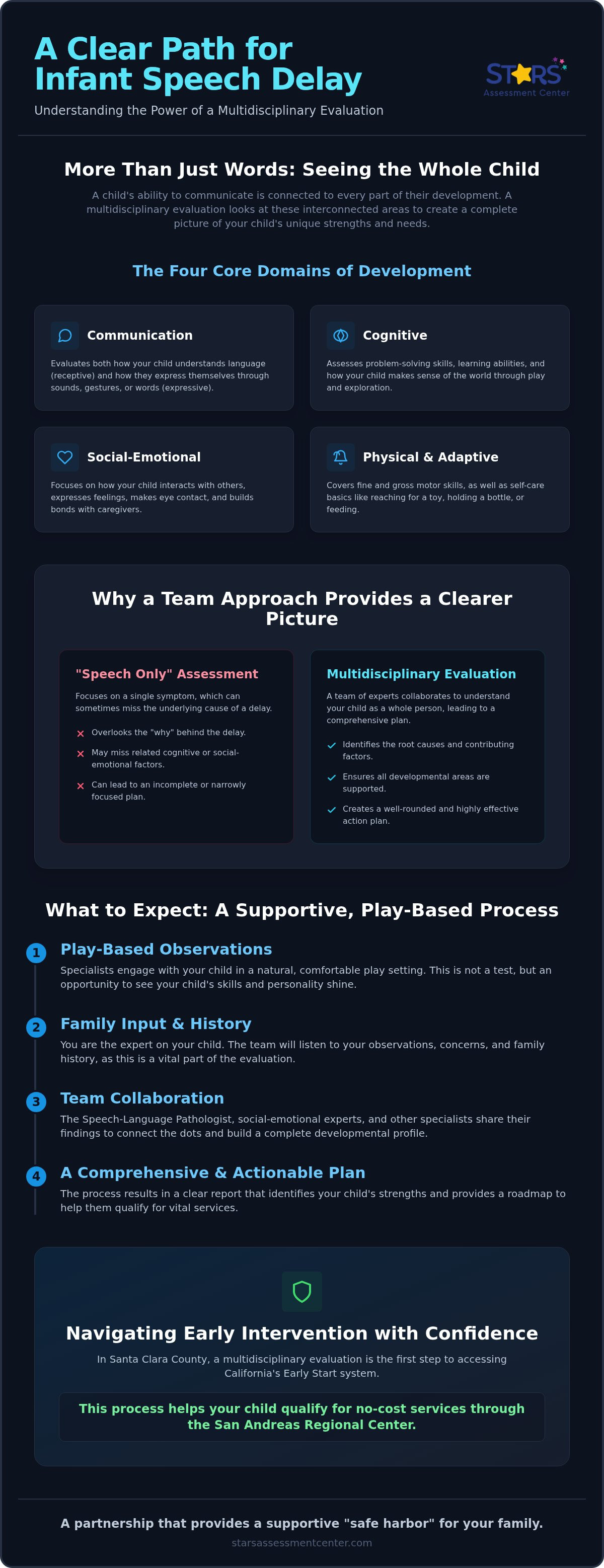
When you first notice your child isn't reaching for words like their peers, it's easy to focus solely on the sounds they aren't making. However, development doesn't happen in isolated boxes. A Speech delay is often a single thread in a much larger tapestry of growth. A multidisciplinary evaluation for infant speech delay is a holistic assessment of five key developmental domains conducted by a team of experts to create a complete picture of a child’s growth. This team-based approach recognizes that a child's ability to speak is deeply connected to how they think, move, and connect with the people around them.
The window from birth to age three is a period of incredible brain plasticity. It's the most critical time for intervention because your child's brain is rapidly forming the foundations for all future learning. By looking at the whole child now, we can identify exactly where they need a helping hand. This isn't just about a clinical test; it's about starting a partnership that honors your child's unique personality and your family's needs. Opting for a multidisciplinary evaluation for infant speech delay ensures that no stone is left unturned during these formative years.
The Five Domains of Development
During a comprehensive assessment, specialists look at five specific areas to see how they're working together. These domains provide a roadmap for understanding your infant's progress:
- Communication: This involves both expressive language, which is how your child uses sounds or words, and receptive language, which is how they understand what you say.
- Cognitive: These are the problem-solving and learning abilities that help an infant make sense of their world.
- Social-Emotional: This domain focuses on how your infant interacts with others, expresses feelings, and builds bonds.
- Physical and Adaptive: This covers motor skills and self-care basics, like reaching for toys or trying to hold a bottle.
Why "Speech Only" Assessments Can Miss the Big Picture
Focusing only on speech can sometimes overlook the "why" behind a delay. For example, a child might not be talking because they're struggling with the social-emotional aspect of connecting with a caregiver. In other cases, cognitive processing challenges might make it difficult for an infant to organize the steps needed to form a word. When we only look at communication, we might miss these underlying factors. A multidisciplinary team ensures that if a social-emotional gap or a cognitive hurdle is present, it's identified and addressed alongside speech. This comprehensive view gives your family the most accurate path forward, ensuring the support your child receives is as well-rounded as they are.
The Evaluation Team: Who Will Be Helping Your Family?
Walking into an assessment can feel overwhelming, but you aren't walking alone. A team-based approach ensures that every facet of your child's development is seen and supported. This process is guided by federal standards under the Individuals with Disabilities Education Act, which mandates that evaluations for infants and toddlers be comprehensive and involve multiple disciplines. By bringing together different perspectives, a multidisciplinary evaluation for infant speech delay creates a safe harbor where your concerns are met with expert care and actionable answers.
The Role of the Speech-Language Pathologist
The Speech-Language Pathologist (SLP) is often the first person parents think of when a delay is suspected. While they certainly focus on sounds, their role is much broader. They evaluate receptive language, which is how well your baby understands the words and directions you give. They also look at expressive language, or how your baby communicates their needs through babbling, gestures, or early words. Additionally, an SLP assesses oral-motor skills. These are the physical movements of the mouth and tongue required for both feeding and future sound production.
The Social-Emotional Perspective
Sometimes, a delay in talking is linked to how a child relates to others. Social-emotional experts look at the "heart" of your child's growth. They observe attachment patterns and how your child engages with you. We look for signs of shared joy, such as eye contact and gesturing. This specialized lens helps in identifying early signs that may require a social emotional assessment toddlers might need to rule out or identify specific developmental conditions. Understanding these engagement patterns early allows us to build a more supportive environment for your child.
Developmental specialists are also key members of the team. These experts are masters at observing how your child plays and learns. They watch how an infant solves problems, like figuring out how to get a toy out of a box or how they react to new textures. By seeing how your child navigates their world, they can determine if a speech delay is isolated or if it's connected to broader cognitive or physical milestones.
You are the most important member of this team. While the specialists bring clinical expertise, you bring the deep, daily knowledge of your child's life. You know what makes them laugh, what frustrates them, and the small progress they've made at home that a short observation might miss. We view this multidisciplinary evaluation for infant speech delay as a partnership where your voice is heard and valued. If you're ready to see how a team can support your family, you can learn more about our multidisciplinary developmental assessment.
The Evaluation Process: What Parents Can Expect
Preparing for your child's assessment might feel like getting ready for a major exam, but it's actually designed to be a gentle discovery process. You don't need to coach your child or worry about them "passing" a test. Instead, think of this as a time to gather your observations and medical history to share with a supportive team. A multidisciplinary evaluation for infant speech delay relies on a blend of standardized tools and what experts call informed clinical opinion. This means the team uses their years of experience to understand your child's behavior beyond just a score on a page.
The official guidelines for these assessments, such as the New York State Multidisciplinary Evaluation Procedures, emphasize that a child's functioning must be looked at across all settings. While the team uses specific instruments, the most valuable insights often come from watching how your child moves, reacts, and communicates in a comfortable, low-pressure environment. We want to see the child you see every day at home.
Play-Based Assessment: It Looks Like Fun, But It’s Science
For an infant, play is their work. During the evaluation, specialists use toys, bubbles, and games to elicit natural communication. It might look like just a fun play session, but it's actually a highly structured observation. We watch how your infant responds to new challenges, like a toy they can't quite reach or a game of peek-a-boo. This natural environment approach is the gold standard for infants because it shows us what they can truly do when they feel safe and engaged.
Sharing Your Story: The Parent Interview
Your insights are the foundation of a successful toddler developmental evaluation. During the parent interview, we'll talk about your daily routines, your child's milestones, and your specific concerns. We want to know what a typical morning looks like for your family. This is a judgment-free zone where your story helps us connect the dots between clinical observations and real-life experiences. Your perspective ensures the final report reflects your child's whole world.
Once the observations and interviews are complete, the team meets with you for a feedback session. We don't hide behind medical jargon. Instead, we discuss our findings in plain, supportive language. You'll walk away with a clear understanding of your child's needs and, more importantly, a roadmap for the next steps in their development. This session is your time to ask questions and ensure you feel like a confident partner in the path forward.
Navigating Early Intervention in Santa Clara County
Finding out your child may need extra support is a big moment, but living in Santa Clara County means you have access to a robust network designed to help. The California Early Start program is the state's response to federal requirements for supporting infants and toddlers with developmental delays. In our community, the San Andreas Regional Center (SARC) serves as the primary hub for these services. SARC contracts with trusted providers like the Stars Assessment Program to conduct the multidisciplinary evaluation for infant speech delay that determines if your child is eligible for specialized care.
Qualifying for Services in California
To qualify for Early Start services in Santa Clara County, a child from birth to 36 months must show a developmental delay of at least 25% in one or more areas. This includes communication, social-emotional growth, or cognitive skills. This isn't a hurdle meant to exclude families; it's a tool to ensure resources go where they are needed most. Once the multidisciplinary evaluation for infant speech delay is complete, the results are used to create an Individualized Family Service Plan (IFSP). This plan is a roadmap of goals and services tailored specifically to your child. By law, the process from your first contact to the development of the IFSP is expected to be completed within 45 days.
Local Resources for Santa Clara County Families
For families in San Jose, Milpitas, or Salinas, local expertise is just a phone call away. You don't have to navigate this system alone. Connecting with speech and language evaluation toddlers Santa Clara County specialists helps demystify the process and provides a clear starting point. Beyond the evaluation, communities like Morgan Hill, Gilroy, and Santa Cruz offer support groups where you can connect with other parents walking a similar path. The Stars Assessment Program acts as a bridge during this time, ensuring that your transition from having a concern to receiving care is seamless and supportive.
It's helpful to remember that these initial assessments through the Early Start program are provided at no cost to families. This ensures that every child in our community has a chance to thrive regardless of financial circumstances. If you have concerns about your child's development, taking the first step is the most important thing you can do. You can contact the Stars Assessment Program today to begin your journey toward clarity and support.
Choosing the Stars Assessment Program for Your Child’s Evaluation
At the Stars Assessment Program, we understand that the journey to finding answers can feel like navigating stormy seas. That's why we've built our center to be a "Safe Harbor" for families in San Jose, Santa Clara, and throughout the county. We specialize exclusively in the birth-to-three developmental window. This focus allows our team to become deep experts in the subtle ways infants and toddlers communicate and grow. When you choose us for a multidisciplinary evaluation for infant speech delay, you're gaining a partner who is as invested in your child's success as you are.
A Compassionate Approach to Developmental Assessment
We believe that an assessment should be a supportive experience, not a clinical trial. Our teams work hard to minimize stress for both you and your little one. By using play-based techniques in a warm environment, we help your child feel comfortable enough to show us their true self. We don't just look for deficits; we focus on your child's unique strengths. Every infant has a set of skills they're already using to navigate their world. By identifying these "bright spots," we can build a plan that unlocks their full potential while respecting your family's cultural values and personal goals.
Ready to Take the Next Step?
Taking the first step often feels like the hardest part, but we've made the referral process as clear as possible. In Santa Clara County, most families begin by contacting the San Andreas Regional Center (SARC) to request an evaluation. You can specifically ask to work with our team for your child's multidisciplinary evaluation for infant speech delay. Our commitment to family-centered care means we guide you through every administrative hurdle, ensuring you never feel like just another number in a system. Our goal is to move you from a place of uncertainty to a place of confidence.
For your first appointment, it's helpful to bring any medical records, previous screening results, and a few notes about your child's daily routines. These details help us hit the ground running. You've already done the hard work of noticing your child's needs and seeking help. Now, let us help you turn that concern into a clear, actionable roadmap for growth. Schedule a consultation with the Stars Assessment Program today to find the clarity and support your family deserves.
Finding Clarity and Connection for Your Child
Navigating the early years of your child's life should be filled with joy rather than constant worry about milestones. By choosing a multidisciplinary evaluation for infant speech delay, you're looking beyond a single symptom to see the whole, wonderful child. You now understand that a team of experts can provide the most accurate roadmap for growth, helping you access the local support your family deserves. This process isn't just about qualifying for services; it's about building a foundation of understanding and partnership.
Since 1988, our employee-owned organization has been a dedicated partner for families across Santa Clara County. We specialize exclusively in the birth-to-three window, ensuring your infant receives care from professionals who truly understand this unique stage of development. We're here to help you move from uncertainty to action with compassion and expertise. If you're ready to start this journey, please Request a Multidisciplinary Evaluation for Your Child today. You've taken the first step by seeking information, and your child is already lucky to have such a dedicated advocate in their corner.
Frequently Asked Questions
Does a speech delay at 18 months always mean my child has autism?
A speech delay at 18 months does not automatically mean your child has autism. Many children experience delays for various reasons, including hearing issues or simply needing a bit more time to develop. While communication gaps are one sign specialists look for, we also examine social-emotional engagement and play skills. A multidisciplinary evaluation for infant speech delay helps provide a complete picture, ruling out or identifying specific conditions while focusing on your child's unique growth pattern.
How long does a multidisciplinary developmental evaluation usually take?
The actual in-person assessment typically takes between two to three hours. However, the entire process from your initial referral to the creation of an Individualized Family Service Plan (IFSP) is designed to be completed within 45 days. This timeline ensures your family receives answers and support quickly. We move at a pace that is thorough yet respectful of your time, ensuring every developmental domain is carefully observed by our expert team of specialists.
What is the difference between a speech screening and a full evaluation?
A speech screening is a brief snapshot used to determine if a child might be at risk for a delay. It's often the first step your pediatrician takes during a checkup. In contrast, a multidisciplinary evaluation for infant speech delay is a deep, comprehensive dive into your child's communication, cognitive, and social-emotional skills. It involves a team of experts observing your child's play and interactions to determine eligibility for early intervention services and create a tailored support plan.
Will my insurance cover a multidisciplinary evaluation for speech delay?
Evaluations conducted through the California Early Start program are provided at no cost to families regardless of income or insurance status. While the assessment itself is free, ongoing therapy services may involve your private insurance or Medi-Cal. California acts as a funder of last resort, meaning the state helps cover costs that insurance doesn't. Our team can help you understand how this works for families in San Jose, Milpitas, and surrounding areas during your intake process.
What happens if the evaluation shows my child is not delayed enough for state services?
If your child doesn't meet the 25% delay threshold for state-funded services, it doesn't mean your concerns weren't valid. We still provide a detailed report highlighting your child's strengths and areas for growth. Our team offers practical recommendations for activities you can do at home to encourage development. We can also connect you with community resources in Santa Clara County, such as local library programs or parent support groups, to keep your child moving forward.
Can I self-refer my child for an evaluation in Santa Clara County?
Yes, you can absolutely self-refer your child for an evaluation in Santa Clara County. You don't need a doctor's note to contact the San Andreas Regional Center (SARC) if you have concerns about your child's development. As a parent, you are the expert on your child, and the system is designed to honor your intuition. Once you reach out, SARC can coordinate with programs like ours to begin the assessment process for your little one.
What should I do while waiting for the evaluation date?
While waiting for your appointment, the best thing you can do is continue engaging with your child through simple, everyday routines. You might start a milestone log to jot down specific sounds, gestures, or behaviors you notice. This information is incredibly helpful during the parent interview. Focus on narrated play, where you describe what your child is doing. This reduces pressure on them to perform while keeping the environment supportive and language-rich for your infant.
How do I prepare my toddler for a play-based assessment?
You don't need to coach your toddler for a play-based assessment. The goal is to see how they naturally interact with the world. To help the day go smoothly, try to schedule the appointment at a time when your child is usually well-rested and fed. Bring a favorite toy or a familiar snack to help them feel comfortable in a new environment. Remember, to your child, this will simply feel like a fun play session with new friends.


