
Imagine sitting in your living room, holding your child, and feeling a heavy fog of uncertainty about their next developmental steps. You want the best for them, but the path forward often feels hidden behind clinical terms and complex systems. Understanding what to expect during a Down syndrome assessment shouldn't feel like a hurdle you have to clear alone. Instead, think of it as the first step toward building a supportive community around your family.
We know that the days following a diagnosis are often filled with more questions than answers. It's completely natural to feel anxious about how these evaluations will impact your child's future or how to manage the logistics of California's early intervention system. Our goal is to replace that worry with a sense of partnership and clarity. In this guide, we'll walk you through the multidisciplinary process, introduce the specialists who will join your team, and show you exactly how to access vital services in Santa Clara County. You'll gain a clear roadmap for the evaluation day so you can focus on what matters most: helping your little one thrive.
Key Takeaways
- Learn why a developmental assessment provides a holistic roadmap for your child's growth, going far beyond an initial genetic diagnosis.
- Discover how a multidisciplinary team of specialists collaborates to support your child’s unique social-emotional, physical, and communication needs.
- Gain a clear, step-by-step understanding of what to expect during a Down syndrome assessment to ensure you and your child feel safe and prepared.
- Find out how to translate evaluation results into actionable early intervention services that help your infant or toddler thrive in Santa Clara County.
Understanding the Down Syndrome Developmental Assessment
A developmental assessment is much more than a medical checkup; it's a holistic look at how your child interacts with their world. While a genetic diagnosis identifies the presence of an extra chromosome, it doesn't tell the full story of your child’s unique personality, strengths, or specific needs. This evaluation serves as a comprehensive baseline, allowing specialists to see exactly where your child is today so they can help them reach their next milestone tomorrow.
For parents of infants and toddlers, this process is about moving from uncertainty to action. If you've noticed your little one is taking a bit longer to reach for toys, roll over, or make eye contact, this assessment provides the answers you need. It is designed specifically for children from birth to age three who may be experiencing developmental lags, ensuring they get the right support at the right time.
Assessment vs. Diagnosis: What’s the Difference?
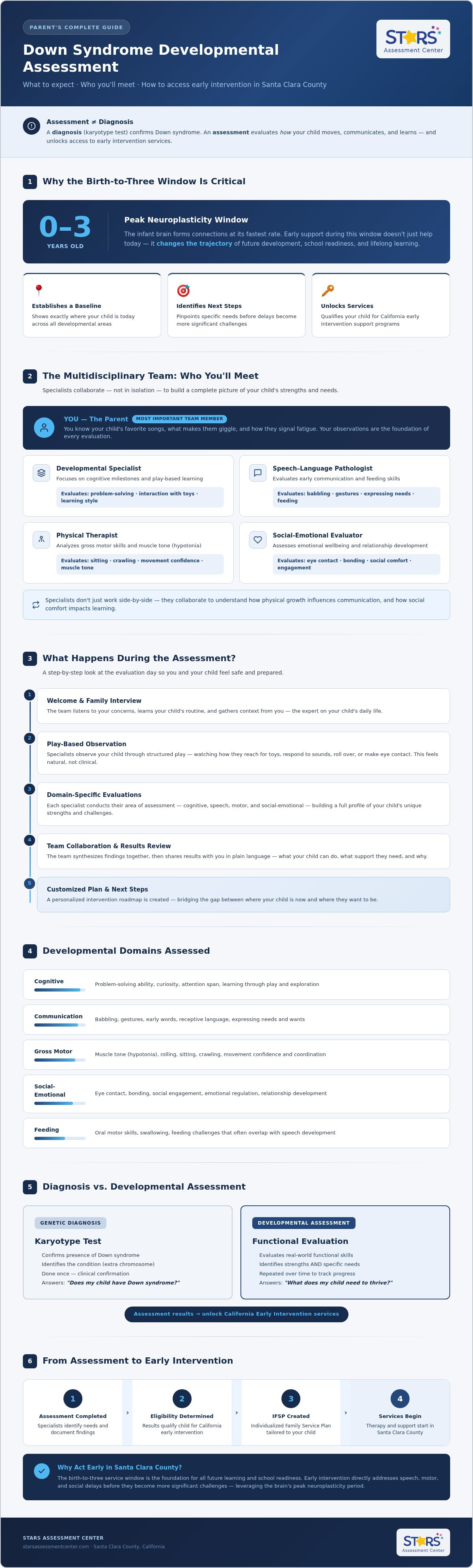
It's common to feel confused by the different types of medical evaluations your child might receive. A diagnosis, such as a karyotype test, is a clinical confirmation of Down syndrome. It identifies the condition itself. In contrast, when you're learning what to expect during a Down syndrome assessment, you're focusing on functional skills. This evaluation looks at how your child moves, communicates, and learns through play. It identifies what your child can do right now and what they need help with next.
These assessments are the key to unlocking support services. Instead of focusing on a label, our team looks at practical areas like babbling, sitting up, and social engagement. This detailed information is exactly what is required to qualify for California early intervention services. By identifying specific needs early, we can create a customized plan that bridges the gap between where your child is and where they want to be.
Why Early Childhood (Birth to Three) is the Critical Window
The first three years of life are a period of incredible neuroplasticity. During this time, a child's brain is like a sponge, forming new connections at a rapid pace. Early support takes advantage of this natural growth, helping to address speech, motor, and social delays before they become more significant challenges. When we provide the right tools during this window, we aren't just helping with today's growth; we're changing the trajectory of your child's future development.
This proactive approach ensures that infants and toddlers receive specialized attention when it matters most. The birth to three service window serves as the essential foundation for all future learning and school readiness.
The Multidisciplinary Team: Who Will You Meet?
When you walk through our doors, you aren't just meeting a group of medical professionals. You're meeting a dedicated team that views your child through a "whole child" lens. This multidisciplinary approach is the gold standard for support because it ensures no part of your child's development is viewed in isolation. When you understand what to expect during a Down syndrome assessment, you'll see that specialists don't just work side-by-side; they collaborate to see how physical growth influences communication and how social comfort impacts learning.
You are the most important member of this team. You know your child's favorite songs, what makes them giggle, and how they signal when they're tired. Our local specialists in Santa Clara County prioritize family-centered care, ensuring your observations are the foundation of our evaluation. We strive to be a safe harbor where professional expertise meets a gentle, human touch. Our goal is to make you feel heard and supported rather than just processed through a system.
Key Specialists in a Down Syndrome Evaluation
Each specialist on the team brings a unique perspective to your child's developmental profile. By combining these viewpoints, we create a complete picture of your child's strengths. Here is who you can expect to meet:
- Developmental Specialists: These experts focus on cognitive milestones and play-based learning. They observe how your child solves problems and interacts with toys to understand their unique learning style.
- Speech and Language Pathologists: They evaluate early communication and feeding skills. Since these areas often overlap, they look at how your child uses sounds or gestures to express needs.
- Physical Therapists: These specialists analyze gross motor skills and muscle tone, often referred to as hypotonia. They provide insights into how your child can move more confidently and reach physical milestones like sitting or crawling.
The Role of the Social-Emotional Evaluator
Social-emotional health is the quiet engine that drives a toddler's growth. For children with Down syndrome, being able to regulate emotions and interact with others is vital for future independence. Our evaluators look closely at how your child responds to new people and how they share joy with you during play. This specialized focus mirrors the social emotional assessment toddlers receive at our center, ensuring every child has the tools to connect with the world around them.
If you're ready to begin building a roadmap for your child, our multidisciplinary team is here to guide you through every step of the process with warmth and expertise.
Step-by-Step: What Happens During the Appointment?
Walking into a clinical setting with a toddler can feel overwhelming. We want you to feel as prepared as possible so you can focus on your child rather than the paperwork. Understanding what to expect during a Down syndrome assessment can significantly lower your stress levels. Our process is designed to be gentle and patient, ensuring your child feels safe and comfortable enough to show us their true personality. We don't just look for what a child can't do; we look for the unique ways they've already begun to learn and grow.
Initial Intake and Parent Interview
The appointment begins with a conversation. We'll spend time gathering information about your child's birth history and the early milestones they've already reached. This is your time to share the daily routines that work for your family and the specific areas where your child faces challenges. Your voice is the most important tool we have. We validate your concerns and use your insights to guide the rest of the evaluation. It's through your stories that we understand how your child navigates their world at home.
Play-Based Assessment Activities
To a toddler, the assessment feels like a playdate. Our specialists use a variety of toys, puzzles, and games to evaluate fine motor skills and cognitive abilities. We observe how they reach for a block, track a moving object, or react to a new sound. Even if your child isn't talking yet, we're carefully watching their communication attempts, such as gestures, eye contact, and facial expressions. Play-based assessment is the most accurate way to measure a toddler's natural abilities.
Local San Jose Assessment Logistics
We want your visit to our Santa Clara County center to be as smooth as possible. Here are a few practical tips for your visit:
- What to bring: Pack a bag with your child's favorite snacks, a comfort toy, and any medical records you haven't already shared.
- Arrival: Our San Jose location offers convenient parking, but we recommend arriving ten minutes early to let your child acclimate to the new environment.
- Timing: The appointment usually lasts between 1 to 2 hours of direct observation. We follow your child's lead, allowing for breaks if they become tired or overstimulated.
As the visit wraps up, our team will share their initial impressions with you. While the detailed multidisciplinary report takes a bit longer to finalize, we'll provide a clear timeline for when you'll receive the results and discuss the next steps for support.
Understanding Your Results and Early Intervention Eligibility
Receiving a detailed multidisciplinary report can feel like a heavy moment for any parent. It is often a thick document filled with scores and observations, but it's helpful to remember that this isn't a judgment of your child's potential. Instead, think of it as a tool for growth. When you know what to expect during a Down syndrome assessment, you realize the final report is a narrative of your child's current strengths and a guide for their future progress. It identifies the exact areas where a little extra support will make the biggest difference.
In California, eligibility for early intervention services is typically based on the presence of a "developmental delay." This term simply means your child is reaching milestones, like rolling over or babbling, at a different pace than typical age expectations. For families in San Jose and Salinas, our assessment provides the clinical evidence needed by the San Andreas Regional Center (SARC) to authorize and fund these essential supports. We work to ensure the data is clear and comprehensive, making the path to services as smooth as possible for your family.
Navigating the Regional Center Referral
Our evaluations act as a vital bridge between identifying a need and receiving actual help. We help you understand the "eligibility" conversation, which can sometimes feel clinical or bureaucratic. Our specialists explain how your child's unique profile meets the criteria for support under the California Early Intervention Services Act. For a broader look at how we monitor these milestones, you can explore our guide on early childhood developmental screening. If you're ready to take this step, our team can coordinate your multidisciplinary evaluation to get the process started.
The IFSP Meeting: Your Roadmap for Support
Once eligibility is established, you'll participate in an Individualized Family Service Plan (IFSP) meeting. This is where we translate assessment results into actionable, daily goals for your child. If the report shows your child needs help with communication, the IFSP will outline exactly how speech services will support that goal in your home. These plans aren't static; they are reviewed and updated every six months to ensure they grow alongside your child. As your little one approaches their third birthday, the team will also help you plan the transition from early intervention to school-age services, ensuring there is never a gap in the care they receive.
Why Choose Stars Assessment Program for Your Child?
Choosing the right partner for your child's developmental journey is a significant decision. At Stars Assessment Program, we understand that you aren't just looking for a clinical report; you're looking for a team that sees your child's potential. Our multidisciplinary approach is built on a foundation of deep expertise in Down syndrome, ensuring that every evaluation is thorough, accurate, and deeply human. When you're researching what to expect during a Down syndrome assessment, you'll find that our process prioritizes the comfort of your child and the clarity of your path forward.
We strive to be a safe harbor for families across Santa Clara County. This means providing a space where you feel heard, validated, and empowered. Our specialists aren't just experts in their fields; they're compassionate guides who understand the emotional weight of seeking support. We're committed to building a personal connection with every family, ensuring that our services are culturally sensitive and tailored to your unique needs.
A Compassionate Approach to Developmental Care
We believe that a child is more than a set of milestones or a collection of data points. Every toddler has a unique personality, a specific way of laughing, and a distinct learning style. Our team moves beyond the clinical numbers to celebrate these traits. We also recognize that a child's growth is tied to the emotional health of the entire family unit. By acting as a community-oriented advocate, we provide the reassurance you need to feel confident in your child's early childhood growth. Our goal is to support the whole family as you transition from the assessment phase into active early intervention.
Local Expertise You Can Trust
Stars Assessment Program has been serving families in San Jose, Santa Cruz, and the surrounding regions since 1988. This long history in the community has allowed us to build a seamless partnership with the San Andreas Regional Center. We understand the local systems and the specific resources available to families in our area. Whether you're scheduling an appointment at our locations in Milpitas or Gilroy, you can trust that you're receiving the highest standard of care from specialists who are invested in your child's success.
Taking the next step doesn't have to feel overwhelming. We're here to help you turn uncertainty into a clear, actionable roadmap for your child's future. If you're ready to learn more about what to expect during a Down syndrome assessment and how we can support your family, reach out to our team. Contact us today to schedule your child's developmental assessment and begin the journey toward helping your little one thrive.
Empowering Your Child’s Developmental Journey
Knowing what to expect during a Down syndrome assessment is the first step in moving from uncertainty toward a clear, actionable plan. We've explored how a multidisciplinary team looks at the whole child, the gentle nature of play-based evaluations, and how these results open doors to vital early intervention services through the San Andreas Regional Center. This process isn't just about collecting data; it's about finding the right tools to help your infant or toddler reach their full potential.
As a trusted partner for families in Santa Clara County, Stars Assessment Program provides a specialized team for the birth to age three population. Our empathetic, play-based evaluation process ensures your child feels safe while we build a roadmap for their growth. You don't have to navigate this system alone. We're here to act as a steady ally, providing the professional warmth and expertise your family needs during these early years.
Schedule a Reassuring Developmental Assessment for Your Child
We're here to walk beside you, providing the clarity and support your family deserves as your child grows and thrives.
Frequently Asked Questions
How long does a Down syndrome developmental assessment take?
A typical multidisciplinary evaluation usually takes between one and two hours of direct observation. We follow your child's lead, so if they need a break for a snack or a nap, we'll adjust our pace. This time allows our specialists in San Jose or Gilroy to see your child's natural abilities through play. We ensure the environment is relaxed so we get the most accurate and thorough picture of their development.
Is the assessment painful or scary for my infant?
Not at all. The process is entirely non-invasive and designed to feel like a playdate. Specialists use toys, bubbles, and games to observe how your child moves and interacts. Since we focus on infants and toddlers under three in Santa Clara County, we prioritize a "safe harbor" environment. Your child stays with you the whole time, ensuring they feel secure and comfortable while we look at their social-emotional and physical growth.
What documents should I bring to my child's evaluation?
Please bring any recent medical records, diagnostic reports, and immunization history. We also recommend bringing items to help your child feel comfortable at our Santa Clara center, such as:
- Favorite snacks and a drink
- A comfort toy or favorite blanket
- Notes on your child's daily routine and your specific concerns
These familiar items help us see your child's natural cognitive and communication skills during the evaluation.
Can my child be assessed for Down syndrome if they are already two years old?
Yes, we provide specialized assessments for children from birth up until their third birthday. If your child is two years old and you're noticing developmental lags, now is a critical time to seek support. Our team has deep expertise in this "birth to three" window, which is the most impactful time for early intervention. We serve families throughout San Jose and Salinas, helping toddlers access the right resources before they transition to school.
Will insurance or the Regional Center cover the cost of the assessment?
Most of our evaluations are funded through our partnership with the San Andreas Regional Center for eligible families in Santa Clara County. We act as a bridge to these services, helping you navigate the eligibility process for early intervention. When you're learning what to expect during a Down syndrome assessment, understanding the financial path is vital. We recommend checking with your Regional Center coordinator or insurance provider to confirm specific coverage details for your child's evaluation.
What happens if the assessment shows my child is meeting their milestones?
If the evaluation shows your child is meeting their milestones, that is wonderful news for your family. The assessment still provides a valuable baseline of their current strengths across cognitive, physical, and social-emotional domains. We'll discuss these findings with you and provide suggestions for continued growth at home. Our goal is to be a steady ally, whether your child needs immediate intervention or simply ongoing monitoring as they grow toward their third birthday.
How soon after the assessment will we receive the final report?
You'll receive a verbal summary of initial impressions immediately following the appointment. The comprehensive multidisciplinary report is typically finalized and shared with you within a few weeks. This detailed document serves as a roadmap for your child's future support and is essential for Individualized Family Service Plan (IFSP) meetings. We'll walk you through the results to ensure you feel empowered and clear about the next steps for your child's development.
Do we need a referral from our pediatrician for an evaluation?
Many families come to us through a referral from their pediatrician, but you can also contact the San Andreas Regional Center directly to request an evaluation. If you're concerned about your child's growth in San Jose or Santa Cruz, talking to your doctor is a great first step. They can help initiate the process so you can learn what to expect during a Down syndrome assessment. We work closely with local providers to ensure a seamless transition.


