
What if the silence you've noticed during playtime isn't just a "late bloomer" phase, but your child's way of asking for a little extra help? It's completely natural to feel a knot in your stomach when you start wondering if your baby is meeting their milestones on time. You might worry that seeking an infant communication assessment Santa Clara County will lead to a permanent label, or you might feel lost in the complex web of paperwork and referral forms required by California's Early Start program.
We understand that your child's voice is the most important thing in your world. You aren't alone in these concerns, and your intuition as a parent is your most powerful tool. This guide provides a clear roadmap for the multidisciplinary assessment process, helping you distinguish between simple speech delays and broader developmental needs. We will explore how to work with the San Andreas Regional Center and what to expect during a "special playdate" evaluation. By the end, you will have the clarity and confidence needed to support your child's growth and ensure they receive the dedicated care they deserve.
Key Takeaways
- Learn to distinguish between expressive and receptive language to better understand how your baby shares and receives information.
- Identify specific "clinical clues," such as joint attention and babbling, to monitor your child's progress during the critical first 24 months.
- Discover why a play-based infant communication assessment Santa Clara County is the most effective, stress-free way to evaluate your child's natural development.
- Understand the benefits of a multidisciplinary evaluation where speech, cognitive, and social-emotional specialists work together to see the whole child.
- Gain a clear roadmap for navigating the local referral system and moving beyond labels toward personalized growth strategies for your family.
Understanding Communication Delays in Infants (Birth to 36 Months)
A communication delay isn't a single obstacle; it is a broad category that describes how a child interacts with their world. It might mean they have trouble sharing their needs or understanding what others say. When you begin to notice these differences, it's common for well-meaning friends to suggest you "just wait and see." However, professional consensus has moved toward a "gold standard" of early identification. A Language delay can manifest in two distinct ways:
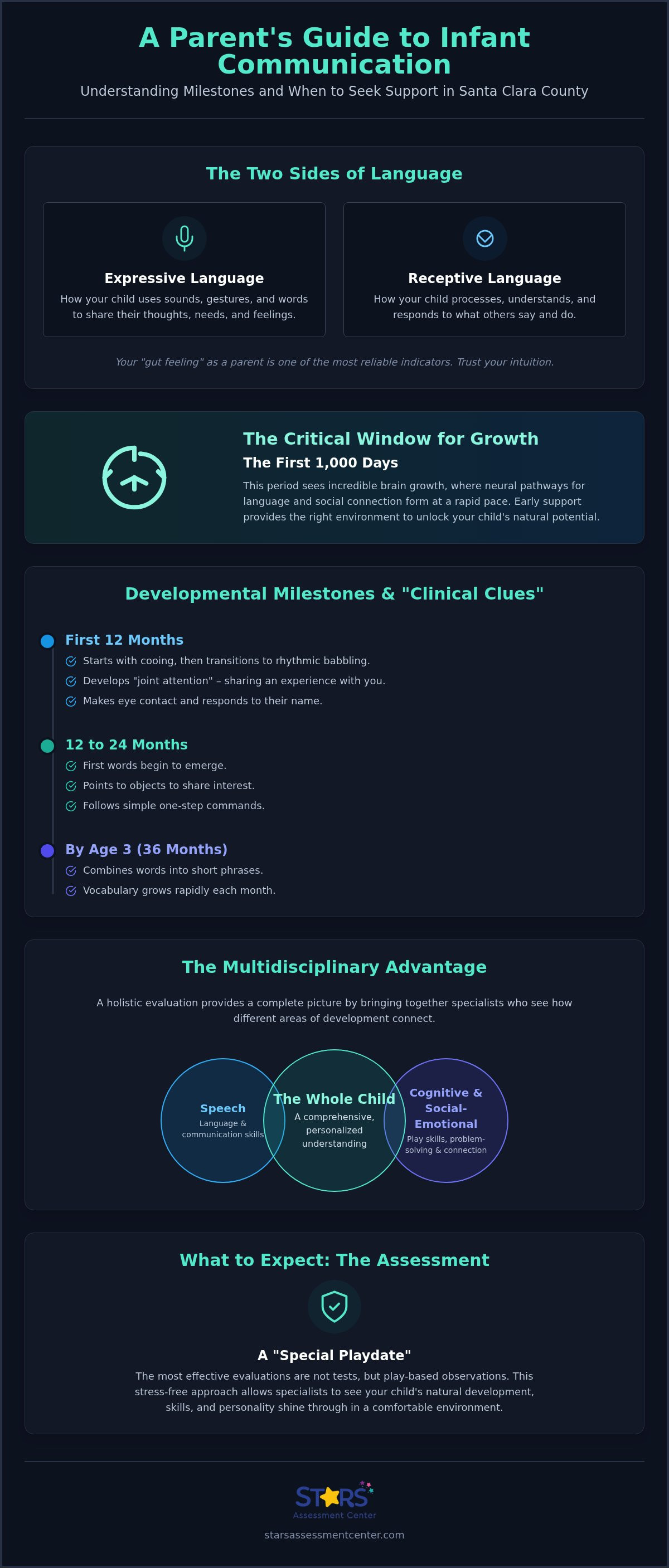
- Expressive language: This involves how your child uses sounds, words, and gestures to share thoughts or feelings.
- Receptive language: This describes how your child processes, understands, and responds to the words and social cues of others.
Your "gut feeling" as a parent is one of the most reliable indicators in the diagnostic process. You know the subtle ways your child tries to connect, and you are the first to notice when those connections feel difficult. Validating these concerns is the first step toward clarity. Instead of waiting for a delay to become a larger barrier, seeking an infant communication assessment Santa Clara County allows for a proactive partnership between families and specialists.
Communication vs. Speech: More Than Just Words
It is helpful to think of speech as the physical mechanics of sound. It involves the tongue, lips, and breath working together to form words. Communication, however, is much larger. It is the ability to share a feeling, follow a social cue, or point to a toy to invite someone to play. A child might be able to say words clearly but still struggle with functional communication, such as using those words to ask for help or connect with a peer. This distinction is a key part of an infant communication assessment Santa Clara County, as it helps specialists see the full picture of your child's social world.
The Critical Window: Why Early Assessment Matters
The first 1,000 days of a child's life represent a period of incredible brain growth. During this time, the neural pathways for language and social connection are forming at a lightning pace. Early support isn't about finding a "problem" to fix; it is about providing the right environment to unlock your child's natural potential. When we address delays early, we often prevent the secondary frustrations that toddlers feel when they can't make themselves understood. By acting now, you are acting as a steady ally for your child's future social-emotional health.
Key Milestones and "Clinical Clues" for Santa Clara Parents
While every child follows a unique path, developmental milestones provide a helpful map for parents to track progress. In the first 12 months, communication begins with cooing and transitions into rhythmic babbling. This is also when we look for "joint attention," which is your baby's ability to share an experience with you, like looking at a dog and then looking at you to see if you see it too. Between 12 and 24 months, you'll likely hear those precious first words. During this stage, pointing to objects and following simple one-step commands become the primary ways your toddler interacts. By age three, most children combine words into short phrases and their vocabulary grows rapidly every month.
We often refer to specific indicators as "clinical clues." These aren't meant to cause alarm; instead, they serve as gentle signals that an infant communication assessment Santa Clara County could provide valuable insights into your child's unique needs. Identifying these clues early allows us to build a bridge to the right resources at the most impactful time.
Social-Emotional Red Flags in Early Communication
Communication is deeply social. By 9 to 12 months, most babies consistently make eye contact and respond when they hear their name. A lack of back-and-forth gestures, such as waving "bye-bye" or reaching up to be held, can sometimes indicate a struggle with the social side of language. Utilizing a social emotional assessment for toddlers allows our team to look at the whole child, ensuring we understand the context behind any communication delays. This holistic view helps us see if a child is struggling with the mechanics of speech or the social connection behind it.
When to Seek a Professional Evaluation
Parents often hear the myth that boys simply talk later than girls, but this can lead to unnecessary delays in getting support. If a child is not babbling by 12 months, it is a clinical clue that a professional evaluation is the next logical step. Seeking an early childhood developmental screening is a proactive way to gain peace of mind and clarity. It's always better to have your questions answered by an expert who can validate your concerns. If you have questions about your child's progress, our team is here to help through a multidisciplinary developmental assessment tailored to your family's needs.
The Multidisciplinary Advantage: A Holistic View of Your Child
Communication doesn't happen in a vacuum. It's woven into every part of an infant's life, from how they move their bodies to how they process the world around them. A multidisciplinary approach means specialists in speech, cognition, and social-emotional growth work together to understand your child's unique profile. This is the core of a thorough infant communication assessment Santa Clara County. It ensures we don't just see a speech delay; we see the child behind the words.
In this collaborative setting, different experts bring different lenses to the table. A Speech-Language Pathologist focuses on the mechanics and structure of language, while a Developmental Specialist looks at broader milestones like problem-solving and play. When you schedule an infant communication assessment Santa Clara County, you're choosing a process that values the interconnected nature of childhood development. If there are specific concerns, we integrate specialized screenings for Autism or Down syndrome into this holistic view. This isn't about adding more labels. It's about getting a complete picture so we can offer the right support at the right time.
Why a Team of Specialists is Essential
One provider might see a single symptom, but a team sees a pattern. When our specialists collaborate, they identify nuances that a single provider might overlook. This collaboration results in a "whole child" report, which acts as a clear roadmap for your family. As an employee-owned organization in San Jose, our team is deeply invested in every child's success. We don't just pass files around; we meet to discuss how to best support your child's growth, ensuring our findings lead to personalized strategies rather than just a diagnosis.
Assessing the Link Between Emotion and Language
A child's social-emotional health is the engine that drives their desire to speak. If a baby feels secure and connected, they're more likely to attempt new sounds and gestures. We look at "functional communication," which is how your baby shares needs in real-world settings like home or daycare. In diverse communities like Milpitas and Salinas, cultural sensitivity is vital. We respect your family's unique traditions and languages, ensuring the assessment feels like a supportive extension of your home life. This approach helps us understand how your child communicates within the context of their own community and family.
What to Expect: Your Child’s Assessment in Santa Clara County
Entering a clinical environment can feel overwhelming for both you and your little one. That's why we've designed the intake process to be as gentle as possible. As an employee-owned organization, our specialists are deeply committed to providing a supportive experience for every family. It begins with a warm conversation where you share your child's history and your specific concerns. You are the expert on your child, and your insights are the foundation of everything we do.
During the actual infant communication assessment Santa Clara County, we use play as our primary diagnostic tool. To your child, it feels like a series of fun activities with new friends. We observe how they reach for blocks, follow a gaze, or try to mimic a sound. This observation-based approach allows us to see their natural abilities in a low-pressure setting. It's about seeing what your child can do when they feel comfortable and engaged.
Once the session is complete, our team compiles a multidisciplinary report. We don't just provide a list of numbers; we turn clinical data into a supportive narrative that explains how your child learns. Whether you are in San Jose, Gilroy, or Morgan Hill, this infant communication assessment Santa Clara County documentation connects you to the specific resources available in your community. We aim to provide a clear, readable document that validates your concerns and highlights your child's strengths.
Preparing Your Child (and Yourself) for the Evaluation
To ensure a low-stress day, try to schedule the session around your child's usual nap times. Bringing favorite toys or familiar snacks can help them feel at home in a new space. We encourage you to frame the evaluation as a "special playdate" for your curious toddler. During the session, you aren't just a spectator. You're an active participant whose presence provides the "safe harbor" your child needs to explore and communicate. Your calmness helps your child feel secure enough to show us their true personality.
The Path Forward: From Results to Intervention
After the evaluation, we'll sit down with you to discuss the findings of your Santa Clara County toddler speech evaluation. This report serves as a "passport" to services, making it much easier to navigate the San Andreas Regional Center (SARC) referral system. Our goal is to move you quickly from uncertainty to action. For families in Salinas, Santa Cruz, and beyond, we provide clear next steps to ensure your child receives the high-quality care they deserve. If you're ready to begin this journey, you can schedule a multidisciplinary developmental assessment with our dedicated team today.
Partnering with Stars Assessment Program for Your Child’s Future
Choosing the right partner for your child's developmental journey is a significant decision. The Stars Assessment Program acts as a steady ally during a time that often feels like a whirlwind of paperwork and uncertainty. We believe that an infant communication assessment Santa Clara County should be a point of clarity, not a source of stress. Our multidisciplinary findings lead to personalized growth strategies that respect your child's unique pace. We don't just hand you a label; we provide a supportive narrative that helps you see your child’s potential and understand their specific needs.
Your mental health as a parent is a vital part of your child’s success. We strive to create a non-alarmist environment where you feel heard and validated rather than overwhelmed. Our deep roots in the Santa Clara County community allow us to offer expert, empathetic care that feels like a partnership. By focusing on the "whole child," we ensure that every family leaves our center with a sense of hope and a clear path forward.
A Compassionate Expert in Your Corner
Our team is defined by professional warmth and a commitment to family partnership. We understand that every child's journey is different, which is why we offer specialized approaches for various developmental needs, including a dedicated Down syndrome assessment in Santa Clara County. We don't treat these evaluations as mere checklists; we treat them as the first step in a lifelong journey of growth.
One of the things that makes the Stars Assessment Program unique is our employee-owned (ESOP) structure. Because our team members are owners, they're deeply invested in the success of every family we serve. This dedication translates into a higher standard of care and a more personal connection. You aren't just another case to us; you're a neighbor, and your child’s milestones are our milestones too.
Ready for Clarity? Contact Stars Assessment Program
Starting the intake process for your infant or toddler is a simple, supportive step toward the answers you need. We've streamlined our system to help you move from a "gut feeling" to a professional plan as quickly as possible. Our service areas cover the heart of the region, providing expert evaluations for families from Milpitas and San Jose down to Gilroy and Salinas. We offer multilingual support to ensure that every family in our diverse community feels welcome and understood.
It's important to remember that you are the expert on your child. You've noticed the subtle cues and the quiet moments that others might miss. Our role is simply to provide the tools and professional insights to support the intuition you already have. If you're ready to gain clarity and start your child's personalized growth journey, we're here to be your dedicated guide every step of the way.
Taking the Next Step Toward Your Child’s Growth
Watching your baby grow is a journey filled with wonder; it's also natural to have questions when milestones seem just out of reach. By understanding the clinical clues of early development and the value of a holistic team approach, you've already taken the first step toward clarity. An infant communication assessment Santa Clara County isn't just about finding answers. It's about building a foundation of support that honors your child's unique personality and strengths while providing you with a clear roadmap for the future.
Since 1988, our multidisciplinary team of developmental experts has provided specialized infant and toddler screenings that families can trust. As a local provider with deep roots in the community, we're here to turn your uncertainty into an actionable plan for success. You don't have to navigate this path alone. We're ready to act as your steady ally, ensuring your child receives the dedicated care they deserve during these critical early years.
Schedule a gentle multidisciplinary assessment for your child today and let us help you unlock your child's full potential. Your intuition is your greatest strength, and we're honored to be your partner in this next chapter.
Frequently Asked Questions
What is the difference between a speech delay and a communication delay?
Speech refers specifically to the physical production of sounds and words, involving the mechanics of the mouth and breath. Communication is a much broader category that includes how your child shares needs, follows social cues, and understands others. An infant communication assessment Santa Clara County evaluates both of these areas. A child might have clear speech but still struggle to use language to connect with people socially.
How much does a multidisciplinary developmental assessment cost?
The cost of an evaluation depends on the specific pathway your family chooses. Many families in California receive these services at no cost through the Early Start program if their child meets eligibility requirements. For families opting for private services, fees vary among providers in the San Jose and Milpitas areas. We recommend contacting your insurance provider or the San Andreas Regional Center to explore the options available for your child.
Does my child need to be talking to have a communication assessment?
No, your child doesn't need to be talking to benefit from an evaluation. Our specialists look for pre-verbal "clinical clues" like pointing, eye contact, babbling, and responding to their name. These behaviors are the essential building blocks of future language. We use play-based observations to understand how your baby interacts with their world, even if they haven't started using words to express themselves yet.
Can a communication delay be an early sign of Autism?
A delay in communication can sometimes be an early indicator of Autism, but it isn't the only factor we consider. Our multidisciplinary team looks at the whole child, including social-emotional milestones and repetitive behaviors. By identifying these patterns early, we can provide a clearer picture of your child's needs. This proactive approach ensures your family can access the right support and resources at the most impactful time.
How long does the assessment process take from start to finish?
The timeframe for the assessment process can vary based on the referral source. For families participating in the California Early Start program, the state mandates that the eligibility determination and planning process be completed within 45 days of your initial contact. This period includes the intake, the evaluation by our specialists, and the creation of a support plan. We work diligently to provide your family with clarity as quickly as possible.
Is a referral from a pediatrician required for an evaluation at Stars?
While a pediatrician's recommendation is a common first step, it isn't always a strict requirement to begin the process. Parents can often self-refer or go through the San Andreas Regional Center to start an infant communication assessment Santa Clara County. We work closely with families in San Jose, Gilroy, and Salinas to help them navigate the intake requirements. Our team is here to guide you through the paperwork and the next steps.
What happens if the assessment shows my child is meeting their milestones?
If the evaluation shows your child is meeting their developmental milestones, it provides a wonderful sense of reassurance and peace of mind. You'll receive a detailed report highlighting your child's current strengths and progress. Sometimes, children simply have their own unique rhythm for learning. In these cases, we offer validation of your concerns and can provide gentle suggestions for activities at home that continue to support your child's healthy growth.
Are these services available for children older than three years?
Our specialized program is designed specifically for infants and toddlers from birth to age three. This "Early Start" window is a critical period for brain development where support can be most effective. Once a child turns 36 months old, their developmental services typically transition to the local school district. If your child is older than three, we can help point you toward the appropriate resources in Santa Cruz or Morgan Hill for their age group.


