
You're sitting on the living room floor, watching your two year old stack blocks in a perfectly straight line, wondering why they haven't started pointing to the birds outside yet. It's a quiet moment, but your mind is loud with questions you're almost afraid to ask. If you've found yourself searching for a multidisciplinary autism evaluation for toddlers, you're likely looking for more than just a diagnosis. You're looking for a way to truly understand your child's unique world.
It's completely natural to feel overwhelmed by clinical jargon or the fear of what a specific label might mean for your child's future. You want answers, but you also want your toddler to be seen as the whole, wonderful person they are. We believe that an evaluation should feel like a supportive partnership rather than a cold medical process. It's about finding a safe harbor where your concerns are heard and your child's strengths are celebrated.
This article explains how a team-based multidisciplinary evaluation provides the clearest picture of your child’s development and a gentle path toward early support. You'll learn the difference between a basic screening and a full assessment, how to access early intervention services, and why looking at social-emotional growth is so vital. We're here to help you move from uncertainty to a clear, hopeful plan for the road ahead.
Key Takeaways
- A multidisciplinary autism evaluation for toddlers brings together diverse specialists to ensure no part of your child's developmental profile is overlooked.
- Learn how experts use gentle, play-based observations to understand your child's natural interactions and social-emotional strengths.
- Discover the specific roles of developmental and speech specialists in creating a comprehensive roadmap for your child's growth.
- Find out how families in Santa Clara County can navigate the referral process to access vital early intervention services.
- Understand how to transform complex clinical reports into a clear, supportive action plan that prioritizes your family's unique needs.
What is a Multidisciplinary Autism Evaluation for Toddlers?
Parents often hear the phrase "wait and see" when they first mention a developmental concern. That advice can feel like an eternity when you're worried about your child's growth. A multidisciplinary autism evaluation for toddlers is the opposite of waiting. It's a comprehensive, team-based approach where specialists from different fields work together to understand your child's unique development from every angle. This isn't just about a checklist; it's about seeing the whole child.
Instead of a single doctor making a quick judgment, this process involves a group of experts. This matters because toddlers develop at different rates across various areas. A speech specialist sees communication, while a social-emotional expert looks at how your child connects with others. This collaborative view ensures a more accurate Diagnosis of autism or other developmental delays by pooling the expertise of several professionals who specialize in early childhood.
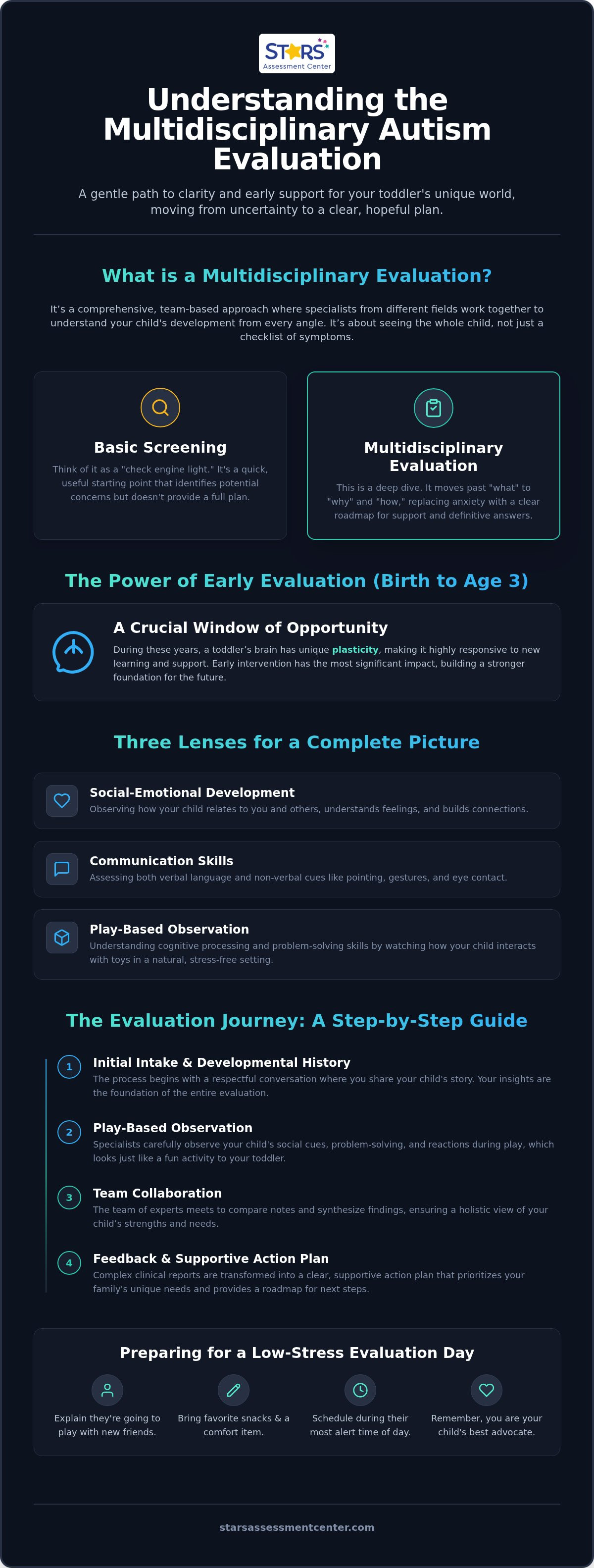
Think of a screening as a quick "check engine light" at the pediatrician's office. It's a useful starting point, but it doesn't provide a plan. A multidisciplinary autism evaluation for toddlers is a deep dive. It moves past the "what" and gets into the "why" and "how," replacing anxiety with a clear roadmap for support. This approach reduces the stress of the unknown by providing definitive answers and a supportive partnership from the very beginning.
The Core Components of a Toddler Assessment
We look at the whole child through three main lenses to build a complete picture. First, we evaluate social-emotional development, which is how your child relates to you and others. Second, we assess communication skills, looking at both verbal words and non-verbal cues like pointing or eye contact. Finally, we use play-based observations. Experts watch how your child interacts with toys to understand their cognitive processing and problem-solving skills in a natural, stress-free environment. This helps us see how they learn and process information in the real world.
Why Early Evaluation (Birth to Three) is Critical
The period from birth to age three is a window of incredible opportunity. During these years, a toddler’s brain possesses unique plasticity, meaning it's highly responsive to new learning and support. By identifying needs early, we can start intervention when it has the most significant impact. Addressing social or communicative delays now helps build a stronger foundation before your child enters the more structured environment of school. It’s about giving them the best possible start during their most formative years by matching them with the right resources at the right time.
The Step-by-Step Multidisciplinary Evaluation Process
The journey begins with a deep, respectful conversation. We start with an initial intake and developmental history where you share your child's story. You know your toddler better than anyone else, and your insights are the foundation of the entire multidisciplinary autism evaluation for toddlers. We look at milestones, early habits, and those small gut feelings you've had since they were an infant. This history helps us understand the context of your child's current behaviors and unique personality.
Next comes the play-based observation. While it might look like your child is just having fun with new toys, our specialists are carefully watching how they interact. We look for social-emotional cues, how they problem-solve, and how they react to transitions. Afterward, our team of experts meets to compare notes. A multidisciplinary autism evaluation for toddlers ensures that every specialist has a seat at the table to form a holistic view of your child's strengths and needs. By looking at the data together, we avoid the narrow perspective of a single-provider exam.
Preparing Your Toddler (and Yourself) for the Day
Keeping the day low-stress is our top priority. We recommend bringing your child's favorite snacks, a familiar comfort item like a blanket, and a few toys they love. Try to schedule the evaluation during their most alert time of day, usually after a morning nap. It's also helpful to explain to your child that they're going to play with some new friends. Managing your own anxiety is just as important. Remember, you aren't just an observer; you're your child's best advocate. If you feel uncertain, our multidisciplinary developmental assessment team is here to guide you through every step with patience and warmth.
Standardized Tools and Play-Based Methods
Clinicians use specialized toddler evaluations to gather objective data. Tools like the ADOS-2 or the M-CHAT-R help us identify specific patterns in a toddler context. We pay close attention to joint attention, which is when a child shares an interest in an object with another person, such as pointing at a toy to show you. We also look for social reciprocity, the natural give-and-take of interaction. For a child under three, play is their most important work. It's the most authentic way for us to see how they process the world around them without the pressure of a clinical environment. This approach allows us to see their true personality shine through.
Meeting the Team: Who Evaluates Your Child?
When you walk through our doors, you aren't just meeting medical professionals. You're meeting a dedicated group of specialists who've committed their careers to supporting families during these vital early years. A multidisciplinary autism evaluation for toddlers works because it brings several viewpoints together at once. Instead of visiting different clinics weeks apart, you benefit from a coordinated team that sees your child as a whole person. This collaborative approach prevents "siloed" diagnoses, where one person might miss what another specialist catches.
Each member of the team brings a specific lens to the assessment. The Developmental Specialist acts as a guide for tracking milestones, looking at the big picture of your child's growth from birth to age three. The Speech and Language Pathologist focuses on how your child shares their world, watching for the intent to communicate rather than just listening for sounds. Our Social-Emotional experts look at how your child builds relationships and manages their feelings, which is often the most nuanced part of identifying autism in very young children. By working together, these experts ensure that every part of your child's development is understood and supported.
Speech and Language Evaluation Basics
It's common for parents to notice a speech delay first, but our specialists look deeper to distinguish between a simple delay and social communication challenges. We evaluate receptive language, which is what your toddler understands, not just what they say. For example, we watch to see if they follow a simple direction like "find your shoes" or respond to their name. A specialized speech evaluation toddlers Santa Clara County helps identify early communication needs by looking at how your child uses gestures, eye contact, and sounds to interact with the people they love.
Social-Emotional and Behavioral Observation
This part of the evaluation is often where parents feel the most heard. We observe how your child regulates their emotions and interacts with others in the room. It’s helpful to distinguish between typical toddler temperament, like the "terrible twos," and specific signs of autism. You play a vital role here. By sharing how your child behaves at home or in the park, you provide the "natural setting" data that helps us see the full picture. We're partners in this, and your observations are just as important as our clinical tools. This shared knowledge allows us to create a plan that fits your child's real life, not just their time in the clinic.
Navigating the Evaluation Process in Santa Clara County
Finding a multidisciplinary autism evaluation for toddlers in our region doesn't have to be a journey you take alone. In California, the process is built around a partnership between families and specialized local agencies. Stars Assessment Program works as a dedicated ally within this system, providing clear answers for families in San Jose, Milpitas, and Morgan Hill. We understand that the paperwork and referral steps can feel daunting when you're already concerned about your child's growth. Our goal is to make the local path to support as smooth and transparent as possible.
The system is designed to catch delays early. If you live in Santa Clara, Santa Cruz, or the surrounding South Bay cities, your primary point of contact for state-funded support is the regional center. They act as the gateway to the services your child may need during these formative years. It's a structured process, but it's one that prioritizes your child's right to thrive in their own community.
Regional Center Referrals and Eligibility
The referral process for children under age three typically begins with a phone call or an online request for an intake. The san andreas regional center plays a vital role in funding local assessments to determine if a child qualifies for early intervention. Once a referral is made, a service coordinator is assigned to help guide your family through the next steps. If your child is found eligible after their multidisciplinary autism evaluation for toddlers, the team works with you to create an Individualized Family Service Plan (IFSP). This plan isn't just a document; it's a customized roadmap that outlines the specific supports and goals tailored to your child's unique needs and your family's daily life.
Support for Families in the South Bay and Central Coast
We're proud to serve a diverse community that spans from the busy streets of San Jose to the coastal air of Santa Cruz. Finding a developmental specialist for infants in Santa Cruz or Morgan Hill is the first step toward gaining peace of mind. Our local assessments are conducted with deep cultural sensitivity, ensuring that language barriers or cultural differences never stand in the way of a child receiving care. Families in Salinas, Milpitas, and Gilroy also have access to robust parent networks and community groups where they can connect with others walking a similar path. If you're ready to take the next step for your child, you can start your journey with Stars Assessment Program today. We're here to provide the expertise and the heart your family deserves.
After the Evaluation: Understanding Results and Next Steps
The final meeting of a multidisciplinary autism evaluation for toddlers is often the most important conversation you'll have. This feedback session is designed to be a calm, empathetic space where we review our findings together. We don't just hand you a stack of papers and send you on your way. Instead, we walk through each observation, explaining how your child's unique behaviors fit into the larger picture of their development. Our goal is to ensure you leave the room feeling empowered, not just informed.
Decoding the evaluation report is the next step in your journey. While these documents contain precise clinical data, we help you translate that information into a living plan. Because our assessment is multidisciplinary, the results are already integrated across different domains like communication and social-emotional growth. This means your child's early intervention plan will be highly targeted. You won't have to guess which support to prioritize first; the report provides a clear hierarchy of needs based on our team's collective expertise. This creates a long-term partnership where we remain a steady ally for your family.
When the Results Point to Autism
Receiving a diagnosis can trigger a whirlwind of emotions. Whether you feel a sense of relief at finally having an answer or a heavy heart about the road ahead, your feelings are valid. It's okay to take time to process this news. We encourage families to look beyond the diagnosis to see their child’s individual "superpowers." Perhaps it's their incredible focus on details, their musical ear, or their infectious smile. These strengths are the foundation we build upon. Your immediate next steps involve sharing the report with your pediatrician and contacting local service providers to begin the supports identified during the multidisciplinary autism evaluation for toddlers.
Your Advocacy Journey Begins
The evaluation report is your primary tool for securing the services your child deserves. To stay organized, we recommend starting a "developmental binder" for your toddler. Keep copies of the assessment, your Individualized Family Service Plan (IFSP), and any progress notes from specialists in one place. This helps you track growth and ensures every professional you work with is on the same page. Remember, you're the expert on your child, and we're here to be your guide as you navigate this new path. Schedule a compassionate consultation with Stars Assessment Program today.
Taking the Next Step Toward Clarity and Support
Seeking answers for your child's growth is a powerful act of love and advocacy. You've seen how a team-based approach moves past simple screenings to provide a complete picture of your toddler's social-emotional and communicative world. By focusing on the critical window from birth to age three, you're giving your child the best possible start during a time of incredible brain development. This early roadmap ensures that no strength goes unnoticed and no need goes unsupported.
Investing in a multidisciplinary autism evaluation for toddlers is more than just a clinical step; it's the beginning of a supportive partnership. As an employee-owned organization and a member of the Stars Behavioral Health Group, we're deeply committed to being a safe harbor for families in San Jose and across the South Bay. Our specialists focus exclusively on the needs of very young children to ensure your family receives the gentle, expert care you deserve.
Begin your child’s developmental journey with a multidisciplinary assessment.
You don't have to navigate this path alone. With the right team by your side, you can move forward with confidence, clarity, and a plan that celebrates your child's unique potential. Your journey toward understanding starts here, and we're honored to walk it with you.
Frequently Asked Questions
How long does a multidisciplinary autism evaluation take for a toddler?
A comprehensive multidisciplinary autism evaluation for toddlers typically lasts between two and four hours. This timeframe allows our team of specialists to conduct play-based observations, parent interviews, and standardized assessments without rushing your child. We often schedule breaks or split the evaluation into smaller segments if a toddler needs more time to feel comfortable. Our goal is to gather accurate data while keeping the experience low-stress for both you and your little one.
Will my child be diagnosed with autism after just one visit?
Most families receive a clear diagnostic picture after the team completes their collaborative review, which often happens shortly after the evaluation visit. While the physical assessment occurs in one primary timeframe, our experts spend additional time comparing observations from the speech and social-emotional specialists. We then schedule a dedicated feedback session to discuss the findings with you. This ensures you have a chance to process the information and ask questions in a supportive environment.
What is the difference between a screening at the pediatrician and a multidisciplinary evaluation?
A pediatrician’s screening is a quick tool, like the M-CHAT-R, used to identify potential red flags during routine checkups. It doesn't provide a diagnosis. In contrast, a multidisciplinary evaluation is a deep-dive assessment performed by a team of experts. This process looks at your child’s cognitive, communicative, and social-emotional domains to provide a formal diagnosis and a specific roadmap for support. It moves beyond identifying a concern to creating an actionable plan for your family.
Does insurance or the Regional Center cover the cost of the evaluation?
In Santa Clara County, the San Andreas Regional Center typically funds these evaluations for children under age three who meet specific criteria for developmental delays. Many private insurance plans also provide coverage for a medical diagnosis of autism, though out-of-pocket costs like copays or deductibles may apply. We recommend contacting your insurance provider or your regional center service coordinator to confirm your specific coverage details before beginning the multidisciplinary autism evaluation for toddlers.
What happens if my toddler is too shy or has a tantrum during the assessment?
Our team fully expects toddlers to be shy, tired, or even have a tantrum during their visit. These behaviors are actually helpful pieces of information that show us how your child regulates their emotions and handles new environments. We use gentle, play-based methods to help your child feel safe and engaged. If your toddler is having a particularly difficult day, we can pause the session or adjust our approach to ensure we see their most authentic self.
Can a two-year-old really be accurately diagnosed with autism?
Yes, specialists can accurately identify autism in children as young as 18 to 24 months. Research shows that a diagnosis made at this age by an experienced multidisciplinary team is highly stable and reliable. Early identification is vital because it allows families in San Jose and Milpitas to access specialized support during the brain's most plastic years. By identifying needs early, we can start interventions that build a stronger foundation for your child's communication and social skills.
What should I do if I disagree with the evaluation results?
You are an essential member of the assessment team, and your perspective matters. If the results don't align with what you see at home, we encourage you to share your specific concerns with the specialists during the feedback session. You always have the right to seek a second opinion or request an Independent Educational Evaluation (IEE) through your local school district or regional center. Our goal is a partnership that feels accurate and supportive for your family's journey.
How soon can we start early intervention services after the assessment?
Services can often begin as soon as the eligibility and Individualized Family Service Plan (IFSP) are finalized. In cities like Morgan Hill and Gilroy, the regional center works quickly to connect eligible families with local providers once the evaluation is complete. Our team provides the necessary documentation to streamline this transition. Having a clear evaluation report in hand allows you to advocate for the specific speech or social-emotional supports your child needs to thrive right away.


