
You're sitting at a park in San Jose, watching your toddler play, when a quiet thought begins to tug at your heart: "Should they be reaching that milestone by now?" It's a moment many parents face, filled with love and a sudden, sharp anxiety. If you've been searching for an early intervention assessment Santa Clara County, you aren't just looking for a checklist. You're looking for a way to understand your child's unique rhythm and ensure they have every opportunity to flourish.
It's natural to feel overwhelmed by the San Andreas Regional Center (SARC) system or worried about what a developmental evaluation might mean. We believe that seeking answers is an act of bravery and the first step toward empowerment. This guide provides a clear roadmap for 2026, helping you understand the referral process with confidence. You'll discover how the Stars Assessment Program supports families through multidisciplinary evaluations to secure the tools your child needs to thrive. We will walk through eligibility criteria, the 45 day timeline, and exactly what to expect.
Key Takeaways
- Understand that early intervention is a supportive, specialized process designed specifically for infants and toddlers from birth to age three.
- Learn how an early intervention assessment Santa Clara County uses a multidisciplinary team approach to gain a holistic view of your child's unique development.
- Discover why trusting your parental intuition is the most important first step and which specific communication red flags warrant a professional evaluation.
- Get a clear, step-by-step roadmap of the referral and intake process through the San Andreas Regional Center (SARC) to reduce uncertainty.
- See how the Stars Assessment Program serves as your dedicated local partner, providing the expertise and compassion your family needs to thrive.
What is Early Intervention Assessment in Santa Clara County?
Early intervention is a specialized support system designed for infants and toddlers from birth to age three. In California, this collaborative effort is known as the "Early Start" program. It operates under the federal Individuals with Disabilities Education Act (IDEA) Part C, which ensures that families receive the help they need during the most formative years of a child's life. An early intervention assessment Santa Clara County is the essential first step in this journey. It isn't a hurdle to clear; it's the key that unlocks access to a wide range of community resources and professional guidance tailored to your family's needs.
When families ask What is Early Childhood Intervention?, they often discover it's a philosophy of partnership. The process focuses on the child's environment and the family's daily routines. By identifying developmental delays early, we can provide targeted support that helps children reach their unique potential. This proactive approach turns uncertainty into a clear, actionable plan for growth.
The Role of the San Andreas Regional Center (SARC)
SARC serves as the primary gateway for early intervention services in our region. They coordinate the "Early Start" program and ensure that every child who meets the 25% developmental delay threshold receives the necessary support. SARC works closely with specialized partners like the Stars Assessment Program to conduct evaluations. It's a relief for many parents to learn that these assessments are provided at no cost to eligible families. This ensures that financial barriers never stand in the way of a child's development. SARC acts as your advocate, helping you navigate the system and connecting you with specialists who understand the local landscape of San Jose and surrounding cities.
Why Early Intervention Matters Now
The first three years of life are a window of incredible opportunity. This is because of neuroplasticity, the brain's remarkable ability to form new connections and adapt rapidly. During this stage, a child's brain is more flexible than it will ever be again. Providing support now is significantly more effective than waiting until a child enters the school system. Early intervention can often reduce the need for more intensive special education services in the future. It's a gift of time and support. Acting now isn't about labels; it's about providing the right tools at the most impactful moment. Your intuition is powerful, and taking this step is the best way to honor it.
The Multidisciplinary Developmental Assessment: A Holistic View
When you prepare for an early intervention assessment Santa Clara County, it's helpful to realize this isn't just a standard doctor's visit. Instead, it's a team-based approach designed to see the "whole child." This multidisciplinary method brings together different experts who look at how various areas of growth overlap. A child who isn't speaking yet might actually be struggling with a physical motor delay or a social-emotional hurdle. By looking at everything at once, we ensure no "hidden" delays are missed. A thorough early intervention assessment Santa Clara County provides the peace of mind that every stone has been turned.
The evaluation focuses on five core domains. These include cognitive skills (learning and thinking), physical development (vision, hearing, and movement), and communication. We also place a high priority on social-emotional assessment. For toddlers, the ability to connect with others and manage feelings is a vital foundation for all other learning. This comprehensive view is a hallmark of California's Early Start Program, which prioritizes a family-centered perspective over a narrow medical diagnosis.
Meet the Specialists on Your Child’s Team
Your child's team is hand-picked to provide the most accurate picture of their development. Speech and language pathologists (SLPs) look beyond just words; they evaluate how your child understands language and uses gestures to communicate. Developmental specialists focus on the "work" of childhood: play. They observe how your child solves problems or uses toys to understand cognitive milestones. We also include social-emotional experts who offer behavioral insights, helping you understand your child's unique temperament and interaction style. This collaborative spirit ensures you get a 360-degree view of your child's strengths.
Specialized Screenings: Autism and Down Syndrome
Sometimes, a parent or pediatrician has a specific concern about conditions like Autism or Down Syndrome. We integrate these screenings into the broader assessment process with a gentle, play-based approach. It's designed to be low-stress for your little one. If you're curious about the difference between a quick check and a deep dive, you can read more about Autism Screening vs. Evaluation for Toddlers. Our goal is to provide clarity while maintaining a supportive environment. If you're ready to see how a multidisciplinary team can support your family, reaching out for an initial conversation is a wonderful next step.
Recognizing the Signs: When to Seek an Evaluation
You know your child better than anyone else. Often, the first sign that a child might need extra support isn't a medical test, but a parent's quiet intuition. This "parental instinct" is a powerful tool. If you find yourself comparing your toddler's progress to their peers or feeling that something is just slightly off, it's okay to seek clarity. An early intervention assessment Santa Clara County isn't about finding something wrong. It's about understanding how your child learns and ensuring they have the right environment to grow. Trusting your gut now can make a world of difference in your child's future.
Developmental delays can appear in several ways. Some are physical, such as a baby who hasn't started rolling over, sitting up, or crawling by the expected ages. Others are social, like a toddler who rarely makes eye contact or seems to prefer playing alone in a repetitive way. These signs aren't definitive proof of a long term challenge, but they are indicators that a multidisciplinary team should take a closer look. Identifying these cues early allows for a much more effective and gentle support plan.
Communication and Speech Milestones
Language development is one of the most common reasons families seek an early intervention assessment Santa Clara County. While every child grows at their own pace, there are general goals to keep in mind. By 12 months, most babies are babbling and using simple gestures like waving. By 18 months, they typically have a handful of spoken words. By age two, you'll often hear two-word phrases like "more milk." If your child isn't pointing to show you things or seems frustrated when trying to communicate, our Santa Clara County Toddler Speech Evaluation Guide can help you decide if it's time for a professional evaluation. "Late talking" is frequently the first bridge to broader developmental support.
Social-Emotional and Behavioral Indicators
We also look closely at social-emotional cues, such as "joint attention." This is when a child looks at an object and then looks back at you to share the experience. It's a fundamental building block for learning and connection. If a child struggles with regulation or shows very limited interest in interactive play, it may suggest a need for specialized social-emotional support. You can explore these nuances further in our guide on Understanding Social Emotional Milestones in Infants. These assessments help us identify if a child needs help managing their environment or building the foundational skills needed for social success.
The Step-by-Step Assessment Process in Santa Clara County
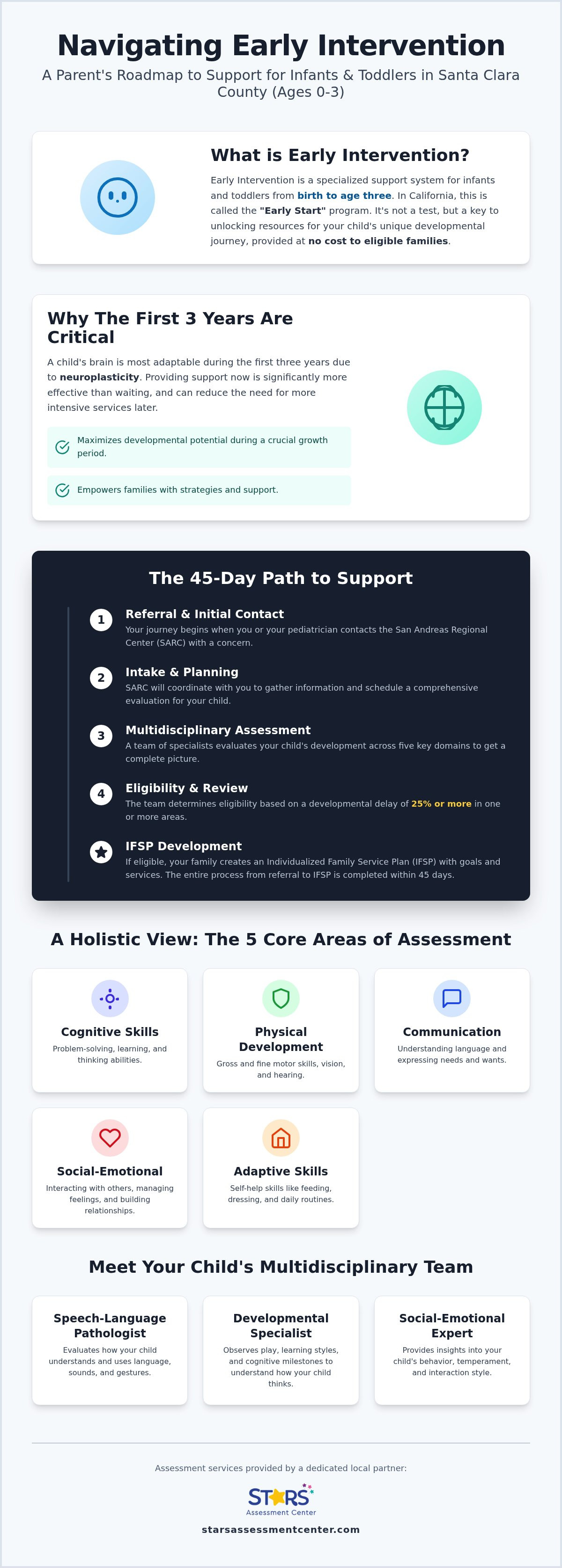
Knowing the path ahead can turn a stressful experience into a manageable journey. In California, the law requires that an early intervention assessment Santa Clara County be completed within 45 days of your first contact. This timeline is designed to ensure your child receives support during their most critical stages of growth. The process is collaborative and transparent, keeping you involved at every turn.
- Step 1: The Referral. You can begin by contacting the San Andreas Regional Center (SARC) or reaching out to the Stars Assessment Program directly at 1-844-701-9889. You don't need a doctor's note to start this process.
- Step 2: The Intake Interview. This is a gentle conversation where a coordinator listens to your concerns, gathers developmental history, and explains your rights.
- Step 3: The Observation and Play-Based Evaluation. Specialists meet with your child to observe their skills in a natural, low-pressure environment.
- Step 4: The Findings Meeting and IFSP Development. We meet to discuss the evaluation results. If your child is eligible, we create a plan for services together.
What Happens During the Evaluation?
To your child, the evaluation feels like a simple playdate. We use "play-based" assessments because toddlers show their true abilities best when they're comfortable and engaged. You aren't just a spectator in this process; you are an active co-observer. Your knowledge of your child's daily habits and personality is vital for an accurate picture. Evaluations can take place in the familiar setting of your home or at a local clinic, whichever feels most supportive for your family.
Understanding the IFSP (Individualized Family Service Plan)
The IFSP is a legal document that serves as your roadmap for support. It's unique because it doesn't just focus on the child; it focuses on the family's goals and daily routines. The plan outlines which services will be provided, how often they'll happen, and where they'll take place. This document is a living thing, reviewed every six months to stay current with your child's rapid progress. For a deeper look at how these milestones are tracked, explore our Early Childhood Developmental Screening: A Parent’s Guide. If you're ready to take the first step, our team at Stars Assessment Center is ready to help you navigate the system with care.
Stars Assessment Program: Your Local Partner in Growth
When you seek an early intervention assessment Santa Clara County, you deserve more than just a clinical report. You need a partner who understands the local community and the unique challenges families face. The Stars Assessment Program serves as the dedicated multidisciplinary specialist for our region, acting as the contracted provider for the San Andreas Regional Center (SARC). Our team isn't just a group of experts; we're your neighbors. We have deep roots in San Jose, Milpitas, Gilroy, and the surrounding cities, ensuring that our care is as accessible as it is professional.
We believe that every family brings a rich cultural background that deserves respect and understanding. Our approach is built on cultural sensitivity and a family-centered heart. We don't just look at milestones in isolation; we look at how your child interacts within your specific family dynamic and daily routines. This ensures that the support we recommend isn't just technically sound, but practically useful for your everyday life. We're here to provide a safe harbor where your concerns are heard and your child's potential is celebrated.
Why Families in Santa Clara County Trust Stars
One of the things that sets us apart is that we are an employee-owned organization (ESOP). This means every member of our team, from our speech pathologists to our developmental specialists, is personally invested in the success of the families we serve. We take pride in our specific expertise in social-emotional and multidisciplinary assessments, providing a level of depth that helps clarify complex developmental pictures. Whether you're concerned about general delays or seeking a Down Syndrome Early Intervention Guide, our specialists offer the nuance and compassion required for these delicate evaluations.
- Multidisciplinary Team: Experts from different fields working together for a single, cohesive view.
- Birth to Three Focus: Specialized knowledge of the most rapid period of human development.
- Community Commitment: A local presence that understands the SARC system inside and out.
Taking the First Step Toward Clarity
It's okay to feel a mix of hope and hesitation. Please remember that seeking an early intervention assessment Santa Clara County is an act of profound love. It's the best way to advocate for your child's future and secure the resources they need to thrive. You don't have to wait for a "perfect" time to ask for help; the best time is always now. Requesting an assessment is a straightforward process designed to support you, not overwhelm you.
To begin, you can call our team directly at 1-844-701-9889 or reach out through the San Andreas Regional Center. We'll guide you through the initial intake and stay by your side until a clear path forward is established. Your child has a unique journey ahead, and we're honored to help you navigate the first steps. Contact the Stars Assessment Program today to find the clarity and support your family deserves.
Empowering Your Child's Developmental Journey
Navigating your child's early years is a journey filled with discovery; sometimes, it requires a little extra guidance. By understanding the role of an early intervention assessment Santa Clara County, you've already taken a significant step toward advocacy. You now know that the process is designed to be a supportive, play-based experience that honors your family's unique routines and cultural background. Whether you've noticed subtle communication shifts or are seeking clarity on motor milestones, professional support is closer than you think.
As the official SARC assessment partner for the region, Stars Assessment Program has supported families in San Jose and across Santa Clara County since 1988. Our multidisciplinary team of developmental experts focuses exclusively on children from birth to age three, ensuring your little one receives specialized care during their most formative stage of growth. You don't have to walk this path alone; we are here to act as your steady ally and guide.
Request an Early Intervention Assessment for Your Child today to gain the clarity and support your family deserves. Your child's potential is limitless, and we're here to help them shine every step of the way.
Frequently Asked Questions
How do I know if my child qualifies for early intervention in Santa Clara County?
Your child may qualify if they are between birth and 36 months old and meet specific state criteria. This includes having a developmental delay of at least 25% in one or more areas, such as communication, social-emotional skills, or physical growth. Children with established risk conditions or those at high risk due to biomedical factors are also eligible. An early intervention assessment Santa Clara County is the most reliable way to determine if your child meets these 2026 standards.
Is there a cost for a developmental assessment through the Regional Center?
There is no cost for the evaluation, assessment, and service coordination required to determine your child's eligibility for Early Start services. This ensures that every family can access the answers they need without financial worry. While the initial assessment is free, families receiving ongoing services may be assessed an Annual Family Program Fee based on income. Families with annual incomes below 400% of the Federal Poverty Level are not assessed this fee.
How long does the assessment process usually take?
The entire process, from your initial contact to the creation of an Individualized Family Service Plan (IFSP), is completed within 45 days. This legal timeline ensures that your child doesn't lose valuable time during their most formative years of brain development. Our team works efficiently to coordinate the multidisciplinary evaluation, review the findings with you, and establish a support plan immediately if your child is found eligible for services.
Do I need a doctor’s referral to get an assessment for my toddler?
No, you don't need a doctor's referral to request an evaluation for your child. While many pediatricians suggest an assessment during well-child visits, parents have the right to self-refer if they have concerns about their child's development. You can reach out directly to the San Andreas Regional Center or the Stars Assessment Program to start the process. Your intuition as a parent is a valid and sufficient reason to seek professional guidance.
What is the difference between a screening and a full evaluation?
A screening is a brief "snapshot" used to see if a child is meeting typical milestones or if more testing is needed. In contrast, a full multidisciplinary evaluation is a deep dive into all five areas of development. This comprehensive assessment involves a team of specialists who determine if a child meets the 25% delay threshold for eligibility. Evaluations provide a much more detailed roadmap for support than a simple screening can offer.
Where do the assessments take place in San Jose or Milpitas?
Assessments are designed to be as comfortable as possible for your little one. They can take place in your family home, where your toddler feels most secure, or at one of our local clinic settings in San Jose. We serve families across the region, including Milpitas, Gilroy, and Morgan Hill. By observing your child in a natural environment, our team can gather the most accurate information about their daily skills and interactions.
What happens if my child is found ineligible for services?
If your child doesn't meet the 25% delay threshold for Early Start, we won't leave you without answers. Our team will provide a clear explanation of the findings and suggest community resources or local programs that can still support your child's growth. You can also monitor their progress and request a new early intervention assessment Santa Clara County in the future if new concerns arise as your child continues to develop.
Can I request a specific provider like Stars Assessment Program?
Yes, you can request our services. The Stars Assessment Program is the specialized multidisciplinary team contracted by the San Andreas Regional Center (SARC) to serve infants and toddlers in this region. When you contact SARC to request an evaluation, you can mention your preference for working with our team. We have been a trusted partner for families in San Jose and the surrounding cities since 1988, providing expert, compassionate care.


