
You're sitting at a park in San Jose, watching your toddler play, when you notice the other children are already pointing at birds or calling out simple names. Your little one seems content but hasn't quite reached those same markers yet. It's common to wonder if you're seeing actual signs of developmental delay in 2 year old children or if your child is simply a late bloomer who will catch up in their own time. This uncertainty often brings a heavy sense of anxiety, especially when milestone charts online seem to contradict one another.
We understand how isolating it feels to have these quiet concerns while everyone else tells you not to worry. Your intuition as a parent is a powerful tool, and seeking clarity is an act of love, not an overreaction. In this guide, you'll learn how to recognize the subtle signs of developmental delays in your two-year-old and discover how early intervention in Santa Clara County can support your child's unique journey. We'll walk through the social-emotional and communicative milestones for this age and provide a clear roadmap for getting a professional multidisciplinary assessment right here in our community. You aren't alone in this process; we're here to provide the steady guidance your family deserves.
Key Takeaways
- Learn to distinguish between typical growth and the five core domains of development to better understand your child's unique progress.
- Identify specific signs of developmental delay in 2 year old children, ranging from subtle social-emotional cues to communication red flags.
- Discover why the window between birth and age three is the most critical time for brain adaptability and how early support prevents secondary challenges.
- Gain a step-by-step plan for documenting your observations and using standardized checklists to prepare for a professional assessment.
- Learn how to navigate local Santa Clara County resources like the San Andreas Regional Center and the Stars Assessment Program for a comprehensive evaluation.
Understanding Developmental Delays at Age Two
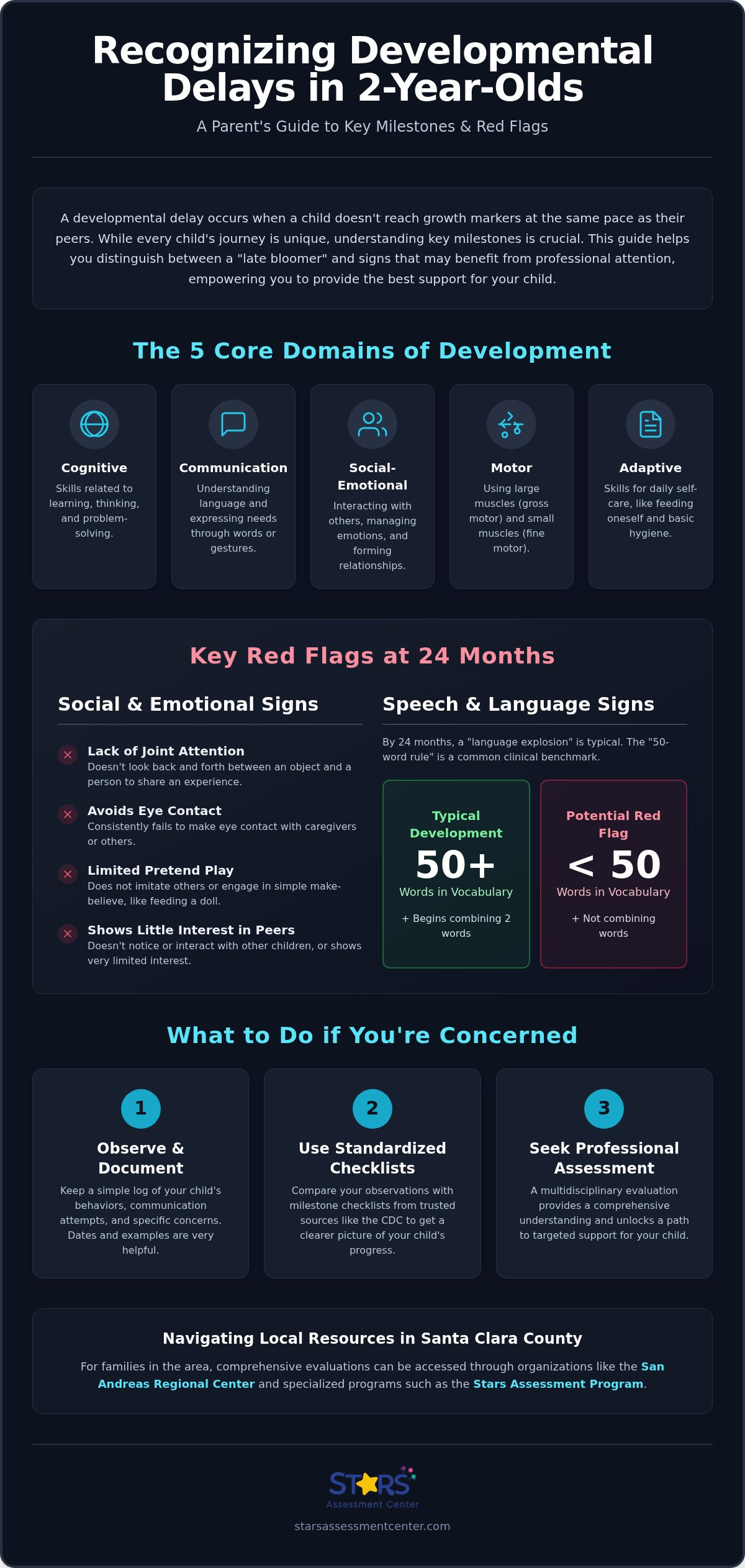
A developmental delay occurs when a child does not reach specific growth markers at the same pace as their peers. While every child follows their own unique timeline, these markers help us understand how a child is processing the world. A milestone is a functional skill achieved by most children by a specific age. When we look for signs of developmental delay in 2 year old children, we typically evaluate five core domains: cognitive, communication, social-emotional, motor, and adaptive skills. Cognitive skills involve learning and problem-solving, while adaptive skills relate to daily self-care like using a spoon.
Parents often hear the term "late bloomer" from well-meaning friends or family. It is a common myth that all children will eventually catch up on their own without support. While some children do find their stride a bit later, waiting too long can miss the window where intervention is most effective. Choosing to investigate your concerns isn't about looking for problems. It is about ensuring your child has the right "scaffolding" to climb their own developmental ladder with confidence.
The Difference Between a Delay and a Disability
It's helpful to understand that a delay and a disability are not the same thing. A delay suggests a child is moving through the usual stages of growth but at a slower pace. A disability often refers to a long-term condition that may require ongoing, specialized support. Understanding Developmental Delays involves recognizing that a lag in two or more of those five core areas is sometimes called a global delay. This distinction matters because it changes how we approach support.
The best way to gain clarity is through a multidisciplinary developmental assessment. This process brings together different experts to look at your child as a whole person rather than just a list of symptoms. We want to reassure you that an assessment is a tool for support. It's a way to unlock resources and understanding rather than a permanent label that defines or limits your child's future potential.
Why the 24-Month Mark is a Critical Milestone
The second birthday is a major turning point. This is the age where we usually see a "language explosion" and a new level of social curiosity. Because so much growth happens at once, pediatricians prioritize the 2-year checkup for formal developmental screenings. It is a high-growth window where the brain is incredibly flexible and ready to learn.
This flexibility is known as neuroplasticity. It's the reason early identification is so powerful. When we identify signs of developmental delay in 2 year old toddlers early, we can use that natural brain adaptability to build new pathways and skills. Catching a delay now often means a much smoother transition into preschool and a stronger foundation for the years ahead.
Key Red Flags: Signs of Delay in 2-Year-Olds
Watching your child grow is a journey filled with wonder. Sometimes, you might notice moments that feel different from what you see in other toddlers. Identifying signs of developmental delay in 2 year old children early is one of the most proactive steps you can take for their future. While every child has "off" days, persistent patterns in how they play, speak, and move provide valuable clues about their development.
Social and Emotional Warning Signs
At this age, children usually start showing a deep interest in the people around them. One major concept to watch for is "joint attention." This happens when your child looks at an object you point to, like a plane in the sky, and then looks back at you to share the experience. A lack of this shared focus, or a persistent lack of eye contact, can be a signal that your child needs more support.
Pretend play, like feeding a stuffed animal or "talking" on a toy phone, should also begin to emerge. If your child doesn't notice when others are upset or shows very limited interest in peers, it might be time to look into an autism screening vs evaluation to get a clearer picture of their social-emotional world. Early identification in this domain helps children learn to navigate their feelings and connect with others more easily.
Speech and Language Milestones at 24 Months
By the time a child is 24 months old, many clinicians look for the "50-word rule." Most toddlers should have a vocabulary of at least 50 words and begin using simple two-word phrases like "More juice" or "Mama go." It's also vital to distinguish between expressive language, which is what they say, and receptive language, which is what they understand. Reviewing CDC developmental milestones can help you track these specific markers.
If your child struggles to follow simple two-step instructions, such as "Pick up the ball and put it in the box," they may have a receptive delay. This can be frustrating for a toddler and often leads to behavioral outbursts. If your child isn't talking yet or seems to have lost previously held skills, our toddler speech evaluation guides offer a helpful place to start your research.
Cognitive and Motor Development Concerns
Cognitive growth involves basic problem-solving and memory. By age two, children should understand object permanence and begin simple sorting by shapes or colors. Red flags include difficulty with basic problem-solving toys or an inability to follow your lead during play. Physical milestones are equally important for independence. You should watch for:
- Difficulty walking or frequent falling during everyday play
- Inability to walk up stairs or kick a ball
- Fine motor struggles like not being able to turn book pages or stack four blocks
- Difficulty using a spoon to feed themselves during meals
If these signs of developmental delay in 2 year old toddlers feel familiar, a multidisciplinary developmental assessment can provide the comprehensive answers you need to move forward with confidence and peace of mind.
Why Early Identification is a Gift for Your Child
When you notice potential signs of developmental delay in 2 year old toddlers, it's natural to feel a sense of hesitation. You might wonder if you're overthinking things or if your child will simply grow out of it. However, reframing this discovery as a gift rather than a burden can change your entire approach. Early identification isn't about finding what's "wrong" with your child; it's about providing the specific resources they need while their brain is in its most flexible state.
Proactive screening is always safer than the "wait and see" approach. Many parents are told to give it time, but waiting can lead to secondary challenges. For example, a child who can't express their needs often becomes frustrated, which can lead to behavioral outbursts. By addressing the root cause early, you can prevent these additional layers of stress for both you and your child. Seeking expert guidance on developmental delays ensures you have the facts necessary to make informed decisions for your family's future.
The Power of Neuroplasticity in Toddlers
The period from birth to age three is often called the "gold standard" for intervention because of how the brain develops. During these years, the brain is incredibly adaptable, a quality known as neuroplasticity. Therapy doesn't just teach skills; it actually helps "rewire" neural pathways to make learning easier and more natural. In the first three years of life, a child’s brain forms over one million new neural connections every second.
This high-growth window is a unique opportunity that doesn't repeat. When we identify signs of developmental delay in 2 year old children during this stage, we're working with the brain's natural momentum. Intervention services are significantly more effective when they begin during this peak period of adaptability. This early support sets a much stronger foundation for preschool and helps your child reach their full potential with less struggle.
Overcoming the Stigma of Developmental Support
It's easy to feel overwhelmed by the idea of a formal assessment, but we invite you to view it as a roadmap for growth. Knowing your child’s specific needs doesn't limit them. Instead, it empowers you to be their best advocate. At Stars, our multidisciplinary team believes in family-centered care that respects your child's personality and your family's values. We don't just look at a checklist; we look at the whole child.
We see ourselves as a safe harbor where parents can find clarity and hope. By identifying your child's unique learning style now, you're giving them the tools to flourish on their own terms. This support is a partnership designed to build confidence, not just for your child, but for you as a parent as well. Understanding their journey today makes the path forward much clearer and more manageable.
Taking Action: What to Do if You Are Concerned
If you've noticed potential signs of developmental delay in 2 year old toddlers, the next steps are about gathering clear information. Start by using a standardized tool like the Ages and Stages Questionnaire (ASQ) or the Modified Checklist for Autism in Toddlers (M-CHAT). These checklists provide a structured way to look at your child's skills and compare them to typical growth markers. Spend the next week documenting specific moments that concern you. Write down what happened, the time of day, and how your child reacted. This documentation transforms a gut feeling into a clear record that helps professionals understand your child's daily life.
How to Talk to Your Pediatrician
Schedule a visit specifically for developmental concerns rather than trying to squeeze the conversation into a routine physical. Seeing signs of developmental delay in 2 year old children in a clinical setting requires a dedicated appointment where the doctor can focus entirely on your observations. A standard screening is often just a brief questionnaire, but a comprehensive evaluation is a much deeper look at your child's strengths and needs. If you feel your concerns aren't being fully addressed, trust your intuition. You have the right to ask for a referral even if your doctor suggests waiting. Use these specific questions to guide the conversation:
- Can you review these specific behaviors I've documented over the last week?
- How does my child’s communication compare to the majority of children their age?
- What are the specific steps for a multidisciplinary referral in our county?
- Does my child qualify for a more intensive evaluation rather than just a basic screening?
Using the CDC Milestone Tracker App
Digital tools like the CDC Milestone Tracker app are excellent for monitoring progress over time. They allow you to check off milestones and even upload photos or videos of your child’s behavior. While these apps are helpful for organization, they aren't a substitute for a professional social emotional assessment. Use the app to organize your thoughts and then bring your phone to the assessment appointment. Showing a video of a specific behavior can be much more descriptive than trying to explain it from memory during a short office visit.
If you're ready to move beyond checklists and get a complete picture of your child's growth, you can request a multidisciplinary developmental assessment with our dedicated team today. We're here to help you turn your concerns into a clear plan for your child's future.
Navigating Local Resources in Santa Clara County
For families in San Jose, Salinas, and throughout Santa Clara County, the San Andreas Regional Center (SARC) serves as the essential gateway to support. SARC manages the Early Start program, which focuses on the critical window from birth to 36 months. If you've observed signs of developmental delay in 2 year old children, SARC is the agency that coordinates the services your child is entitled to receive. We act as a dedicated partner in this process, helping families in Santa Cruz, Gilroy, and Morgan Hill transition from initial concern to a clear, actionable plan.
The Stars Assessment Program Multidisciplinary Team
Our multidisciplinary team at Stars Assessment Program believes that a child is more than just a list of milestones. By bringing together speech pathologists, developmental psychologists, and social-emotional experts, we provide a much more accurate picture than any single provider could. We focus specifically on infants and toddlers under age three because we know how vital these early years are. Our centers are designed to be a safe harbor, offering a calm and welcoming space that feels more like a playroom than a clinic. This helps your child feel at ease while we look at their unique strengths and needs.
Qualifying for Early Intervention in California
In California, the Lanterman Act establishes a right to services for those with developmental disabilities. This legal framework ensures that early intervention isn't just a suggestion; it's a priority. After your child completes a multidisciplinary assessment, an eligibility team determines the best path forward for support. This process can feel bureaucratic, but you don't have to face it alone.
We invite you to contact Stars for personal guidance on the referral process in San Jose. We'll help you document the signs of developmental delay in 2 year old toddlers and ensure you're connected to the local resources that will help your child flourish. Our goal is to make sure every family feels heard, supported, and empowered as they navigate their child's unique developmental journey.
Supporting Your Child’s Path Forward
Recognizing signs of developmental delay in 2 year old toddlers is an act of advocacy that sets the stage for lifelong success. By understanding that the years before age three offer a unique window of brain adaptability, you're ensuring your child receives the specific scaffolding they need right now. An assessment isn't a final label; it's a helpful roadmap that empowers you with the knowledge to support your child's individual growth and learning style.
Since 1988, our multidisciplinary team has acted as a safe harbor for families across Santa Clara County. We provide expert guidance through the Regional Center referral process, specializing in the unique needs of infants and toddlers. You deserve a partner who values your intuition and provides the professional warmth your family needs during this time. Request a Compassionate Developmental Assessment for Your Child to begin this journey with clarity. Your dedication today creates a brighter, more supported tomorrow for your little one.
Frequently Asked Questions
Can a 2-year-old catch up from a developmental delay?
Yes, children can often catch up when they receive the right support during these high-growth years. Because a two-year-old’s brain is still developing its core pathways, early intervention can be incredibly effective. Starting services early allows us to build a strong foundation for preschool. We focus on your child's unique strengths to help them reach milestones at their own pace while providing the tools they need to thrive.
What is the most common sign of developmental delay in toddlers?
Speech and language delays are the most frequently identified signs of developmental delay in 2 year old children. You might notice your child isn't using two-word phrases or has a limited vocabulary. While communication is often the first concern parents notice, our team also looks at social-emotional and cognitive markers. Identifying these patterns early ensures your child gets a comprehensive plan that addresses all areas of their development.
How do I know if my 2-year-old is just a "late talker"?
A "late talker" typically understands what you say and uses gestures or eye contact to communicate, even if they aren't speaking yet. If your child struggles to follow simple instructions or doesn't show interest in social interaction, it may indicate a broader developmental delay. A professional evaluation is the only way to distinguish between a temporary lag and a need for specialized support to help them find their voice.
Is an autism screening the same as a developmental assessment?
No, a screening is a brief tool, like a questionnaire, used to determine if a child might need further testing. In contrast, a multidisciplinary developmental assessment is a comprehensive evaluation performed by a team of specialists. This deep dive looks at speech, social-emotional health, and cognitive skills to provide a complete picture of your child's growth. It moves beyond simple "yes or no" answers to create a personalized roadmap for support.
Do I need a doctor’s referral for a developmental evaluation at Stars?
Most families come to us through a referral from the San Andreas Regional Center (SARC). Seeing signs of developmental delay in 2 year old toddlers is often the first step toward an intake. You don't necessarily need a doctor's referral to start the process with the Regional Center, though your pediatrician can certainly help facilitate the connection. We're here to help guide you through these local referral steps in San Jose.
What happens during a multidisciplinary evaluation for a toddler?
During the evaluation, a team of specialists observes your child in a gentle, play-based environment. We look at how they interact with toys, follow simple directions, and communicate their needs. We also talk with you about your child's history and daily routines. This collaborative approach ensures we see the whole child rather than just a single snapshot, allowing us to provide the most accurate and supportive recommendations possible.
Are developmental assessments covered by insurance in Santa Clara County?
Evaluations for the Early Start program in Santa Clara County are provided at no cost to families. This includes the assessment and service coordination for children birth to age three. While private insurance or Medi-Cal might be used for ongoing medically necessary treatments, the initial multidisciplinary evaluation through the Regional Center is a public service. This ensures every child has access to the identification and support they deserve regardless of financial status.
What if my child is almost three years old—is it too late for early intervention?
It's never too late to seek help, but the system of support changes once a child turns three. The birth-to-three window is managed by the Regional Center and focuses on family-centered early intervention. After age three, your local school district becomes the primary resource for assessments and services. Starting the process now allows you to take advantage of the specialized resources available for the youngest learners in our community before they transition.


