
What if the "wait and see" approach is actually costing your child precious time during their most formative years? As a parent in San Jose or Santa Clara, you've likely spent late nights wondering if your toddler’s big emotions or social struggles are just a phase or something more. It's completely natural to feel a mix of anxiety and protective instinct when considering a professional evaluation for your little one.
We understand the weight of these feelings. A professional social emotional assessment Santa Clara County families can rely on isn't about pinning a label on your child. Instead, it serves as a personalized roadmap, providing the clarity you need to help your toddler thrive during the critical birth-to-three window. By identifying specific needs early, you're not just finding answers; you're opening doors to the right support at the right time.
This guide will walk you through the evaluation process with compassion and expertise. We'll explore how to navigate the San Andreas Regional Center (SARC) referral system and explain how early intervention provides a steady foundation for your child's future growth in Milpitas, Gilroy, and Morgan Hill.
Key Takeaways
- Understand why the first three years are a critical period for brain plasticity and how social-emotional health forms the foundation for lifelong relationships.
- Learn how a comprehensive social emotional assessment Santa Clara County specialists provide goes beyond basic screenings to qualify your child for Early Start services.
- Discover our gentle, play-based multidisciplinary approach that brings together speech and developmental experts in a family-centered environment.
- Get practical guidance on navigating the San Andreas Regional Center (SARC) referral process for families in San Jose, Milpitas, and throughout the county.
- See how a professional evaluation serves as a growth blueprint rather than a label, helping you build a dedicated support team for your child’s unique journey.
Understanding Social-Emotional Development in the First Three Years
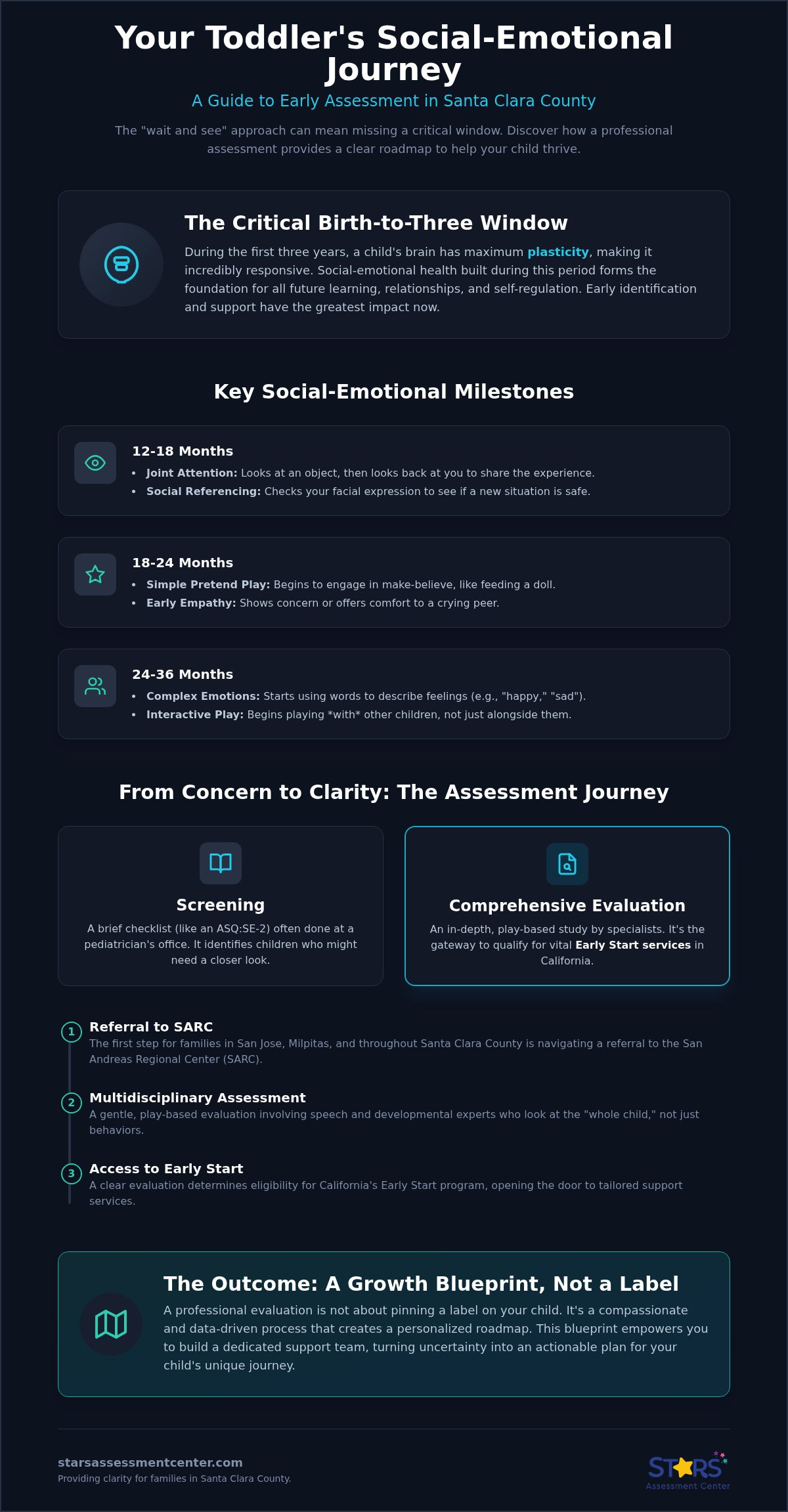
Social-emotional health is the quiet foundation upon which all other learning is built. It isn't just about a toddler being happy; it's about their growing ability to form secure relationships, manage big feelings, and explore their environment with confidence. During the first three years of life, a child's brain possesses a unique level of plasticity. This means the neural pathways are incredibly flexible and responsive to the environment. Because this "Birth to Three" window is so short, a professional social emotional assessment Santa Clara County specialists provide can be the most effective way to ensure your child is building the right connections at the right time.
A central part of this development is self-regulation. This is a toddler's ability to adjust their emotional state to a level of intensity that allows them to function and interact. If you notice your child has frequent, inconsolable meltdowns at a park in San Jose or struggles to move from one activity to another in Santa Clara, it might not just be a "difficult phase." It could be a sign that they need a little extra help learning how to process their internal world.
Key Social-Emotional Milestones for Toddlers
While every child grows at their own pace, there are specific markers that show healthy emotional progress. Our team looks for these indicators during a social emotional assessment Santa Clara County families attend:
- 12-18 Months: Toddlers should begin practicing joint attention, which means they look at an object and then back at you to share the experience. They also start social referencing, looking to your face to see if a new situation is safe or scary.
- 18-24 Months: You might see the first signs of simple pretend play, like feeding a doll. This is also when empathy begins to surface; a toddler might look concerned or offer a toy to a peer who is crying.
- 24-36 Months: Emotional expression becomes more complex. Children in Milpitas and Gilroy at this age start to use words to describe feelings and begin to play with other children rather than just alongside them.
When "Wait and See" Isn’t Enough
Parents in Morgan Hill often receive well-meaning advice to "just wait and see" when they voice concerns about their child's behavior. While some children do catch up, waiting can sometimes delay access to support that is most effective during these early years. Early identification is directly linked to better school readiness and social success later in life. A social-emotional delay is a mismatch between a child’s chronological age and their current emotional skill level. Seeking a professional opinion isn't about looking for problems; it's about finding the best way to support your child's unique personality and potential.
Why a Professional Social-Emotional Assessment is Key for Early Intervention
Taking the step to request a professional evaluation is often the most empowering decision a parent can make. While it's common to feel a sense of trepidation, a social emotional assessment Santa Clara County families undergo is designed to provide clarity rather than a limiting label. In California, this assessment is the vital gateway to Early Start services, ensuring that toddlers who need extra support receive it before they reach school age. It transforms a parent's intuition into a data-driven plan for success.
Screening vs. Comprehensive Evaluation
It helps to understand the difference between a quick check-in and an in-depth study. Many parents first encounter a screening tool, like the ASQ:SE-2, during a routine visit to their pediatrician in San Jose or Santa Clara. This is a brief checklist used to identify children who might need a closer look, but it doesn't provide a full picture. A comprehensive evaluation, on the other hand, is an in-depth study conducted by specialists to determine eligibility for specific services. At the Stars Assessment Program, our specialists help families bridge the gap between these two stages, moving from a general concern to a clear, actionable understanding of their child's needs.
Instead of focusing solely on "challenging behaviors," we look at the whole child. We explore how they process sensory information, how they communicate their needs, and how they interact with their primary caregivers. This holistic view allows us to move beyond a simple diagnosis and provide parents with concrete strategies to use at home. If you're ready to learn more about how this process works, you can explore our approach to developmental support.
The Long-Term Benefits of Early Support
Early support transforms a child's trajectory by addressing needs during a period of rapid development. When a toddler learns to manage their emotions and communicate effectively, frustration-based behaviors naturally decrease. This preparation is invaluable for the transition into preschool and kindergarten environments in Milpitas, Gilroy, and Morgan Hill.
- Improved Communication: Children learn to express their needs with words or gestures rather than outbursts.
- School Readiness: Early intervention helps toddlers develop the social skills needed to play and learn alongside peers.
- Stronger Bonds: When you understand the "why" behind your child's actions, you can respond with more confidence and less stress, strengthening your relationship.
The goal of the Stars Assessment Program is to move beyond the clinical data to find what works for your family. We see ourselves as partners in your child's growth. By providing you with a clear roadmap, we help replace uncertainty with a sense of direction. This shift from "worrying" to "acting" is often the moment parents start to feel a sense of relief and hope for the future.
The Multidisciplinary Assessment Process: What to Expect at the Stars Assessment Program
Many parents worry that an evaluation will feel cold or clinical, like a stressful doctor's visit. At the Stars Assessment Program, we've designed our social emotional assessment Santa Clara County process to feel like a playdate with a purpose. We create a "safe harbor" where your toddler can be themselves, allowing us to see their true strengths and challenges in a natural, supportive setting. This approach ensures the information we gather is accurate and reflects your child's everyday life.
Step-by-Step Through the Evaluation Day
We prioritize your child's comfort from the moment you walk through our doors. Our process is methodical yet gentle, following three key steps:
- Step 1: The Warm Welcome. We start by letting your child explore our child-friendly space at their own pace. There are no white coats or intimidating equipment; instead, your child will find toys, books, and specialists who know how to connect with toddlers.
- Step 2: Observation through Play. Our specialists don't just "test" your child. They engage with them. We watch how they solve problems with a puzzle, how they react when a toy is out of reach, and how they seek comfort from you when they feel uncertain.
- Step 3: Clinical Interviews. Your perspective is the most important data point we have. While your child plays, we'll talk with you about their history and your daily routines in San Jose or Milpitas. Your stories help us understand the "why" behind the behaviors you see at home.
Who is on the Multidisciplinary Team?
A "multidisciplinary" approach means we look at your child from several professional angles at once. This unified view is essential because different areas of development are deeply intertwined. The Stars Assessment Program team works together to ensure no detail is overlooked.
The developmental specialist focuses on cognitive and social growth. They look at how your toddler processes information and interacts with their surroundings. Meanwhile, our speech and language specialists examine the connection between communication and emotion. Often, what looks like a social-emotional struggle is actually a child's frustration because they can't yet express their needs. By combining these perspectives into a single social emotional assessment Santa Clara County report, we provide a holistic "blueprint" for your child’s growth journey in Gilroy or Morgan Hill.
Once the evaluation is complete, our team synthesizes the findings into a clear, comprehensive report. This document serves as more than just a summary; it is a personalized guide for your family and future providers, ensuring everyone is on the same page as your child moves forward.
Navigating Early Intervention Resources in Santa Clara County
Finding the right path for your child can feel like trying to read a map in a different language. In our region, the San Andreas Regional Center (SARC) serves as the primary hub for families in San Jose and Milpitas seeking state-funded support. They coordinate the Early Start program, which is designed specifically for children from birth to age three who have developmental delays or disabilities. Because the system can be complex, having a partner who understands the local landscape makes all the difference.
Understanding the SARC Referral Process
To begin, you can initiate a referral yourself; you don't need to wait for a doctor's order. This process falls under IDEA Part C, known in California as Early Start. It's distinct from school district services, which typically don't begin until a child turns three. The Stars Assessment Program is a trusted partner for multidisciplinary evaluations in the region, working closely with the local system to ensure your child receives a thorough review. When you seek a social emotional assessment Santa Clara County families often find that having professional data ready helps move the process along more smoothly.
Before your first appointment at a local hub in Gilroy or Morgan Hill, it helps to be prepared. We recommend bringing a small folder with the following items:
- Copies of any previous screenings or pediatrician notes.
- A list of your specific concerns or "red flags" you've noticed at home.
- Your child's medical history and insurance information.
- Contact information for any other specialists your child sees.
Local Support for Santa Clara Families
Beyond SARC, there are wonderful community resources available in San Jose, Santa Cruz, and Salinas. For example, the Inclusion Collaborative offers specialized support to help childcare providers create welcoming environments for children with diverse needs. Understanding these local layers helps ensure no child falls through the cracks during these vital early years.
If you're just starting to explore these options, our guide on Early Childhood Developmental Screening: A Parent’s Guide provides a helpful foundation for what comes next. By connecting with these local systems early, you're building a safety net that supports both your child and your family. If you need help navigating these steps, you can contact the Stars Assessment Program team for guidance on starting your journey.
From Assessment to Action: Building Your Child’s Support Team
The day you receive your child's evaluation results marks a significant shift in your family's story. It is the moment where uncertainty transforms into a clear, actionable plan. While the process of obtaining a social emotional assessment Santa Clara County families trust can feel like a major hurdle, it is actually the beginning of a rewarding growth journey. You are no longer wondering what your child needs; you are equipped with the knowledge to provide it.
At Stars, we view the assessment report not as a final verdict, but as a living blueprint. This document bridges the gap between clinical observation and daily life in San Jose or Morgan Hill. It allows you to move forward with a sense of purpose, knowing exactly which skills to nurture and which specialists to invite into your child's inner circle.
Your Blueprint for Growth
Once the evaluation is complete, the results become your most powerful tool for advocacy. We encourage parents to share these findings with their pediatricians in Santa Clara and future educators in Milpitas or Gilroy. By having a unified report, every professional who works with your child will be on the same page, ensuring a consistent approach to their care.
The report helps turn "red flags" into targeted goals. For example, if a toddler struggles with transitions, the blueprint provides specific strategies to help them self-regulate. Ongoing monitoring is vital as your child grows toward age three. Because their brain is still so adaptable, small adjustments to their support plan can lead to significant breakthroughs in their ability to form relationships and manage emotions.
Why Choose Stars for Your Child’s Assessment?
Choosing a partner for this journey is a deeply personal decision. Stars Assessment Center provides a "Safe Harbor" for families, offering a blend of authoritative expertise and a family-centered heart. We understand that every family brings a unique cultural perspective, and we honor that through sensitive, inclusive care. Our multidisciplinary team is specifically trained to identify the nuances of social-emotional delays, including specialized screenings for Down syndrome and Autism.
If you find yourself wondering about specific developmental patterns, you might ask, do you think your child might have autism? Exploring these questions early is the best way to ensure your child receives the specialized support they deserve. We are here to guide you through every question and every milestone with patience and reliability.
You don't have to navigate this path alone. If you're ready to move from concern to action, our team is standing by to help you schedule an evaluation and start building your child's support team today. Your toddler's potential is waiting to be unlocked, and the right roadmap makes all the difference.
Taking the Next Step for Your Child’s Bright Future
The first three years of your child's life are a time of incredible growth and possibility. Understanding their unique social and emotional needs isn't just about finding answers; it's about providing the right foundation for every relationship they will build. By choosing a professional social emotional assessment Santa Clara County families can trust, you are giving your toddler the gift of being truly understood. This roadmap moves you away from uncertainty and toward a future where your child can thrive in San Jose, Santa Clara, or Milpitas.
Our multidisciplinary team has been serving families across Gilroy and Morgan Hill since 1988. We bring deep expertise in Autism and social-emotional growth to every play-based evaluation, ensuring your family feels supported and heard throughout the process. You don't have to navigate the referral system or developmental milestones alone. We are here to be your steady ally and expert guide.
Are you ready to gain the clarity your family deserves? Schedule a Compassionate Consultation for Your Toddler Today and let us help you unlock your child's full potential. Your journey toward growth and support starts with one small, brave step.
Frequently Asked Questions
What is the difference between a social-emotional screening and a full assessment?
A screening is a brief "check-in" used to identify potential concerns, while a comprehensive social emotional assessment Santa Clara County families receive is an in-depth evaluation. Screenings like the ASQ:SE-2 are often parent-completed and take only minutes. In contrast, an assessment involves our multidisciplinary team observing your child through play and interviewing you. This thorough process determines if your child qualifies for specific Early Start services and provides a detailed roadmap for their growth.
Does my toddler need an assessment if they are already in speech therapy?
Yes, it's often beneficial to have both. While speech therapy focuses on communication, a social-emotional evaluation looks at how your child manages feelings and builds relationships. These areas are deeply connected; sometimes a communication delay causes emotional frustration, or a social struggle makes it harder to practice talking. A full assessment ensures that your child’s emotional wellbeing is supported alongside their language development, creating a more holistic plan for their success.
How long does a social-emotional assessment usually take at Stars?
At Stars, the in-person evaluation typically takes about 90 minutes to two hours. This time is carefully structured to be gentle and play-based, so your toddler doesn't feel overwhelmed. We spend this time observing your child’s interactions and talking with you about their history. After the session, our team collaborates to analyze the data. You can usually expect a finalized, comprehensive report within a few weeks of your appointment in San Jose or Santa Clara.
Will my child be diagnosed with a disorder after a social-emotional assessment?
The primary goal of an assessment is to identify your child's strengths and areas where they need extra support, not just to provide a diagnosis. While the evaluation can identify conditions like Autism or Down syndrome, it's more about determining eligibility for Early Start services. We focus on providing you with a "blueprint" for growth. This report helps therapists and teachers understand how to best support your child's unique personality and developmental needs.
How do I get a referral for an assessment in Santa Clara County?
You can initiate a referral by contacting the San Andreas Regional Center (SARC) directly. In California, you don't need a doctor’s note to start the process for a child under age three. Many parents also talk to their pediatricians in Milpitas or Gilroy first to discuss their concerns. Once the referral is made, SARC coordinates with partners like Stars to facilitate the social emotional assessment Santa Clara County children need to access vital early intervention resources.
What happens if the assessment shows my child is developmentally delayed?
If the assessment identifies a delay, it opens the door to a personalized support system called an Individualized Family Service Plan (IFSP). This plan outlines specific goals for your child and the services they'll receive to reach them. Our team stays by your side during this transition, helping you understand the findings and connecting you with the right specialists in Morgan Hill or San Jose. A delay is simply a sign that your child needs a different set of tools.
Are these assessments covered by insurance or the Regional Center?
Evaluations for the Early Start program are typically provided at no cost to families through the Regional Center system, regardless of income or insurance status. This is part of the state's commitment to early intervention. However, some families choose to use private insurance for additional evaluations or specialized screenings. We recommend checking with SARC or your insurance provider to understand the specific coverage options available for your family's needs in Santa Clara County.
Can a two-year-old really be assessed for social-emotional health?
Absolutely, because social-emotional skills begin developing at birth. Even very young toddlers show clear markers of health, such as how they seek comfort, show curiosity, or react to new people. Our specialists are trained to observe these subtle behaviors through age-appropriate play. Assessing a two-year-old allows us to catch potential struggles early, when their brain is most flexible, ensuring they have the emotional foundation needed for preschool and beyond.


