
You’ve spent hours watching your toddler play, noticing the unique ways they interact with their favorite toys, yet a quiet question has started to take root in the back of your mind. It’s a feeling many parents in our community share, a blend of deep love and a growing need for more information. Seeking an autism evaluation Santa Clara County is a brave first step, but it often comes with a heavy side of worry. You might feel overwhelmed by the difference between a quick screening at the pediatrician’s office and a full diagnostic assessment. Perhaps you’re even worried that a testing environment will feel cold or intimidating for your little one.
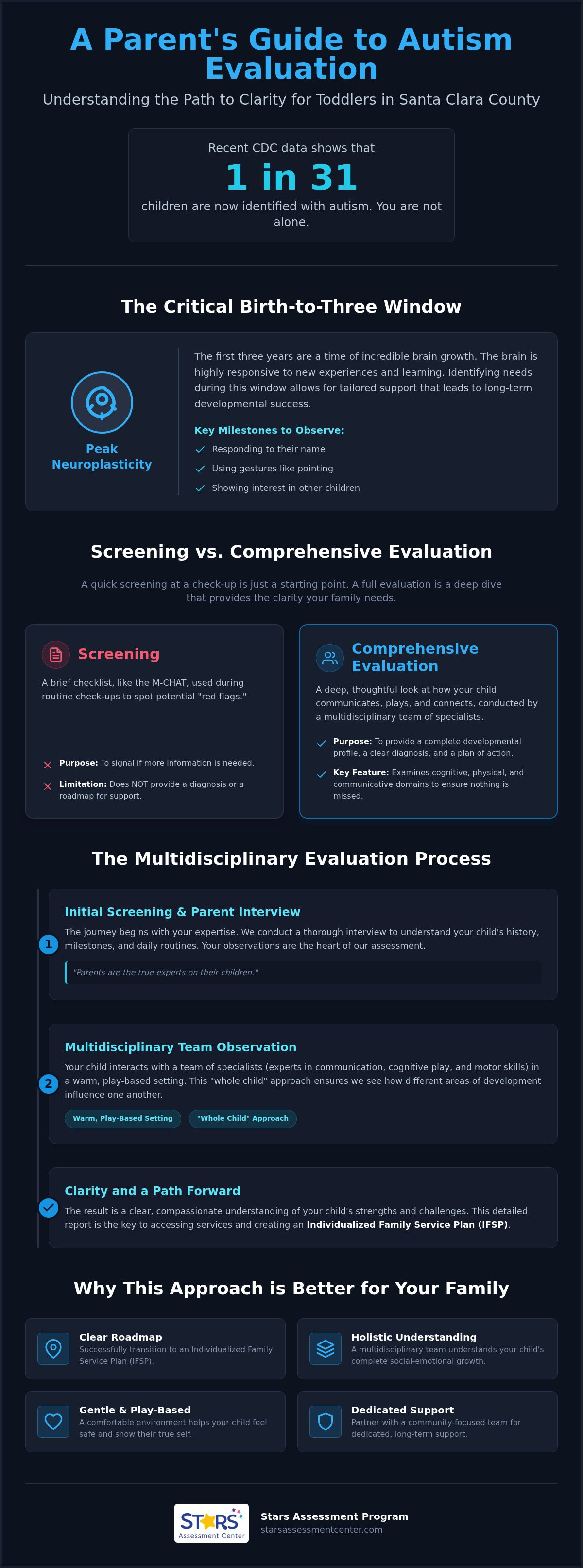
We understand that this journey is about more than just a diagnosis; it's about finding the right path for your family. With recent data from the CDC showing that 1 in 31 children are now identified with autism, you are certainly not alone in this search for answers. This guide is here to offer a steady hand. You'll discover how a specialized, multidisciplinary evaluation provides the clarity and early intervention your child needs during their most critical years of growth. We will walk through the specific steps of the process, explain how to partner with the San Andreas Regional Center, and show you how a team of experts can create a warm, supportive space where your child can truly shine.
Key Takeaways
- Discover why a multidisciplinary team approach is the most effective way to understand your toddler's social-emotional and communicative growth.
- Learn how a gentle, play-based assessment environment helps your child feel comfortable while providing the professional clarity you need.
- Get a clear roadmap for securing an autism evaluation Santa Clara County and successfully transitioning to an Individualized Family Service Plan.
- Understand the vital differences between standard screenings and the specialized assessments required for children during their first three years of life.
- See how partnering with a community-focused, employee-owned organization ensures your family receives dedicated, long-term support.
Understanding Autism Evaluation for Toddlers in Santa Clara County
If you've noticed that your child isn't meeting certain milestones or seems to interact with the world differently, your intuition is your most valuable tool. Seeking an autism evaluation Santa Clara County isn't about looking for a problem; it's about gaining the clarity you need to support your child's unique way of learning. A comprehensive evaluation for a toddler is a deep, thoughtful look at how they communicate, play, and connect with others. It moves beyond simple observations to provide a complete picture of their developmental profile. This process is designed to be a proactive, positive step that transforms uncertainty into a clear plan of action.
The Critical Birth-to-Three Window
The first three years of life are a time of incredible brain growth. During this period, the brain's neuroplasticity is at its peak. This means it's highly responsive to new experiences and specialized learning. In Santa Clara County, we look for specific milestones like responding to their name, using gestures to point, or showing interest in other children. When we identify needs during this window, we can tailor support to fit this rapid growth phase. Early intervention is the key to long-term developmental success.
Screening vs. Evaluation: What is the Difference?
Many parents first encounter a screening at a routine check-up. This is usually a brief checklist, like the M-CHAT, designed to spot potential "red flags." While helpful, a screening doesn't provide a diagnosis or a roadmap. It's simply a signal that more information is needed. An evaluation, however, is a deep dive. The Multidisciplinary Evaluation Process involves a team of specialists looking at cognitive, physical, and communicative domains. This team approach ensures we don't miss anything and can distinguish between autism and other developmental delays.
You can learn more about these distinctions in our guide on Autism Screening vs. Evaluation for Toddlers. At Stars Assessment Program, we go beyond simple checklists. We focus on the social-emotional nuances of your child's behavior. We understand that every child is different, and a "one size fits all" approach doesn't work for infants and toddlers. By looking at multiple areas of development simultaneously, we provide a more accurate and compassionate understanding of your child's strengths and challenges. This depth of information is what allows families to access the right services through local systems like the San Andreas Regional Center.
The Multidisciplinary Evaluation Process: What to Expect
The process of an autism evaluation Santa Clara County is designed to be a gentle, collaborative journey rather than a clinical hurdle. We believe that parents are the true experts on their children. Your observations and insights form the heart of our assessment. By combining your deep knowledge with our clinical expertise, we create a clear picture of your child's developmental path. This partnership ensures that the evaluation is thorough, accurate, and deeply respectful of your family’s experience.
Step 1: The Initial Social-Emotional Screening
Everything begins with understanding your child's unique history and current world. We start with a thorough parent interview to gather details about early milestones, daily routines, and family dynamics. During this phase, our specialists pay close attention to your child's social-emotional development. We observe how they express feelings, seek comfort, and respond to the people they love. This initial step isn't just about checklists; it's about seeing the child behind the behaviors and validating your concerns.
Step 2: Multidisciplinary Team Observation
Instead of a single practitioner, your child will interact with a team of specialists. This group typically includes experts in communication, cognitive play, and motor skills. We conduct these observations in a warm, play-based setting that feels more like a cozy playroom than a doctor's office. This approach is a core part of a Specialized Early Assessment strategy that prioritizes the comfort of toddlers. Our team looks at the "whole child," ensuring we understand how different areas of development influence one another. If you're ready to see how this process can help, you can learn more about our team approach to care.
Step 3: The Comprehensive Results Review
Once the observations are complete, we don't just hand you a report filled with jargon. We sit down with you to translate our clinical findings into a parent-friendly growth plan. Our primary goal is to provide clarity, not just a label. We'll explain exactly what the results mean for your child's daily life and future growth. We also provide a clear roadmap for the next steps, including how to coordinate with the San Andreas Regional Center (SARC) to access local support services. This methodical timeline ensures that you move from uncertainty to a clear, actionable path forward with confidence.
Why Specialized Early Assessment Matters for Your Child
Toddlers don't express their needs the same way seven year olds do. While an older child might use complex language to describe their feelings, a two year old communicates through play, eye contact, and emotional regulation. This is why a standard clinical approach often falls short for the youngest members of our community. A specialized autism evaluation Santa Clara County must be specifically tailored to the nuances of early childhood development. At this age, the line between a speech delay and a social communication challenge can be thin. Understanding that distinction requires a team that speaks the language of toddlerhood.
You may have heard the advice to "just wait and see" if your child catches up. While this perspective is often offered to calm a parent's nerves, it can unintentionally delay the support that makes the biggest impact. Because the brain is so flexible before age three, every month of intervention counts. We don't view an assessment as a way to label a child. Instead, it's a way to ensure they don't miss out on their most formative years of learning. Proactive steps today create a smoother path for your child's future.
Ruling Out Other Developmental Delays
An accurate assessment isn't just about identifying autism; it's about ruling out other possibilities. Sometimes, what looks like a social challenge is actually a primary speech delay or a motor related issue. Our team performs a "differential diagnosis" to ensure your child gets the right kind of help from the very start. For example, some families may find that their child's needs are better met through a Down Syndrome Early Intervention Guide. By looking at the whole child, we ensure that no underlying conditions are overlooked and that the resulting plan is perfectly suited to your child's specific profile.
The Role of Social-Emotional Assessments
For a toddler, social emotional health is the engine of development. It powers how they learn to communicate, how they solve problems, and how they eventually interact in a classroom. During our assessments, we focus heavily on emotional regulation. This is the ability to manage reactions to feelings and the environment. When a child feels secure and understood emotionally, their cognitive and physical skills follow. These early assessments help us build a foundation that supports your child's success long before they ever reach their first day of kindergarten. By identifying these needs early, we help you foster a home environment where your child feels empowered to grow.
Navigating Early Intervention in Santa Clara County
The path to support after an autism evaluation Santa Clara County doesn't have to be a maze. Once you have a clearer understanding of your child's needs, the next step is connecting with the right local resources to turn that clarity into action. In our region, this journey almost always begins with the San Andreas Regional Center (SARC). We view ourselves as your steady ally during this transition, helping you move from the initial assessment to a structured plan that supports your child's daily growth. You don't have to figure out the paperwork or the terminology alone.
Working with San Andreas Regional Center (SARC)
SARC is the primary gateway for state-funded early intervention services for families in our community. The process usually starts with a referral, which can come from your pediatrician or through a self-referral. Stars Assessment Program works closely within this ecosystem to ensure your child's evaluation provides the specific data SARC needs for eligibility. If your child is eligible, you'll develop an Individualized Family Service Plan (IFSP). Think of the IFSP as a living roadmap. It's a parent-friendly document that outlines the services your child will receive and the goals your family wants to achieve together. If you're still in the early stages of this process, you might find it helpful to read: Do you think your child might have autism?
Local Support for San Jose and Surrounding Areas
Whether you live in San Jose, Milpitas, Morgan Hill, or Gilroy, accessing local care is vital for your family's routine. Santa Clara County is beautifully diverse, and we believe that care must be culturally sensitive and inclusive to be truly effective. When you're preparing for your meeting with SARC, having your documents organized can lower your stress levels. We recommend having these items ready:
- Your child's birth certificate and immunization records.
- Medical records or previous screening results from your pediatrician.
- Insurance information for your primary health plan.
- A list of your specific observations or "gut feelings" about your child's development.
Understanding the financial side of care is also important for peace of mind. As of early 2026, California law requires most health insurance plans, including Medi-Cal, to cover medically necessary behavioral health treatments. Additionally, assessments for eligibility conducted through SARC are provided at no charge to families. This ensures that every child in our county has the opportunity to get the help they need regardless of their family's budget. If you're feeling overwhelmed by these steps, you can contact our team today to discuss how we can guide you through the referral process.
Choosing Stars Assessment Program for Your Family
Choosing where to go for an autism evaluation Santa Clara County is a decision made with the heart. You want more than just a clinical report; you want a team that sees your child's personality and potential. At Stars Assessment Program, we've built our organization to be a steady ally for families during these uncertain times. We aren't just a service provider; we are a community-oriented advocate. Our "gentle guide" philosophy means we prioritize your child's comfort and your peace of mind at every stage of the assessment.
As an employee-owned organization (ESOP), our commitment to you is personal. Every specialist you meet has a direct stake in the quality of care we provide. This structure fosters a culture of deep accountability and genuine care. We aren't answerable to distant shareholders; we are answerable to the families in San Jose, Milpitas, and the surrounding areas. This local focus allows us to act as a "safe harbor" for parents who need both technical proficiency and a human touch. When you partner with us, you're working with people who are deeply invested in our local community's success.
A Compassionate, Multidisciplinary Team
Our approach is built on the belief that no single lens can capture the complexity of a growing toddler. When you bring your child to us, you're benefiting from a team that works together in real time. Instead of visiting different offices over several weeks, you have cognitive, communication, and physical experts collaborating in one space. This synergy is particularly vital for children under age three. By seeing the "whole child" at once, we can spot the subtle connections between social-emotional regulation and physical development that a single practitioner might miss. We specialize in this early window of growth, ensuring our methods are age-appropriate and play-based.
Your Next Steps Toward Clarity
Taking that first step can feel heavy, but the process of reaching out is simple. You can contact us through our website to begin an initial intake. Once you reach out, our team aims to connect with you within the first 24 hours to schedule your initial screening and answer any immediate questions you have. We'll guide you through the referral requirements for the San Andreas Regional Center and ensure you have everything you need for a smooth start. You don't have to carry the weight of this journey alone. We are here to partner with you, providing the professional warmth and expert clarity your family deserves. If you're ready to find the answers your child needs, contact us today to begin.
Empowering Your Child’s Brightest Future
Taking the first step toward an autism evaluation Santa Clara County is one of the most proactive choices you can make for your child's growth. By focusing on the vital birth-to-three window, you're giving your little one the gift of early intervention when their brain is most receptive to new learning. You've learned that a multidisciplinary approach doesn't just provide a label; it offers a comprehensive roadmap that considers your child's cognitive, physical, and social-emotional needs as a whole. This clarity is the foundation for everything that comes next, from navigating the San Andreas Regional Center to building a supportive home environment.
Our team of local experts is dedicated to making this process feel like a partnership rather than a clinical hurdle. We specialize in the unique needs of infants and toddlers, ensuring every assessment is conducted with the professional warmth your family deserves. You don't have to navigate these systems alone. We're here to act as your steady ally, providing the expertise and heart needed to help your child thrive.
Begin your journey toward clarity with a gentle assessment
You are your child's greatest advocate, and we're honored to walk beside you as you discover the best path forward for your family.
Frequently Asked Questions
How do I know if my toddler needs an autism evaluation or just has a speech delay?
A multidisciplinary assessment is the most effective way to distinguish between these two developmental paths. While a speech delay focuses primarily on language production, autism involves broader challenges with social-emotional engagement and reciprocal interaction. Our team evaluates how your child uses gestures, eye contact, and joint attention to communicate. This deep dive ensures we identify whether the root cause is purely communicative or related to social-emotional development.
Is an autism evaluation in Santa Clara County covered by insurance or Medi-Cal?
Yes, California law requires most health insurance plans, including Medi-Cal, to cover medically necessary behavioral health services. This includes a comprehensive autism evaluation Santa Clara County. Additionally, if you seek an assessment through the San Andreas Regional Center (SARC) for service eligibility, those evaluations are provided at no cost to families. We can help you navigate your specific plan to ensure your child receives timely clarity.
What is the youngest age a child can be evaluated for autism at Stars Assessment Center?
We specialize exclusively in the birth-to-three age group, meaning we can evaluate infants as soon as developmental concerns arise. Most formal assessments become most accurate between 12 and 18 months as social patterns become more distinct. Early identification is our core priority because it allows your family to access intervention services during the most critical years of your child's rapid brain growth and neuroplasticity.
How long does a multidisciplinary developmental assessment usually take?
The evaluation process is thorough but designed to respect a toddler's limited attention span. Typically, the direct play-based observation takes about two to three hours. This time allows our team of specialists to see your child's natural interactions in a comfortable setting. We move at your child's pace, ensuring they feel safe and supported throughout the session so we can gather the most accurate developmental data possible.
Do I need a referral from my pediatrician to start the evaluation process?
While a pediatrician's referral is a common way to begin, you can also initiate the process yourself. Many parents reach out to us directly or contact the San Andreas Regional Center when they notice their child isn't meeting certain milestones. Having medical records or a previous screening from your doctor is helpful for our team, but it isn't a strict requirement to start the conversation about your child's growth.
What happens if my child is diagnosed with autism after the evaluation?
A diagnosis serves as a gateway to a personalized growth plan rather than just a label. We'll sit down with you to explain the findings and help you coordinate with local resources like the San Andreas Regional Center. From there, your family will develop an Individualized Family Service Plan (IFSP). This roadmap outlines the specific therapies and supports designed to help your child reach their full potential during these formative years.
Can an autism evaluation be done in a single day, or does it require multiple visits?
Most evaluations are structured over two visits to ensure accuracy and reduce stress for your little one. The first visit is the multidisciplinary observation where our team interacts with your child through play. The second visit is a results review meeting where we translate our clinical findings into a parent-friendly roadmap. This structure gives our specialists time to collaborate and synthesize data before providing you with clear answers.
What is the difference between an evaluation at Stars and one at the San Andreas Regional Center?
An autism evaluation Santa Clara County at Stars Assessment Program provides a deep, multidisciplinary look at your child's whole development through our specialized, family-centered lens. SARC assessments are specifically designed to determine eligibility for state-funded services. We often work in close partnership with the regional center system, ensuring our clinical data meets their specific requirements so your family can transition seamlessly into the early intervention programs your child needs.


