
You've likely spent hours watching your little one at the park, noticing how they interact differently than their peers or wondering why those first words haven't arrived yet. It's a heavy feeling, especially when you're told to just "wait and see" by well-meaning friends. Seeking a multidisciplinary assessment for toddlers Santa Clara County shouldn't feel like a bureaucratic hurdle while you're already dealing with these heart-heavy questions. You deserve more than a quick, 15-minute screening that barely scratches the surface of your child's vibrant, unique personality.
We understand that the path to support can feel overwhelming, especially when faced with long wait times or the anxiety of a developmental label. It's completely normal to feel a mix of uncertainty and hope as you look for answers. This guide will help you find clarity by explaining exactly how a deep, team-based evaluation works and how it differs from a standard pediatrician's checkup. We'll walk through the process of securing early intervention in San Jose, Milpitas, and Gilroy, ensuring you have a clear roadmap to support your child's social-emotional and communicative growth.
Key Takeaways
- Learn why the birth-to-three window is a critical period for brain development and how early intervention creates a lasting foundation for your child's future.
- Understand the vital differences between a brief developmental screening and a comprehensive multidisciplinary assessment for toddlers Santa Clara County to ensure your child gets the right level of support.
- Navigate the local support landscape with ease, understanding the roles of organizations like the San Andreas Regional Center (SARC) and how to access comprehensive private evaluation services.
- Identify the key criteria for selecting an evaluation center, focusing on team expertise and a family-centered approach that values your child's unique personality.
- Gain actionable clarity on addressing social-emotional or speech delays through a collaborative, expert-led process designed to lower your stress.
Navigating Toddler Evaluation in Santa Clara County
Choosing to look deeper into your child's development isn't about looking for something wrong; it's about ensuring they have every tool they need to thrive. In Santa Clara County, the Early Start program recognizes that the first three years are a unique window of opportunity. During this time, a child's brain is incredibly flexible, forming millions of new neural connections every second. This natural openness to learning makes a multidisciplinary assessment for toddlers Santa Clara County a powerful, proactive step rather than a reactive one. When you pursue this level of care, you're building a supportive team that values your child's unique spirit.
Trusting your gut feeling as a parent is often the most accurate diagnostic tool available. If you feel something is slightly off, moving past the "wait and see" approach is a profound act of love. It replaces uncertainty with actionable clarity, helping you navigate the local landscape of services with confidence and empathy.
Why Early Assessment Matters for Local Families
Think of your child's early brain development like building the foundation of a home. It's much easier to ensure the foundation is level now than to try and fix structural issues once the walls are up. This concept, often called neuroplasticity, simply means your toddler's brain is highly adaptable. When we provide support early, we can often reduce the need for more intensive services once they reach elementary school in San Jose.
Early intervention isn't just a series of appointments for your child. It's a family-centered partnership that bridges the gap between worry and growth. We work alongside you to integrate supportive strategies into your daily routines at home in Milpitas or Gilroy, ensuring that every interaction becomes an opportunity for development.
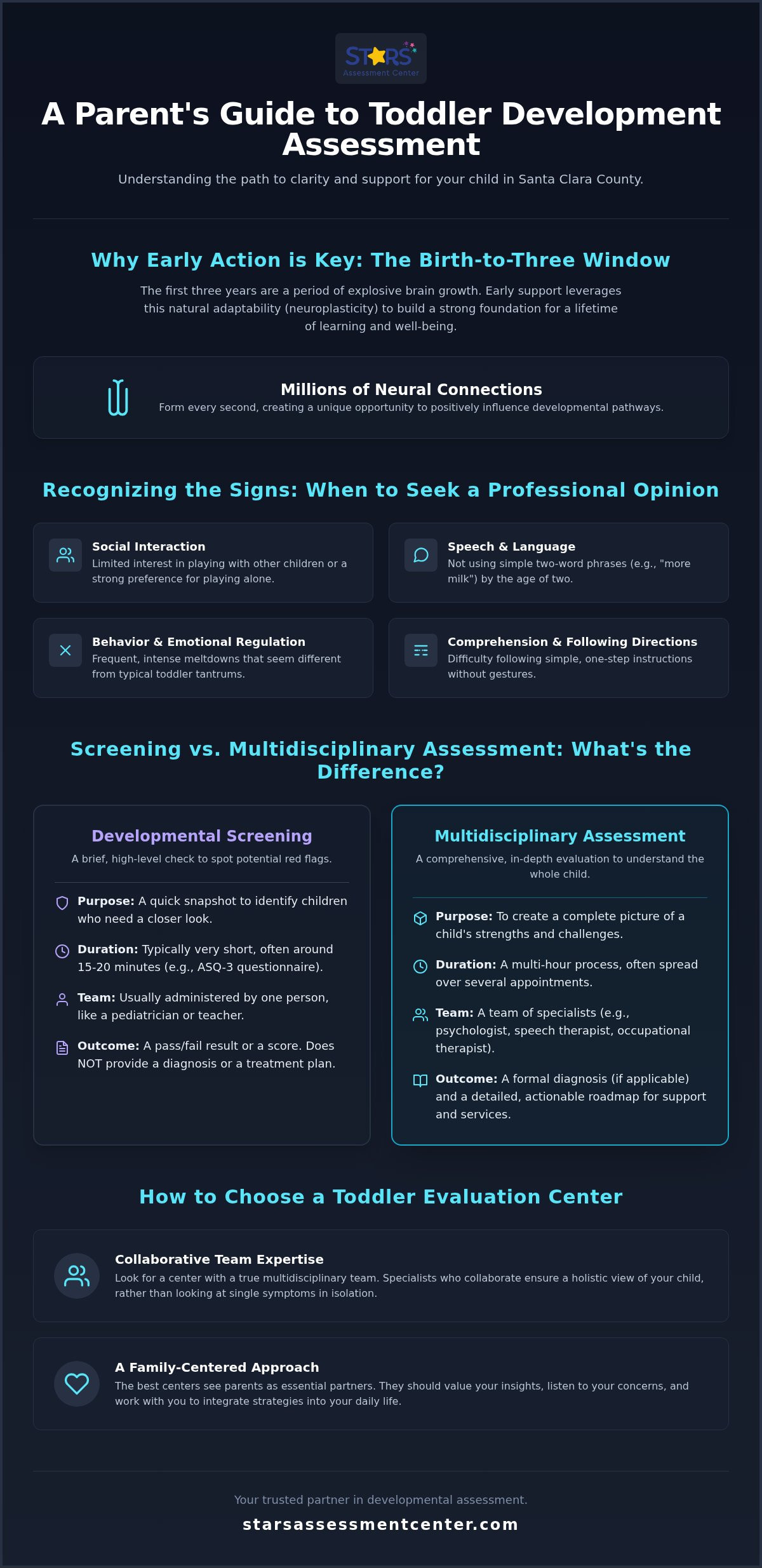
Recognizing the Signs: When to Seek a Professional Opinion
Between 18 and 36 months, toddlers experience an explosion of growth in how they move, speak, and interact. You might notice subtle signs that suggest a deeper look is needed, such as a child who doesn't point to show you things or someone who seems to lose skills they once had. Sometimes, a child might face a Global developmental delay, which affects multiple areas like communication and social engagement.
Common signs to watch for include:
- Limited interest in playing with other children or a preference for playing alone.
- Difficulty following simple, one-step instructions.
- Not using two-word phrases by age two.
- Frequent, intense meltdowns that seem different from typical toddler tantrums.
Local stressors, such as the high cost of living or long commutes in Silicon Valley, can sometimes make it hard for parents to find the quiet moments needed to observe these nuances. If you're feeling uncertain, you can use this gentle guide on developmental delays to help organize your thoughts. Seeking a professional opinion is the first step toward a clear roadmap. A multidisciplinary assessment for toddlers Santa Clara County provides the expert guidance needed to move forward with hope.
Screening vs. Multidisciplinary Assessment: Which Does Your Child Need?
It is common for parents to feel a sense of relief after a quick developmental screening, only to realize later that they still have unanswered questions. A screening is a high-level snapshot. It is designed to catch potential red flags quickly. However, a screening alone cannot provide a formal diagnosis or create a roadmap for services. For that, you need a deeper look. A multidisciplinary assessment for toddlers Santa Clara County offers a comprehensive deep-dive. It brings together a team of experts to look at your child's growth from every possible angle, ensuring no detail is missed.
The biggest benefit of this team approach is that it sees the whole child. Instead of looking at a speech delay in isolation, specialists look at how communication, social skills, and physical development interact. This holistic view is essential for understanding your child's unique way of experiencing the world. If you're ready to move beyond a simple checklist, our team can help you start the process with a multidisciplinary assessment tailored to your family's needs.
The Developmental Screening (ASQ-3 and ASQ:SE-2)
Most families first encounter screenings at a First 5 Santa Clara center or during a routine pediatrician visit. These often use the Ages and Stages Questionnaires (ASQ-3). While the ASQ-3 looks at general milestones, the ASQ:SE-2 is a more specific tool focused on social-emotional health. It helps parents track how their toddler expresses emotions, follows directions, and interacts with others. These tools are excellent starting points. They act as "gatekeepers" that help determine if more specialized support is necessary. Accessing Santa Clara County evaluation services often begins with these forms, but they are just the first step on the journey.
The Comprehensive Multidisciplinary Evaluation
When a screening suggests a need for further investigation, a multidisciplinary team takes over. This team usually includes speech and language specialists, behavioral experts, and developmental professionals. They collaborate on a single, unified report. This is particularly vital when identifying complex conditions like Autism or Down syndrome. Rather than receiving three different opinions, you get one cohesive plan. This process helps families understand the nuances of autism screening vs. evaluation for toddlers, providing the diagnostic clarity needed to unlock state-funded support. By looking at the child's social-emotional health alongside their communication skills, the team provides a roadmap that values your child's personality while addressing their specific challenges.
Comparing Evaluation Pathways in Santa Clara County
Finding the right path for your child's growth can feel like solving a puzzle with too many pieces. In Santa Clara County, families generally encounter three main routes: the public school district, the regional center, or specialized non-profit centers. Each pathway has its own strengths, but they all share the common goal of providing a multidisciplinary assessment for toddlers Santa Clara County. Understanding these differences helps you choose the environment where you and your child will feel most supported. It's about finding a "safe harbor" where your concerns are met with expertise and empathy.
The Role of San Andreas Regional Center (SARC)
The San Andreas Regional Center (SARC) is the primary entry point for state-funded early intervention services for children under three. It's their job to determine if a child is eligible for the California Early Start program. Once a referral is made, SARC coordinates the evaluation process, often partnering with specialized programs in San Jose or Milpitas to conduct the actual testing. This is a critical step for parents who think their child might have autism or another developmental condition. While SARC manages the logistics, the actual assessment is where the human connection happens.
Wait times are a common concern for local parents. By law, the regional center or school district must complete assessments and hold an eligibility meeting within 45 days of your referral. However, the experience during those 45 days can vary. You want a team that doesn't just check boxes but understands your family's unique cultural background and values. Cultural sensitivity is a priority in our community, ensuring that every family feels heard and respected throughout the process.
Why Families Choose Specialized Assessment Centers
Specialized non-profit centers, like the Stars Assessment Program, act as a vital bridge for families. While we work in direct alignment with SARC referral goals, our approach is defined by a "family-centered heart." We prioritize social-emotional development, an area that generic physical evaluations might overlook. Our team is deeply invested in the community, providing geographic accessibility for families in Gilroy, Morgan Hill, and even as far as Santa Cruz.
Choosing a specialized center ensures that a multidisciplinary assessment for toddlers Santa Clara County is conducted by experts who view you as a partner. We know that behind every referral is a family looking for hope and a clear path forward. This personal touch reduces the anxiety often associated with bureaucratic environments. By focusing on your child's unique personality alongside their developmental needs, we provide a roadmap that feels both professional and deeply human.
How to Choose a Toddler Evaluation Center in SCC
Selecting the right location for a multidisciplinary assessment for toddlers Santa Clara County is a deeply personal decision. You aren't just looking for a clinic; you're looking for a team that sees your child's potential. Start by checking if the center has a true multidisciplinary team. This means speech, behavioral, and developmental specialists work under one roof and actually talk to each other. If they don't collaborate, you might end up with fragmented advice that's hard to follow.
Pay close attention to the tone of your first interaction. Do they treat you as a partner who knows your child best, or just another case number? Empathy is a clinical necessity in early intervention. You also want a staff that reflects our diverse Santa Clara County community. Cultural sensitivity ensures that your child's communication style and your family's traditions are respected and understood. Finally, ask about the final report. You deserve a clear, actionable roadmap that highlights your child's strengths alongside their needs. If you're looking for a team that balances expertise with a family-centered heart, you can contact us to learn more about our evaluation process.
Questions to Ask a Potential Assessment Team
Before you commit, it's okay to interview the team. You're the best advocate for your child. Ask these three specific questions to gauge their approach:
- "How do you involve parents and caregivers in the evaluation process?"
- "What specific tools do you use for speech delay or social-emotional screenings?"
- "How quickly will we receive the final multidisciplinary report and next steps?"
A transparent team will answer these questions with patience and clarity. They should make you feel like a valued member of the assessment process from day one.
Preparing Your Toddler (and Yourself) for Evaluation Day
It's natural to feel nervous, but your child doesn't have to. You can think of the evaluation as a supported day of play where specialists observe how your toddler interacts with new toys and gentle people. To keep things low-stress, bring their favorite snack and a comfort object like a blanket or stuffed animal. This helps your child feel safe in a new environment.
Being prepared with documentation also helps lower your own stress levels. Bring your pediatrician's notes and any short videos you've captured of your concerns at home. These "real life" snapshots are incredibly valuable for specialists. By keeping the day playful and coming prepared with your observations, you ensure the team sees the most authentic version of your little one during their multidisciplinary assessment for toddlers Santa Clara County.
The Stars Assessment Program: Compassionate Expert Care
At the Stars Assessment Program in San Jose, we believe that every child's developmental journey deserves a dedicated guide. Our team isn't just a group of clinicians; we're a community-oriented advocate for your family. As part of the Stars Behavioral Health Group (SBHG) legacy, we're an employee-owned organization. This unique structure means every member of our team is personally invested in the success and well-being of the families we serve across Santa Clara County. We don't just provide a service; we build a partnership that values your child's unique personality and your family's cultural background.
We specialize in social-emotional health, speech, and language delays. While physical milestones are important, the way a child connects with others and expresses their needs is the heartbeat of their early development. A multidisciplinary assessment for toddlers Santa Clara County at Stars bridges the gap between your initial worries and a clear, actionable plan. We move at a steady, patient pace that respects your child's comfort, ensuring that the entire process feels like a "safe harbor" rather than a clinical hurdle.
Specialized Screenings: Autism and Down Syndrome
When concerns arise regarding specific conditions like Autism or Down syndrome, the need for a gentle and thorough approach becomes even more vital. Our multidisciplinary team conducts specialized developmental assessments that look at the whole child, not just a list of symptoms. We understand that these evaluations can be sensitive for parents, which is why our family-centered model prioritizes reassurance and professional warmth. If you're looking for specific information on how we support children with chromosomal conditions, you can review our Down syndrome assessment guide for SCC families. Our goal is to provide diagnostic clarity that empowers you to advocate for your child's needs with confidence.
Next Steps: Joining the Stars Family
Taking the next step is often the hardest part, but you don't have to do it alone. Most families join our program through a referral from the San Andreas Regional Center (SARC) or their pediatrician. Whether you're in Milpitas, Salinas, or San Jose, we're committed to making our expertise accessible to you. Once a referral is made, our team works diligently to coordinate your multidisciplinary assessment for toddlers Santa Clara County, keeping you informed at every stage of the process.
We invite you to view this evaluation not as a final label, but as the beginning of a supportive roadmap. By identifying your child's strengths and challenges early, you're giving them the best possible foundation for future growth. We're here to provide the clarity, hope, and expert guidance your family deserves. When you're ready to move forward, we'll be here to welcome you into the Stars family with open arms and a dedicated heart.
Empower Your Child's Growth with Clarity and Support
Moving from the uncertainty of "wait and see" to a clear path of action is one of the most loving steps you can take for your toddler. You now understand the vital difference between a quick screening and a multidisciplinary assessment for toddlers Santa Clara County. By choosing a team that values your child's unique personality, you ensure that any support they receive is as specialized as they are. This journey isn't just about labels; it's about unlocking the tools your little one needs to thrive during these critical early years.
At Stars, our employee-owned model ensures that every interaction is rooted in genuine community care. Our multidisciplinary team of child development specialists provides specialized expertise in Autism and Down syndrome screenings, focusing on social-emotional health with a gentle, family-centered heart. We're here to act as your steady ally, turning confusion into a manageable roadmap for your child's success. Begin your child’s assessment journey with Stars today and find the "safe harbor" your family deserves. You've got this, and we're here to help every step of the way.
Frequently Asked Questions
How much does a toddler evaluation cost in Santa Clara County?
Initial developmental assessments for children under age three are provided free of charge through the Early Start program. This is done in partnership with the San Andreas Regional Center and programs like ours. For families eligible for Early Start, there is no cost for the evaluation or service coordination. If you're seeking private options, some providers offer superbills for insurance reimbursement or accept Medi-Cal to ensure every child gets the support they need.
How long is the wait time for a developmental assessment at Stars?
We follow the state mandated timeline for all referrals coming through the San Andreas Regional Center. This means the assessment process and eligibility meeting must be completed within 45 days of your initial referral. Our team works diligently to ensure families in San Jose and Milpitas don't experience unnecessary delays. We prioritize clear communication so you're never left wondering about the status of your child's multidisciplinary assessment for toddlers Santa Clara County.
Does my child need a referral from a pediatrician for an evaluation?
You don't strictly need a pediatrician's referral to begin the process, though it's often helpful to have their notes. Parents can self-refer directly to the San Andreas Regional Center if they have concerns about their child's development. Your pediatrician is a great first stop for a preliminary screening, but you have the right to request a deeper evaluation whenever you feel it's necessary for your child's growth and well-being.
What is the difference between a screening and a diagnostic evaluation?
A screening is a brief check of milestones, acting like a quick snapshot of your child's current skills. It's often the first step taken at a doctor's office or family resource center. In contrast, a diagnostic evaluation is a comprehensive deep dive. It involves a team of specialists who look at social-emotional, communication, and cognitive skills to determine eligibility for specific services or to provide a formal diagnosis, such as Autism or Down syndrome.
Can my child get an evaluation if we only speak Spanish or Vietnamese?
Yes, we're deeply committed to serving the diverse community of Santa Clara County, including families who speak Spanish or Vietnamese. It's vital that assessments are conducted in a child's primary language to get an accurate picture of their development. We prioritize cultural sensitivity and can coordinate with interpreters or bilingual staff to ensure you feel heard and understood throughout every step of your child's evaluation and support plan.
What happens after the multidisciplinary evaluation is finished?
Once the evaluation is complete, we'll hold a meeting to discuss the results and determine eligibility for services. If your child qualifies for Early Start, an Individual Family Service Plan (IFSP) is developed within the same 45-day timeframe. This plan outlines specific goals and the support your child will receive. We'll walk you through every recommendation so you have a clear, actionable roadmap for the months ahead with your multidisciplinary assessment for toddlers Santa Clara County results.
Is the Stars Assessment Program part of the San Andreas Regional Center?
The Stars Assessment Program is a specialized provider that works in direct alignment with the San Andreas Regional Center (SARC). While we're a part of Stars Behavioral Health Group, an employee-owned organization, we contract with SARC to provide high-quality evaluations for local families. This partnership allows us to offer the specialized expertise of a private program while remaining a core part of the state-funded early intervention system for children birth to three.
What should I do if my child doesn't qualify for state-funded services?
If your child doesn't meet the 25% delay criteria for state-funded services, there are still many local resources available. We can help guide you toward community programs, family resource centers, or private therapy options in San Jose and Gilroy. Not qualifying for state aid doesn't mean your concerns aren't valid. It just means we'll work together to find a different path of support that fits your child's specific social-emotional or communicative needs.


