
Did you know that while approximately 54.7% of children in Santa Clara County receive standardized developmental screenings, many parents still feel a deep sense of uncertainty when a concern actually arises? It's completely natural to feel a flicker of anxiety or even a fear that a multidisciplinary evaluation for infants might lead to a permanent label for your baby. You want answers. You also want to protect your child's future while avoiding the confusion of a complex bureaucracy.
This process is not a search for a deficit; it's a collaborative discovery of your child's unique potential. In this 2026 guide, you'll learn how an expert evaluation identifies specific strengths and provides a clear roadmap for early intervention in Santa Clara County. We'll demystify the San Andreas Regional Center (SARC) referral process and explain why a specialist's insight differs from a routine check-up. This journey is about moving from worry to a proactive plan with a compassionate partner who values your family's voice and provides a safe harbor for your child's growth.
Key Takeaways
- Learn why the first 1,000 days are vital for brain development and how specialists use play-based methods to assess your child's growth.
- Discover how a multidisciplinary evaluation for infants provides a collaborative, expert-led roadmap to identify your child's unique strengths and needs.
- Distinguish between a routine developmental screening and a formal evaluation to understand which path leads to specialized early intervention support.
- Recognize specific social-emotional and communication red flags that indicate when it's time to seek a professional opinion for your toddler.
- Gain clarity on the Santa Clara County referral process and how to work with the San Andreas Regional Center to access local resources.
Understanding the Role of a Developmental Specialist for Infants
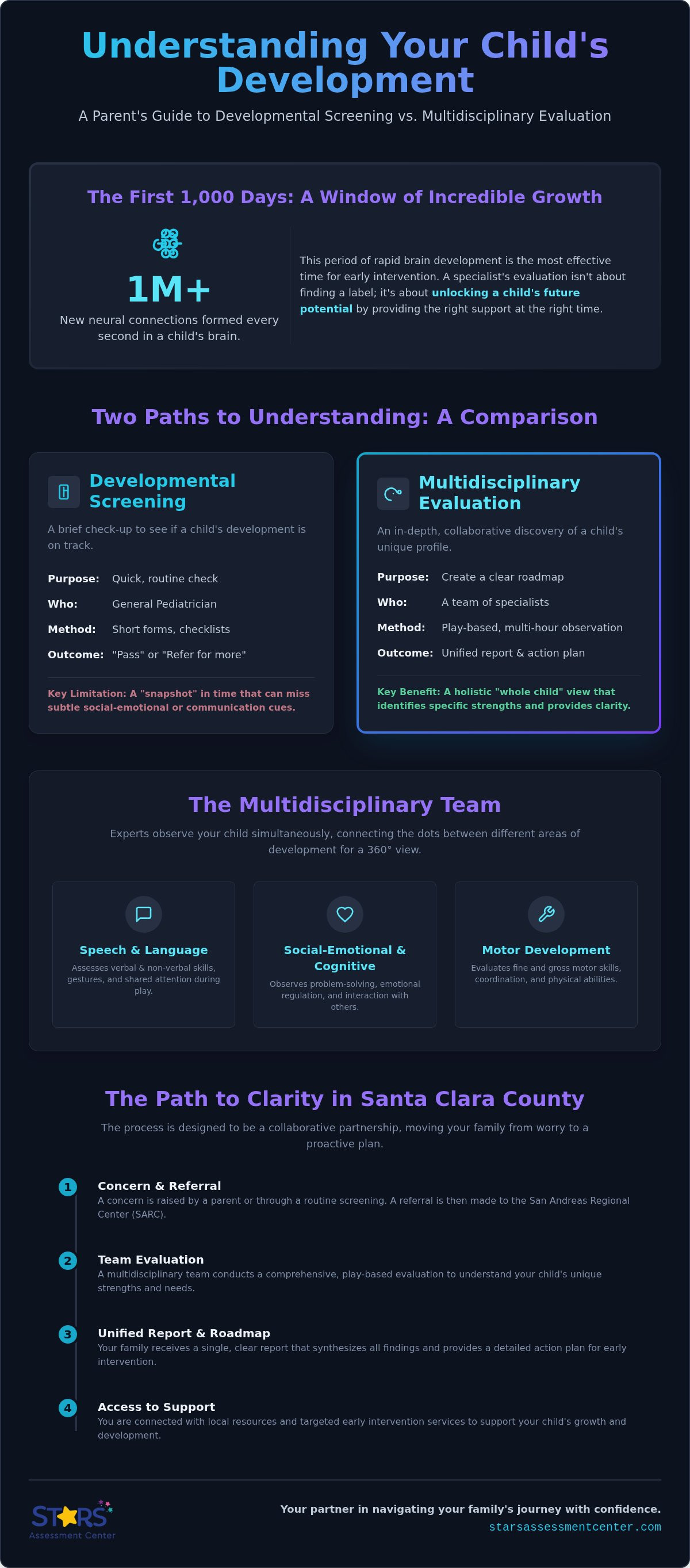
The first 1,000 days of your child's life represent a period of incredible transformation. During this window, the brain forms more than one million new neural connections every second. A developmental specialist recognizes that this is the most sensitive period for growth. Unlike a general health check, a specialist doesn't just measure height and weight. They observe how your child plays, learns, speaks, and interacts with their world. This specialized focus turns a multidisciplinary evaluation for infants into a powerful tool for understanding your child's unique developmental profile. Early identification isn't about finding a label; it's about unlocking future potential by providing the right support at the right time.
When a Standard Check-Up Isn't Enough
Most parents are familiar with the standard pediatrician visit. While these check-ups are essential for physical health, they often rely on brief screening tools that may miss subtle social-emotional cues. A developmental specialist takes a much deeper dive. They perform comprehensive, multi-hour observations to see how your baby solves problems or reacts to new faces. This level of detail allows them to see the "whole child." They partner with you to understand your child's behavior across different settings. This collaborative approach ensures that the assessment reflects your child's daily reality, not just a snapshot in a doctor's office. It's a way to gain clarity when your intuition tells you something needs a closer look.
Specialized Focus: The Birth to Age Three Window
Milestones move at lightning speed during the infant and toddler years. A skill that hasn't appeared today might be just around the corner, or it might indicate a need for extra support. Early childhood intervention is designed to capitalize on this period of rapid brain development. The Stars Assessment Program specializes exclusively in this birth-to-three phase. Every observation we make is grounded in an expert understanding of early childhood milestones. We believe in a family-centered approach because you're your child's first and most important teacher. By combining your intimate knowledge of your baby with a multidisciplinary evaluation for infants, we create a steady alliance. This partnership provides the clarity and hope you need to navigate your family's journey with confidence.
The Multidisciplinary Evaluation: Why a Team Approach is Essential
A multidisciplinary evaluation for infants turns a fragmented experience into a unified picture of your child's growth. Instead of visiting separate specialists across different offices, this process brings experts together to observe your child simultaneously. Federal guidelines require a multidisciplinary assessment to ensure every area of development is carefully considered. This 360-degree view allows specialists in speech, motor development, and social behavior to see how one domain affects another. For instance, a child’s social frustration might actually be rooted in a communication struggle. By observing these connections together, the team provides a holistic understanding that a single doctor might miss.
The Stars Assessment Program integrates social-emotional health with cognitive and physical milestones to ensure nothing is overlooked. We don't view development as a checklist of isolated skills. Instead, we focus on how your child's unique strengths work together. This collaborative effort results in a single, unified report. You won't have to juggle conflicting advice or separate sets of notes. This document acts as your steady ally, providing a clear roadmap for every intervention step that follows.
Evaluating Communication and Speech
It's often difficult for parents to distinguish between a "late bloomer" and a true developmental delay. Our team includes experts who provide the speech and language evaluation toddlers Santa Clara County families need for clarity. We look at much more than just spoken words. Specialists observe non-verbal communication, early gestures, and how your baby shares attention with you during play. These early markers are vital indicators of communicative health that go beyond simple vocabulary counts.
Assessing Social-Emotional and Cognitive Growth
A social emotional assessment toddlers receive is the foundation for all future learning and relationship building. During the assessment process, we evaluate problem-solving skills through natural, play-based interactions. This approach is non-intimidating and allows your child to show us what they can truly do. We also use this time to screen for specific neurodevelopmental conditions like Autism or Down syndrome. If you have questions about your child's progress, a multidisciplinary evaluation for infants can offer the professional warmth and expert guidance your family needs to move forward with hope.
Screening vs. Evaluation: A Practical Comparison for Parents
Understanding the difference between a screening and a formal assessment is the first step toward gaining clarity for your child. Screenings are quick tools used to catch "red flags" during a standard pediatrician visit. They identify if a child might be at risk for a delay. However, a screening cannot provide a diagnosis or determine eligibility for state-funded early intervention services. That is the specific role of a multidisciplinary evaluation for infants. While a screening says there might be a concern, an evaluation confirms the nature of that concern and builds a roadmap for support.
It's common for parents to feel confused when a child "passes" a screening but their own intuition suggests something is still off. Don't ignore that feeling. Screenings are brief snapshots and can sometimes miss subtle developmental nuances. A formal evaluation provides a detailed diagnostic roadmap that honors your observations as a parent. This process includes understanding the autism screening vs evaluation for toddlers process, which helps families move from a place of uncertainty to a clear plan of action.
The Depth of a Comprehensive Assessment
A comprehensive assessment is a deep dive into your child's unique world. While a screening takes minutes, a multidisciplinary evaluation for infants involves several hours of standardized testing and clinical observation. Our team doesn't just look at what a child can or cannot do; we look at the "why" behind their behavior. For example, if a toddler isn't following a simple command, we investigate if it's related to hearing, receptive language, or social engagement. This level of analysis transforms a stressful "wait and see" period into a proactive, structured plan for your family.
Specialized Screenings for Autism and Down Syndrome
When specific concerns arise, we use specialized tools to gain a clearer picture. This includes providing guidance for families seeking a Down syndrome assessment Santa Clara County. We prioritize using culturally sensitive tools to ensure every child is understood within the context of their family's unique background. To keep the experience stress-free, our evaluations take place in a play-based, non-intimidating environment. Your child simply thinks they're playing, while our specialists gather the vital data needed to support their future growth. This approach ensures that the findings are accurate and reflect your child's true abilities in a natural setting.
Recognizing the Signs: When to Seek a Specialist's Opinion
Parental intuition is often the most accurate tool in early childhood development. You know your baby better than anyone else. While every child follows their own unique timeline, certain patterns suggest that a multidisciplinary evaluation for infants might be a helpful next step. These signs aren't just about physical growth; they involve how a child connects with you and their surrounding environment. If you feel that something is "just a little off," trusting that feeling is the first step toward finding clarity.
Communication red flags often appear early in the first year. By 12 months, most infants engage in frequent babbling and maintain consistent eye contact with their caregivers. A lack of these social signals can be a subtle indicator that a child needs extra support. Similarly, motor skill delays, such as difficulty sitting independently, crawling, or grasping small objects at age-appropriate stages, warrant a closer look. Social-emotional cues are equally important. You might notice a lack of "shared joy" during play or significant distress during simple daily transitions that other children seem to navigate more easily.
Language and Communication Milestones
Language development involves two distinct parts: receptive language, which is what a child understands, and expressive language, which is what a child says. By 18 months, many toddlers use approximately 10 to 20 individual words and frequently use gestures like pointing to communicate. By 24 months, this typically grows to 50 words or more, often combined into simple two-word phrases. If your toddler understands commands but struggles to speak, or if they seem disconnected from conversation entirely, a professional look is appropriate. A multidisciplinary evaluation for infants helps determine if these gaps are temporary or require targeted intervention to help them find their voice.
Behavioral and Social Red Flags
Behavior is a primary form of communication for young children. When an infant or toddler exhibits "challenging" behaviors, they're often signaling an unmet developmental need or a sensory processing difference. Some children may be over-sensitive to lights, sounds, or textures, which can lead to intense emotional reactions. Understanding early childhood developmental screening helps parents identify these patterns early. If you notice your child avoids eye contact or struggles to engage in back-and-forth play, it's a sign that they might benefit from a compassionate partner in their growth. If these signs resonate with you, don't wait to find answers. You can request a multidisciplinary evaluation for infants to start building a roadmap for your child's success today.
Navigating Early Intervention in Santa Clara County
The San Andreas Regional Center (SARC) serves as the vital hub for early intervention services in Santa Clara County. For families living in San Jose, Milpitas, Morgan Hill, and Gilroy, SARC is the primary gateway to receiving a multidisciplinary evaluation for infants. As an employee-owned organization with a deep community mission, the Stars Assessment Program partners closely with SARC to provide these expert evaluations. We act as your steady ally throughout the entire process, ensuring you never feel lost in a bureaucratic system. Our goal is to move you from the initial moment of concern to a structured, hopeful plan for your child's future.
Navigating these systems shouldn't feel like a solo journey. We've designed our partnership with SARC to be a seamless experience that prioritizes your child's needs. Whether you're just starting to notice a delay or have been worried for some time, the local resources available in our county are designed to provide clarity without cost for the evaluation itself. We're here to help you understand the local landscape and access the support your family deserves.
The Referral and Intake Process
Starting the journey is simpler than many parents realize. You don't need a formal diagnosis or a doctor's order to begin. You can self-refer by contacting SARC directly, or you can ask your pediatrician to initiate the referral. For concerns regarding developmental delays in infants and toddlers, the Stars Infant Program is a primary referral point at (844) 700-9889. To prepare for intake, it's helpful to gather medical records, milestone trackers, and your own written observations. In California, strict legal timelines ensure your child is assessed promptly. If your child shows a 25% delay in areas like communication or social-emotional growth, they may be eligible for an Individualized Family Service Plan (IFSP). This plan acts as a collaborative roadmap for early intervention.
What to Expect During Your Stars Visit
We understand that visiting a specialist can feel intimidating, so we've designed our environment to be a safe harbor for your family. Our offices are warm and welcoming, specifically tailored for the comfort of toddlers and infants. During a multidisciplinary evaluation for infants, our specialists use play-based methods to observe your child's natural, authentic behavior. We avoid cold, clinical testing; instead, we engage your child with toys and activities that reveal their true strengths. After the observation, we hold a feedback session to share our findings. We provide clear, empathetic answers and a concrete plan for the future. You'll leave with more than just data; you'll leave with a partnership and a path forward that honors your child's unique potential.
Building a Path Forward Together
Taking the first step toward a multidisciplinary evaluation for infants is an act of love and advocacy for your child's future. You've learned that this process isn't about finding a lifelong label, but rather about uncovering your baby's unique strengths and identifying the specific support they need to thrive. Whether you're navigating the California regional center system for the first time or seeking specialized expertise in Autism or Down syndrome, you don't have to walk this path alone. Our compassionate multidisciplinary team has been a steady ally for Santa Clara County families since 1988, providing a safe harbor of professional warmth and clear answers.
By choosing a play-based, non-intimidating approach, we ensure your child feels comfortable while we gather the insights necessary for a successful early intervention roadmap. Clarity is within reach, and early support makes a world of difference during these critical first three years. We invite you to begin your child’s journey toward growth with a Stars Assessment. Your intuition has brought you this far, and we're here to help you navigate every step that follows with confidence and hope.
Frequently Asked Questions
What does a developmental specialist do during an infant evaluation?
A specialist observes how your child interacts with toys, people, and their environment to gauge growth across multiple domains. Instead of just checking boxes, they analyze the quality of movements, the intent behind sounds, and social engagement levels. During a multidisciplinary evaluation for infants, specialists in speech and social-emotional health work together to see how these areas overlap. They use play to create a natural setting where your baby feels safe.
How is a specialist assessment different from my pediatrician’s milestone check?
A pediatrician's check is usually a brief screening designed to catch high-level red flags during a short office visit. In contrast, a specialist assessment is an in-depth, multi-hour observation conducted by a team of experts. While a pediatrician looks at general health and basic milestones, specialists use standardized tools to evaluate the specific "why" behind a delay. This deeper look provides a diagnostic roadmap that a routine check-up cannot offer.
Does my child need a referral to see a developmental specialist in San Jose?
You don't strictly need a doctor's referral to begin the process through the San Andreas Regional Center (SARC). Parents in San Jose can self-refer by contacting SARC or the Stars Infant Program directly at (844) 700-9889 if they have concerns. While speaking with your pediatrician is a helpful first step, programs like Stars partner with SARC to provide the necessary multidisciplinary evaluation for infants at no cost to your family.
Will my child be diagnosed with a condition during the first assessment?
The primary goal of the first assessment is to determine eligibility for early intervention services rather than just providing a label. While the team may identify specific conditions like Autism or Down syndrome, the focus remains on identifying your child's unique strengths and needs. You'll receive a comprehensive report that explains your child’s developmental status. This document serves as a foundation for creating a personalized plan to support their growth immediately.
What age should a child see a developmental specialist?
Children should see a specialist as soon as a concern is identified, typically between birth and age three. This window is critical because of the rapid brain growth occurring during these early years. If you notice your infant isn't meeting milestones like sitting or babbling, or if your toddler struggles with social transitions, it's the right time to seek an expert opinion. Early support often leads to better long-term outcomes for the child.
How long does a multidisciplinary developmental assessment take?
A typical evaluation usually lasts between two and four hours, depending on your child's needs and engagement level. Because it involves a team approach, multiple specialists observe your child at the same time to ensure a holistic view. This duration allows the team to see your child in various states, such as focused play or social interaction. We move at your child's pace, allowing for breaks to ensure they remain comfortable throughout.
What happens if the assessment shows my child is delayed?
If a delay is identified, the next step is the creation of an Individualized Family Service Plan (IFSP). This plan outlines the specific goals for your child and the services they'll receive to reach them. You aren't left to figure this out alone. The team at Stars and SARC acts as a steady ally, guiding you through the available resources in Santa Clara County and ensuring you have a clear roadmap for intervention.
Is the assessment process scary for a toddler?
The assessment is designed to feel like a fun play session rather than a medical appointment. Specialists use age-appropriate toys, games, and gentle interactions to put your child at ease. There are no painful procedures or intimidating equipment. Most toddlers enjoy the one-on-one attention and the variety of engaging activities. Our goal is to see your child's authentic behavior, which only happens when they feel safe and happy in their environment.


