
You’ve noticed your little one doesn’t always respond to their name, or perhaps they prefer lining up blocks rather than sharing a giggle with you. It’s a heavy, quiet feeling in your chest when you start wondering if their development is on track. You aren’t alone in this uncertainty. It’s completely natural to feel overwhelmed by conflicting advice or the fear of what a diagnosis might mean for your child’s future.
Understanding what is involved in an autism assessment for a toddler is the first step toward finding peace of mind. While a screening is a quick check-in to see if more help is needed, a full evaluation provides a deeper look at your child’s unique social-emotional world. We’ve created this guide to show you exactly how to move forward, from recognizing early signs to accessing local resources like the Stars Assessment Program in Santa Clara County. You’ll gain a clear, actionable path to support your child’s growth with confidence, specifically focusing on the needs of children from birth to age three.
Key Takeaways
- Learn to identify early developmental markers and why your intuition is the most powerful tool in seeking a proactive "check-up" for your child’s social-emotional health.
- Understand the difference between a quick screening tool like the M-CHAT-R and what is involved in an autism assessment for a toddler during a full multidisciplinary evaluation.
- Navigate local support systems in Santa Clara County, including how to leverage your rights under the California Early Intervention Services Act.
- Discover how to prepare for your first appointment by gathering milestone logs and behavioral videos to act as a confident advocate for your little one.
- Gain clarity on interpreting assessment results and how a family-centered partnership can provide a clear roadmap for your child's next steps.
Recognizing the Early Signs: When to Seek an Autism Screening
You know your child better than anyone else. That quiet voice in your mind telling you something might be different isn't something to ignore; it’s actually your most valuable tool. Think of an autism screening as a proactive developmental check-up. Just as you'd visit a pediatrician to check height and weight, a screening looks at your child's social-emotional health. While physical milestones like crawling or walking are easy to see, social-emotional growth is more subtle. It involves how your toddler shares joy, responds to your voice, and connects with the people around them.
The old advice to "wait and see" is quickly being replaced by a more supportive "act early" approach. Research shows that identifying needs during the toddler years leads to much better long-term outcomes. If you're wondering what is involved in an autism assessment for a toddler, it often starts with these simple, early observations of how they interact with their world.
Common Social-Emotional Red Flags in Toddlers
Every child develops at their own pace, but certain patterns suggest a child might benefit from extra support. You might notice your toddler doesn't look when you point at something exciting, like a plane in the sky or a dog in the park. This is called joint attention, and it’s a key way children learn from their parents. Other signs to look for include:
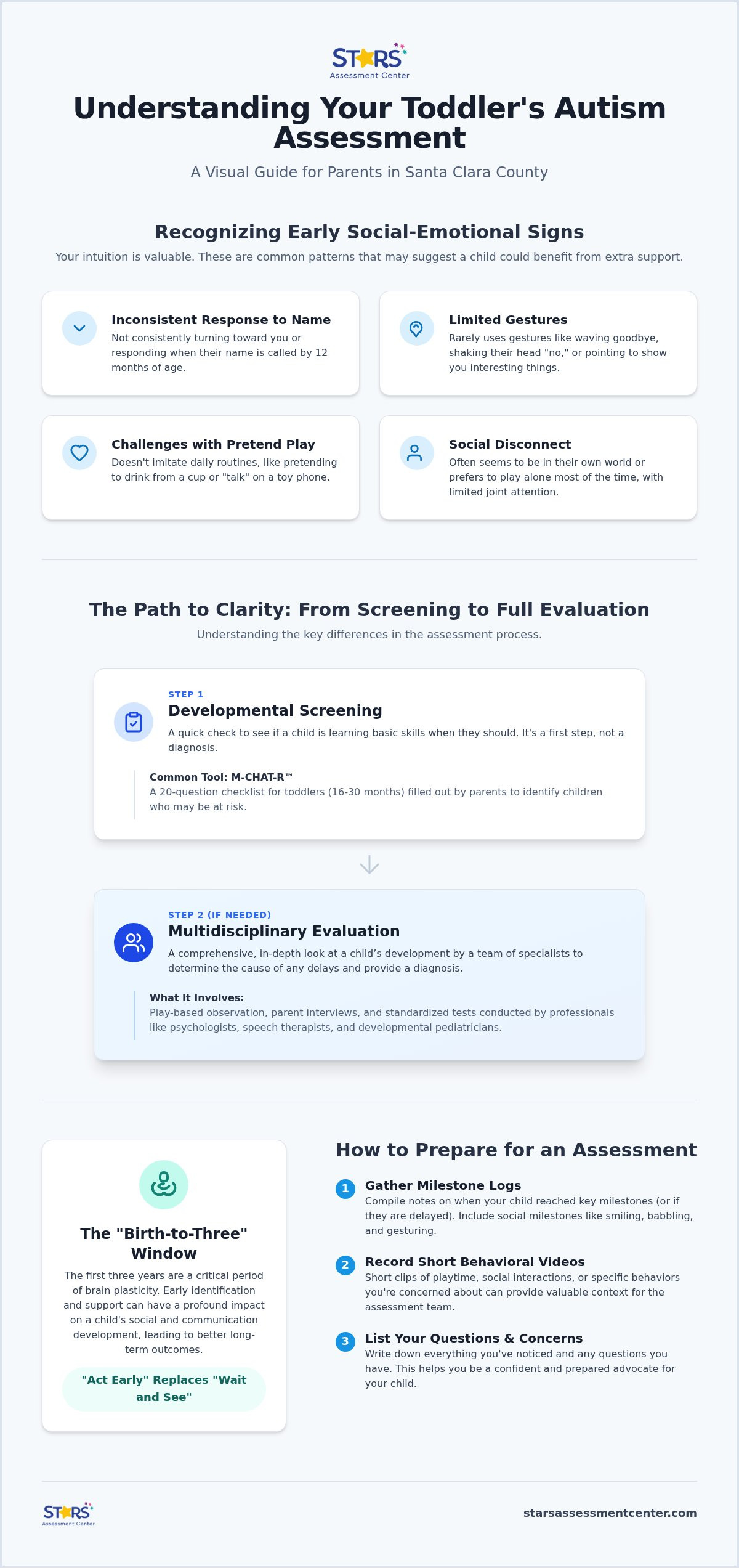
- Inconsistent response to their name: Not turning toward you when called by 12 months of age.
- Limited gestures: Rarely waving goodbye, shaking their head "no," or pointing to show you things they like.
- Challenges with pretend play: Not imitating daily routines, such as pretending to drink from an empty cup or "talking" on a toy phone.
- Social disconnect: Appearing to be in their own world or preferring to play alone almost all the time.
To help identify these patterns, many local providers and pediatricians use the Modified Checklist for Autism in Toddlers (M-CHAT) as a reliable starting point during routine wellness visits.
The Importance of the Birth-to-Three Window
The first three years of life are a unique period of brain plasticity. During this time, a child’s brain is incredibly adaptable and responsive to new learning experiences. This makes early screening highly effective because the right support can have a profound impact on a child's communicative and social development. Identifying delays early doesn't just provide a label; it opens doors to Early Intervention services designed specifically for this age group.
At Stars Assessment Program, we focus exclusively on this critical birth-to-three phase. We serve as a supportive ally for families in Santa Clara County, helping you move from uncertainty to a clear plan of action. Understanding what is involved in an autism assessment for a toddler is the first step in ensuring your child has the best possible foundation for the years ahead. We're here to help you navigate this process with professional warmth and expert guidance.
Understanding the Screening Process: M-CHAT-R and Beyond
The journey toward answers usually begins with a screening, but it's important to know that a screening isn't the same as a diagnosis. Think of it as a wider net. A screening is designed to identify children who might need extra support, whereas a diagnostic evaluation is a detailed deep dive into why those delays are happening. When parents ask what is involved in an autism assessment for a toddler, they're often looking for a roadmap that moves from a quick checklist to a clear understanding of their child's unique world.
How the M-CHAT-R Works
The most common tool used for children between 16 and 30 months is the Modified Checklist for Autism in Toddlers, Revised (M-CHAT-R). It's a simple 20-question form that asks about your child's behaviors, such as whether they point to things or show interest in other children. The results are grouped into low, moderate, and high likelihood categories. While this tool is incredibly helpful, it's just a snapshot. Professional context is vital because a toddler might miss a point on the checklist for many reasons, such as a speech delay or even just a shy personality.
The Value of a Multidisciplinary Developmental Assessment
If a screening suggests a higher likelihood of autism, the next step is a more comprehensive look. When you explore autism screening and diagnosis, you'll find that the most effective evaluations involve a team of specialists working together. This is known as a multidisciplinary developmental assessment. This approach ensures that more eyes are on your child, providing a much more accurate picture than a single checklist ever could.
Understanding what is involved in an autism assessment for a toddler at this level means looking at the whole child. A team of experts, including specialists in speech and language, social-emotional growth, and cognitive domains, observes how your child plays and communicates. This provides a holistic view of your child's needs. Instead of just looking for symptoms, this approach identifies your child's unique strengths and the specific areas where they need a helping hand. It's about building a bridge between where your child is now and where they can go with the right support.
Getting this right requires a partnership with experts who see your child as a whole person, not just a set of data points. If you're feeling unsure about your child's screening results or want a more detailed look at their growth, you can learn more about our multidisciplinary approach to see how we provide clarity for families in Santa Clara County.
Navigating the Path to Screening in Santa Clara County
Finding a clear path forward shouldn't feel like a puzzle. In Santa Clara County, we have a robust system designed to catch developmental delays early, ensuring no child slips through the cracks. Your first step is always your pediatrician. During a well-child visit, share your specific observations about your child's social-emotional growth. If you're wondering what is involved in an autism assessment for a toddler, your doctor can provide a preliminary screening, but you also have the right to request a deeper, multidisciplinary look.
It’s helpful to understand your rights under the California Early Intervention Services Act. This legislation ensures that families have access to timely evaluations if a developmental delay is suspected. You don't have to wait for a formal diagnosis to start seeking help or asking questions. By connecting with the San Andreas Regional Center (SARC), you tap into a network specifically built for infants and toddlers. From there, you can request a referral to a specialist team, like our multidisciplinary group at Stars Assessment Center, to ensure your child gets the focused attention they deserve during this critical window of growth.
Local Resources for Families in San Jose and Salinas
Families living in San Jose, Salinas, and surrounding areas like Milpitas, Gilroy, and Morgan Hill have access to dedicated regional centers. These centers act as the primary gateway for early intervention services. The Stars Assessment Program works in partnership with these local agencies to provide comprehensive evaluations for children from birth to age three. Being part of the Santa Clara County community means you aren't alone; there’s a local infrastructure ready to support your family’s specific journey with professional warmth and expertise.
What to Ask Your Pediatrician
Sometimes the hardest part is knowing how to start the conversation with a medical professional. Instead of expressing general worry, try using specific phrasing to describe what you see at home. You might say, "I've noticed my child isn't making eye contact as often as they used to," or "I'm concerned about their social-emotional milestones compared to their peers." Don't hesitate to ask directly for a referral for a multidisciplinary evaluation if your intuition tells you something is different.
According to the CDC's guide to autism screening, formal developmental screening is recommended at 9, 18, and 30 months. If your child is in this age range, ask your doctor how their current progress compares to typical developmental markers. Regarding costs, most assessments are covered by insurance or funded through the regional center system. Understanding what is involved in an autism assessment for a toddler includes knowing that these financial pathways exist to protect your child's right to care, regardless of your family's financial situation.
How to Prepare for Your Toddler’s First Assessment
It's completely natural to feel a rush of emotions as the date for your child's evaluation approaches. Instead of viewing this day with fear, try to see yourself as your child’s most important advocate. You're the expert on their daily life, and your preparation helps specialists see the full picture. Start by organizing your thoughts and records. Having a clear record of medical history and developmental milestones ensures that no detail is lost during the excitement of the appointment.
Preparing your toddler is equally important. Try to keep their routine as consistent as possible on the day of the assessment. Bring along their favorite comfort object or a preferred snack to help them feel secure in a new environment. When you understand what is involved in an autism assessment for a toddler, you can walk into the room feeling like a partner in the process rather than a bystander.
Creating a Concern Log
One of the most helpful things you can provide is a log of your child's daily interactions. Focus on social-emotional observations rather than just physical tasks. Note how often they make eye contact, how they respond to your smiles, and whether they seek to share joy with you by showing you a toy. Track their communication attempts and any specific sensory responses, like covering their ears at certain sounds.
Short video clips are incredibly valuable for specialists during a screening. Sometimes a child might be shy or tired during an appointment and not show their typical behaviors. Having a 30 second video of them playing at home or interacting with a sibling provides a window into their natural world that a single office visit cannot capture. If you’re ready to take this step, you can contact our team to start the preparation process and receive a list of helpful observations to track.
What Happens During the Appointment?
Many parents ask what is involved in an autism assessment for a toddler during the actual visit; essentially, it's a blend of structured play and conversation. Because we focus on children birth to age three, the assessment is designed to be gentle and non-intimidating. Specialists interact with your child using age-appropriate toys to observe their natural social and communicative responses. They aren't looking for "right" or "wrong" answers, but rather how your child processes information and engages with others.
While the specialists play with your child, there will also be an interview portion for you. This is your chance to discuss your child’s daily habits, eating and sleeping patterns, and how they handle transitions. This collaborative approach ensures that the final evaluation reflects your child’s true personality and needs across all areas of their life.
Beyond the Screening: Partnering with Stars Assessment for Next Steps
Receiving the results of an evaluation can feel like a whirlwind of emotions. You might see terms like "at risk" or "developmentally delayed" on a report. These aren't just labels; they're indicators that your child's social-emotional or communicative growth is following a different path. Understanding what is involved in an autism assessment for a toddler helps you see these results as a starting point rather than a final destination. At Stars Assessment Program, we view this as the beginning of a lifelong partnership where we provide the clarity and hope your family needs to move forward.
Our evaluations lead directly to a personalized intervention plan tailored to your child's specific strengths. Whether your little one needs focused speech and language support or guidance in social-emotional development, we ensure the next steps are clear. We don't just hand you a report and say goodbye. We stay by your side as you navigate the transition from assessment to active support.
From Assessment to Action Plan
Once the evaluation is complete, we coordinate closely with the San Andreas Regional Center (SARC) to ensure your child receives the right care. This often includes a speech and language evaluation toddlers Santa Clara County families can rely on to address communication barriers early. By identifying these specific needs before age three, we maximize the impact of early intervention. You're the leader of your child’s developmental journey, and we provide the professional data and emotional support to help you lead with confidence.
A Safe Harbor for Your Family
Our San Jose-based team is specifically trained to work with children under the age of three. We understand the unique challenges and joys of this stage of life. We strive to be a "safe harbor" where your questions are answered with patience and your concerns are met with professional warmth. If you're still in the early stages of wondering about your child's development, you might find our guide on do you think your child might have autism? helpful for your next steps.
We believe that every child has the potential for growth when given the right environment. By choosing a multidisciplinary approach, you're ensuring that every part of your child's social-emotional world is understood. We’re here to help you take the insights gained from learning what is involved in an autism assessment for a toddler and turn them into a bright, supportive future for your little one.
Empowering Your Child’s Future with Early Support
Taking the first step toward a developmental screening is an act of love and advocacy for your child. By recognizing early social-emotional markers and preparing with a simple concern log, you've already begun the process of securing the support your little one deserves. Understanding what is involved in an autism assessment for a toddler is the bridge between the weight of uncertainty and a clear, actionable plan for growth. You don't have to navigate this path alone; local resources and specialized teams are here to guide you through every milestone.
At Stars Assessment Program, we are a trusted partner of the San Andreas Regional Center, offering a compassionate, family-centered approach right here in Santa Clara County. Our specialized multidisciplinary team focuses exclusively on children under the age of three, providing the professional expertise and gentle care your family needs during this critical window of development. We invite you to Begin Your Journey with a Comprehensive Multidisciplinary Assessment today. Your child’s potential is limitless, and with the right partnership, you can move forward with confidence and hope.
Frequently Asked Questions
How much does an autism screening for a toddler cost in California?
Under the California Early Intervention Services Act, evaluations for children birth to age three are typically provided at no cost through regional centers. Additionally, California law SB 946 requires state-regulated insurance plans to cover diagnostic services for autism. Families in Santa Clara County can access these pathways to ensure their child receives a thorough check-up without financial barriers. It's always best to check with your local regional center for specific eligibility details.
Can a 2-year-old be accurately screened for autism?
Yes, a 2-year-old can be accurately screened, and research shows that autism can often be reliably detected by 18 months or younger. Early identification is highly effective because of the significant brain plasticity during the birth-to-three window. Children born more recently are being diagnosed earlier than in previous years, allowing them to access life-changing support during their most formative developmental stages when their brains are most adaptable to new learning.
What is the difference between an M-CHAT screening and a full diagnostic evaluation?
An M-CHAT is a quick, 20-question parent-report checklist used to identify a likelihood of developmental delays. In contrast, understanding what is involved in an autism assessment for a toddler means looking at a full multidisciplinary evaluation. This comprehensive process involves specialists in speech, social-emotional, and cognitive domains who use professional observation to build a holistic profile of your child’s unique strengths and needs rather than relying on a single checklist.
How long does the autism screening process take from referral to results?
The timeline varies, but many families experience a wait of several months from the initial referral to the final results. A 2026 report found that 61% of specialized centers in the U.S. have wait times longer than four months. Because of these potential delays, it’s vital to start the process as soon as you have concerns. Acting quickly helps ensure your child enters the early intervention system during their peak learning years.
What if my pediatrician says we should "wait and see"?
If your pediatrician suggests waiting, you still have the right to request a formal screening or contact your local regional center directly. The "Act Early" approach is widely recognized as more effective than "wait and see" because early intervention can significantly improve social-emotional outcomes. Your intuition is a powerful tool; if you feel your child needs support, pursuing a professional opinion is a proactive way to care for their long-term growth.
Does a positive screening result mean my child definitely has autism?
A positive screening result does not mean your child definitely has autism; it simply indicates a higher likelihood that warrants further investigation. Screeners like the M-CHAT-R are designed to be broad so that no child who needs help is missed. When you learn what is involved in an autism assessment for a toddler, you’ll see that the full evaluation is what provides a definitive, clear understanding of your child's specific developmental path.
How do I get a referral to the Stars Assessment Program?
You can get a referral to our program by discussing your concerns with your pediatrician or by contacting the San Andreas Regional Center (SARC). As a trusted partner for early intervention in Santa Clara County, we work closely with these entities to support families in San Jose and surrounding areas. Once the referral is made, our multidisciplinary team coordinates with you to begin the evaluation process for your child's social-emotional health.
Is the screening process scary for my toddler?
The screening process is designed to be a gentle, play-based experience that feels natural for your toddler. Specialists use age-appropriate toys and activities to observe how your child interacts and communicates in a low-pressure environment. Our family-centered approach ensures that you are present throughout the visit, providing a "safe harbor" for your little one. We focus on making the experience supportive, predictable, and reassuring for both you and your child.


