
Imagine sitting at a park in San Jose, watching your little one play while other toddlers chatter nearby. You might find yourself quietly counting the sounds your child makes, wondering if that sweet "ba-ba-ba" is just babbling or the start of something more. It's natural to feel a flutter of anxiety when you start comparing your child's progress to their peers. Understanding the journey of baby talking is about more than just checking off boxes on a chart; it's about seeing how your child connects with the world around them.
You want the very best for your child, and it's completely normal to worry about whether they're meeting their developmental windows on time. We believe every parent deserves clarity and peace of mind during these formative early years. This guide allows you to discover the stages of speech development and learn how to identify when your child's communication journey might benefit from a professional assessment. We'll walk through the milestones from birth to age three, explain the difference between speech and language, and provide a clear path forward for families in Santa Clara County who suspect a delay.
Key Takeaways
- Learn to distinguish between early babbling and meaningful speech to better understand how your child is processing language.
- Follow a clear timeline of baby talking milestones from birth to age three to track your child's progress with confidence.
- Discover how to tell the difference between a "late bloomer" and a child who may benefit from a professional speech and language evaluation.
- Find practical, stress-free ways to encourage communication at home through daily narration and shared reading habits.
- Understand how a multidisciplinary assessment offers a gentle and supportive path forward for families in Santa Clara County.
What is 'Baby Talking'? Defining the Early Stages of Communication
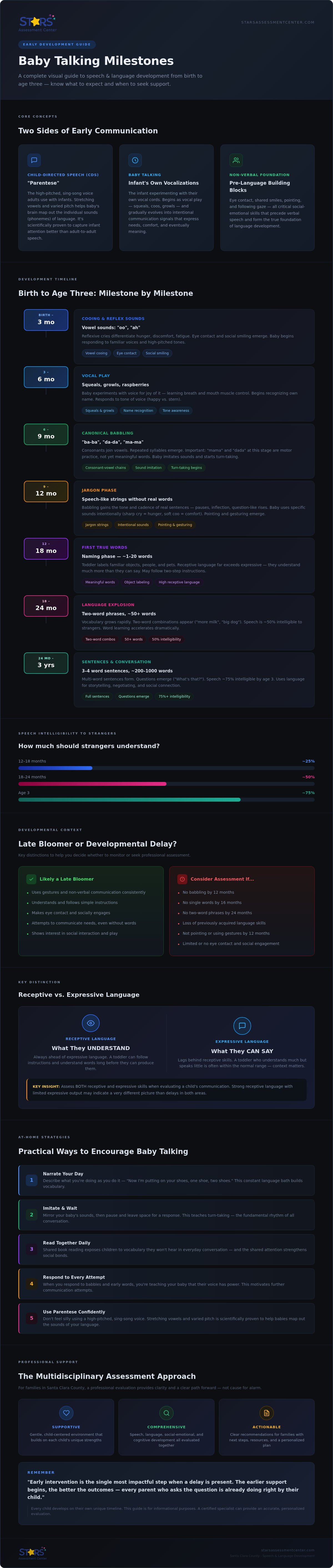
When we discuss the early stages of language, it's easy to get confused by the terminology. Parents often use the phrase "baby talk" to describe two distinct parts of the communication process. There is the way adults speak to infants, known as child-directed speech, and then there is the actual act of baby talking, where the infant experiments with their own vocal cords. Recognizing the difference helps you appreciate the complex work your little one is doing every day.
Communication is more than just the words we eventually hear. It begins with a deep social-emotional connection that starts at birth. Before your child ever says "Mama" or "Dada," they are building a foundation through eye contact, shared smiles, and tiny gestures. These non-verbal cues are the building blocks of language. When your baby points at a toy or follows your gaze across the room, they are participating in a sophisticated exchange that prepares their brain for verbal speech.
The Science of Child-Directed Speech (CDS)
You might feel a bit silly using a high-pitched, sing-song voice when talking to your newborn, but science shows this "parentese" is incredibly beneficial. This rhythmic way of speaking captures an infant's attention more effectively than adult-to-adult speech. By stretching out vowels and using a wider range of pitches, you are helping your baby's brain map out the phonemes, or individual sounds, of your language. Child-directed speech serves as a vital tool for linguistic bonding, creating a bridge between a parent's voice and a child's understanding. Simplifying your vocabulary during these interactions doesn't "dumb down" the language; it provides a clear, manageable map for your baby to follow as they begin to recognize familiar words in the daily flow of life.
Vocal Play vs. Intentional Communication
During the first six months, your baby is likely engaged in what experts call "vocal play." This involves making a variety of noises, from squeals to growls, just to see what their voice can do. It's a joyful period of exploration where they learn how to control their breath and mouth movements. As they approach their first birthday, this play shifts toward intentional communication. You'll notice they start using specific sounds to get a reaction, like a sharp cry for hunger or a soft coo for comfort. Responding to these early attempts at baby talking is essential. When you mimic their sounds or answer their babbles, you are teaching them that their voice has power. This back-and-forth interaction is the very first step in supporting their development and can be a key indicator used during a professional assessment if you ever suspect a delay.
The Baby Talking Timeline: Milestones from Birth to Age Three
Every child follows a unique path, but language development generally follows a predictable sequence of stages. Watching the progression of baby talking is one of the most rewarding parts of early parenthood. It's a journey that begins with simple sounds and evolves into complex thoughts. By understanding these milestones, you can better support your child's growth and recognize when they might need a little extra help along the way.
The First Year: Building the Vocal Foundation
The first twelve months are all about exploration. Around three months, your baby will likely begin cooing, focusing primarily on vowel sounds like "oo" and "ah." By six months, they start adding consonants, leading to "canonical babbling" like "ba-ba" or "da-da." It is a common surprise for parents to learn that while "mama" and "dada" are often the first sounds a baby makes, they aren't always the first meaningful words. At this stage, your baby is simply practicing the motor skills required for speech. You can encourage this development through imitation. When you mirror their sounds and wait for a response, you are teaching the fundamental rhythm of conversational turn-taking.
Between nine and twelve months, babbling often turns into "jargon." This is a string of sounds that has the tone and cadence of real speech but lacks recognizable words. It is a sign that your baby is working hard to mimic the patterns of the language they hear at home every day.
Toddlerhood: From Words to Sentences
Between 12 and 24 months, most children experience a language explosion. This period often begins with a "naming phase," where your toddler starts labeling everything from their favorite toy to the family dog. It's important to remember the role of receptive language during this time. Your child almost certainly understands far more than they can actually say. They might follow a simple command like "get your shoes" long before they can say the word "shoes" themselves.
By the time a child reaches their second birthday, they should begin combining words into basic two-word phrases, such as "more juice" or "mama go." As they move toward age three, their vocabulary expands rapidly. They will start using short sentences and their pronunciation will become clearer to people outside the immediate family. If you notice your child is struggling to meet these markers or seems frustrated when trying to communicate, a speech and language evaluation for toddlers can help determine if they are simply a late bloomer or if they would benefit from early intervention. Supporting your child's communication journey is a partnership, and having the right information can replace anxiety with a clear plan for progress.
Late Bloomer or Developmental Delay? Comparing Speech Patterns
It's easy to feel a sense of unease when you hear other children the same age as yours chatting away. You might hear stories from well-meaning friends about a relative who didn't speak until they were four and turned out fine. While late bloomers do exist, relying on anecdotes can be risky when the window for early intervention is so critical. A late talker is typically a child who has strong receptive language skills, meaning they understand what you say, but has a limited expressive vocabulary. However, a true developmental delay often involves more than just a lack of words.
Identifying red flags early can make a significant difference in your child's progress. You should look for specific signs such as a lack of pointing to show interest, not responding when their name is called, or a sudden loss of skills they previously mastered. These markers often suggest that the delay in baby talking is part of a broader developmental picture rather than just a slow start. When a child isn't using gestures or eye contact to communicate their needs, it can impact their social-emotional growth and lead to frustration for both the child and the parent.
When to Wait and When to Act
The common "wait and see" advice can sometimes delay the support a child needs during their most plastic brain-development years. For toddlers, early action is far more effective than a delayed approach because it builds a stronger foundation for later learning. As a general guideline, many clinicians look for about 15 words by the age of 15 months. If your child isn't meeting these markers or if you feel something isn't quite right, a speech and language evaluation for toddlers is a helpful next step to gain clarity. Seeking help is a proactive act of love, not a sign of failure.
The Multidisciplinary Perspective on Speech
Language doesn't develop in a vacuum. It often overlaps with physical and cognitive milestones in ways that aren't always obvious. For instance, a child who struggles with social-emotional connection may show less interest in baby talking or engaging in back-and-forth play with caregivers. This is why we look at the whole child rather than just their vocabulary count. A comprehensive child development evaluation helps determine if a speech delay is isolated or if it's connected to other areas like cognitive or social growth. Understanding these connections provides a much clearer roadmap for how to best support your child's unique journey and ensures they receive the specific type of guidance they need.
Encourage Your Baby to Talk: Practical Tips for Parents
Supporting your child's first attempts at communication doesn't require expensive toys or complex programs. It's about the small, intentional moments you share throughout the day in your San Jose home. By creating a communication-rich environment, you're giving your little one the tools they need to transition from simple sounds to meaningful words. Your role as their primary "communication partner" is the most important factor in their linguistic growth.
One of the most effective techniques is "sportscasting." This means narrating your daily activities as they happen. Whether you're folding laundry or preparing a snack, describe what you're doing out loud. "I'm slicing the yellow banana" or "Now I'm putting the blue shirt in the basket." This constant stream of language helps your baby map words to objects and actions in real-time. Reading and music are equally powerful tools. Books expose infants to vocabulary they might not hear in everyday conversation, while nursery rhymes use rhythm and repetition to make sounds more memorable. These activities aren't just educational; they're opportunities for the eye contact and physical closeness that fuel social-emotional development.
Daily Strategies for Language Growth
To help your child move forward, try expanding on their utterances. If your toddler points and says "dog," you can respond with "Yes, that is a big brown dog." This validates their effort while modeling more complex grammar. Another vital strategy is "wait time." After you ask a question or make a sound, count to five in your head before speaking again. This gives your baby the necessary space to process information and formulate a response. Finally, prioritize human interaction over digital devices. Reducing screen time ensures your child is focused on the subtle facial expressions and mouth movements that are essential for learning baby talking skills.
Local Resources in Santa Clara County
Living in San Jose or Milpitas provides access to wonderful community resources that support language development. The San Jose Public Library system offers frequent story-time sessions that encourage socialization and early literacy in a low-pressure setting. Joining local parent-child groups can also provide your toddler with opportunities to observe and mimic their peers' communication. If you ever feel concerned about your child's progress, talk to your pediatrician. If they suggest a referral for a screening, remember that this is a positive step toward understanding your child's unique needs. For families seeking specialized support, a Multidisciplinary Developmental Assessment can provide a gentle and comprehensive look at your child's growth across all domains, ensuring you have the guidance needed to support their baby talking journey effectively.
The Stars Assessment Approach: Support for Santa Clara Families
Deciding to seek professional guidance for your child's development is a significant step, and it's one we approach with the deepest respect for your family's journey. At our center, we don't view an evaluation as a "test" that a child passes or fails. Instead, we see it as a gentle screening designed to capture a complete picture of your little one's strengths and areas where they might need extra support. This comprehensive approach is central to the Stars Assessment Program. When a child's baby talking milestones seem to be lagging, looking at the whole child often reveals the most helpful path forward.
Our multidisciplinary developmental assessment is unique because it brings together experts from different fields to observe your child simultaneously. We understand that communication is deeply linked to social-emotional and cognitive growth. A child who isn't yet baby talking might be struggling with motor planning, or perhaps they are focusing all their energy on physical milestones like walking. By evaluating these areas together, we provide a much more accurate and helpful roadmap than a single-lens evaluation could offer. This collaborative environment ensures that no detail of your child's growth is overlooked.
A Team of Specialists for Your Child
The benefit of our team-based approach is that it reduces the stress of multiple appointments for your family. During a single session, we can look at communication, social-emotional skills, and physical development. This is particularly important when families are trying to understand the nuances of their child's behavior, such as the differences between an autism screening vs evaluation. We are proud to serve families across Santa Clara County, extending our support to those in Salinas, Gilroy, and Morgan Hill. Our goal is to be a steady ally, providing the clarity you need to move from a place of uncertainty to a place of action.
Taking the Next Step with Confidence
In the days following an assessment, we sit down with you to discuss our findings in plain, everyday language. We'll help you navigate the San Andreas Regional Center (SARC) referral process, ensuring you have a dedicated guide as you access early intervention services in California. We know the paperwork and systems can feel overwhelming, but you don't have to manage them alone. We'll work closely with you to determine if your child qualifies for specific programs that can boost their communication and social skills.
Your child’s journey is entirely unique, and a delay in one area doesn't define their future potential. Whether they need a little extra encouragement or a more structured intervention plan, we are here to provide a safe harbor for your family. You're doing the right thing by seeking answers, and with the right support, your child can find their voice and thrive.
Looking Forward to Your Child’s First Words
Navigating the milestones of baby talking is a journey filled with both wonder and questions. By recognizing the difference between early babbling and intentional communication, you are already providing your child with a supportive environment. Remember that early intervention isn't about fixing a problem; it's about providing the right tools at the right time to help your little one reach their full potential.
If you're feeling anxious about your child's progress, taking a proactive step can bring you much-needed peace of mind. Our expert multidisciplinary team in San Jose specializes in children from birth to age three, offering a compassionate, family-centered evaluation process. We look at communication alongside social-emotional and physical skills to ensure no part of your child's growth is missed. Ready to understand your child's unique growth? Schedule a Multidisciplinary Developmental Assessment with Stars today.
You're doing an incredible job as a parent by staying informed and attentive. Trust your instincts, and know that we are here to walk alongside you every step of the way. Your child's voice is unique, and we are dedicated to helping them find it.
Frequently Asked Questions
Is it normal for my 12-month-old not to be talking yet?
Yes, it's quite common for many 12-month-olds to not have their first clear word yet. At this age, we primarily look for "jargon" or babbling that mimics the rhythm of actual speech. If your child is using gestures like pointing, waving, or reaching for objects, they're still building the necessary foundations for language. Most children say their first meaningful word anywhere between 10 and 14 months.
What is the difference between a speech delay and a developmental delay?
A speech delay specifically refers to challenges with producing sounds or using words to communicate. A developmental delay is a broader term that suggests a child is behind in multiple areas, such as motor skills, cognitive growth, or social-emotional functioning. Our multidisciplinary team evaluates these areas together to determine if a communication struggle is an isolated issue or part of a more complex developmental pattern.
How can I tell if my baby understands me if they aren't talking?
You can gauge your baby's receptive language by watching how they respond to simple requests and familiar cues. If they can follow a one-step command like "give me the toy" or look toward the kitchen when you mention "dinner," they're demonstrating understanding. These non-verbal responses are crucial foundations for the baby talking stage and show their brain is processing language even without verbal output.
Do boys generally start talking later than girls?
Research indicates that, on average, girls may begin talking slightly earlier than boys, but the difference is usually only a matter of a few months. This slight trend isn't a reason to ignore a suspected delay. If a boy is significantly behind the standard milestones for his age, we don't recommend waiting. Early intervention is equally effective and important for all children regardless of their gender.
What are the earliest signs of autism related to speech?
Early signs often involve a lack of "social" communication rather than just a delay in making sounds. This might include not responding to their name by 12 months, avoiding eye contact, or not using gestures like pointing to share interest. If your child isn't attempting baby talking or engaging in back-and-forth vocal play with you, a multidisciplinary assessment can help provide clarity and a supportive path forward.
How do I get a speech evaluation for my toddler in Santa Clara County?
You can begin by speaking with your pediatrician or contacting the San Andreas Regional Center (SARC) for a referral. Families in San Jose can also reach out to specialized programs like Stars for a comprehensive evaluation. We help you navigate the referral process and determine if your child qualifies for early intervention services in California, ensuring your family feels supported through every step of the journey.
Can ear infections cause a delay in baby talking?
Yes, chronic ear infections can lead to temporary hearing loss, which often interferes with a child's ability to hear and mimic sounds accurately. If a baby can't hear the subtle differences in language, they may struggle to develop the phonemes necessary for speech. If your child has a history of frequent infections, it's helpful to mention this during an evaluation to see if it has impacted their communication.
What should I do if my pediatrician says to 'just wait' but I'm worried?
If your instincts tell you that your child needs extra support, it's okay to seek a second opinion or a formal screening. You spend the most time with your child and understand their frustrations and needs best. Taking action early is a proactive choice that utilizes the critical brain development window before age three. We empower parents to follow their intuition and access the guidance their family deserves.


