
You are sitting on a bench at a San Jose park, watching your toddler point excitedly at a passing bird. While other children their age are beginning to string words together, your little one remains quiet, relying on gestures and facial expressions to tell you what they need. It's natural to feel a heavy sense of worry or wonder if your child will eventually find their voice. When you're looking into pediatric non-verbal support, the uncertainty can feel overwhelming. It's common to feel stuck between a simple speech delay and something more complex like autism.
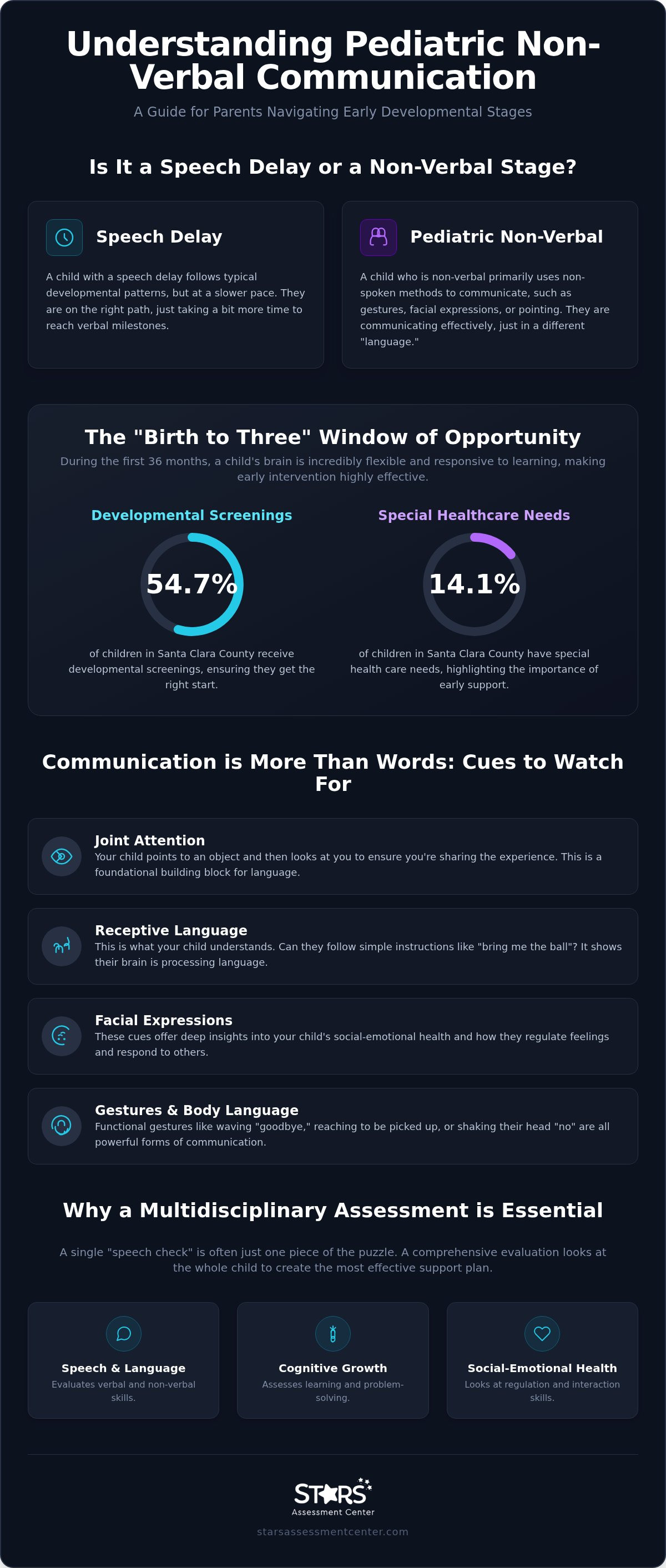
We understand that this journey is filled with more questions than answers right now. You want the best for your child's future independence, and that starts with having a clear map of their development. This guide will help you understand that being non-verbal isn't an absence of communication; it's a unique stage of connection. We'll walk you through how a multidisciplinary assessment provides the clarity you deserve. You'll also find specific information about Santa Clara County resources, where 54.7 percent of local children receive developmental screenings to ensure they get the right start.
Key Takeaways
- Understand the distinction between a speech delay and a non-verbal stage to better navigate your child's developmental milestones.
- Learn why pediatric non-verbal cues like joint attention and eye contact are often more telling than a child's first words.
- Discover how a multidisciplinary assessment provides a more complete picture of your child's needs than a single-specialist "speech check."
- Gain practical advice on preparing for a developmental evaluation to ensure your toddler feels comfortable and supported throughout the process.
- Find specific pathways for accessing early intervention resources tailored for families living in San Jose and the surrounding Santa Clara County area.
What Does It Mean to Be Pediatric Non-Verbal?
When we talk about a child being non-verbal, we aren't describing a lack of desire to connect. Instead, we are looking at a specific stage of development where a child hasn't yet started using spoken words to share their world. Understanding What Does It Mean to Be Pediatric Non-Verbal? involves looking at the many ways toddlers "speak" without sounds. They might use a tug on your sleeve, a specific look, or a finger pointed at a favorite toy to tell you exactly what they're thinking.
The "Birth to Three" window is particularly vital for your family's journey. During these first 36 months, the brain is incredibly flexible and responsive to new ways of learning. In Santa Clara County, where about 14.1 percent of children have special health care needs, identifying these patterns early allows families to start support when it has the most impact. It's about catching that window of opportunity where the right partnership can make a lifetime of difference.
A key distinction to understand is the difference between a speech delay and being non-verbal. A child with a speech delay might follow typical patterns but at a slower pace. They're on the path, just moving a bit more slowly. A child who is pediatric non-verbal may rely entirely on non-spoken methods, such as gestures or facial expressions, to navigate their daily life. They are communicating, but they're using a different "language" that requires specific tools and understanding to bridge the gap.
Non-Verbal vs. Pre-Verbal: Knowing the Difference
Every child starts as "pre-verbal." This is the stage where infants babble, coo, and experiment with sounds. It's the foundation for later speech. Concerns usually arise when this vocal play doesn't transition into recognizable words or when a child stops using the sounds they once had. If a toddler is consistently quiet or doesn't use babbling to get your attention, it's a sign that they might need a closer look. We look for these subtle shifts to help parents understand if their child is simply taking their time or if there's a deeper need for support.
Common Reasons for Communication Delays
There isn't just one reason why a child might not be talking yet. Sometimes, it's linked to conditions like Autism Spectrum Disorder (ASD) or Down syndrome. In other cases, it might stem from social-emotional factors or physical delays that make forming words difficult. Because communication involves the whole child, a Speech and Language Evaluation is often just one piece of the puzzle. A multidisciplinary approach helps us look at cognitive growth and social-emotional health to see how all these areas work together for your child's success.
Beyond Speech: Understanding Non-Verbal Communication Cues
Communication starts long before a child utters their first word. For parents of a child who is pediatric non-verbal, it is helpful to look for "joint attention." This happens when your toddler points at a dog in the park and then looks at you to make sure you see it too. This simple gesture is actually a sophisticated milestone. It shows that your child wants to share an experience with you, which is a foundational building block for all future language. While it might feel like you're waiting for sounds, these shared moments of attention are powerful indicators of their desire to connect.
Receptive language is another critical area to observe. This refers to what your child understands rather than what they can say. If your toddler can follow a simple instruction like "find your shoes" or "bring me the ball," they are demonstrating that their brain is processing language effectively. Understanding these "hidden" skills helps lower anxiety because it shows that communication is happening, even if it's currently silent. By focusing on what your child can do, you can better support their unique way of interacting with the world.
Eye contact and facial expressions also provide deep insights into your child's social-emotional health. These cues tell us how a child regulates their feelings and responds to others. Because these behaviors are so interconnected, looking at one area in isolation often doesn't give the whole story. This complexity is exactly Why a Multidisciplinary Developmental Assessment is Essential for families who want to see the full picture of their child's progress. In California, where 15.8 percent of children have special health care needs, having this comprehensive view is the first step toward effective support.
The Power of Gestures and Body Language
Functional gestures like waving goodbye, reaching to be picked up, or nodding "yes" are the bridges that lead to verbal speech. These movements aren't just random; they are intentional attempts to influence their environment. When you respond to these gestures, you're teaching your child that their "voice" has power. Encouraging these non-verbal conversations through daily play helps build the confidence they need to eventually experiment with sounds and words. If you're noticing these signs, a Speech and Language Evaluation can help identify which bridges your child is already building.
Social-Emotional Milestones in Toddlers
Healthy social engagement isn't always loud. It can be found in the way a child seeks comfort from a caregiver or mimics a parent's smile. These small interactions are signs of a strong emotional foundation. A social-emotional assessment acts as a dedicated tool to measure a child’s ability to form healthy relationships and interact with the world around them. By monitoring these milestones, we can ensure that every child in our community has the social tools they need to thrive alongside their peers.
Why a Multidisciplinary Developmental Assessment is Essential
Many families are initially told to "wait and see" if their child catches up on their own. While this advice is often given with good intentions, the first three years of life are too precious to leave to chance. A single-specialist "speech check" can sometimes miss the underlying reasons why a child is pediatric non-verbal. By looking at communication in isolation, you might only see the symptom rather than the cause. A comprehensive approach ensures that we aren't just counting words, but understanding how your child interacts with their entire world. This is about building a partnership that supports your child's long-term independence and gives you the clarity you've been searching for.
Evaluating the Whole Child
A Multidisciplinary Developmental Assessment is designed to look at every facet of your child's growth simultaneously. Instead of separate appointments that only focus on one area, a team of experts collaborates to see how different domains of development influence one another. For example, a Speech and Language Evaluation might reveal that a child has strong receptive skills, while a Social-Emotional Assessment helps identify underlying connection barriers that make expressive communication difficult. By including cognitive and physical screenings in the same visit, we ensure that no stone is left unturned. This holistic view is especially important for children who may be showing early signs of Autism or Down syndrome, as it allows for a more nuanced understanding of their specific needs.
The Multidisciplinary Advantage
The biggest benefit for local families is the "complete picture" this team approach provides in a single setting. When specialists work together, they can set cohesive goals that address the child’s needs as a whole person, not just a set of symptoms. This collaborative environment significantly reduces the stress of managing multiple appointments across Santa Clara County. It also creates a clear roadmap for families seeking support through the San Andreas Regional Center, which is essential for accessing long-term services. As of 2026, California has updated its rate reform structure to prioritize quality and transparency in these services. Knowing what happens during the visit helps ease anxiety for both you and your toddler. For more on the process, Preparing Your Child for a Developmental Evaluation can give you a head start on what to expect during your appointment. This partnership ensures you leave with a clear plan of action.
Preparing Your Child for a Developmental Evaluation
The days leading up to a developmental assessment often bring a mix of hope and anxiety. It's helpful to view this process not as a "test" for your toddler to pass, but as a partnership designed to uncover their unique strengths. When your child is pediatric non-verbal, your daily observations are the most valuable data we have. You see the subtle ways they communicate that a specialist might not catch in a single visit. By preparing ahead of time, you can turn this evaluation into a safe harbor where your family finds clarity and a clear path forward.
One of the most effective ways to help your multidisciplinary team is by capturing "home videos" of your child. Toddlers often act differently in new environments, so having a recording of them playing comfortably at home provides a true reflection of their skills. Focus on moments where they are trying to tell you something, even without words, or how they interact with their favorite toys. These clips help specialists see the "whole child" in their most natural state.
Observation Checklist for Parents
Before your appointment, take a few days to jot down specific behaviors. This helps ensure that important details don't get lost in the moment. Consider tracking the following:
- Gestures and Sounds: Do they point, wave, or reach? Are they making repetitive sounds or babbling?
- Social Responses: Do they smile back at you or look at you when you say their name?
- Sensory Preferences: Do they seem sensitive to loud noises, certain textures, or bright lights?
- Physical Milestones: Note when they reached major milestones like crawling, sitting up, and walking.
Logistics for a Stress-Free Evaluation
Timing is everything when it comes to assessing infants and toddlers. Try to schedule the appointment during your child's most alert time of day, usually after a morning nap and a good meal. A hungry or tired toddler won't be able to show their full range of abilities. Remember that these evaluations are play-based and designed to be non-intimidating for the child. We want them to feel like they are simply playing with new friends while we observe their growth.
Don't forget to pack a "go-bag" for the visit. Include familiar snacks, a favorite comfort toy, and any relevant medical or birth history documents. Managing your own anxiety is just as important as preparing your child. Your calm presence helps your toddler feel secure. Come prepared with questions for your team, such as "What can we do at home right now?" or "How do these results help us with Regional Center services?" If you are ready to move from uncertainty to action, you can schedule a Multidisciplinary Developmental Assessment to begin this supportive journey.
Supporting Non-Verbal Children in Santa Clara County
San Jose parents don't have to walk this path alone. In Santa Clara County, the San Andreas Regional Center serves as a vital hub for families seeking support for their toddlers. If your child is currently pediatric non-verbal, the Regional Center helps coordinate the specialized services needed to bridge communication gaps. This process is designed to be a community-wide effort, ensuring that every child from San Jose to Salinas has access to the resources they need for a bright future. Moving from an evaluation to actual support is a collaborative journey that begins with understanding your local options.
The Stars Assessment Program Approach
Our program is built on the belief that every family deserves a steady ally. With locations in San Jose and Milpitas, we provide multidisciplinary expertise that reaches families throughout Gilroy, Morgan Hill, and Santa Cruz. We aren't just a clinical entity; we're an employee-owned organization dedicated to community-centered care. Our teams bring a blend of professional warmth and authoritative expertise to every interaction. We focus on children in the birth-to-three age group because we know how impactful these early years are. By partnering with us, you get a complete picture of your child's growth in a supportive, family-centered environment. This approach helps us identify specific patterns related to pediatric non-verbal development while providing the reassurance you need.
Accessing Early Intervention Services
Starting the journey toward support begins with a referral for a child under age three. You don't need a formal diagnosis to reach out and ask for help. In Santa Clara County, 54.7 percent of children have already received a developmental screening, which is higher than the state average. This proactive approach to care is why our region is a leader in early intervention. Once a referral is made, we work alongside you to identify any delays in communication, social-emotional, or cognitive domains. This collaborative effort transforms a complex medical process into a clear, manageable roadmap for your family. It ensures that your child is not just another number, but a valued member of our community who deserves the best start possible.
If you're ready to move forward with clarity, you can Schedule a compassionate developmental assessment for your child today. Taking this step ensures your child receives the specialized screenings they need for conditions like Autism or Down syndrome. We are here to help your child reach their full potential through every stage of their development.
Taking the First Step Toward Clarity
Every child’s developmental journey is unique, and while the quiet moments might feel heavy with uncertainty, they are also filled with potential. By looking beyond spoken words and focusing on the rich world of non-verbal cues, you are already advocating for your child's future. You now understand that a multidisciplinary approach is the most effective way to see the "whole child" and move past the "wait and see" stage. This specialized support is designed to turn your anxiety into a concrete plan of action.
Our multidisciplinary team of specialists is here to serve families across San Jose, Santa Clara, and Salinas. We focus specifically on the birth to age three window, ensuring that every pediatric non-verbal toddler receives the precise screening and social-emotional support they need to thrive. You don't have to navigate the complexities of the Regional Center or developmental milestones alone. We are ready to partner with you to create a safe harbor for your family's growth.
If you're looking for answers and a dedicated team to guide you, Request a Multidisciplinary Evaluation for Your Child today. Your proactive care is the greatest gift you can give your child, and we are honored to walk beside you every step of the way.
Frequently Asked Questions
Is my non-verbal 2-year-old definitely autistic?
No, a lack of speech at age two does not automatically mean a child is autistic. While it can be a sign, many other factors like hearing issues, motor delays, or social-emotional barriers might be the cause. A multidisciplinary assessment helps us see the whole picture. We look at how your child plays and interacts with others to determine the best path forward for their unique needs.
What is the difference between being non-verbal and having a speech delay?
A speech delay means a child is following the usual developmental path but moving a bit slower than their peers. Being non-verbal means the child isn't using spoken words yet to communicate. Non-verbal children often use gestures, eye contact, and facial expressions to tell you what they need. Understanding this distinction helps us tailor the right support for your child’s specific communication style.
Can a child who is non-verbal at age two learn to talk?
Yes, many children who are non-verbal at age two develop spoken language as they grow. The birth-to-three window is a critical time because the brain is incredibly flexible. Early intervention focuses on building communication foundations like joint attention and gestures. These skills often serve as a bridge to verbal speech, helping your child find their voice in their own time.
What tests are used to evaluate a toddler who does not speak?
We use play-based tools and standardized screenings to observe how your child interacts with their environment. These tests look at communication, social-emotional health, and physical milestones. Specialists might use observations to see how your toddler solves problems or follows simple directions. The goal is to make the process feel like a fun play session rather than a clinical test for your child.
How do I get a developmental evaluation in San Jose or Santa Clara?
You can initiate a referral through the San Andreas Regional Center or by speaking with your pediatrician. In Santa Clara County, there are specific pathways designed to help families access pediatric non-verbal support quickly. Programs in San Jose and Milpitas specialize in the birth-to-three age group. Starting this process early ensures your family gets the clarity and support needed to navigate your child's growth.
Does being non-verbal mean my child has a low IQ?
No, a child’s ability to speak isn't a measure of their intelligence. Many non-verbal children have high cognitive potential and understand much more than they can express. This is known as receptive language. An evaluation helps us identify your child's internal strengths and find alternative ways for them to communicate their thoughts and feelings while they work on verbal skills.
How long does a multidisciplinary assessment typically take?
A typical evaluation usually lasts between two and four hours. This allows our multidisciplinary team enough time to observe your child in different settings and activities. We move at your toddler's pace to ensure they don't feel overwhelmed or tired. Including breaks and play sessions helps us get the most accurate and complete picture of their developmental needs and strengths.
Will insurance cover a pediatric non-verbal evaluation?
Most insurance providers, including Medi-Cal, provide coverage for these evaluations when they are medically necessary. The cost and coverage for a pediatric non-verbal assessment can vary based on your specific policy. We recommend contacting your insurance company or the Regional Center to confirm which services are authorized. This helps ensure your family can access the care you need without unexpected financial stress.


